The news window blocks opening new FX and metals positions; closing is always allowed.
Weekend holding needs its own add-on; MFC Stocks is flat every night anyway.
Add-ons give a permission; they never widen the loss limits.
News windows
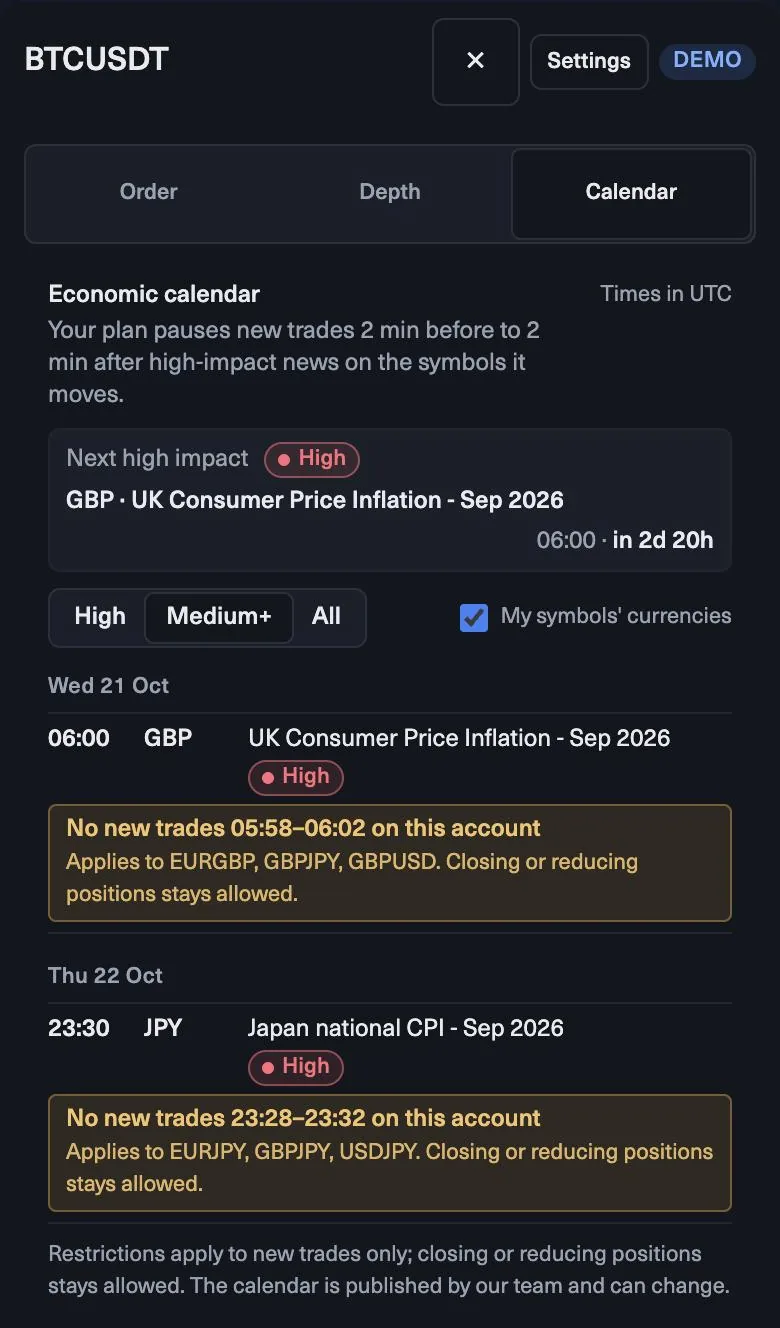
On 1-Step, 2-Step and Instant Funded accounts bought from 7 October 2026, you may not open new FX or metals positions from 2 minutes before to 2 minutes after high-impact news, unless you bought the News Trading add-on. Closing a position is always allowed. Older accounts keep the rules they were bought with.
The window is short, but it covers the moment when spreads are widest and prices jump. Opening a trade one minute before a number is out means entering at the worst spread of the day, so the rule protects you from your worst fills as much as it restricts you.
Example: a release at 08:30 New York time blocks new EURUSD and gold entries from 2 minutes before it to 2 minutes after. A position you opened earlier stays open, and you can close it at any time.
Weekend holding
Holding open positions over the weekend requires the Weekend Holding add-on. Without it, close positions before the Friday session ends. The rule is about open positions, so it covers crypto as well, even though crypto prices keep moving at the weekend.
MFC Stocks handles this for you: it trades the regular US session (09:30–16:00 New York time; new entries stop at 15:45 and positions close from 15:50), so you are flat every night and every weekend. Prediction Markets has its own terms; check its rules before holding through an event.
What an add-on does not change
An add-on gives a permission, and only on the account it was bought for: permission on one account does not carry over to another. It does not widen the daily or maximum loss limits, remove the consistency rule or allow prohibited strategies. A weekend gap or a news spike still counts against both floors, and a stop loss can fill well beyond its price when the market jumps.
Even with the News Trading add-on, repeatedly opening large positions right before high-volatility releases counts as event betting, a prohibited gambling practice.
Planning around releases
High-impact releases are the ones that move whole markets: central bank rate decisions, inflation (CPI) and the US jobs report (NFP) are typical. Mark the week’s events every Monday, with the time in New York and in your own time zone. Then decide for each one: stay flat, reduce size, or trade it with a plan and the right permission.
Spreads often widen around a release, so a stop that is fine at noon can be too tight at the number. Add-ons are chosen at checkout; do not assume one can be added to an account later.
Weekend and news rules are easy to forget on a Friday afternoon or a busy data morning, so put both into your pre-session checklist. If your account is older or carries add-ons, compare the rules in your Dashboard with your accepted agreement, and ask support before relying on a general example.
Quiz
Check yourself
0 / 4
Lesson complete
Nice work. … of 6 lessons in Risk & rules done.
MyFundedCapital School
Risk & rules checklist
Rules as of 17 Oct 2026. Tick each line before your next session.
| Rule | 1-Step Challenge | 2-Step Challenge | Instant Funded | MFC Stocks | Prediction Markets |
|---|---|---|---|---|---|
| Profit target | 10% | 8% + 5% | — | 7% | 10% |
| Daily loss limit | 5% | 5% | 3% | 2% daily pause | 3% |
| Maximum loss | 10% · trailing | 10% · static | 6% · trailing | 5% · trailing | 6% · trailing |
| Consistency | 35% | 35% | 35% | 35% | 35% |
| First payout | after 7 days | after 14 days | after 14 days | after 14 days | after 7 days |
| Then every | 7 days | 14 days | 7 days | 14 days | 7 days |
| Profit split | 80% → 95% | 80% → 95% | 70% → 80% | 70% → 80% | 75% → 90% |
1. What is a daily loss limit and how is it calculated?
- Daily floor = yesterday’s closing balance × (1 − the daily limit).
- Equity is checked, so an open loss can breach the account before you close it.
- Set your own stop for the day at about half the limit.
2. Static vs trailing drawdown: which floor applies to you?
- Static: the floor never moves, so every dollar of profit adds room.
- Trailing: the floor follows your best close, so profit moves it up, not away.
- Once a trailing floor locks at the starting balance, it stops moving.
3. How do you size a trade from your stop and risk?
- Position size = risk in money ÷ (stop distance × value per pip or point).
- Set the stop first, then let the size follow from it.
- Leverage changes margin, not the loss when the stop is hit.
4. How much should you risk per trade on a funded account?
- Losing streaks are normal; the question is whether the account outlives them.
- Divide the maximum loss by your risk per trade to get your streak budget.
- Cut size after a new high on a trailing account, never raise it to win back.
5. What is the consistency rule and how do you stay inside it?
- Best-day share = best profitable day ÷ total profit × 100.
- Later losses shrink total profit, so they can push the share over the cap.
- The fix for one oversized day is more ordinary days, not giving profit back.
6. Can you trade news or hold over the weekend?
- The news window blocks opening new FX and metals positions; closing is always allowed.
- Weekend holding needs its own add-on; MFC Stocks is flat every night anyway.
- Add-ons give a permission; they never widen the loss limits.
myfundedcapital.com/learn/
Questions
Does the news window stop me from closing a trade?
No. Closing a position is always allowed, inside or outside the window.
Which instruments does the news window cover?
Opening new FX and metals positions on 1-Step, 2-Step and Instant Funded accounts bought from 7 October 2026. Check the event and the affected instrument before trading.
Related lessons
Read more on the blog
Tools and rules
Rules shown here come from the help center and the live rulebook; your program terms apply.