ES
ES
 DE
DE
 FR
FR
 AR
AR
 IT
IT
 NL
NL
 PL
PL
 SV
SV

You buy a forex pair, and the position opens in red before price even moves. Most new traders think the platform is wrong. It is not. You are seeing the difference between bid and ask in real time.
If you want to trade consistently, especially in a prop environment with tight drawdown rules, you need to know what those two prices mean, why the gap changes, and how that gap affects your P&L from the moment you click buy or sell.
The Core Concept of Bid vs Ask Price in Trading
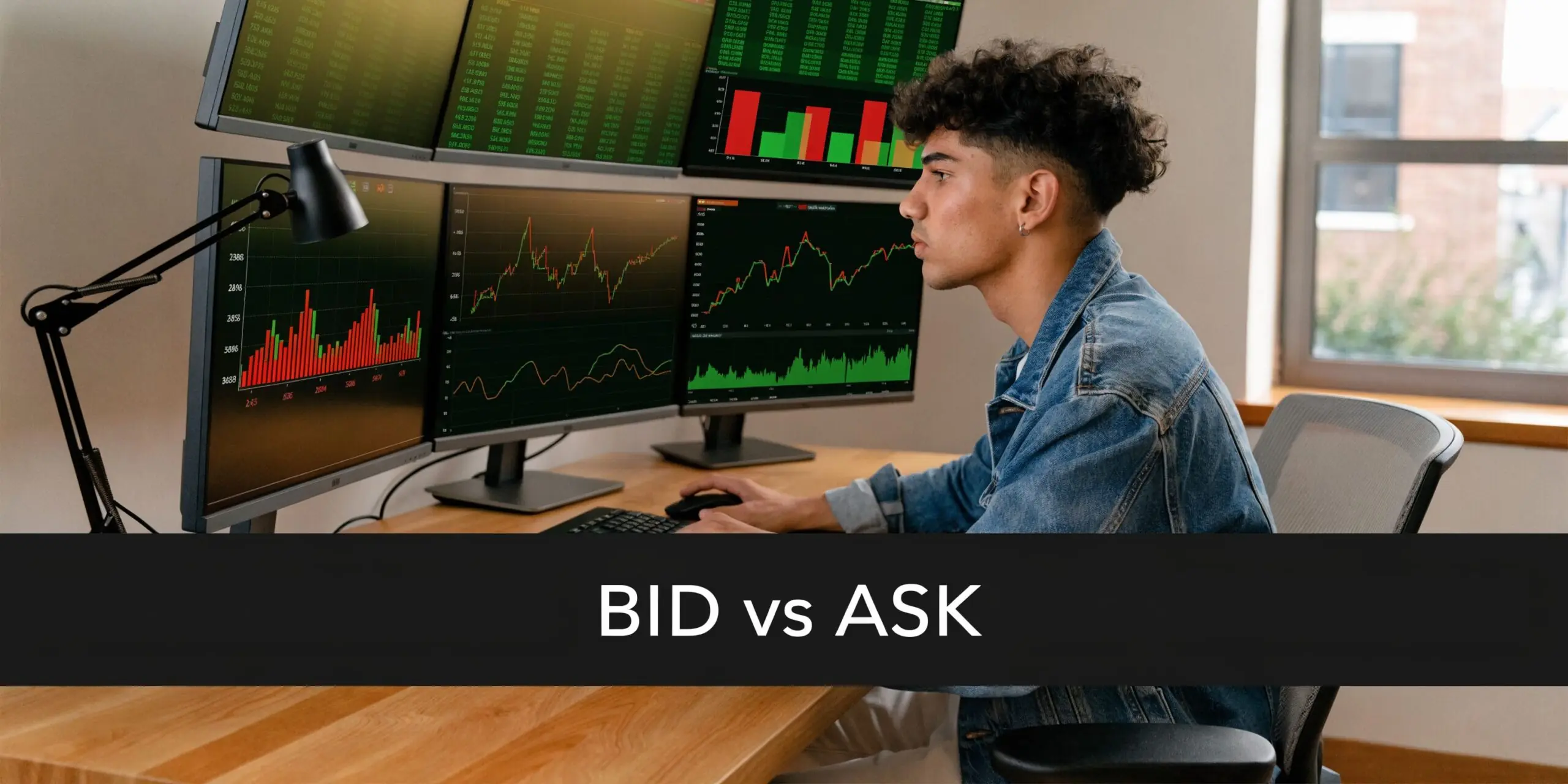
A trading platform always shows two prices because there are always two sides to a market.
- The bid is the highest price a buyer is willing to pay.
- The ask is the lowest price a seller is willing to accept.
- The spread is the difference between them.
If you are still getting comfortable with trading language, a forex prop trading slang glossary helps connect these terms to what you see on the platform.
A simple way to think about it
Think about a pawn shop or used car dealer.
If you walk in wanting to sell, the shop offers you one price. That is the bid.
If you want to buy, the shop asks for a higher price. That is the ask.
The gap between those two prices is how the dealer protects their business and gets paid for facilitating the transaction.
Markets work the same way. You are not trading against a single magical price. You are dealing with the best available buyer and the best available seller at that moment.
Why your trade starts negative
When you place a market buy order, you usually enter at the ask. If you closed that trade immediately, you would sell at the bid. That gap is your immediate cost.
That is why a fresh buy order often shows a small unrealized loss right after entry. The same logic applies in reverse for short positions.
Key takeaway: The spread is not a platform glitch or hidden mistake. It is the built-in cost of crossing from one side of the market to the other.
Why this matters more than beginners think
Many traders learn candle patterns, indicators, and entry models before they learn execution. That is backwards.
The difference between bid and ask affects:
- Entries
- Exits
- Stop-loss placement
- Scalping viability
- Net profitability
If your setup aims for small moves, the spread is not a side issue. It is part of the setup itself.
How the Bid-Ask Spread Works
The spread exists because markets need participants willing to stand between buyers and sellers. In many instruments, that role is handled by market makers or liquidity providers.
They quote both sides of the market. One price to buy from you. Another price to sell to you. The spread is part of how they get compensated for the risk of holding inventory and facilitating trades.
Why the spread is never fixed
The spread changes because market conditions change.
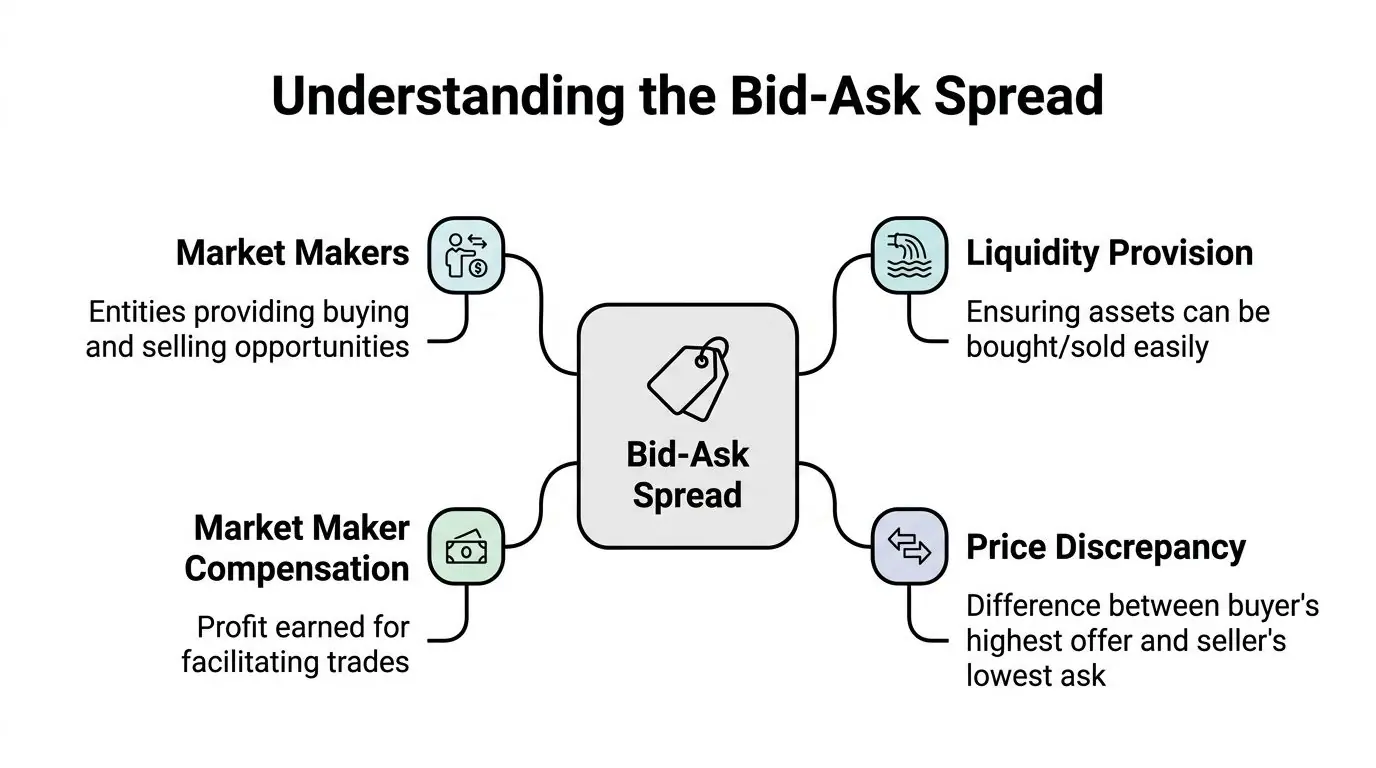
The most important driver is liquidity. When many buyers and sellers are active, it is easier to match orders. That usually leads to tighter spreads. When participation is thin, the spread often widens.
A useful benchmark comes from forex. According to Nasdaq Private Market’s explanation of the bid-ask spread, major currency pairs like EUR/USD typically exhibit bid-ask spreads of 0.1-0.3 pips (0.001-0.003%), while more exotic currency pairs can have spreads of 1-10 pips or higher. The same source notes that market makers manage this spread as compensation for the risk they bear in facilitating transactions.
The main forces behind a tight or wide spread
Here is the practical version traders need to remember:
High liquidity narrows spreads
Popular instruments with steady participation usually trade cleaner. Major forex pairs are the classic example.Low liquidity widens spreads
Exotic pairs, less active options, and thinly traded instruments often cost more to enter and exit.Volatility expands uncertainty
During fast moves, news releases, or unstable conditions, liquidity providers protect themselves by quoting wider prices.Time of day matters
Some sessions are active and efficient. Others are thin and jumpy.
What traders often get wrong
A lot of beginners think the spread is just a broker fee with a different label. That is too simplistic.
The spread reflects a live negotiation between buyers and sellers. It also reflects how much risk the market sees in that instrument at that moment. If order flow is balanced and deep, the spread can stay tight. If the book thins out or volatility increases, the quoted prices separate.
Practical read: A wider spread usually means one of two things. The instrument is less liquid, or current conditions are riskier for anyone providing prices.
Why this matters for execution quality
Execution quality is not only about being right on direction. It is also about entering a market that is efficient enough for your strategy.
A swing trader may tolerate more spread than a scalper. A news trader may accept wider pricing for access to a move. But if you trade frequently, spread behavior becomes part of your strategy selection.
You are not only asking, “Will price go up or down?”
You are also asking, “What does it cost me to participate right now?”
Calculating Your Exposure to the Spread
The spread looks small on the screen. Over many trades, it becomes one of the biggest leaks in a trader’s results.
The difference between bid and ask then transitions from theory to accounting.
How to calculate spread cost in practice
At a basic level, spread cost depends on:
- The width of the spread
- Your position size
- How often you trade
If you enter at the ask and exit at the bid, you pay that gap on the round trip. If you trade larger size or trade more often, the total cost rises fast.
For stocks, SmartAsset’s discussion of bid vs ask prices gives a clear contrast. In highly liquid markets, spreads on frequently traded securities can be as narrow as a few cents, while thinly traded securities can show spreads representing 1-5% or more of the security’s price. The same source gives a practical example: a stock trading at $50 might have a $0.01 spread in a liquid market, while an illiquid security at the same price could have a spread of $1.00 or more.
Why active traders feel it the most
The same SmartAsset example shows how quickly costs pile up. A day trader executing 10 trades daily on a $50,000 account with an average 0.1% spread loses approximately $50 per round-trip trade, totaling $500 daily in spread costs alone, which compounds to $130,000 annually in trading expenses.
That is the part newer traders often miss. They focus on win rate and ignore execution cost.
If your strategy takes many entries, spread is not a background detail. It is a direct operating expense.
A simple comparison
| Market condition | Example from verified data | Practical effect |
|---|---|---|
| Highly liquid | Spread can be a few cents | Lower friction, easier to trade actively |
| Thinly traded | Spread can represent 1-5% or more of price | Higher cost, harder to trade short-term |
| Same stock price | $50 stock with $0.01 spread vs $1.00 spread | Same chart price, very different execution cost |
What works and what does not
What works
- Choosing instruments with consistently tighter spreads
- Reviewing spread cost in your journal, not just gross profit
- Matching your strategy to the instrument’s execution profile
What does not
- Ignoring spread because “it’s only a small gap”
- Scalping wide-spread instruments
- Judging a strategy on chart entries without including trade costs
Tip: Track gross result and net result separately. A setup can look strong before spread and weak after spread.
Spreads Impact on Prop Trading and Risk Management
For a prop trader, the spread is not just a cost. It is an immediate risk event.
When you buy, you enter at the ask. Your floating P&L is then marked against the bid. That means your account starts with a small unrealized loss equal to the spread. On a sell order, the same principle applies in reverse.
That matters a lot more when you trade under strict rules. If you are working within a daily loss cap, your spread cost is part of your real exposure from the instant you enter. A helpful companion read is this prop trading challenge survival guide, because execution mistakes and risk-rule mistakes are usually tied together.
The spread creates instant drawdown
NordFX’s explanation of bid and ask price describes the spread as a microstructure tax on every trade. The same source notes that when opening a buy trade at the ask price and closing at the bid price, traders immediately experience a floating loss equal to the spread width, and that this can amplify drawdown calculations against the MFC 5% daily loss limit.
This is why traders sometimes believe they were stopped out by “noise” when the underlying issue was poor execution planning on a wide spread.
Why scalpers are especially exposed
Scalpers live on small targets. That makes spread efficiency essential.
The same NordFX source gives a sharp example. A scalper targeting a 5-pip gain while paying a 2-pip spread is giving up 40% of the intended profit target to spread alone.
That changes the entire math of the strategy:
- Your reward shrinks before price even moves
- Your required win rate rises
- Your stop placement becomes less forgiving
- Your challenge account becomes easier to damage through repetition
The prop trader’s filter for every setup
Before entering, ask four things:
- How wide is the spread right now
- Is this instrument normally tight or currently distorted
- Does my target justify paying this spread
- Will the opening floating loss create unnecessary pressure on my risk limits
A lot of challenge failures come from decent directional ideas traded in bad execution conditions.
Good traders treat spread as part of risk, not just cost
This is the mindset shift that helps funded traders survive.
Do not separate market analysis from execution analysis. If a setup has a good chart pattern but poor spread conditions, it may still be a bad trade. In prop trading, staying within limits matters as much as finding opportunity.
Bottom line: A wide spread can hurt you even if your directional read is correct, because your account absorbs the cost before the market proves you right.
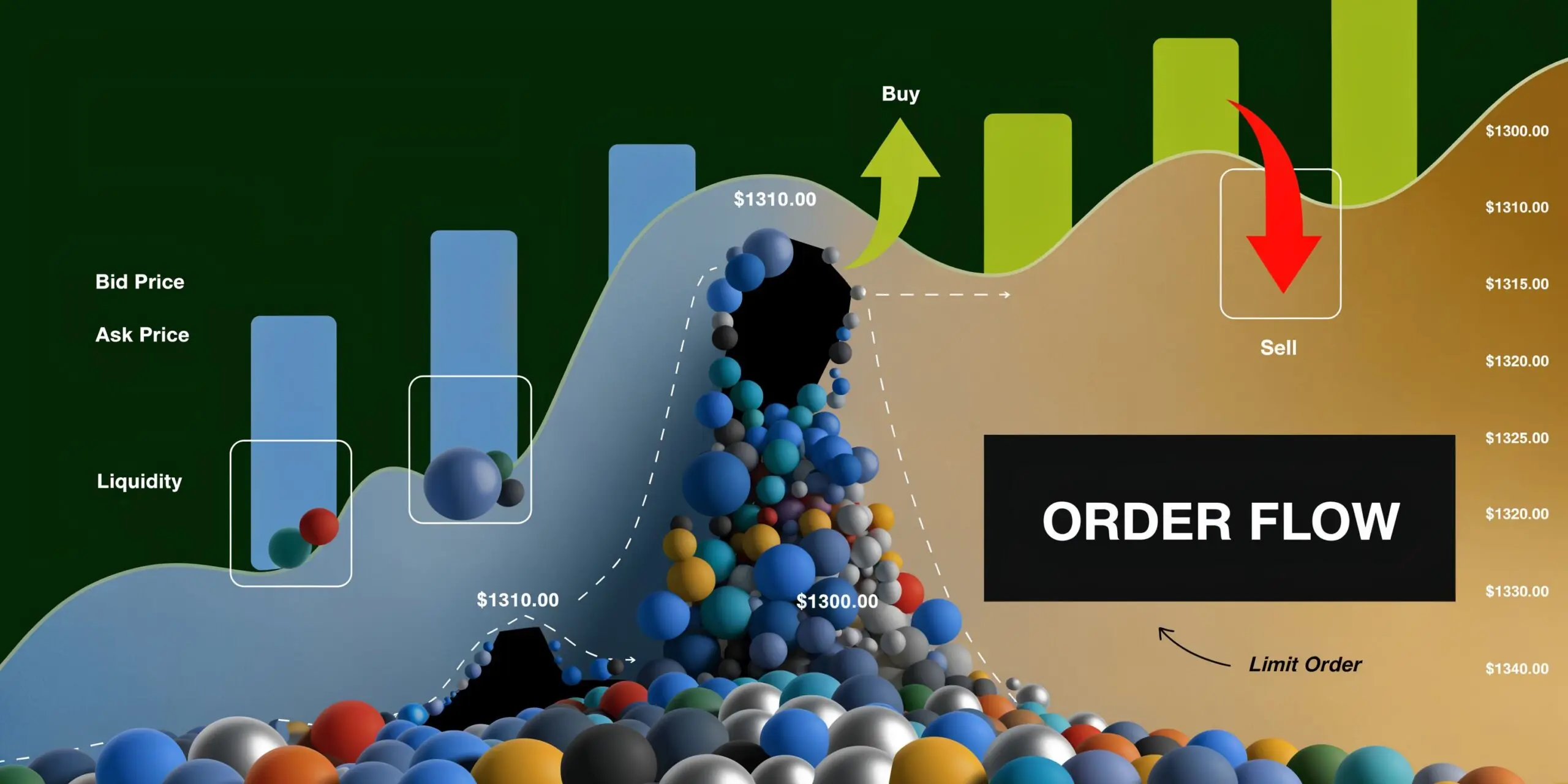
How Order Types Interact with Bid and Ask Prices
Order type changes how you deal with the spread.
Most traders know the names. Fewer understand the execution trade-off. That is where unnecessary cost slips in.
If you want to check what your platform supports around execution behavior, platform details, and trading tools, review the platform features available here.
Market orders and limit orders compared
| Order type | What it does | Strength | Weakness |
|---|---|---|---|
| Market order | Executes immediately at the best available price | Speed and certainty | You cross the spread |
| Limit order | Sets a price or better | Better price control | May not fill |
When a market order makes sense
A market order is the blunt tool. You use it when execution matters more than price precision.
For example:
- You need immediate entry
- Liquidity is strong
- Spread is acceptable for the setup
- Missing the trade would be worse than paying the spread
The downside is simple. You accept the current ask on a buy and the current bid on a sell. In fast conditions, you may also deal with slippage, which can make the effective entry worse than expected.
When a limit order makes sense
A limit order is the patient tool.
You choose your price and wait for the market to come to you. That can help reduce entry cost and avoid paying more than you planned. It is especially useful when the spread is wider than normal or when your setup depends on precision.
But the trade-off is real. The market may never touch your level. Or it may touch it briefly and move away before filling.
Use this rule: If your edge depends on exact entry, lean toward limits. If your edge depends on guaranteed participation, market orders may be justified.
Common execution mistakes
Chasing fast candles with market orders
This often means paying the spread in poor conditions.Using limit orders in moves that require urgency
Good idea, no fill. The setup runs without you.Ignoring bid and ask on stop placement
Some traders place stops based only on the visible chart price and forget which side triggers the exit.Testing a strategy without realistic execution
A backtest that ignores spread and order fill behavior is incomplete.
The right order type does not remove spread. It changes how you engage with it.
Practical Tips to Minimize Spread Costs on DXtrade and cTrader
You cannot eliminate spread. You can reduce how much damage it does.
For active traders on DXtrade and cTrader, that starts with execution discipline. Small changes in timing, instrument selection, and order handling can protect a surprising amount of P&L over time.
A working checklist
Trade the most liquid instruments first
Spreads vary by instrument class and liquidity. If you are trading frequently, start with markets that are known to stay tighter more often.Be selective with session timing
Some hours produce cleaner pricing than others. If your strategy allows flexibility, trade when participation is strongest and the book is deeper.Treat news windows carefully
Spreads can widen sharply around major releases. If your edge is not news-specific, waiting can be the smarter decision.Use limit orders when your setup allows patience
They do not guarantee a fill, but they can improve price control and reduce unnecessary crossing of the spread.Review spread behavior by instrument
Do not assume all forex pairs, indices, or commodities behave the same. Build your own watchlist of instruments that match your style.
Why this matters more for high-frequency traders
According to Saxo’s guide on bid vs ask price, existing guides often fail to address how spreads affect prop traders under strict daily loss limits. The same source notes that spreads vary dramatically by instrument class and liquidity, and for a day trader executing 50+ trades daily across volatile instruments, spread slippage can erode 0.5–2% of daily returns before market movement is even considered. It also notes that traders on DXtrade and cTrader need to understand which instruments offer the tightest spreads to maximize profit retention.
What I would focus on first
If a trader asked me where to start, I would keep it simple:
- Cut the instruments that regularly show ugly spread behavior
- Stop trading right into unstable conditions unless that is your edge
- Compare gross strategy performance with net execution-adjusted performance
- Build around clean markets before trying to force opportunity out of expensive ones
That approach is boring. It also keeps more of what you make.
Frequently Asked Questions About Bid-Ask Spreads
Why does the spread change during the day
Because liquidity and risk change during the day. Active sessions usually produce tighter pricing, while thin periods and volatile moments often lead to wider spreads.
Can the bid be higher than the ask
In a normal market, no. If that happened and stayed available, traders would immediately exploit the price mismatch. In practice, platforms and liquidity systems resolve that quickly.
Are zero-spread accounts free
Usually not. If the spread is reduced or shown as zero, the cost is often handled through a commission model instead. You still need to evaluate total execution cost, not just the displayed spread.
Should beginners avoid wide-spread instruments
For short-term trading, that is usually a smart move. Wider spreads make trade management harder, especially when you are still learning entries, exits, and position sizing.
Trading involves risk of loss, and this article is educational only, not financial advice. If you want to put these concepts to work in a structured prop environment, explore the funding programs at MyFundedCapital, compare challenge and instant funding options, and choose the account type that fits your trading style and risk discipline.