You're looking at a MyFundedCapital challenge page, seeing profit targets, drawdown limits, trading-day requirements, and optional add-ons, but you're not yet sure which rule can fail the account. This guide breaks down the step challenge rules as one connected risk system, so you can read the MFC rulebook independently, plan an equity path, and spot the behaviours that commonly end an evaluation. Trading involves risk of loss, and this educational content isn't financial advice.
Free resources: Prop Trading Challenge Survival Guide (the math behind the rules and the habits that get traders through).
What the Step Challenge Rules Decide
The rulebook evaluates how you produce gains, how much volatility you accept, and whether your equity remains inside the permitted path. Reaching a target does not settle the evaluation if the account breaches a loss limit, violates a trading restriction, or misses an activity or consistency condition. The account's result must fit the rules from entry to completion.
MyFundedCapital offers 1-Step and 2-Step Challenge structures. The 1-Step format concentrates evaluation in one phase. The 2-Step format separates it into two stages, giving the firm more than one target period in which to assess performance. Industry summaries describe the wider two-phase prop-firm model as commonly using an 8% to 10% Phase 1 target, a 4% to 5% Phase 2 target, daily loss limits around 4% to 5%, and maximum drawdown within an 8% to 12% range. The exact MFC rulebook controls your account, as explained in this industry overview of prop-trading rules.
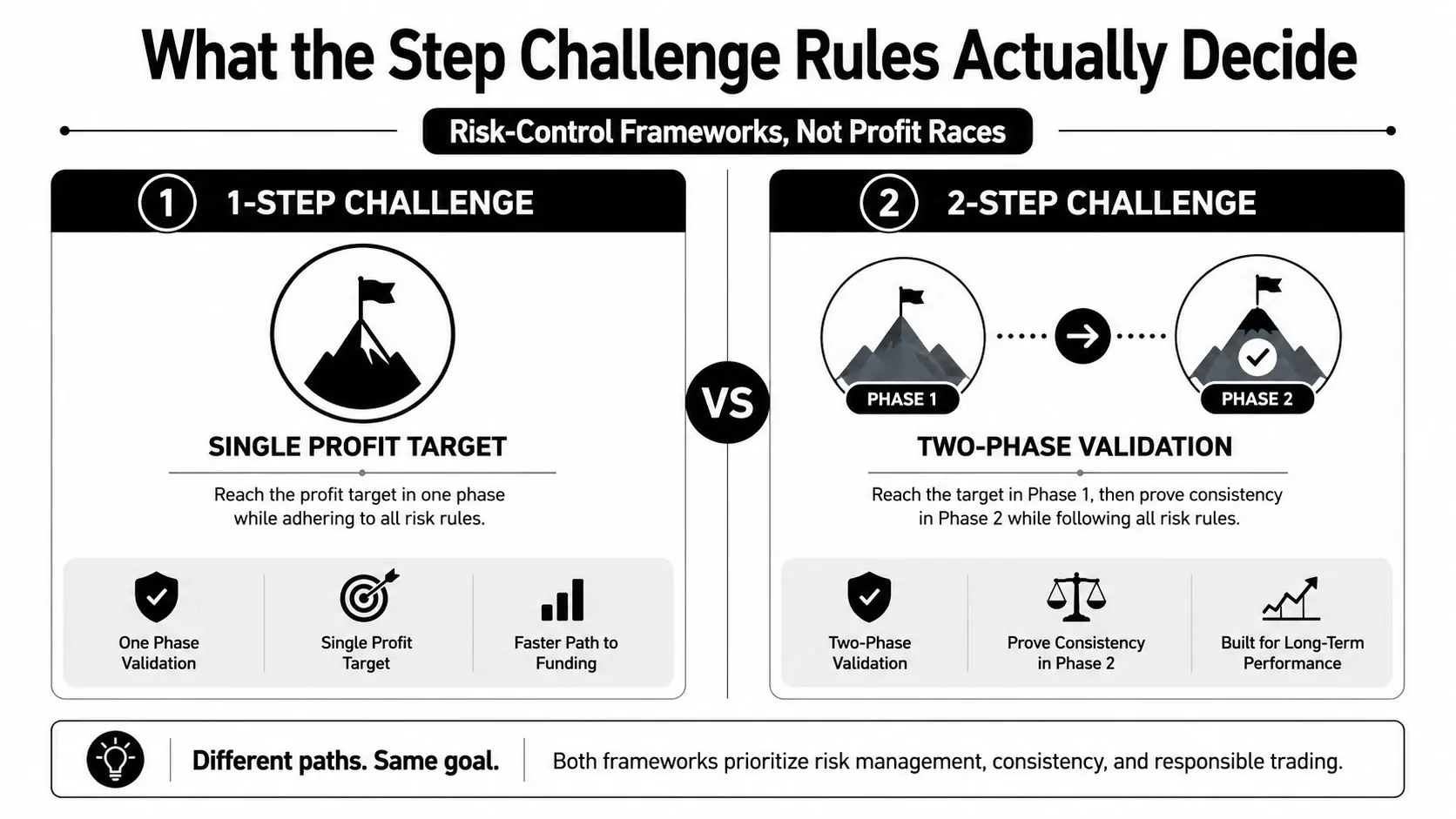
Read the rules as a connected equity path. Check which equity reference each limit uses, whether drawdown moves as the account gains, and how many trading days must be completed. Then verify whether news trading, weekend positions, expert advisers, and copy trading are permitted, along with the conditions before a first payout.
This approach turns a long rules page into a decision framework. A plain-language explanation of what a prop-firm challenge involves can clarify the evaluation process, but the specific MFC product page remains the authority before purchasing.
Practical rule: Treat the profit target as one condition within the system. Passing depends on a compliant equity path, not the final balance alone.
How MFC Structures the Core Rules
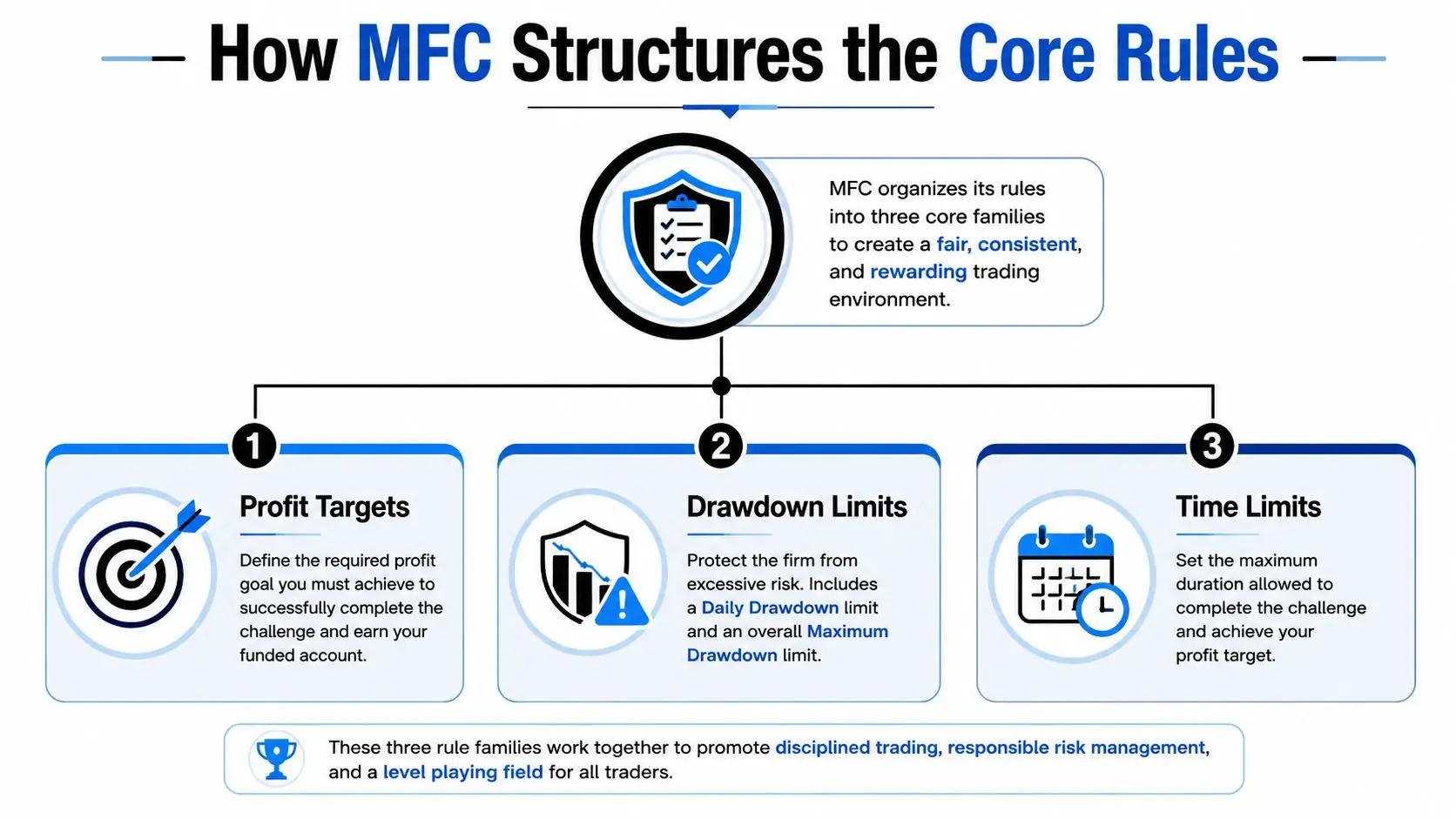
A trader can reach the profit target and still fail the evaluation. The account path might breach a daily loss limit first, or fall through maximum drawdown after an earlier gain. MFC's rulebook therefore works as one connected system built around profit targets, drawdown limits, and time limits. These families interact, but each measures a different aspect of risk.
A profit target sets the required account growth. Drawdown limits set how much loss the account may absorb while pursuing that growth. Time and activity conditions test whether the result developed through the required trading process rather than one unusually large trade or a brief favourable market move. Understanding this distinction helps you avoid breaching one limit while chasing another.
Daily loss and maximum drawdown are different
A daily loss limit controls short-term damage. It can stop trading after a bad session, when frustration may produce revenge trades, larger positions, or weaker setups. A common industry evaluation pattern uses a daily trailing drawdown around 3% to 6% and a total trailing drawdown around 6% to 10%, according to prop-firm evaluation risk guidance.
A maximum drawdown limit controls the longer equity path. It measures how far the account may fall from its permitted reference point, which may be the starting balance, a peak, or a trailing level. Maximum drawdown is formally the decline from an earlier equity peak to the subsequent trough, so open losses, correlated positions, and the order of wins and losses all matter. (Drawdown definition and risk context)
Use these rules as separate checks on the same account path:
- Daily loss limit restricts the risk used within one session.
- Maximum drawdown restricts the account's total decline from its permitted reference.
- Profit target defines the required growth.
- Time or minimum-day rule sets the activity pattern required for that growth to count.
Read each condition alongside the others before trading. The distinction between scope, usage conditions, and obligations also appears in Mava's legal terms for SaaS support, but here the practical point is specific to trading: a winning balance does not erase a breached risk limit.
1-Step Versus 2-Step Challenge at a Glance
Choosing between one phase and two phases changes how pressure is spread across the same risk system. A 1-Step challenge concentrates the evaluation in one stage. A 2-Step challenge separates it into a first target and a second phase, so the trader must preserve the account through the transition as well as reach both objectives.
Industry descriptions often place Phase 1 targets in the 8% to 10% range and Phase 2 targets around 4% to 5%, with minimum trading-day requirements commonly set at four or more days per phase. Treat these figures as broad patterns rather than MFC account terms. Confirm the selected product's rule page before trading.
| Parameter | 1-Step Challenge | 2-Step Challenge |
|---|---|---|
| Evaluation structure | One phase | Two connected phases |
| Profit objective | One higher target | A target in Phase 1, followed by a lower target in Phase 2 |
| Time pressure | One evaluation window | A separate window or condition for each phase, according to the product rules |
| Minimum trading days | Check the selected MFC account rules | Check the required days for each phase |
| Main psychological demand | Sustain discipline while pursuing one concentrated objective | Maintain discipline through a first target, transition, and second target |
| Best fit | Traders comfortable with a single evaluation hurdle | Traders who prefer validation across separate stages |
The format should match the path your strategy normally takes. Consider setup frequency, average holding period, and the length of a typical losing streak. A patient approach may need room for fewer entries, while an active approach must still control position size when opportunities arrive close together. The phase structure does not replace the daily loss limit or maximum drawdown. It determines how often you must reach a target while those limits remain active.
Read what two-stepping means in prop trading before deciding. Then record your expected setups, holding period, and likely losing streak. Choose the structure that fits those conditions, rather than the format that looks simpler on a sales page.
Profit Targets, Drawdown Limits, and Time Windows in Practice
A challenge account can pass one checkpoint and still fail on the next move. The rules work together along the equity path, so review each trade against the daily loss limit, maximum drawdown, profit target, and available time.
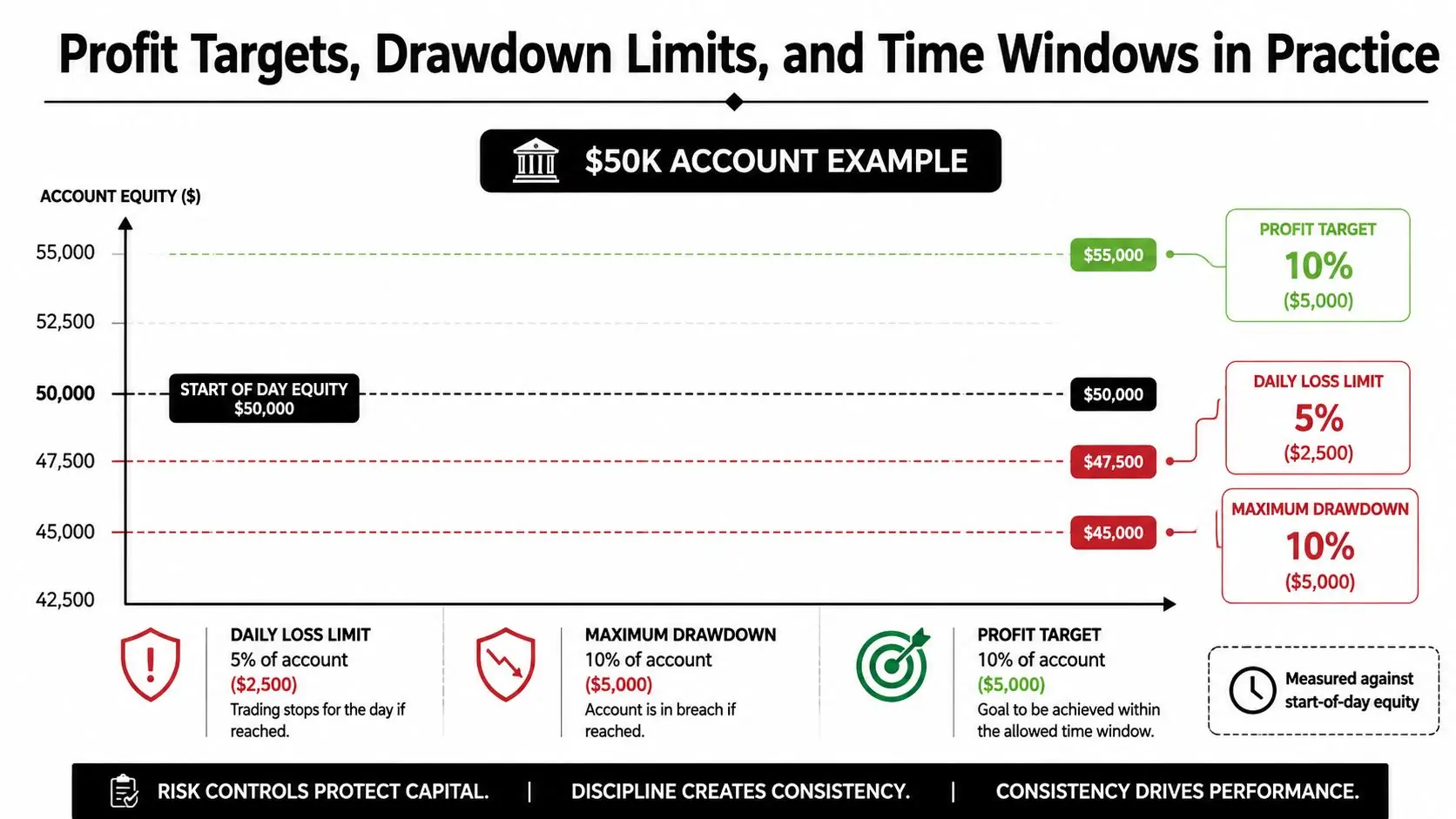
Consider a $50,000 account with a 5% daily loss limit, a 10% maximum drawdown, and a 10% profit target. The dollar equivalents are calculated in the MFC challenge rule information and illustrated below.
For this account, the operating boundaries are:
- Daily loss limit 5% of the relevant daily reference, equal to $2,500 when measured against the stated $50,000 start-of-day equity.
- Maximum drawdown 10% of the starting balance, equal to $5,000.
- Profit target 10%, equal to $5,000.
- Leverage The referenced 1-Step challenge information lists 1:50 leverage.
- Inactivity The same product information lists a 30-day inactivity period.
Follow the equity path
Suppose the account begins a session at $50,000. One oversized position moves against the trader, and realised plus floating losses reach the permitted daily amount. A sound long-term strategy cannot offset that breach. The session has used its short-term loss budget, so the account fails under the daily rule.
Another account may decline more slowly. Several trades lose across different sessions, with some positions exposed to the same market move. No single order appears reckless, yet the combined decline reaches the maximum drawdown. Position sizing therefore needs to cover clustered exposure, not only the risk assigned to each order.
Risk reviewer's question: If all open positions moved against you together, would the account still remain inside both limits?
Time windows add pressure to the same path. They prevent indefinite waiting and require activity within the product's stated schedule. That does not justify weak entries. Define a normal setup, size it before entry, and recognise that a strategy requiring unlimited time may not fit the challenge.
Use a mechanical review before each session:
- Record the equity reference for the day.
- Set a personal stop below the firm's daily limit.
- Check total exposure across correlated instruments.
- Stop after reaching the personal threshold, even if the firm's limit remains untouched.
- Check the calendar and challenge deadline before entering.
In a 2-Step structure, confirm whether minimum days reset per phase. One completed target does not guarantee that the next activity requirement is satisfied. The target, loss limits, and time conditions must all be tracked through the relevant phase.
Allowed Instruments, Order Types, and Add-Ons
The trading environment determines whether a valid strategy can be executed without unnecessary restrictions. MFC describes access to 350+ instruments across forex, crypto, and commodities, with trading available on DXtrade and cTrader, while MT5 is identified as coming soon in the publisher information.
That range doesn't make every instrument suitable for every account. Spreads, volatility, trading hours, contract specifications, and news sensitivity can differ sharply between a major currency pair, an index, a cryptocurrency, and a commodity. You should confirm the symbol specifications inside the platform rather than assuming that the same stop distance or position size works everywhere.
Match the account to the strategy
Manual trading, algorithmic trading, and copy trading are described as supported behaviours, but the exact implementation still matters. An expert adviser can place orders faster than a human, while a copy system can duplicate exposure across accounts. Neither removes the responsibility to respect drawdown, restricted-event, and holding rules.
The optional add-ons change the permissions around particular behaviours:
- News trading add-on relevant if your strategy opens or manages trades around high-impact releases.
- Weekend holding add-on relevant if positions remain open when the normal trading week ends.
- Faster payout add-on relevant if withdrawal timing is a central operational requirement.
A trader who never holds over the weekend doesn't need to pay for weekend flexibility. A trader whose edge depends on scheduled announcements may need news permission, but should still reduce size because volatility and slippage can expand quickly. The add-on changes the rule, not the market risk.
Order execution still needs a plan
Before you trade, verify whether your intended market, limit, stop, hedge, EA, or copying method is permitted for the exact account. Check whether the restriction applies to opening orders, holding positions, closing positions, or profit attribution. Keep a saved copy of the current terms because add-on conditions can be product-specific.
Payouts, Scaling, and the Consistency Check
Passing an evaluation isn't always the same as being ready for a payout. The post-challenge process can include account activation, a review of trading-day requirements, consistency conditions, and compliance with the funded-account restrictions.
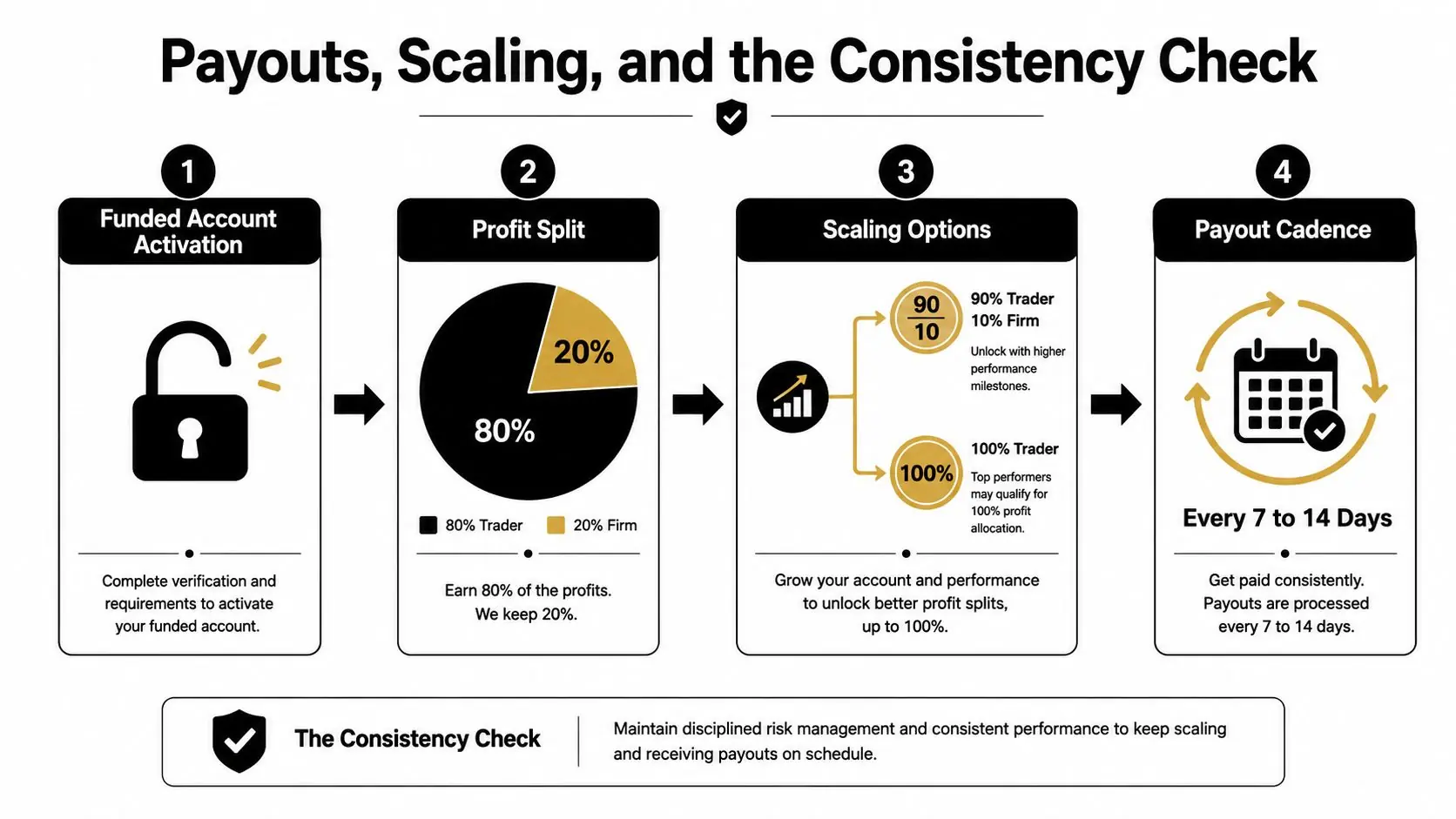
MFC's published product information describes profit splits beginning at 80/20, with routes to 90/10 or 95/5, and payout availability every 7 or 14 days depending on the program, or on demand with the payout add-on, with average processing around 2 hours. These conditions should be checked against the account type and current terms before you buy.
The consistency question
Minimum trading days and minimum profitable activity aren't the same requirement. A trader may complete the required number of days while producing most of the profit in one unusually large session. Some industry guides describe consistency conditions where total profit must be at least twice the biggest day or trade, and they also report minimum-day requirements ranging from 3 to 10 days across firms. (Example of a current one-step rule explanation)
That distinction can affect both challenge completion and payout eligibility. Before the first withdrawal, check:
- Trading-day status Have you completed the required number of qualifying days?
- Profit distribution Did one day or trade account for too much of the result?
- Funded restrictions Did you follow news, weekend, and execution conditions?
- Equity path Did the account remain inside the applicable drawdown model?
Scaling is also rule-dependent. The publisher information describes account paths from $5K to $100K, with scaling routes up to $500K for traders who continue to follow the rules. Scaling isn't a substitute for risk control. A larger nominal account can create larger dollar swings, while the percentage constraints remain the important reference.
Some rulebooks require the profit target to be reached only after a minimum period of trading activity. One evaluation guide specifies qualification after at least 7 trading days and describes drawdown as peak equity minus the permitted drawdown amount. (Evaluation account rules and parameters)
For a clearer explanation of the rule that can affect withdrawals after a target is reached, review how the consistency rule works in prop firms.
Common Rule Violations and a Pre-Session Checklist
Most failures don't come from an inability to identify a profitable setup. They come from treating one permission as if it overrides every other condition. A news add-on may permit event trading, but it doesn't permit excessive risk. Weekend access may permit holding, but it doesn't protect the position from a gap.
Failure modes worth checking
- Restricted news trading You open or keep a position during a prohibited event without the relevant permission. A separate industry rule set, for example, prohibits open trades within 5 minutes of red-folder news and limits news-influenced trades to 30% of total profit on funded accounts. (Example news-trading policy)
- Weekend holding You leave a position open when weekend holding isn't active for the selected account.
- Oversizing One setup consumes the daily loss allowance before the strategy has time to recover.
- Trailing drawdown A winning streak raises the reference line, and a later decline breaches the updated threshold even though the balance remains above its original starting point.
- Minimum-day confusion You reach the profit target but haven't completed the required activity, so the evaluation or payout review remains incomplete.
Run this checklist before each session:
- Confirm the exact account type and phase.
- Confirm active add-ons, especially news and weekend permissions.
- Mark the daily equity reference and your personal stop below the firm cap.
- Check high-impact events and planned holding times.
- Add the risk of correlated open trades before placing another order.
- Record the session so you can monitor trading days and profit concentration.
Before clicking buy or sell: Know the rule that would fail the account, and know the number at which you stop before the firm has to stop you.
Step Challenge Rules FAQ
What happens after a small rule breach?
A small breach can still count as a breach if the rule is defined as a hard limit. Don't assume that a minor excess will be ignored. Check the account terms and contact support before placing another trade.
Do minimum trading days restart after a phase?
They may apply separately to each phase in a 2-Step structure. Confirm the exact phase transition rules because completing one target doesn't automatically prove that the next activity requirement is complete.
How is consistency checked before the first payout?
The review can consider whether profits are distributed across qualifying activity rather than concentrated in one day or trade. Passing the target alone may not settle payout eligibility where a consistency condition applies.
Do Instant Funding accounts use the same rules?
Not necessarily. Instant Funding, 1-Step, and 2-Step products can use different activation, drawdown, payout, and activity conditions. Read the rules for the specific account, and remember that trading involves risk of loss. This article is educational only and isn't financial advice.
MyFundedCapital offers Instant Funding alongside 1-Step and 2-Step challenges, with simulated trading environments, access to multiple markets and platforms, and optional rules for news trading, weekend holding, and payout timing. Visit MyFundedCapital to compare account types, review the current rulebook, and start a challenge only after confirming that its limits match your strategy and risk tolerance.