Struggling to keep up with the 24/7 forex market is a common path to burnout, and emotional trading decisions can sabotage a great strategy. This guide explains how an automatic forex trade system can help you trade with discipline and consistency. You'll learn the practical steps for choosing, testing, and managing an automated strategy without the hype or false promises.
This content is for educational purposes only and is not financial advice. All trading involves substantial risk of loss.
Why Automatic Forex Trade Is a Game Changer
For most traders, the biggest hurdles are psychology and time. Fear can make you close a winning trade too early, while greed convinces you to hold a loser far too long. An automated system doesn't have these problems; it operates on pure logic, executing your plan with discipline every single time.
This mechanical approach is more relevant than ever. The forex market's massive liquidity makes it an ideal environment for automated systems. For perspective, the average daily turnover recently hit a record $9.6 trillion, a huge leap from the $1.4 trillion reported back in 2001.
Key Advantages of Automation
Automating your strategy isn't a silver bullet, but it's a powerful tool for building consistency and overcoming common trading pitfalls.
- Emotional Detachment The software doesn’t get scared or greedy. It just follows the rules you set. This is a huge advantage, especially in a prop firm setting where sticking to drawdown limits is non-negotiable.
- Around-the-Clock Trading The forex market is always open somewhere, but you need to sleep. Automation ensures your strategy is live during the London, New York, and Tokyo sessions, so you don't miss opportunities just because you're offline.
- Speed and Efficiency A machine can scan dozens of currency pairs and execute a trade in a fraction of a second. No human can react that fast. This speed is a major edge for capturing small, fleeting price movements.
The real purpose of automation isn't to "set and forget." It's to enforce discipline. It turns your trading plan from a static document into an active, impartial executor of your strategy.
Automatic forex trading is a practical application of principles seen in Artificial Intelligence in business, using data-driven rules to achieve specific outcomes. Whether using Expert Advisors (EAs), copy trading, or custom algorithms, you're applying a systematic approach to the markets.
Choosing Your Forex Automation Toolkit
Ready to start with automated trading? The right tools depend on your technical skill, time commitment, and how much control you want. It's like deciding whether to buy a ready-made performance car or build one from scratch.
Let's break down the main paths you can take.
Expert Advisors (EAs)
The most common path into automation is through Expert Advisors (EAs). An EA is a program that runs on your trading platform, like cTrader or DXtrade, and automatically executes trades based on a set of rules.
For example, you could program an EA to buy EUR/USD when the 50-day moving average crosses above the 200-day moving average, but only if the RSI is below 30. The EA then scans the market 24/5, waiting for those exact conditions.
This approach is great for traders who already have a solid, rules-based strategy. The main benefit is that it enforces discipline and removes emotion. The downside is that many pre-made EAs are "black boxes," meaning you don't know the logic inside. A system you don't understand is a system you can't trust when markets get choppy.
Copy Trading
If you're not ready to build or manage your own system, copy trading is a practical alternative. You automatically mirror the trades of an experienced trader in your own account.
Platforms often have this feature built-in. You browse different strategy providers, review their performance history and risk metrics, and link your account when you find one that fits your goals. The platform handles the rest, replicating their trades at a scale appropriate for your account size.
This isn't a passive solution. You must do your due diligence on the trader you copy. To understand what separates a robust system from a risky one, review these effective strategies for algo trading.
Custom Algorithms and AI
For traders with programming skills and a passion for data, building a custom algorithm offers the most control. This involves creating a unique trading system from scratch using languages like Python or C++.
This advanced path allows for highly sophisticated strategies. You can go beyond simple if-then rules and incorporate machine learning to help your system adapt to new market behaviors. For anyone serious about this route, learning about building AI systems for trading is essential.
The Real Pros and Cons of Automated Trading
An automated trading system offers powerful advantages, but it's a tool, not a money-printing machine. To succeed, you need a balanced view of both its potential and its risks.
Algorithms have reshaped the markets, with their influence growing significantly since the 2008 financial crisis. Today, algorithms are behind over 75% of the $9.6 trillion traded daily in the forex market. This isn't a niche strategy anymore; it's how the modern market operates. You can get a sense of this scale by exploring data from sources like the CME Group on FX volume.
The Clear Advantages of Automation
Automating your trading plan delivers key advantages that are difficult for a human to match consistently.
- Emotional Discipline on Autopilot Your system doesn't get scared during a drawdown or greedy after a winning streak. It executes your plan with cold logic, hitting your stop-loss or take-profit without hesitation.
- 24/7 Market Coverage An automated system can monitor the charts and execute trades through the Asian, London, and New York sessions, ensuring your strategy is always active.
- Blazing-Fast Execution Speed An algorithm can spot a setup and fire off an order in milliseconds—faster than you can blink. For strategies built on rapid price moves, this speed is a significant advantage.
- Rigorous Backtesting Before risking real money, you can run your strategy against years of historical data to find its strengths and weaknesses in a safe, simulated environment.
The Unspoken Disadvantages and Risks
It’s not all upside. Ignoring the risks of automated trading is the fastest way to blow an account.
The greatest danger in automated trading is not a system failure, but a false sense of security. A profitable backtest does not guarantee future results, and a "set and forget" mindset is a recipe for disaster.
Here are the critical drawbacks you must manage:
- The Danger of Over-Optimization It’s tempting to tweak your strategy on historical data until the backtest results look perfect. This is a trap called curve fitting. You create a system that’s tailored to the past but fails in live market conditions.
- Sudden Market Event Failures Your system learned from the past; it doesn't know how to react to a surprise interest rate decision or a geopolitical crisis. These "black swan" events can cause a historically sound system to incur devastating losses.
- Constant Monitoring is Non-Negotiable Thinking you can turn on a bot and walk away is a rookie mistake. Technology fails—internet outages, platform bugs, or server crashes can leave your system offline with live trades dangerously exposed. You have to keep an eye on it.
How to Properly Backtest and Validate Your Strategy
Having an idea for an automated strategy is one thing; trusting it with capital is another. Before you let a bot trade a live account, you must put it through rigorous backtesting.
Think of backtesting as a flight simulator for your trading plan. It runs your strategy's rules against years of historical market data to see how it would have performed. A bad backtest is a blessing, sending you back to the drawing board before any real money is lost.
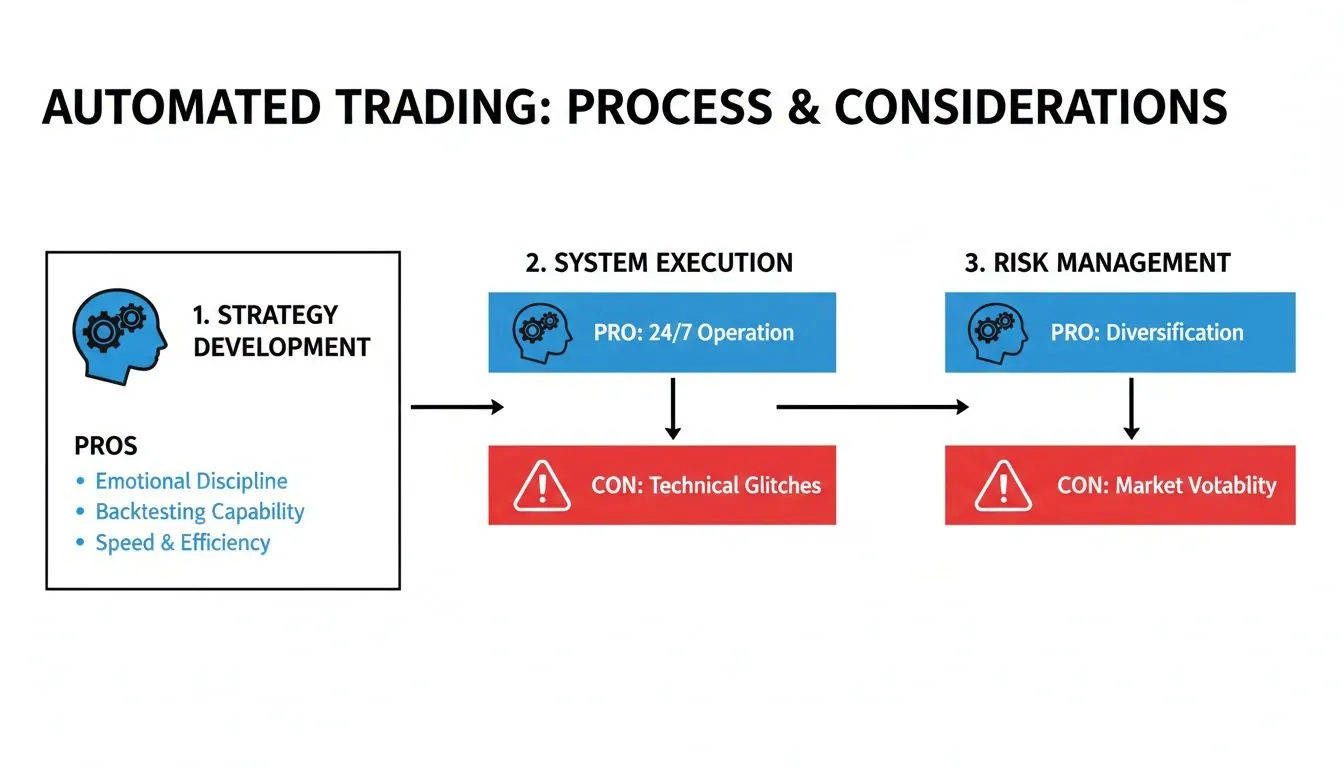
While automation provides an edge in speed and discipline, it also introduces new risks like over-optimization. This validation process is crucial for mitigating them.
Sourcing High-Quality Historical Data
Your backtest is only as good as your data. Using low-quality or incomplete data will produce misleading results and give you a false sense of security.
You need tick-by-tick data that includes the bid/ask spread to accurately simulate real trading costs like commissions and slippage. While platforms like cTrader and MT5 offer historical data, its quality can be inconsistent. Consider data from a reputable third-party provider for reliable testing. You can explore a wide range of forex market data feeds to find sources.
A Practical Checklist for Backtesting
Once you have quality data, fire up your platform's strategy tester.
- Load Your Strategy Choose the Expert Advisor (EA) or cBot you want to test.
- Define the Market Select the currency pair and chart timeframe (e.g., EUR/USD, H1) the strategy was designed for.
- Set a Long Date Range Test over 5-10 years of data to see how the strategy performs in different market conditions (trending, ranging, high volatility).
- Configure Test Parameters Set your starting balance, leverage, and any other inputs your bot requires.
- Use a Precise Model Always select the most accurate simulation model available, such as "Every tick based on real ticks."
When the test is done, look beyond the final profit figure.
The goal of backtesting isn't to find a strategy that never loses. It's to understand how your strategy behaves—its strengths, weaknesses, and breaking points—before risking real capital.
Avoiding the Curve-Fitting Trap
The biggest pitfall in backtesting is curve fitting, where you endlessly tweak settings until the strategy performs perfectly on past data. The system is almost guaranteed to fail live because it was tailored to the past, not designed for the future.
To avoid this:
- Split Your Data Test your strategy on one period (e.g., 2018–2022) and validate it on a fresh, unseen period (e.g., 2023–2024) without changing any settings. This is called out-of-sample testing. If performance drops significantly, you've likely curve-fit.
- Keep It Simple A robust strategy often has simple, clear logic. The more parameters a strategy has, the easier it is to over-optimize.
The Crucial Step of Forward Testing
A successful backtest is just the first step. Next is forward testing (or paper trading), which means running your EA on a demo account with live data. This is your final dress rehearsal.
This step confirms that the EA executes correctly in a live environment and that its real-time performance aligns with your backtest results. Many traders use specialized tools for this; you can check out our review of the best back-test software to see professional options.
Using Automated Trading with a Prop Firm
You've built and tested your bot. Now it's time to deploy it with a prop firm. This requires a smart plan to ensure your bot's logic works within the firm's rulebook.
Stop thinking of prop firm rules as restrictions. Instead, see them as a built-in risk management framework. Your job is to configure your Expert Advisor or copy trading setup on platforms like DXtrade or cTrader to operate well within the firm's guardrails, like daily loss and max drawdown limits.
Aligning Your EA with Prop Firm Risk Rules
Your most important job is to ensure your automated system never gets close to breaking the firm’s main risk rules, like a 5% daily loss or 10% maximum drawdown. One violation can terminate your account.
This means your EA’s internal risk settings must be more conservative than the firm's limits.
If the prop firm's daily drawdown limit is 5%, your bot’s own internal "kill switch" should be set to 2.5% or 3%. This creates a critical buffer to absorb unexpected slippage or a sudden volatility spike.
This proactive approach turns a potential account-killer into a disciplined part of your strategy, prioritizing account protection.
Configuring Your EA for Prop Firm Rules
| Prop Firm Rule | Actionable Tip for Your EA/Bot | Why It Matters |
|---|---|---|
| Maximum Total Drawdown | Set your EA's internal max drawdown to a conservative level (e.g., 6-7% if the firm's limit is 10%). | This is your ultimate safety net. It ensures a bad run doesn't wipe out your account, giving your strategy room to recover. |
| Daily Loss Limit | Program a "daily stop" into your bot's code. For a 5% firm limit, have the EA stop trading for the day after a 2.5% loss. | This prevents the algorithm from "revenge trading" and contains damage from a bad day, protecting you from a rule violation. |
| Position Sizing | Ensure your bot calculates position size as a percentage of equity, not a fixed lot size. | This keeps your risk consistent. As your account grows, your position size can grow; if you hit a drawdown, it scales back automatically. |
| Platform Compatibility | Before going live, run your EA on a demo account using the exact platform the prop firm provides (cTrader, DXtrade, etc.). | A bot coded for one platform can have execution errors on another. You must fix bugs before real money is on the line. |
Making the Most of Prop Firm Add-Ons
Many prop firms offer add-ons that are game-changers for automated strategies. For a deeper look at how automation and prop firm goals align, our guide on AI in forex trading covers more advanced ideas.
Two of the most valuable add-ons for bot traders are:
- News Trading Permission Most standard accounts block trading during major news events. If your EA is a volatility breakout system built for those moments, this add-on is a must-have.
- Weekend Holding If your strategy holds positions for several days, the weekend holding add-on is essential. Without it, you'd have to close good trades every Friday, undermining your bot's logic.
When you match these add-ons to your bot’s strategy, the firm’s rules become part of a framework that supports your automated approach.
Monitoring Your System for Long-Term Success
One of the biggest myths about an automatic forex trade system is the "set and forget" idea. Successful automation is an active, ongoing process. You are the pilot, and even on autopilot, you must monitor the instruments and be ready to take control.
This hands-on management is what separates traders who build lasting success from those whose accounts blow up.
Building a Monitoring Routine
A consistent monitoring routine is your best defense against surprises. Here’s a simple checklist to get started:
- Daily Check (5-10 minutes) A quick morning check-in. Is the system running correctly? Are there any errors? Check open trades and your daily drawdown to ensure everything is within prop firm limits.
- Weekly Review (30 minutes) How did the bot perform this week compared to your backtests? If there's a big difference, investigate why.
- Monthly Analysis (1-2 hours) Dig into your metrics: profit factor, win rate, and average risk-to-reward. Ask the big-picture question: Has the market changed, and is my strategy's edge still sharp?
Knowing When to Intervene
Knowing when to step in is a critical skill. Sometimes the smartest move is to hit the pause button.
The point of intervening isn't to second-guess every trade. It's about protecting your capital from a "black swan" event or a market environment your strategy wasn't built for.
Step in during these key moments:
- Extreme Market Volatility Before a major news event like an FOMC announcement, markets can become chaotic. Pausing your bot is smart risk management.
- Performance Divergence If your bot’s live results are suddenly much worse than its backtested performance, the market conditions it relies on may have changed.
- Approaching Drawdown Limits If you're on a losing streak and getting close to a daily or maximum drawdown limit, pause the bot manually. Protect your account to trade another day.
If performance degrades over weeks or months, take the system offline for a tune-up. This cycle of monitoring, intervening, and re-optimizing is what keeps an automatic forex trade system running for the long haul.
Frequently Asked Questions About Automatic Forex Trade
Here are answers to some of the most common questions from traders exploring automated systems.
Can I use an automated system with no trading experience?
While technically possible, it is strongly discouraged. An automated system is a tool that executes a strategy; it doesn't replace a foundational understanding of the market. Learn to trade manually first. Once you understand market dynamics and have a rules-based strategy, you can use automation to execute it with discipline.
What is a realistic profit goal for an automated system?
There is no magic number. Profitability depends on the strategy, risk management, and market conditions. Be very skeptical of any EA promising high monthly returns like 20% or 50%. A more realistic and sustainable target for a well-vetted system is in the low single digits per month. A system that consistently generates 2-3% average monthly return with a low drawdown is an extremely powerful tool, especially when scaled with a funded account.
Can my automated system violate prop firm rules?
Yes, absolutely. A "set-and-forget" bot is one of the quickest ways to fail a prop firm challenge. If an EA's risk settings are too aggressive, a volatile news event could cause it to blow past the 5% daily loss limit in minutes. The key is to program your EA's internal risk limits to be much tighter than the firm's rules. For example, if the firm's max drawdown is 10%, set your EA's hard stop at 6-7%.
How much does a good trading bot or EA cost?
Prices vary widely, from free to thousands of dollars, but price is not a reliable indicator of quality. Many expensive EAs are over-optimized systems that fail in live markets. Instead of focusing on price, demand transparency. Can you run your own backtests? Does the developer explain the trading logic, or is it a "black box"? A transparent system is a far smarter investment than a mystery bot with flashy promises.
Ready to put your automated strategy to the test? At MyFundedCapital, we support algorithmic and EA traders. Compare our funding programs and find the right account to scale your system.