You're probably staring at a chart that looked strong five minutes ago and then gave half the move back. That's the core problem with momentum, knowing when it's tradeable momentum and when it's just noise, a news pop, or late buyers chasing a wick. The practical edge comes from reading the move, filtering the setup, and managing risk like a prop trader, not like a gambler.
Understanding Momentum Trading Concepts
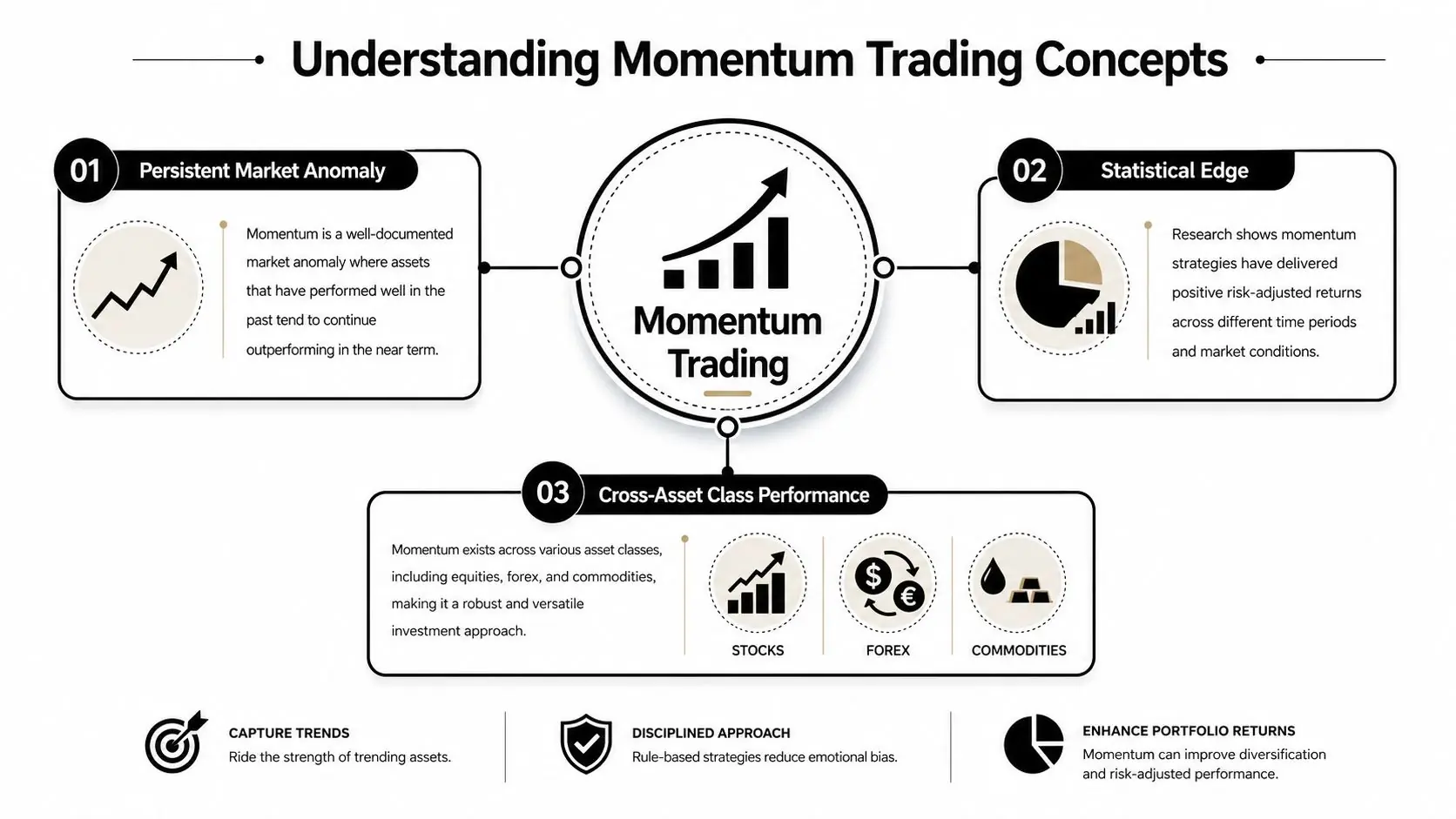
Momentum trading is one of the most durable anomalies in financial markets, and that matters because it gives traders a statistical reason to focus on recent strength instead of random price action. Academic work commonly finds that a long-short momentum factor has delivered about 6% to 12% annualized excess returns above the market over long sample periods, with evidence across asset classes and geographies since 1927 (momentum trading statistics). The classic Jegadeesh and Titman work is the reason most traders still talk about winners keeping their lead for a while, not forever.
What the edge looks like
The core idea is simple. Assets that have already been strong often keep outperforming for a stretch, especially over multi-month lookback windows such as 6 to 12 months. The classic study found roughly 1% average monthly returns for momentum portfolios, which is why traders still build rules around ranking recent strength instead of guessing tops.
That edge does not mean every breakout is valid. It means the job is to separate persistent strength from a one-off spike that gets faded before the trade can be managed.
Practical rule: If the move only exists on the last candle, it is not enough. Momentum worth trading usually shows up in structure, relative strength, and follow-through.
The indicators that matter
Most traders do not need a messy indicator stack. A clean momentum read usually starts with moving averages, rate of change, and relative strength, then gets confirmed by price behavior. Those tools do not predict the future, they help show whether price is staying strong long enough to justify entry and hold time.
A useful habit is to treat the indicator as a filter, not a trigger. If the trend is firm but volume is dead, or if the chart is strong but the move has already stretched, the trade is usually late.
For funded prop accounts, the practical filter is whether the move still leaves room under the platform rules. A setup can look clean on the chart and still be a bad trade if it has already burned too much of your daily loss cushion or if the spread and execution on DXtrade or cTrader make the entry sloppy. That is why I keep one eye on the chart and one eye on the account constraints, especially when using ATR and Bollinger Bands for crypto to judge whether the move has enough room to continue without getting chopped up. If you want a focused refresh on the RSI side of that decision, this RSI trading strategy resource is a useful reference.
Selecting Timeframes and Setup Criteria
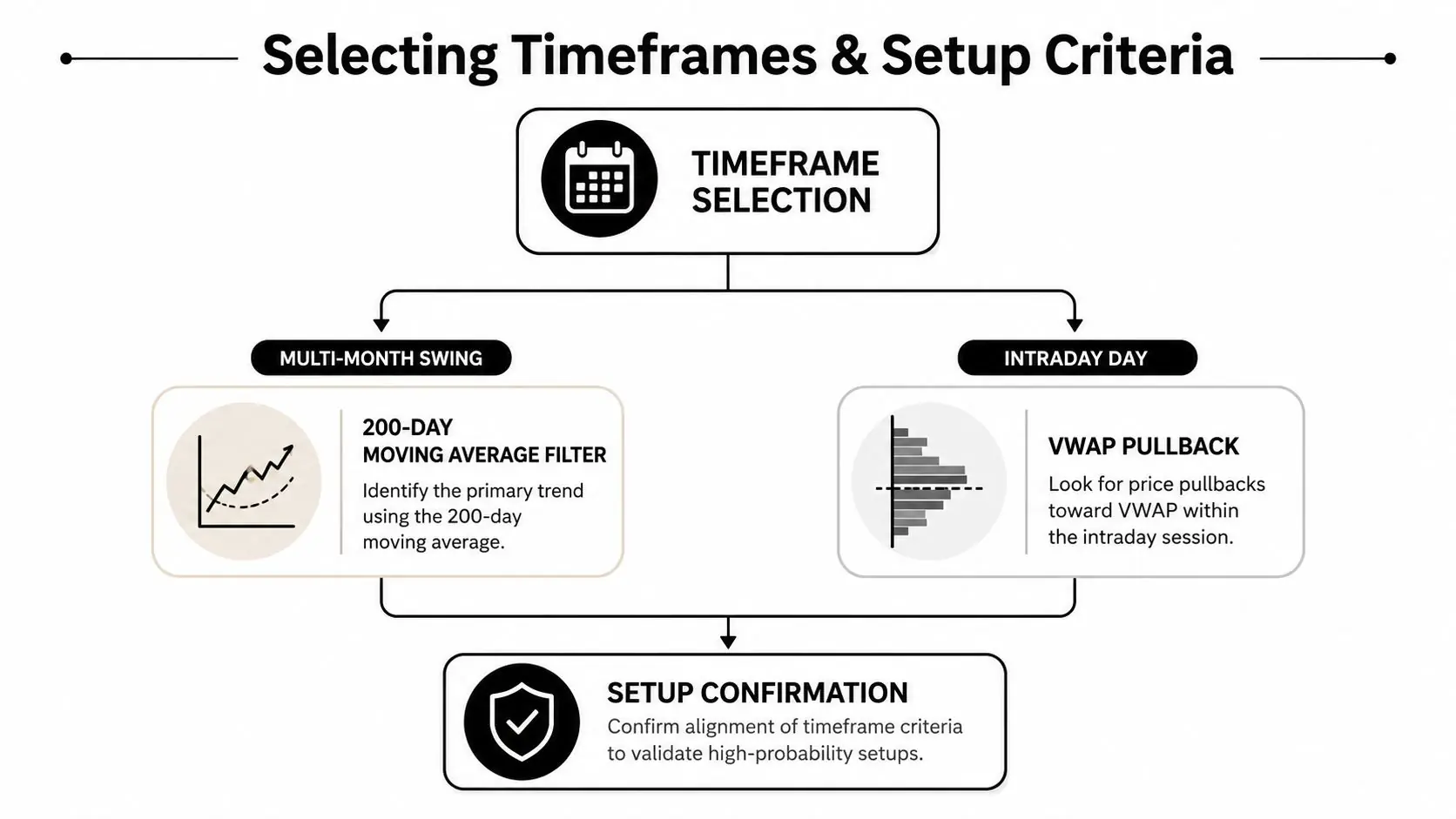
The first decision is how long you plan to hold the trade. Momentum on a swing chart and momentum on a one-minute chart are different trades, even if the candle shape looks similar. Traders usually frame momentum around catalysts, relative volume, and short holding periods after news or social-media-driven bursts instead of only the classic breakout-at-highs idea (momentum trading guide). That matters because the wrong timeframe can turn a valid edge into a slow, frustrating chop-fest.
A clean timeframe choice starts with the account rules, then the chart. On funded prop accounts, the hold time has to fit the daily loss limit, the evaluation rules, and the platform's execution quality. A setup that looks tradable on the higher timeframe can still be a poor choice if the spread on DXtrade is wide, the fill on cTrader is delayed, or the move is too stretched to survive normal noise. That is also where swing trading and day trading helps frame the trade, because the holding period changes the entire decision process.
Swing momentum versus intraday momentum
For swing trading, the usual focus is on 3-, 6-, or 12-month return rankings, with many implementations skipping the most recent month to reduce microstructure noise. That approach follows the historical pattern where momentum persists for months but fades later, so you want the stretch where continuation is still alive, not the point where everyone already piled in. The practical use is simple, a swing setup needs room to breathe, while an intraday setup needs immediate participation.
For day trading, the lens changes fast. You want an active catalyst, a clean move, and enough participation to keep the trade moving. The first impulse, the pullback, and the rebound matter more than a long lookback ranking, because on a funded account the trade has to work within a tight risk envelope, not just look good in hindsight.
A simple way to choose:
- Swing names strong recent relative strength, clean higher-time-frame trend, and enough room before resistance.
- Intraday names fresh catalyst, visible relative volume, and a pullback that holds a key level.
- Avoid both thin, unfocused charts with no catalyst and no participation.
The biggest mistake is mixing a swing-trade process with a scalp-trade mindset. That usually leads to bad exits, bad sizing, and no clear thesis.
Reading the catalyst correctly
Momentum gets cleaner when the move has a reason. Earnings, economic releases, FDA decisions, and social attention can all create tradable bursts, but not every burst becomes durable. The job is to wait for proof that traders are still bidding the move after the first surge, instead of chasing the opening candle.
For crypto-specific traders, a practical cross-check is to pair momentum reading with volatility tools. A resource like ATR and Bollinger Bands for crypto can help you judge whether the move has room left or is already stretched.
The platform matters here too. On DXtrade and cTrader, momentum can look cleaner on the chart than it feels in execution, especially when the spread widens into the move or the order book thins out. That is why I prefer setups that still make sense if the fill is a little worse than expected, because funded rules punish sloppy entries faster than they reward perfect chart reading.
Defining Entry Rules and Position Sizing
Momentum entries need a trigger, not a vibe. The practical intraday routine that holds up best starts with trend alignment, then catalyst confirmation, then a pullback, then a volume expansion on the bounce, with ATR-based stops placed at structure and OCO orders handling the exit logic (practical intraday momentum routine). That sequence keeps you from buying the first emotional spike and gives the market room to prove the trade.
A clean entry sequence
A workable long setup looks like this:
- Trend filter price is above the dominant moving average, often the 200-day on swing charts or the 50/200 alignment on intraday workflows.
- Catalyst check there's a real reason for the move, not just random drift.
- Pullback price retraces into a logical area like VWAP or a rising EMA.
- Trigger volume expands on the bounce, showing buyers are back in control.
- Execution use an OCO structure so the stop and target are tied to the trade from the start.
The main mistake is buying strength before the pullback forms. That's usually the highest emotional entry and the worst risk-to-reward entry.
Position sizing that respects prop rules
Position sizing has to be boring. On funded-style accounts, the goal is survival first, because one oversized trade can ruin a clean plan. A good habit is to predefine risk in dollars, then translate it into size using the stop distance, instead of deciding size after you've already fallen in love with the setup.
Use this internal check before every entry:
- Risk per trade keep it fixed from plan to plan, not random from trade to trade.
- Concurrent exposure don't stack too many correlated positions at once.
- Stop placement put it where the setup is invalidated, not where the loss feels comfortable.
- Order type use bracket logic so you're not improvising under pressure.
A reliable sizing calculator like this position size tool is handy because it forces the math before the click. That discipline matters more than clever chart reading when spreads widen, the candle accelerates, or the platform lags.
Execution rule: if the stop placement changes after entry, the plan wasn't finished before entry.
Implementing Risk Controls and Journaling
Momentum traders usually don't lose because the setup was impossible. They lose because they keep pressing after the tape changes, or they ignore their own stop discipline once the trade gets noisy. In a funded-account environment, that gets expensive fast, especially when the platform and the rule set already limit how much room you have to recover.
Build the day around hard limits
The strongest protection is a kill-switch mindset. If your plan says the day is over after the loss limit is hit, then the day is over. No revenge trade, no “one more try,” no exception because the next chart looks cleaner.
A solid daily checklist looks like this:
- Pre-market scan mark catalysts, trend structure, and probable entries.
- Pre-trade checklist confirm entry, stop, and size before order entry.
- Live monitoring watch whether volume confirms or fades after entry.
- Stop discipline exit where the setup says you're wrong, not where you hope the chart turns.
- End-of-day review record what worked, what failed, and what you ignored.
Journal the trade like a professional
A trading journal is more useful when it captures context, not just P&L. Write down the setup type, entry trigger, stop placement, emotional state, and whether you followed the plan. That gives you a pattern map over time, which is much more valuable than a list of wins and losses.
If your workflow includes automation, platform security matters too. Traders who build bots, scripts, or plug-ins should pay attention to a resource like secure Claude Code deployment, because shaky automation often fails in the exact moment traders assume it's safest.
The key takeaway is simple. Good journaling doesn't just track mistakes, it reveals which mistakes you keep repeating when momentum gets fast and you start making decisions under pressure.
Conducting Backtesting and Evaluating Performance
Momentum rules can look clean on a chart and still fall apart once you test them against live trading conditions. Before I trust a setup with real money, I want to see how it behaves across different market regimes, under wider spreads, and inside the restrictions that come with a funded prop account. Backtests do not prove a strategy is good, they show whether it survives the kind of friction you will face on DXtrade or cTrader.
A useful starting point is the classic momentum research framework, which focused on intermediate-term strength and then watched winners lose steam later. That shape gives you a practical clue about what to test, but it does not hand you a finished system. The job is to see whether your own rules still work once the entry, exit, and risk limits match the way you trade.
Test the rule, not the story
A backtest should answer direct questions about the setup itself:
- Does the strategy still hold up if you change the lookback a little?
- Does the equity curve stay usable when the market gets choppy?
- Does the edge survive out-of-sample data?
- Does performance break down when spreads and execution costs get worse?
If one input makes the whole thing look great, the test is probably flattering the model instead of measuring it.
Start with one rule set at a time. Compare one momentum lookback against another, then test whether skipping the most recent period improves the result. That approach is closer to how a trader refines a momentum play than stuffing every possible filter into the same test and hoping the best version survives. You also want to separate signal quality from platform behavior, because a setup that looks good in a spreadsheet can behave differently once order routing and fills are involved on DXtrade or cTrader.
What to measure
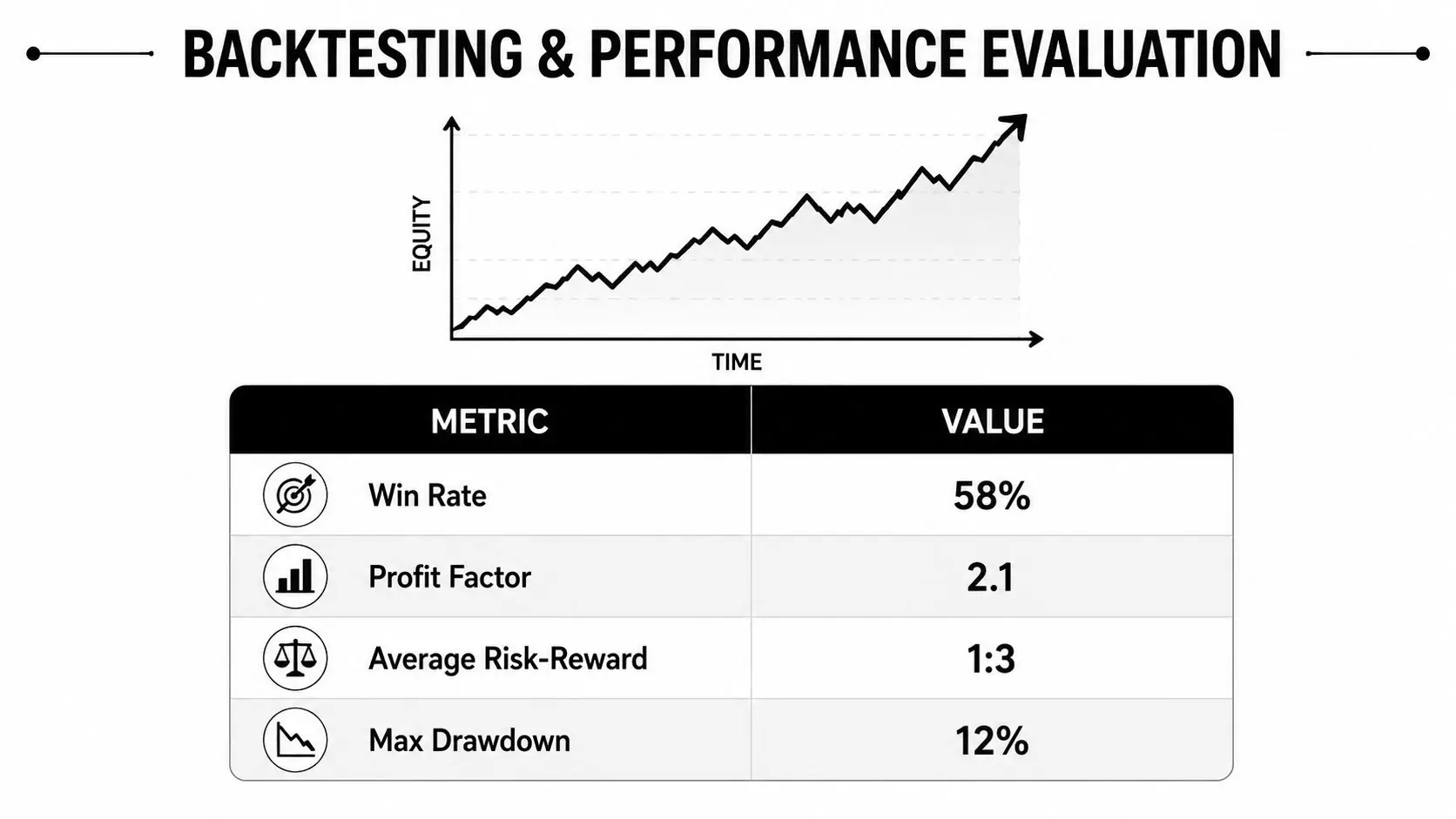
You do not need a crowded dashboard of vanity metrics. Focus on the figures that tell you whether the strategy is tradable under prop rules:
- Win rate shows how often the setup works.
- Reward-to-risk shows whether the winners can cover the losers.
- Drawdown profile shows whether the account can absorb the losing stretches without breaking the rules.
- Sensitivity analysis shows whether the edge is real or just the result of one lucky parameter choice.
Trade sequencing matters too. A simple stress check is to review the same results as if the wins and losses arrived in a less friendly order, because momentum systems often look fine in summary and feel much worse during a stretch of failed follow-through. That matters even more in a funded account, where a run of sloppy losses can force you to slow down, reduce size, or stop trading altogether.
The point of backtesting is not to prove the setup is perfect. It is to find out whether the rules can survive real slippage, real hesitation, and the execution quirks that show up when the market is moving fast.
Automating Trades on DXtrade and cTrader
Automation helps momentum traders when the rules are clear and the market is fast. DXtrade and cTrader can both handle a rules-based workflow, but the setup has to be simple enough that you can monitor it under pressure. If the script needs constant babysitting, it isn't reducing stress, it's creating a second job.
Keep the logic tight
Start with one signal and one execution path. That usually means a trend filter, a catalyst or volume condition, and a trigger that places the order only when the bounce or breakout confirms. Once that works in demo, you can add the exit logic, usually through bracket or OCO-style order handling.
A practical build process looks like this:
- Connect the feed make sure the platform is reading the same market data you'll trade live.
- Code the filter define trend and momentum conditions in the editor.
- Set the trigger use a rule that won't fire on every noisy candle.
- Attach exits program stop and target logic so the trade is protected instantly.
- Check logs confirm the system is placing, modifying, and closing orders as expected.
Test platform behavior before live deployment
The biggest problem with automation isn't the idea, it's the edge cases. Orders can fail if size limits are wrong, symbols aren't mapped correctly, or the logic doesn't match the platform's trade permissions. Demo testing should catch that before the first live attempt.
For prop-style accounts, also check whether your script respects practical limits like maximum order count and size constraints. A momentum EA that ignores those rules can be technically correct and operationally useless.
The cleanest mindset is this. Build the simplest version that can trade your setup without improvising, then expand only after the first version behaves exactly the way you expect.
Crafting Example Trade Plans for Funded Accounts
A funded account changes the conversation. You're no longer asking whether the setup is exciting, you're asking whether it fits the drawdown rules, the platform, and the holding style you can execute without stress. That's why a momentum plan for a challenge account should look more like a operating manual than a prediction.
A swing plan and an intraday plan
A $25K swing plan can be built around 6-month momentum rankings, with the universe filtered by trend strength and a simple exit when the name falls out of the top ranks. The trade stays small enough to absorb normal noise, and the stop belongs under the structure that invalidates the move, not under some random round number.
A $50K intraday FX plan can be built around 1-hour charts, a catalyst, and a pullback entry near VWAP or a rising EMA. The trade is shorter, the size is controlled, and the exit comes from predefined structure rather than last-second judgment.
A practical way to think about the two:
- Swing plan slower hold time, fewer decisions, more patience.
- Intraday plan tighter management, faster confirmation, quicker exits.
- Both fixed risk, written rules, and no improvising after entry.
If the account rule says you can't afford a loose stop, then the setup has to be filtered harder, not sized bigger.
That's the part many traders skip. They try to make the trade fit the account instead of making the account constraints part of the setup itself. A good funded-account plan respects the platform, the risk limits, and the fact that momentum can reverse hard when the crowd exits together.
FAQ
How do I know if a momentum move is real?
Look for price staying strong after the first push, not just during the first candle. Real momentum usually has a catalyst, visible participation, and a pullback that holds instead of collapsing.
Should I trade momentum on higher timeframes or lower timeframes?
Use the timeframe that matches your style and your attention span. Swing traders usually work from multi-month context, while intraday traders need cleaner catalysts and faster confirmation.
What's the biggest mistake momentum traders make?
They chase the first spike and ignore the pullback. The second biggest mistake is oversized risk, especially when the chart is moving fast and the trader starts improvising.
Can momentum trading work in funded accounts?
Yes, but only if the plan respects the account's drawdown rules, position limits, and execution realities. Without that, a good setup can still fail on process.
If you're serious about building a momentum plan that fits funded-account rules instead of fighting them, check out MyFundedCapital and compare the funding paths, account sizes, and challenge options before you take the next trade. Trading involves risk of loss, this content is educational only, and the right move is to match your setup to your rules before you put capital on the line.