

You've tested the method. You know the setup, you know where the stop belongs, and you've watched the same pattern play out on EUR/USD a hundred times without ever putting meaningful size behind it. The plan isn't the problem. Trading it properly needs more capital than you're willing to risk from your own savings.
A funded trader forex account closes that gap. A proprietary trading firm, usually shortened to prop firm, supplies the capital. You make the decisions. When the account is profitable, you take a share of that profit under terms both sides signed before the first trade.
Those terms are where most traders get hurt, and not because the rules are unfair. They get hurt because a 10% drawdown limit reads like an abstract percentage until you convert it into trades. How many losses in a row can you absorb before the account is gone? That count is the number worth knowing before you pay for anything.
What a Funded Trader Forex Account Is
A funded account works like a company car. You pass a road test, you get the keys, and you keep them only while you follow the driving rules. The firm's capital is the car. The evaluation is the road test. The trading rules are the price of keeping those keys.

These programs concentrate on currency majors because the market is deep enough to enter and exit a position. Foreign exchange trades over the counter rather than on a single exchange, and the BIS Triennial Central Bank Survey measured average turnover of $7.5 trillion per day in April 2022, counted from dealer-reported transactions worldwide rather than exchange volume. That depth is why EUR/USD, GBP/USD and USD/JPY can reprice through the active session.
That turnover belongs to the whole market. It is not your loss allowance. Risk 2.5% of the account on each trade and a 10% drawdown limit absorbs four full losers. Risk 1% and the same limit absorbs ten. The number of losing trades you can survive determines the account's size, not the headline balance.
At MyFundedCapital, trades are placed only inside the MyFundedCapital Terminal, a web trading platform. The record that counts is how prices moved and whether each trade stayed inside the program's rules. Funded accounts there are fully simulated. They use real market quotes from liquidity providers, and they are not live trading accounts. The firm limits its activities to prop trading and trading education, and it does not carry out regulated activities.
Rules, loss limits, and payout terms decide whether an account is usable or only impressive in an advert.
Key Terms for Challenges, Drawdown and Payouts
A $10,000 account risking 1% per trade loses $100 on a full stop. Five of those use a 5% daily loss limit ($500). Ten of them use a maximum drawdown of up to 10% ($1,000). Read the other terms the same way: as a count of losers the account can absorb, not as a slogan.
| Term | What It Measures | Typical or Example Value | Where to Check |
|---|---|---|---|
| Profit target | Profit to reach before a challenge is passed | One target on a 1-Step; none on Instant Funded | Program terms |
| Daily loss limit | Largest loss allowed within one trading day | 5% of account | MyFundedCapital trading rules |
| Maximum drawdown | Cap on total loss measured against the account | Up to 10% | MyFundedCapital trading rules |
| Forex leverage | Notional exposure controlled per $1 of margin | 1:30, 1:50, or 1:100 by program | Program terms |
| Profit split | Share of profit paid to the trader | Starts at 80/20; can rise to 90/10 or 100% | Program terms |
| Payout | Withdrawal of the trader's share of profit | Every 7 to 14 days, or on demand | Payout terms |
The daily limit resets when a new trading day starts. It works like a speed bump: a bad session ends the day, then the next session gets a fresh allowance. Maximum drawdown is the cliff. It measures cumulative damage against the account and does not reset. Breach that and the account is finished, even if today's loss looked small.
Same $10,000, three position sizes:
| Risk per trade | Cash at risk | Losers inside the $500 daily limit | Losers inside the $1,000 drawdown |
|---|---|---|---|
| 0.5% | $50 | 10 | 20 |
| 1% | $100 | 5 | 10 |
| 2% | $200 | 2 | 5 |
At 2%, two losers end the day and five end the account. Half-percent risk buys four times as many attempts. That gap is why a limit catches people who size for the profit target and ignore the stop.
The rule to write down: a daily limit protects the day, a drawdown cap protects the account, and neither one protects you from a position size that's too large for both.
Profit splits start at 80/20 and can be upgraded to 90/10 or 100%. The plan terms name the split that applies, including whether it changes as the account scales. The top rate is not attached to every account on day one.
Forex position limits are 1:30 on Instant Funded, 1:50 on the 1-Step, and 1:100 on the 2-Step. That multiple, written in the program terms, is what turns a small margin into a large position. A retail ceiling quoted in general marketing is not your schedule.
Four numbers are worth copying into a notes file before you compare any two offers:
- The profit target, in percent and in cash.
- The daily loss limit, plus the exact time it resets.
- The drawdown type, static or trailing, and whether it's measured on equity or balance.
- The payout frequency and the first eligible date.
How the Evaluation Path Works, Step by Step
You finish a session a small distance short of the profit target, double the next position to close the gap, and the trade moves against you. The daily loss limit triggers. The attempt is over, even though the target was close. Every evaluation runs that same loop: reach a profit target without touching a limit, then keep trading the same way with more capital behind you. The order of those steps matters more than the size of the target.
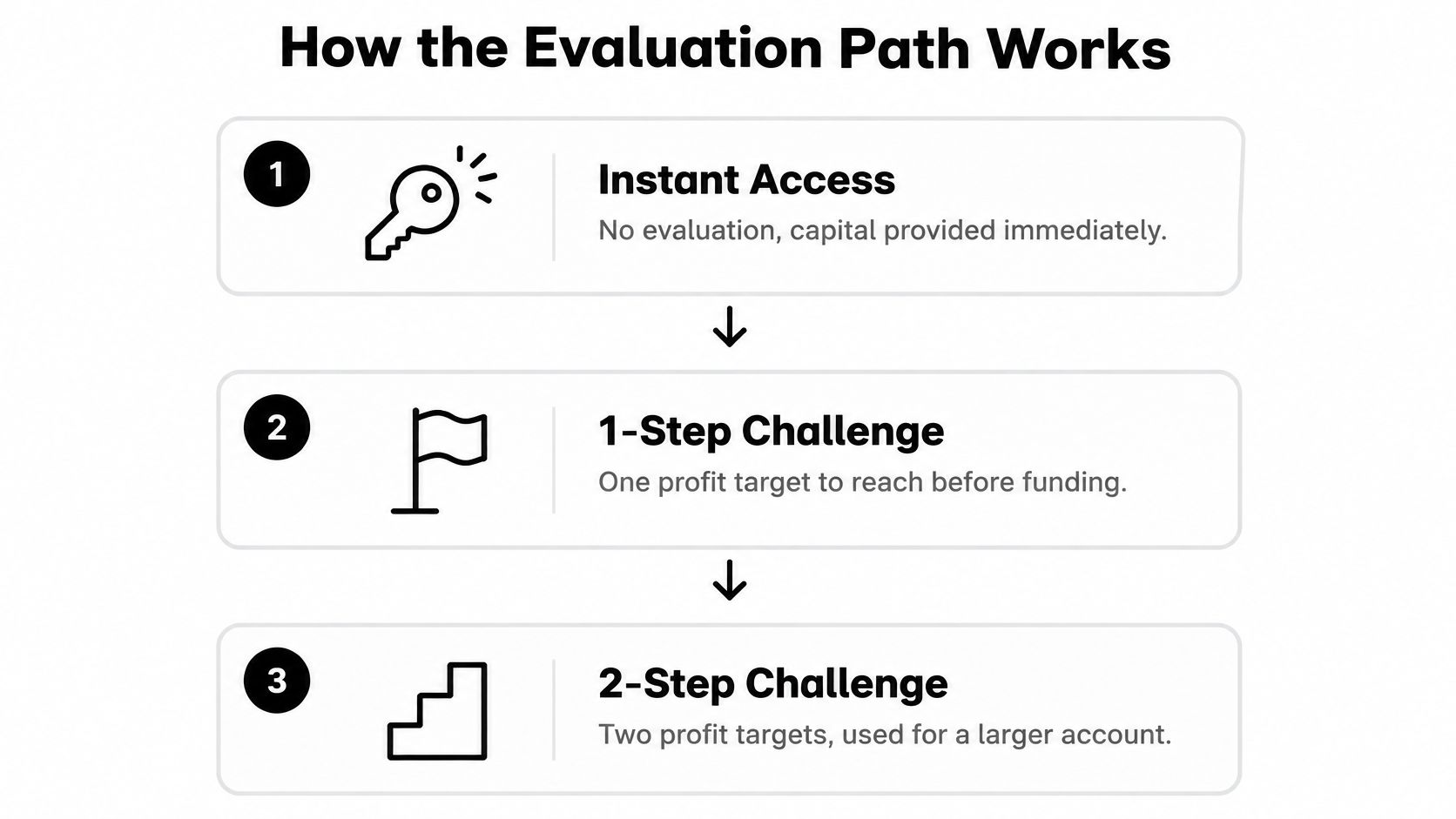
Choose the route that matches your experience. Instant Funding puts a funded account in front of you with no target to clear. A 1-Step Challenge asks for one profit target. A 2-Step Challenge asks for two, and typically opens access to larger account sizes. The common miss is picking the biggest headline balance, then forcing trades so you can sit through extra phases.
Read the trading rules before the first trade. Position limits, news handling, weekend holding and consistency requirements all live there. Any one of them can wipe an otherwise profitable run. Skipping that page is the most expensive shortcut in this business.
Trade toward the target without touching a limit. A breach can end an attempt when you are a fraction away from passing, because the limit is checked against the rule, not against your progress. Doubling size near the finish line is how traders hand the attempt back.
Clear the review. The firm compares your record with its rules, not just with your closing profit. Trade sizes, holding periods and behaviour around news releases all get read. A smooth equity curve does not hide a rule break.
Trade the funded account inside the same limits. The target disappears. The daily loss limit and the maximum drawdown usually do not. Traders who treat the funded stage as a reward for passing tend to hand the account back within a month.
Request the payout once conditions are met, using the method and frequency the terms allow.
MyFundedCapital runs three access routes, Instant Funding, the 1-Step Challenge and the 2-Step Challenge, with challenge and funded paths from $5,000 to $100,000 and scaling routes up to $500,000. All trading takes place in the MyFundedCapital Terminal, a web platform opened from the Dashboard after purchase.
| Route | How it works | Where to check |
|---|---|---|
| Instant Funding | Funded access from day one, no profit target to clear | Plans comparison page |
| 1-Step Challenge | One profit target before funded trading | Plans comparison page |
| 2-Step Challenge | Two profit targets before funded trading, for larger account sizes | Plans comparison page |
If the phrase itself is unfamiliar, this explainer on what a prop firm challenge is walks through the format from the inside. Current prices sit on the plans comparison page, and the exact limits are on the trading rules page.
A challenge works like a driving test with a speed limit that stays in force after you pass. Hitting the target only proves you can do it inside the lines. On the funded account those lines stay. Only the target comes off the sheet.
Risk Limits and Why Drawdown Is an Equity Problem
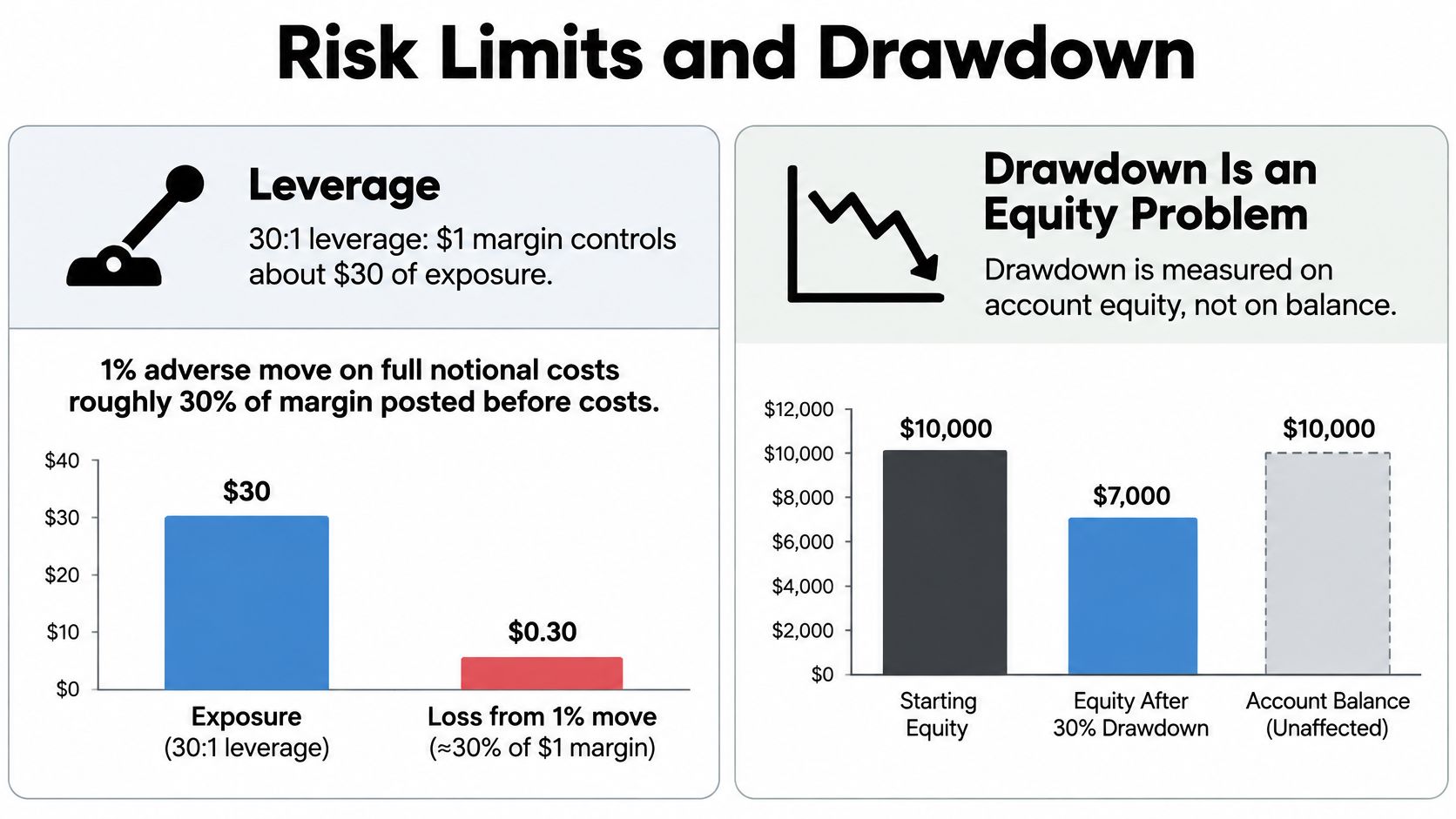
Borrowing magnifies both gains and losses, regardless of which way the price moves. ESMA's product intervention framework caps retail CFD exposure at 30:1 for major currency pairs and 2:1 for cryptocurrencies, and requires margin close-out and negative-balance protection for covered retail clients. At 30:1, $1 of margin controls about $30 of notional exposure, so a 1% adverse move on the full notional costs roughly 30% of the margin you posted, before financing and commission.
Leverage sets the speed, not the direction
That arithmetic explains why a funded account's drawdown is an equity problem rather than a margin problem. Your broker doesn't call you; the account equity just falls until a rule triggers. A trader risking 0.5% per trade absorbs about 20 consecutive full losses before a 10% drawdown is used up. Risking 1% buys only 10. Risking 2% buys 5.
| Risk per trade | Losses to reach 10% drawdown | Losses to reach 5% daily limit |
|---|---|---|
| 0.25% | 40 | 20 |
| 0.5% | 20 | 10 |
| 1% | 10 | 5 |
| 2% | 5 | 2 |
Read the right-hand column carefully. At 2% per trade, two losses in a single session reach your daily ceiling. That's not a losing streak, it's an ordinary Tuesday afternoon.
Where correlation and weekend gaps break the count
The count above assumes independent trades. Five long USD positions opened before one inflation release behave like a single oversized trade, so count them as one unit of risk, not five. Weekend gaps break the arithmetic differently: a crypto or index position held from Friday to Monday can reopen past your stop, which means a stop-based plan can lose more than the plan allowed for.
Setting your own ceiling below the firm's
The daily limit is a separate ceiling that resets inside the firm's trading day. Set a personal shutdown threshold below it, say half, so slippage and one emotional re-entry don't consume the whole allowance. Costs belong inside the calculation from the start: spread, commission and slippage are part of the loss, not an afterthought added later. The CFTC's warning on margin trading shows the same mechanic from the regulator's side, where a 2% margin requirement could control a $100,000 position with $2,000 and losses may exceed the initial margin deposited. The daily limit and the drawdown cap are the boundary that holds.
Stop trading before the rule stops you. A personal stop at half the published limit is what keeps a bad morning from becoming a closed account.
MyFundedCapital allows news trading and weekend holding as optional features, so news-spread filters and gap plans only matter if you switch them on; the conditions sit on the trading rules page. ESMA's negative-balance protection covers retail clients under that regime, so check whether your program's terms offer something similar.
Work backward when you size. Take the drawdown limit, divide it by the number of losing trades you could absorb, and keep each trade at or below that share. On a 10% cap and a tolerance of ten straight losses, your ceiling is 1%, and how equity differs from balance explains why that number moves against you while a position is open.
Payout Terms Covering Profit Split and Timing
Read the split in cash, not in percentages. If your terms pay 90% of profit, a $2,000 profit puts $1,800 in your pocket and $200 with the firm. At 75%, the same profit pays you $1,500. On the top end, up to 95% of $2,000 would be $1,900, which is why the exact figure attached to your plan matters more than the headline.
What up to 95% means in cash
A split stated as a ceiling can sit below that ceiling for your account, and it can change as an account scales. Confirm two things: the percentage that applies to the plan you bought, and whether a higher tier requires a larger balance, a longer record, or a paid upgrade. Then run one more check, whether profit is calculated on balance or on equity, since open positions pull equity away from balance and can change the number you're paid on.
Why payouts get delayed
Timing has two parts, frequency and processing. Frequency is how often you may request, whether weekly, every two weeks, or on demand. Processing is how long the money takes to arrive. An average of around 24 hours is an average, not a same-day guarantee, and bank and crypto routes differ in both fees and speed, so compare them before your first request rather than after.
At MyFundedCapital, payouts run every 7 to 14 days or on demand, by bank transfer or crypto, with average processing around 24 hours, and faster payouts are an optional feature. Three things commonly hold a request up:
- An open trade at the moment of the request.
- A rule under review, for example a news trade taken outside the permitted window.
- Incomplete verification, which is slow to fix once a payout date has passed.
Ask whether a drawdown breach removes eligibility for profit you already earned. Some terms say yes. Read those worked profit-sharing examples to see how the cash splits across different account sizes.
Four questions before you request a first payout: which percentage applies to me, is profit measured on balance or equity, what is the minimum and the method, and does a breach cancel profit already banked?
Strategy Fit for Manual, Algorithmic and Copy Trading
Three styles of trading sit inside these rules. Manual discretionary trading relies on your read of the chart. Algorithmic trading runs a system inside the MyFundedCapital Terminal. Copy trading lets you follow another trader or a signal service. All three are permitted, and copying other traders is allowed too, as long as every copied trade follows the trading rules, and the account holder stays responsible for the outcome.
Automation isn't automatically robust
The assumption worth testing is that a system removes emotion and therefore removes risk. A 2025 systematic review of algorithmic trading research, published in Acta Informatica Pragensia, found forex accounted for 30% of the studies it examined and flagged latency, scalability and regulatory issues as recurring challenges, noting that transaction costs and latency can disadvantage retail traders even when a strategy looks profitable in backtests. A robot that ignores a news spread will happily buy the worst price of the week.
A four-stage validation sequence
- Backtest the method on enough data to include quiet and violent conditions.
- Forward test it on the evaluation account, where the rules apply.
- Compare results after spread and slippage, not before.
- Test news and rollover periods separately, because those windows behave nothing like the rest of the session.
Telling strategy failure from execution failure
Log every fill against the price that was quoted when the order left your hand. If the fill matches the quote, the strategy lost. If the fill is consistently worse, the execution did, and no amount of parameter tweaking fixes a plumbing problem. That single record separates a method that needs work from a platform, timing or order-type decision that needs changing.
Fit test: if your method needs a long run of losses before it turns, or depends on a single weekend gap to make its year, run it against the daily loss limit before you buy anything.
Confirm Your Fit Before You Choose a Program
A funded account is a better fit when you already have a documented, tested edge and can keep each trade within the program's loss limits. It will not create a strategy for you. Capital amplifies the results of your method, including its losing streaks, so check the arithmetic before choosing a program.
Use this checklist before you pay:
- A tested strategy with recorded results, including losing runs, so you know how it behaves when conditions turn against you.
- Position sizing that survives the arithmetic in the table above, even during your worst realistic losing streak.
- A clear grip on the 5% daily loss limit and maximum drawdown of up to 10%, including when the daily limit resets.
- A written plan for weekends and news events, and a deliberate decision about any optional features that affect how you trade.
- Clarity on payout conditions and your profit split, which starts at 80/20 and can be upgraded to 90/10 or 100%.
Choose the route that matches your current habits. Instant Funded may suit a confident trader with a tested approach who wants to skip a multi-stage evaluation. A 1-Step Challenge provides a defined target before funded trading begins. Neither route makes a larger advertised account size a substitute for sound risk management.
Before comparing plans, read the trading rules and review your recent trades. Check how your worst losing stretch would have affected the daily limit and overall drawdown. If the numbers do not fit, adjust your risk or keep practicing before paying for an account.
MyFundedCapital offers Instant Funded from $95, with no evaluation, and the 1-Step Challenge from $189. Both provide simulated funded accounts using real market quotes, not live trading accounts. Trading takes place inside the MyFundedCapital Terminal, a web platform opened from the Dashboard after purchase. Visit MyFundedCapital to compare the routes, check current prices, and read the trading rules before committing.
