You've probably seen the pitch: pay a challenge fee, trade a larger account, and keep a share of the profits. The part most traders skip is the conversion math. This guide explains what forex trader funding really costs, how to choose between Instant Funding and evaluation paths, and how to protect an account long enough to reach a payout.
What Forex Trader Funding Actually Costs You
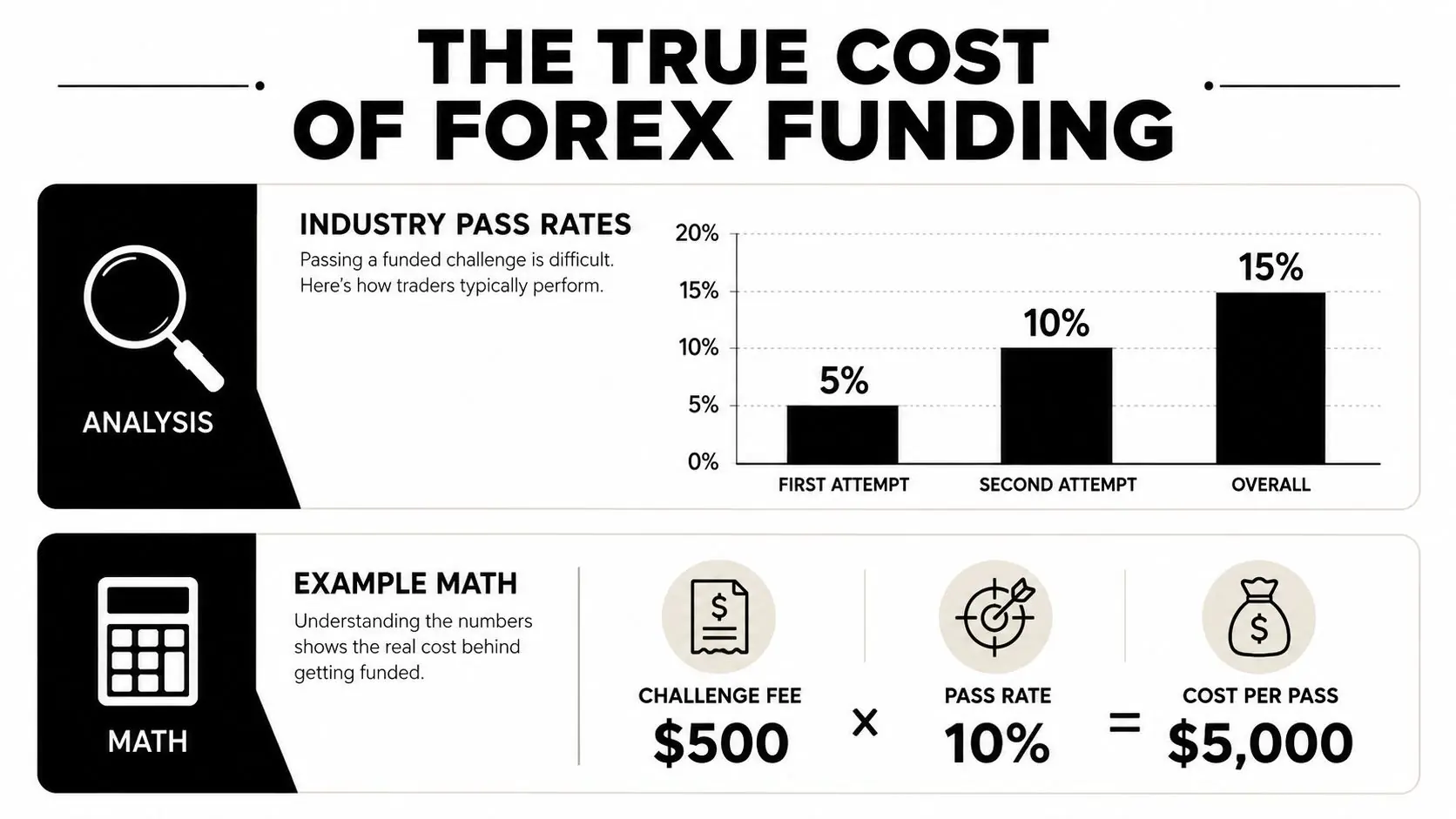
Start with the uncomfortable numbers. Industry summaries put first-attempt prop challenge pass rates at roughly 5% to 15%, while only about 7% of traders who pass ever reach a first payout, according to independent prop-firm evaluation data. That doesn't mean funding programs are automatically bad. It means the fee is only one part of your real cost.
Suppose a challenge costs $300 to $500 and you need five attempts. Your direct challenge spend becomes $1,500 to $2,500, before platform fees, data, resets, or time spent rebuilding after a breach. The same source describes the industry's low conversion from paid evaluation to payout, so treat those fees as a probability-adjusted acquisition cost, not as a single ticket to funded capital.
Where the money leaks
The biggest leak isn't usually the entry fee. It's the behavior that follows a near-pass.
- Over-sizing late Traders increase position size during the final stretch because they want to finish quickly.
- Reset cycles A daily-loss breach can erase the account immediately, forcing another fee and another emotional restart.
- Recurring tools Platform access, data, and related trading infrastructure can add monthly expenses. A plan that includes $80 to $120 in monthly platform fees must be evaluated against the rules and payout terms, not just the advertised account size.
- Payment friction If you regularly move money across borders, review practical resources such as zero cost money transfers NomadCards before payment costs add to your trading budget.
Practical rule: The fee isn't the cost. The cost is the fee, the failed resets, the time lost, and the strategy that was never sized to survive the account rules.
Before paying, compare the complete fee structure, including resets and platform charges, using this comparison of cheap prop firms. Then ask whether your trading plan can operate under the firm's daily-loss and total-drawdown limits. If it can't, buying another challenge won't repair the strategy.
Prerequisites Before You Pay for a Challenge
A challenge should test a working process, not serve as your practice account. Run this self-audit before entering payment details.
Skill comes first
You need a verified trading history from demo or live execution. A practical minimum is three to six months, with a journal that shows entries, exits, mistakes, spreads, and rule violations. Your edge should target at least a 1.5 reward-to-risk ratio, and your written plan should define the session, currency pairs, setup conditions, entry trigger, stop placement, and exit logic.
If your plan says “trade good momentum,” it isn't finished. Define what momentum means on your chart and what invalidates the trade.
Capital and tools
Use a working laptop and a stable internet connection. If you run an Expert Advisor, test the VPS before the evaluation, not after a connection problem disrupts an open position. MT5 and TradingView can support backtesting and chart review, but neither platform can rescue vague rules.
Set aside only disposable money. A budget of $300 to $500 for two or three attempts is acceptable only if losing it won't affect rent, debt payments, or essential expenses. Trading involves risk of loss, and a challenge fee should never be treated as emergency capital.
Platform fluency
Lot size, margin, swap, and spread calculations need to be automatic. You should know how a stop-loss distance changes position size and how a widening spread affects execution before you place the order.
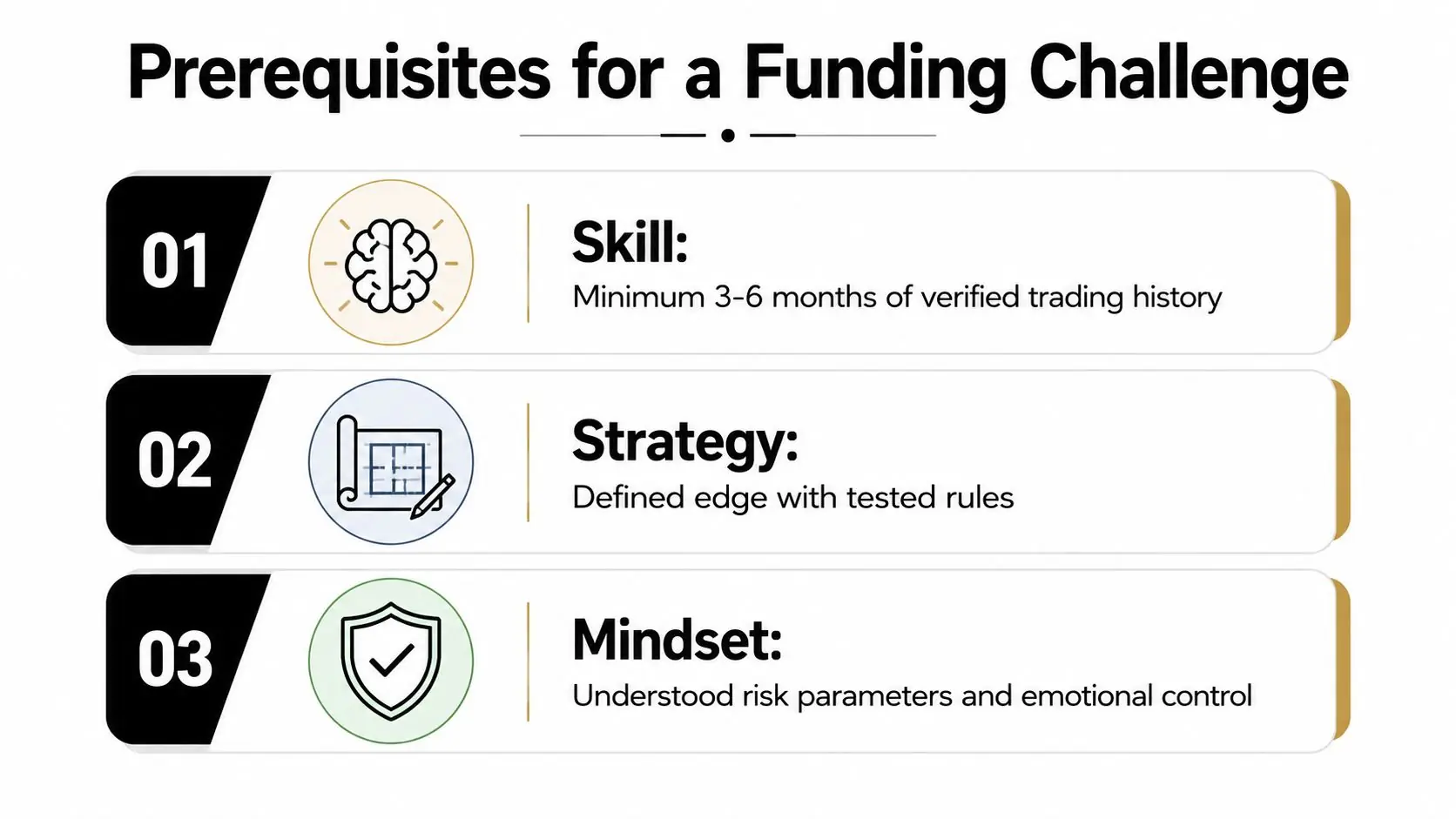
If one of these three areas is missing, paying for a challenge is a donation to the prop firm, not a step toward funded capital. Spend the money on data, journaling, or more testing instead.
Choosing Between Instant Funding and Challenge Paths
The choice between Instant Funding, a 1-Step evaluation, and a 2-Step evaluation comes down to what you're optimizing. Instant Funding removes the evaluation stage, but you pay for immediate access and accept the account's risk envelope from the first trade. A 1-Step path reduces the number of phases, while a 2-Step path gives you more room to demonstrate consistency across separate targets.
| Path | Entry Fee | Profit Target | Drawdown | Speed to Payout | Best For |
|---|---|---|---|---|---|
| Instant Funding | Higher than evaluation paths | No evaluation target | Strict static or account-specific limit | Fastest route, subject to payout rules | Experienced traders with verified execution |
| 1-Step | Lower than Instant Funding | Single target | Often tighter trailing logic | Faster than 2-Step after passing | Confident traders who value speed |
| 2-Step | Typically lower upfront pressure | Two phases | Generally friendlier tracking | Slower qualification, clearer progression | Traders building a funded track record |
The decision matrix
Upfront cost: Instant models can charge $500 to $2,000 for a $10,000 to $25,000 account, while 1-Step challenges commonly fall around $150 to $400, according to the supplied program comparison. Those figures aren't enough to decide. A cheaper fee becomes expensive if the trailing drawdown doesn't match your strategy.
Risk rules: Instant Funding usually starts with strict drawdown control and no profit target. A 1-Step challenge may use a single 8% to 10% target with tighter trailing rules. A 2-Step structure commonly uses an initial 8% target followed by 5%, with more forgiving tracking. These terms vary by provider, so read the official rule page before paying.
Payout speed: Instant Funding can provide the quickest route to a withdrawal because there's no evaluation phase. A 1-Step path can be quicker than 2-Step, but speed creates pressure. If you trade faster only because the calendar is pushing you, the route is wrong for you.
Breakeven math: Compare the fee with the amount of profit you must generate after the split, payout conditions, and any reset costs. A headline split doesn't compensate for a rule set that repeatedly stops your strategy.
Review MyFundedCapital's Instant Funding option alongside its 1-Step and 2-Step routes. Instant suits an experienced operator, 2-Step suits a trader who needs a structured proving ground, and 1-Step fits someone with a tested process who can handle a faster qualification cycle.
Passing the Evaluation Without Blowing the Account
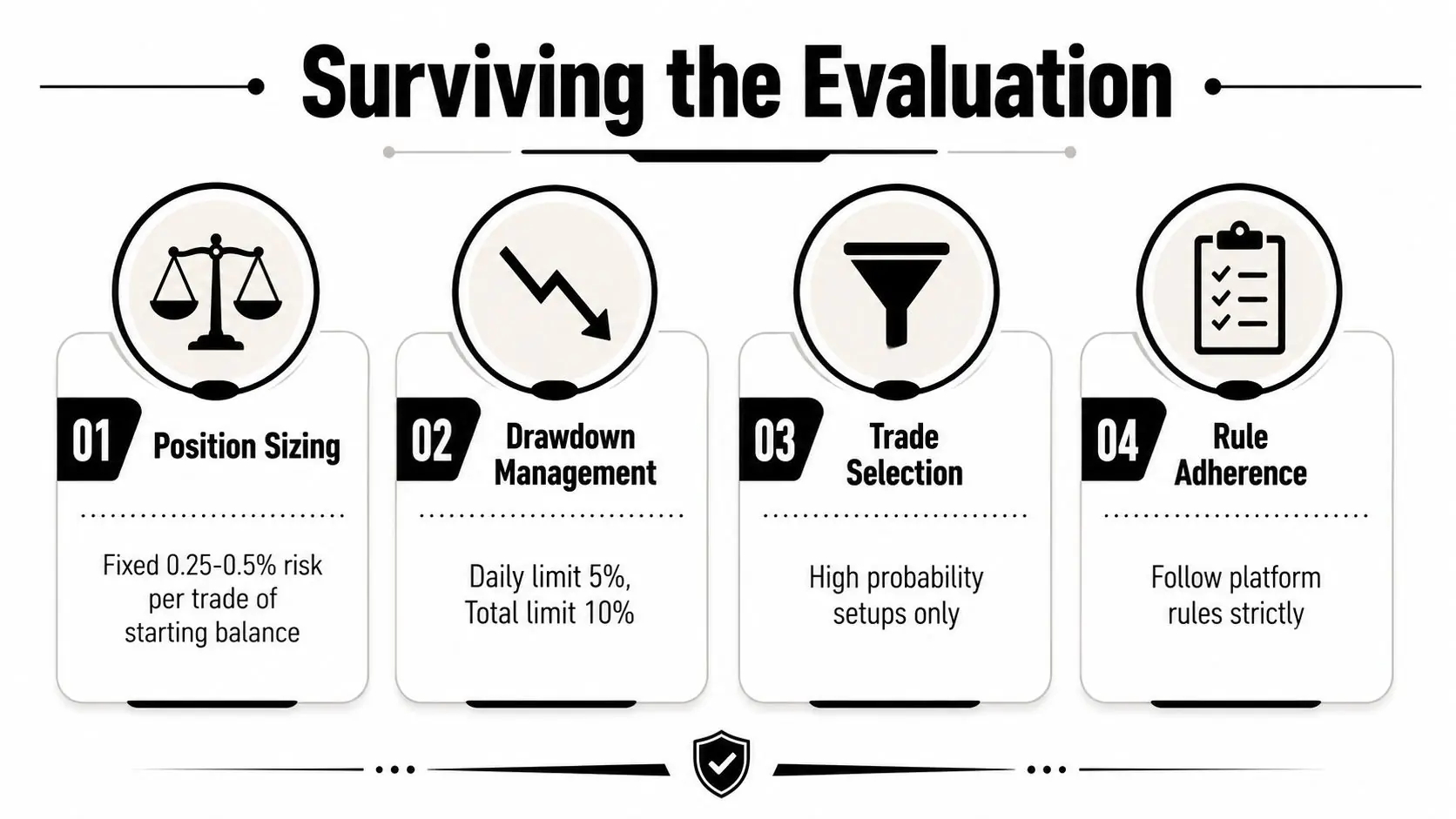
A firm with a 5% daily loss limit and 10% maximum drawdown gives you a defined operating box. Those are the MFC-style limits described in the supplied product information, and they should shape every position before you think about profit targets.
Risk 0.25% to 0.5% of starting balance per trade, calculate size from the stop distance, and cap yourself at one or two trades per session. At 0.5% risk, five full losses equal 2.5%, leaving room inside a 5% daily cap. That buffer disappears quickly if you add correlated positions, widen stops, or keep trading after the daily plan is clearly failing.
Use a fixed risk model
Target at least 2:1 reward to risk only when the setup supports it. Don't force a distant target just to improve the ratio on paper. A clean 2:1 trade with a defined invalidation point is useful. A 2:1 target placed beyond realistic market structure is not.
Trailing drawdown deserves special attention. A temporary intraday equity spike can raise the effective floor on some account types, while a later pullback can breach that floor even if the trade eventually would have recovered. Track both balance and equity, and check whether the firm calculates loss from starting balance, end-of-day balance, or a trailing high-water mark.
Risk rule: Reduce size after a losing session. Never increase it to recover the loss before the day ends.
Remove avoidable disqualifiers
Before starting, write the firm's rules beside your platform:
- News trading Confirm whether high-impact releases are allowed and whether positions must be closed before restricted events.
- Weekend holds Check whether positions can remain open through the market close.
- Overnight exposure Verify the permitted holding window and swap treatment.
- Symbols Confirm that your preferred forex pairs, indices, crypto, and commodities are supported.
- Automation Read the rules for EAs, copy trading, and trade management tools.
Common account killers include revenge trading, scaling into losers, moving stops farther away, and trading after reaching a daily stop. The forex risk-management guide can help you turn these points into a written operating procedure.
One support guide illustrates how strict these rules can be. It states that an equity drop of more than 4% during the trading day triggers an immediate hard breach and permanent account loss under that program's rules, as shown in the funded-account challenge guide. Never assume an end-of-day review protects you from an intraday breach.
Setting Up Your Funded Account and First Payout
Passing the evaluation is not the finish line. It changes the job from proving that you can make money to proving that you can preserve access to the account.
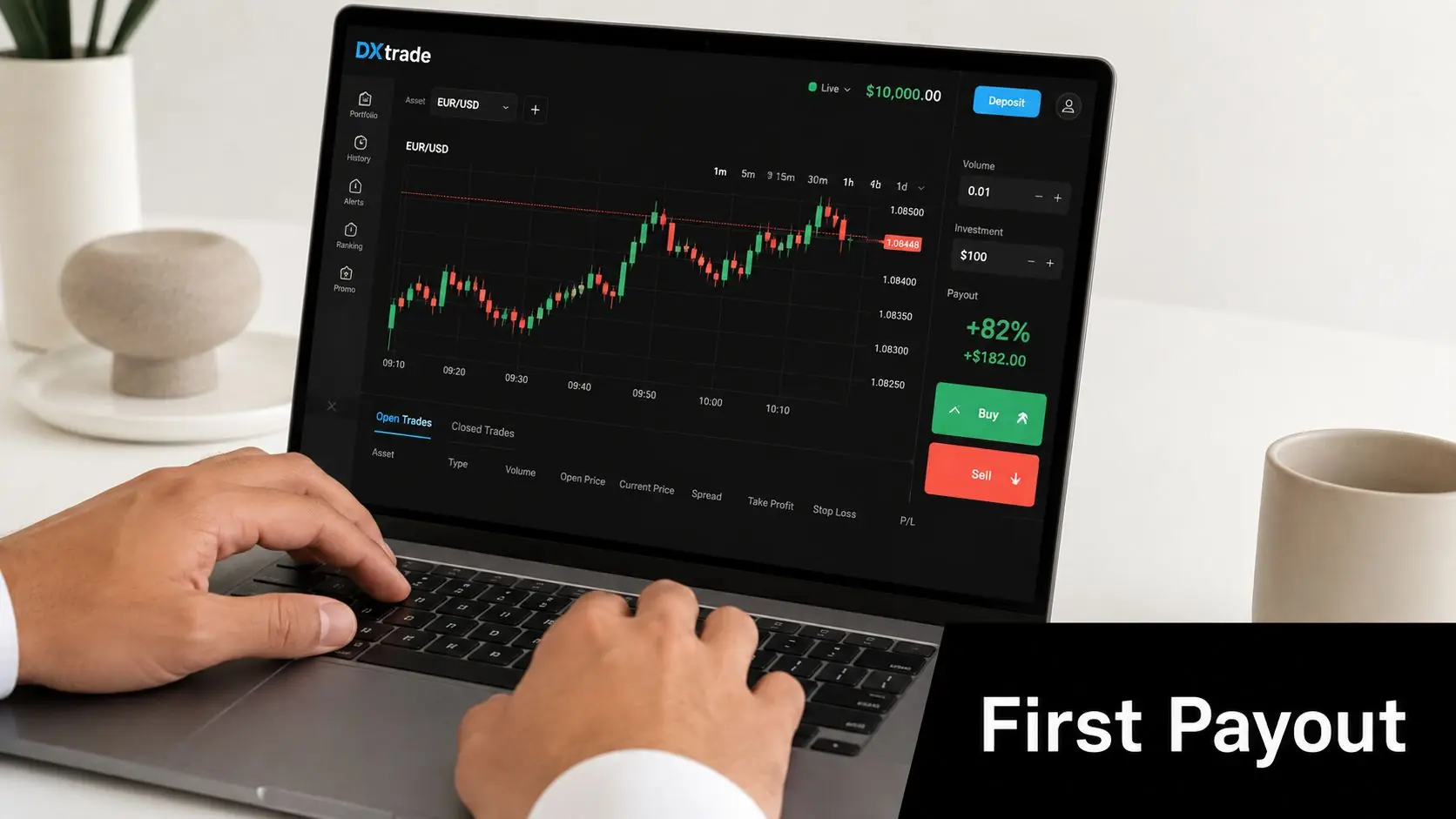
Start with verification. Complete identity checks and provide proof of address before placing funded trades. Then wait for the firm's account credentials and confirm whether you'll trade through DXtrade or cTrader. Do not begin by copying your most aggressive challenge settings. Use the funded account to confirm that the platform, spreads, order execution, and stop behavior match what you tested.
Configure the account before trading
Set templates for your normal lot sizes and define alerts below the hard limits. A sensible internal warning level is 4% daily loss against a 5% firm limit, and 9% maximum loss against a 10% firm limit. These are your personal circuit breakers, not permission to trade up to the breach line.
Check the dashboard for the drawdown floor. If the account uses trailing equity, identify exactly how the floor moves and what happens after a withdrawal. Record the server reset time for daily loss calculations, since a reset based on the firm's server clock may not match your local midnight.
Make the first payout boring
Connect the supported payout method, such as bank transfer, Wise, Rise, or crypto, and make sure the account holder name matches your verification documents. Before requesting money, read the minimum balance, trading-day, split, and withdrawal conditions in the current terms. The supplied onboarding plan references minimum balances commonly around $250 to $500, a requirement of 5 to 10 trading days, and a processing window of 7 to 14 days, but your provider's rules control.
Submit the request through the official dashboard, save the confirmation, and record the request date. Delays often come from incomplete KYC, mismatched payment details, an unmet minimum, an open trade, or a rule review. Contact support with the account number and timestamp instead of opening multiple tickets that create confusion.
Profit Splits, Payouts, and Scaling Your Capital
The split is only meaningful after the account survives long enough to produce withdrawable profit. Common structures give the trader 70%, 80%, or 90%, and some models offer 100% of the first profit threshold before reverting to a lower split, according to this explanation of prop-firm payout rules.
Calculate net take-home before choosing add-ons. News access, weekend holding, and faster payouts may change the fee or the trader's share. A feature that helps your strategy can be rational. A feature purchased because it sounds premium is just another cost.
Compare the economics
| Path | Challenge Cost | Starting Split | Payout Cadence | Break-Even Trades |
|---|---|---|---|---|
| Instant Funding | Higher entry cost | Often lower until milestones | Fast or on-demand, subject to terms | Depends on fee and drawdown |
| 1-Step | Moderate evaluation fee | Usually defined after passing | Scheduled or provider-specific | Depends on target and fee |
| 2-Step | Lower initial barrier in some models | Usually defined after passing | Scheduled or provider-specific | Depends on two-stage qualification |
A claim that scaling will automatically turn a small allocation into a much larger one is marketing, not a plan. Scaling should follow documented consistency, controlled withdrawals, and enough remaining drawdown to absorb normal variance. Don't compound every payout into another fee if your process hasn't demonstrated stable execution.
Cash-flow test: Before paying, write down the fee, expected resets, split, payout delay, and minimum withdrawal. If you can't estimate the path to net positive cash flow, you aren't evaluating the offer. You're buying access to a story.
The required break-even calculation is simple in principle. If a challenge costs $89, the trader must generate roughly $890 in funded profits before seeing a net-positive return under a 10-times recovery assumption. The exact result depends on the split, withdrawals, and other costs, so use the firm's current terms rather than relying on the headline percentage.
Your 90-Day Funded Trader Action Plan
Use the next three months to validate behavior, not to chase a dramatic return.
Days 1 through 7
Journal 20 historical trades from one strategy. Define setups that can produce between 1.5R and 3R, then calculate a risk amount that stays below the daily limit after a five-loss streak. Mark every trade that would have violated your written rules.
Days 8 through 30
Choose an account size that matches your demonstrated skill, not your ambition. The available challenge range is $5,000 to $25,000 for this planning exercise. Track expectancy after commission and spread, and run the same setup on demo to check whether the equity curve remains within the firm's 10% trailing band.
Days 31 through 60
Select Instant Funding, 1-Step, or 2-Step based on your data. Keep position size fixed at 0.5% to 1% only if your tested plan and the provider's rules support it, and treat the first funded month as an extension of the evaluation. Do not celebrate a winning day by changing your risk.
Days 61 through 90
Request the first payout only after verifying the applicable window, split, and withdrawal conditions. Confirm whether your share is 80%, 90%, or 100% under the current terms, then choose between scaling the allocation and compounding into another account.
Industry summaries indicate that 85% to 95% of traders fail prop challenges, and only about 7% of those who pass reach a first payout, as documented in the earlier evaluation data. Your edge is discipline, not a signup bonus. Review the current MFC pathway, rules, and any active promotion directly before committing money, because terms can change.
MyFundedCapital offers Instant Funding alongside 1-Step and 2-Step challenge paths, with simulated trading environments, defined drawdown rules, profit-sharing options, and payout routes that fit different trading styles. Visit MyFundedCapital to compare the available account types, read the current rules, and choose a challenge only if your risk plan can survive it.