

A profit sharing contribution in prop trading is the share of a funded trader's net eligible profit that the firm pays out under the account's split, such as 80/20. If you're comparing account offers with a calculator open beside your trading journal, the important question isn't just which percentage is higher, but how each firm gets from closed trades to cash received.
What a Profit Sharing Contribution Means in Prop Trading
In prop trading, profit sharing contribution describes a trader's contractual share of eligible trading results. It isn't a standardized industry term, so don't assume every firm uses it to mean the same thing.
You'll also encounter profit split and profit share. Those labels are easier to recognize, but none tells you whether the firm calculates your payment before costs, after adjustments, or only after you satisfy additional payout conditions.

The same label can describe different payments
The word contribution is familiar from retirement plans, where employers deposit money into employee accounts. That's a different arrangement from paying a trader for approved performance.
The IRS's Publication 560 explains that a traditional profit-sharing plan has no legally required contribution amount. An employer can choose not to contribute, so the label doesn't mean guaranteed compensation or employee-funded savings.
Where the term appears and what decides the amount
| Context | What the contribution is | What decides the amount |
|---|---|---|
| Retirement plan profit sharing | Employer deposit into employee accounts | Company profit formula or discretion; can be zero |
| Discretionary bonus | Cash award from management | Management judgment; not formula-based |
| Adviser performance fee | Share of managed-account gains | Advisory fee rules and eligibility thresholds |
| Prop trading profit split | Trader's percentage of net eligible profit | Profit measure, split tier and payout rules |
Don't transfer retirement-plan assumptions to a funded trading agreement. The agreement must identify what the payment represents and which conditions govern it.
The slice matters, but so does the pie
Think of the split as your slice. The firm's profit definition determines the size of the pie. Two offers displaying identical percentages can produce different payments because they recognize different profits or apply different deductions.
Start with these components:
- Profit measure Which trading results qualify, and which costs or losses reduce them?
- Split tier Which trader percentage applies to your account now, rather than after a possible upgrade?
- Payout timing When does an eligible balance become available to request and receive?
A percentage alone answers none of those questions. It also doesn't establish whether payment is automatic, discretionary, or conditional on account review.
Offer test: Can you state, in one sentence, which profit number the advertised percentage applies to?
If you can't, you don't yet have enough information to compare the offer.
How to Calculate Your Profit Share Step by Step
The core formula is straightforward:
Trader share = net eligible profit × trader percentage
Most calculation errors happen before multiplication. Your job is to establish the correct base, then account for anything that changes the amount released.
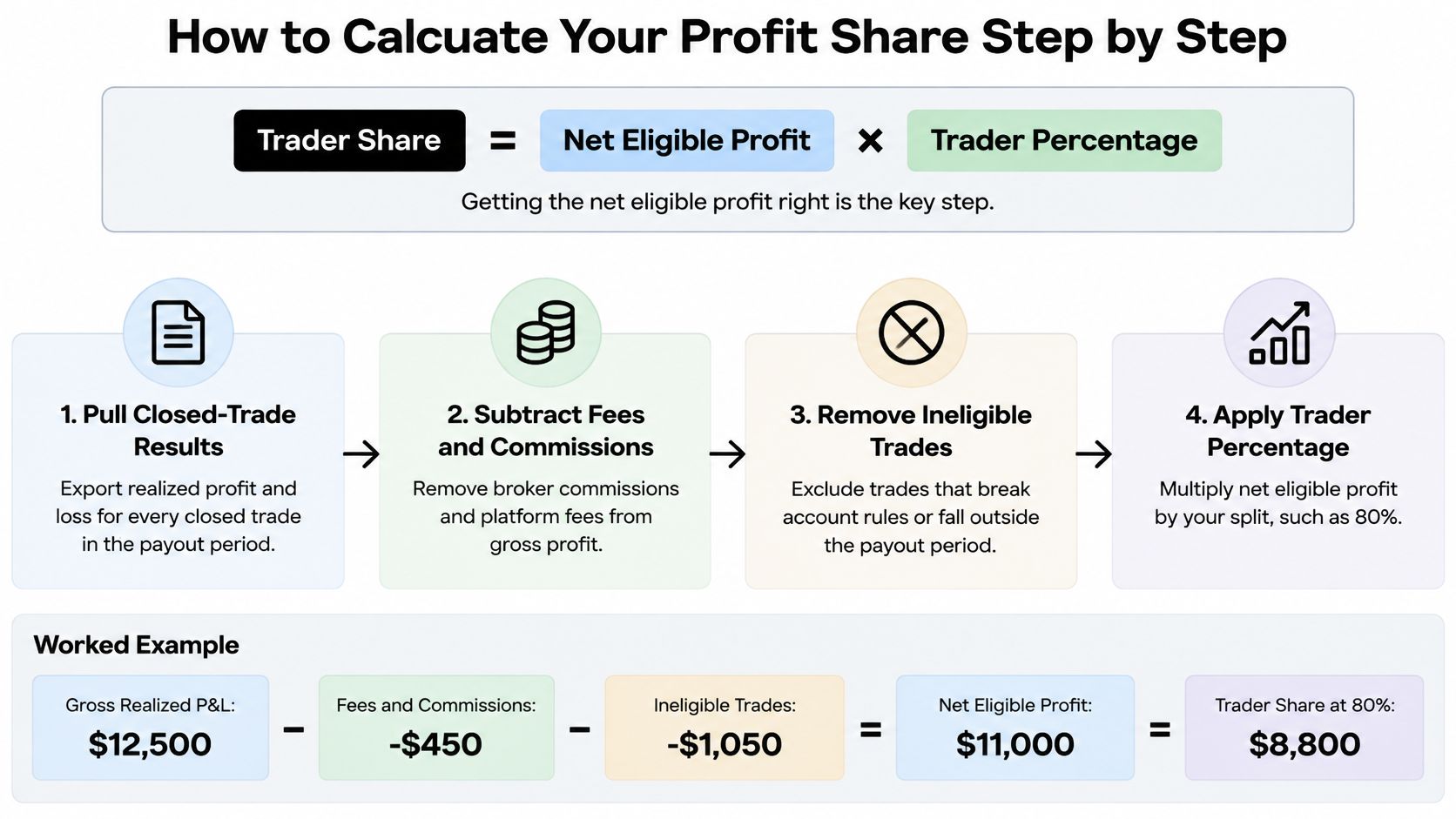
Build the calculation from your trade export
Pull closed-trade results for the payout period. Export realized profit and loss from DXtrade, cTrader, or your account dashboard, using the firm's cutoff time. Including floating gains from open positions is a common mistake.
Subtract the costs specified in your terms. Check commissions, swaps, and any add-on fees charged against profit. First confirm whether the platform's exported result already includes those charges, otherwise you could deduct them twice.
Check eligibility before calculating a payment. Confirm that the period has positive eligible profit and that you've met the account's rules. Don't assume a rule breach merely removes the offending trade, because some agreements disqualify the account or payout period.
Identify the active split tier. For a hypothetical account, the initial split might be 80/20, with 90/10 or 100% available after an approved upgrade. Use the tier already effective for that period, not the highest percentage advertised.
Multiply the eligible base by your percentage. Apply the trader percentage after the deductions that the agreement assigns to the profit base. Applying it to gross profit and subtracting all costs afterward can produce the wrong answer.
Apply release conditions. Check any reserve, minimum payout threshold, or cap written into the agreement. Distinguish money deferred until a later request from profit permanently excluded from eligibility.
Reconcile the payout statement. Match the approved amount, currency, conversion treatment, and rounding against your calculation. A platform balance and a bank receipt aren't necessarily expressed in the same currency or net of the same transfer charges.
Keep an audit trail
A spreadsheet works well: give each trade its own row, then separate realized results, included costs, eligibility adjustments, and payout deductions into columns. Keep the original export unchanged so you can trace every adjustment.
For broader accounting context, HireAccountants' guide to using P&L reports for smarter decisions helps explain why separating income and expenses matters. Your trading agreement, however, remains the authority for payout eligibility.
If the firm's statement differs from yours, reconcile the difference line by line against your closed-trade history before contacting support. Send the specific disputed entries, not just a screenshot of your balance.
Profit Measures That Change the Same Payout
Your bank's statement balance and available balance can differ. You can't decide what's spendable without knowing which balance applies, and a trading payout requires the same care.
A hypothetical 80/20 split can produce different cash amounts when firms apply it to different profit measures. The percentage hasn't changed, but the calculation base has.
Profit bases and their effect on the payout
| Profit basis | How it is measured | Effect on payout | Watch for |
|---|---|---|---|
| Closed-trade net profit | Closed trades after costs | Conservative; open gains excluded | Whether costs were already deducted |
| Gross closed-trade profit | Closed trades before costs | Larger base, larger calculated share before later deductions | Whether costs are deducted later |
| Equity-based gain | Balance change including open trades | Can count gains that later reverse | Whether open trades count on the payout date |
| Single-trade or daily cap | Maximum profit counted per trade or day | Large winners are trimmed | The cap, calculation order, and treatment of excess profit |
Read each basis as a different agreement
Closed-trade net profit gives you a realized starting point, but the word net still needs a definition. Ask which charges the platform includes and whether the firm makes additional adjustments.
Gross closed-trade profit can look more generous because expenses haven't yet been removed. Ask where those expenses appear later, particularly whether they reduce the profit pool or your individual payment.
Equity-based gain can include unrealized results at a particular moment. The risk is that an open position reverses after measurement, so ask whether the firm requires positions to close before approval.
Single-trade or daily caps can reduce the contribution of your strongest trading results. Ask whether excess profit is excluded permanently, deferred, or relevant to another account rule.
Check the measurement window too
The period boundary matters alongside the profit basis. Ask whether an earlier loss offsets the current period's gains, and whether requesting a payout changes the reference balance.
For an accounting comparison, Bookkeeping and Accounting of Florida Inc. explains how to calculate gross, operating, and net profit. Those business categories illustrate why profit needs a qualifier, but they don't replace a prop firm's contractual definition.
Use a trading profit-and-loss calculation guide to organize your figures, then match each input to the program's wording.
Before comparing percentages, write down the profit basis. If you can't find it in the written terms, mark it unknown, not favorable.
Worked Examples With Real Account Numbers
Start with Scenario B, a hypothetical funded account showing $3,000 in closed profit and $120 in deductible costs. These are illustrative account figures, not actual customer results or projections.
Subtracting the costs leaves $2,880 in net eligible profit. At an 80/20 split, the trader receives $2,304, and the firm receives $576.
Follow the money through the standard split
The arithmetic is:
- Eligible profit $3,000 − $120 = $2,880.
- Trader allocation $2,880 × 80% = $2,304.
- Firm allocation $2,880 × 20% = $576.
The allocations add back to the eligible base, which is a useful error check. If your allocations don't reconcile, inspect the percentage, deductions, and rounding before proceeding.
At 90/10, the same eligible result pays the trader $2,592, an increase of $288. That comparison isolates the split tier because the trading result and costs remain unchanged.
Worked payout examples across account sizes and splits
All rows below are hypothetical and assume eligibility, no reserve, and no additional payout deductions.
| Scenario | Account size | Split | Gross closed profit | Costs | Net eligible result | Trader payout |
|---|---|---|---|---|---|---|
| A: Small funded account | $10K | 80/20 | $800 | $25 | $775 | $620 |
| B: Standard split | $50K | 80/20 | $3,000 | $120 | $2,880 | $2,304 |
| C: Same result at a higher tier | $50K | 90/10 | $3,000 | $120 | $2,880 | $2,592 |
| D: Full split offer | $100K | 100% | $3,000 | $120 | $2,880 | $2,880 |
| E: Losing period | $50K | 80/20 | −$120 | $25 | −$145 | $0 |
What these examples don't establish
Scenario A demonstrates that you calculate the split on eligible results, not the account's headline size. A larger account label doesn't itself create a larger payout.
Scenario D assumes a program permits the full trader allocation. Even then, receiving the full eligible profit isn't the same as receiving gross profit without expenses.
Scenario E has no positive profit to share. Whether its loss reduces a later payout requires a separate check of the program's loss-carryforward rules.
Results vary, and trading involves risk of loss. A profitable period doesn't guarantee the next one, and none of these examples forecasts a return. Tax treatment also depends on the trader's country and circumstances, so the table doesn't represent after-tax income.
Rebuild each row with your own gross profit, costs, and split before judging an offer.
Costs, Timing and Policy Rules That Change Your Cash
Your calculated share may not equal the cash you receive immediately. Separate profit-base deductions, release conditions, and payment costs, because each affects a different part of the calculation.
Consider a hypothetical $40 monthly add-on deducted from $2,880 before an 80% trader split. The eligible base falls to $2,840, and the share falls from $2,304 to $2,272, a $32 difference.
If you pay that add-on separately, the displayed payout stays unchanged, but your personal net proceeds fall by the full fee. Record separately paid expenses in your trading budget rather than treating them as free because they're absent from the payout statement.
Price the permission you actually need
Optional news trading, weekend holding, and faster payouts solve different problems. A swing trader might need weekend permission, while a trader who closes positions before the weekend may have no use for it.
Don't buy an add-on solely because it raises a headline split. Check its price, duration, renewal terms, and whether it applies during evaluation, funded trading, or both.
Payment schedules require equally careful reading. In a hypothetical program offering a 7–14 day cycle or on-demand requests, eligibility to request payment isn't necessarily the same as approval or settlement.
For a hypothetical account with a 5% daily loss limit and 10% maximum drawdown, breaching a limit can end payout eligibility under the agreement. Confirm how the firm measures those limits, including open losses, reference balances, and reset times.
Use a written comparison checklist
- Profit measure: Establish whether the calculation uses closed trades only or equity including open positions.
- Cost treatment: Identify charges deducted before the split and expenses you pay separately.
- Split structure: Record whether the percentage is fixed or tiered, what triggers an upgrade, and when it becomes effective.
- Payout cadence: Check request windows, minimum amounts, processing time, reserves, and payment-method charges.
- Loss handling: Determine whether losses carry forward, reset, or change the amount available for withdrawal.
- Scaling: Confirm the conditions for larger accounts and whether the split or risk rules change.
- Change control: Check whether the firm can revise terms during a period and what notice or acceptance is required.
Save the version you accepted, including add-on selections and order confirmation. Wording such as may signals discretion, while will suggests a commitment, though surrounding exceptions still matter.
Transparency matters more than motivation slogans
A British Journal of Industrial Relations meta-regression covering 355 estimates from 56 studies found that workplace profit sharing was positively associated with productivity on average, with stronger effects alongside participation and other organizational features. That's workplace evidence, not proof that a trader will perform better after receiving a more generous split.
For traders, the practical question is whether you can understand and independently reproduce the payout calculation. Clear rules help you evaluate an arrangement without assuming that incentives eliminate trading risk.
Use the payout information page to identify the relevant request process, then verify the rules attached to your selected account.
Before paying: Ask support to identify the written clause governing any deduction or eligibility condition you can't reconcile.
Trading involves risk of loss, and a profitable period doesn't guarantee another.
Compare Two Profit Splits on Equal Terms
Take two hypothetical offers and apply the same $3,000 of closed profit. Offer X advertises 90/10 but deducts $600 in add-on fees from profit, producing ($3,000 − $600) × 90% = $2,160.
Offer Y advertises 80/20 with no deductions in this scenario, producing $3,000 × 80% = $2,400. The lower headline split pays $240 more.
Compare the complete arrangement
| Hypothetical offer | Closed profit | Deductions before split | Trader percentage | Calculated payout |
|---|---|---|---|---|
| X | $3,000 | $600 | 90% | $2,160 |
| Y | $3,000 | None | 80% | $2,400 |
This doesn't mean a lower split is automatically better. It means you should compare offers using identical trading results and include the costs required to obtain each advertised percentage.
Apply the checklist to both agreements. Establish the profit measure and cost treatment first, then examine the active tier, upgrade path, payment access, and loss rules.
Don't assign value to permissions you won't use. Conversely, an inexpensive account isn't suitable if its trading restrictions conflict with your strategy.
Use a funded program as a reference point
MyFundedCapital is one option offering simulated funded trading accounts with contractual profit-sharing arrangements. Treat its profit-split and add-on information as terms to verify for your chosen program, including:
- Split options A starting 80% split and upgrades to 90% or 95% with the split add-on.
- Payment access 7–14 day schedules or on-demand requests, with stated average processing of 1:46h, rather than a guaranteed arrival time.
- Risk parameters A flat 5% daily loss limit and up to 10% maximum drawdown, with the calculation method checked in the account rules.
- Trading permissions Optional news trading, weekend holding, and faster-payout add-ons.
- Platform fit the MyFundedCapital Terminal across 750+ markets (plus 1,500+ US stocks in the Stocks program), with availability confirmed for the selected account.
Evaluations and funded accounts operate in demo environments with real market quotes. Don't interpret the account's displayed capital as money deposited into your personal brokerage account.
Recalculate the offer with its written terms in front of you. Trading involves risk of loss, and a favorable payout formula doesn't establish that your strategy will remain profitable or compliant.
Profit Sharing Contribution Questions and Next Steps
What does a profit sharing contribution mean for a prop trader?
It means the trader's share of net eligible profit under the account agreement, such as a hypothetical 80/20 split. The term has no single industry-standard definition, so identify the calculation base rather than relying on the label.
Is a higher split always better?
No. In a separate hypothetical $3,000 example, deducting 15% before a 90/10 split leaves a trader payment of $2,295, below the $2,400 from 80/20 without deductions. Compare net proceeds, not percentages in isolation.
Can a losing period still pay?
There's no positive profit to share from a losing period, so that period's profit-share payout is zero. A previously approved balance is a separate issue, and the agreement determines whether current losses affect it or future eligibility.
Before choosing an account, confirm that you can reproduce its calculation and explain its withdrawal conditions. This content is educational only and not financial advice.
Compare the Challenge and Instant Funding account types at MyFundedCapital, which offers simulated funded trading programs with profit-sharing arrangements. Read the written split, payout cadence, add-on costs, and drawdown limits, then start a challenge or choose Instant Funding only when your own recalculation matches the offer. Trading involves risk of loss.
