

 AR
AR
 NL
NL
 FR
FR
 DE
DE
 ES
ES
 IT
IT
 PL
PL
 SV
SV
 PT
PT

You've hit a profitable month, opened the payout page, and discovered that the headline account size doesn't tell you what you'll receive. The profit split method determines how much of your approved profit reaches you, how quickly your earnings can scale, and what rules you may accept in exchange. This guide breaks down prop firm payout mechanics, common split structures, realistic math, and a practical way to compare offers without relying on promotional percentages.
Why the Split Matters More Than the Headline Account Size
Two traders can trade identical $100,000 evaluation accounts, reach the same target, and produce the same monthly profit. Yet one may receive $7,200, while the other receives $9,000, because their agreements use different profit splits.
That difference changes the economics of the account. The displayed balance is a risk framework and operating limit, not money you can withdraw. Your relevant figure is the approved net profit multiplied by your trader share, after the firm applies its payout rules.
| Trader | Account Size | Profit Generated | Split | Trader Take-Home | Firm Take |
|---|---|---|---|---|---|
| Trader A | $100,000 | $9,000 | 80/20 | $7,200 | $1,800 |
| Trader B | $100,000 | $9,000 | 90/10 | $8,100 | $900 |
The example above shows why you shouldn't compare account sizes in isolation. A smaller account with a more favorable split can produce more take-home income than a larger account with a weaker arrangement, provided your strategy generates comparable approved profits and remains within the same risk limits.
This article focuses on four practical questions:
- How payouts work: What the firm pays, what “net profit” means, and when eligibility begins.
- How structures differ: Fixed tiers, upgrades, performance conditions, scaling plans, and hybrids.
- What the math looks like: The same gross result compared across split levels.
- How to choose: Matching the structure to your trading frequency, average winner, and tolerance for waiting.
Practical rule: Compare the complete payout policy, not just the largest percentage printed on the sales page.
Treat the split as a structural decision. It can be locked, improved through milestones, or purchased as an add-on. That makes it something you should evaluate line by line before starting a challenge.
What a Prop Firm Profit Split Actually Is
In a prop trading context, a profit split is the agreed percentage of approved trading profit that goes to the funded trader and the firm. A simple analogy is a partnership: one side supplies the capital framework, technology, and risk controls, while the other supplies the trading decisions and execution. The parties divide the resulting profit according to the account agreement.
The payment direction is important. On a funded account, the firm pays the trader, not the other way around. You trade under the firm's rules, request a payout when eligible, and receive the trader's share after the firm reviews the result.
The calculation normally starts with net profit, not every favorable price movement shown in the platform. Net profit can account for trading costs such as commissions and other charges, along with deductions required by the firm's rules. Read the definitions carefully, because “profit” may be calculated differently across providers.
The split applies to profit only. It doesn't mean you own or withdraw part of the displayed account balance. If a platform shows a funded balance, that figure remains part of the firm's risk and account framework. Your payout is based on the eligible profit created under the applicable terms.
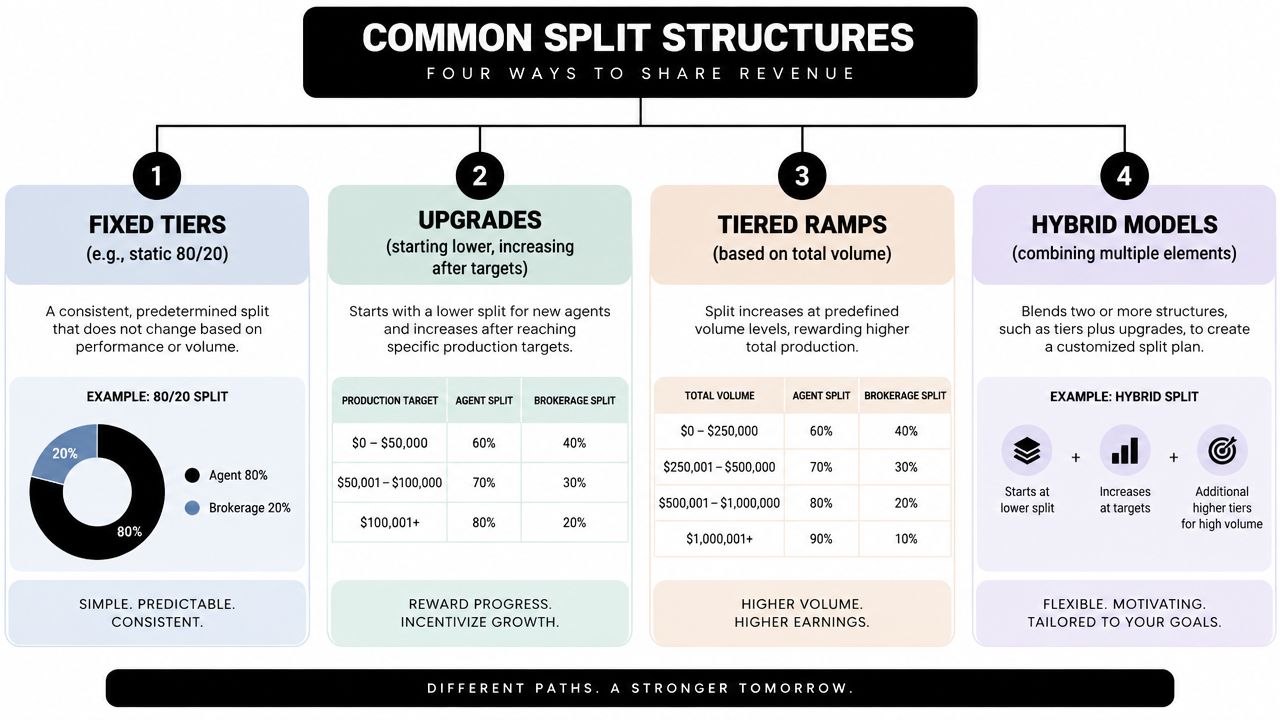
The four structures you'll encounter
Most arrangements fall into one or more of these categories:
- Fixed tiers: A stated ratio remains unchanged while the account operates under that plan.
- Upgrades: Your share improves after a milestone, such as a payout, target, or qualifying performance period.
- Tiered ramps: The percentage changes as your account or accumulated results move through defined levels.
- Hybrid models: The firm combines a base split with paid upgrades, scaling conditions, or performance requirements.
A common prop firm example is 80/20, where the trader keeps 80% and the firm keeps 20%, as described in this overview of prop firm payouts. Industry coverage also describes structures that can move from 80% to 90% or even 100% through upgrades, scaling, or payout milestones, although the conditions differ by provider, as explained in this guide to prop firm payout structures.
If you also work on trader visibility and content distribution, clipping strategies from FindClout can help you think about how educational trading content is repurposed and surfaced. That's separate from payout math, but it's useful when you're building a public trading profile.
How Prop Firms Structure Their Splits
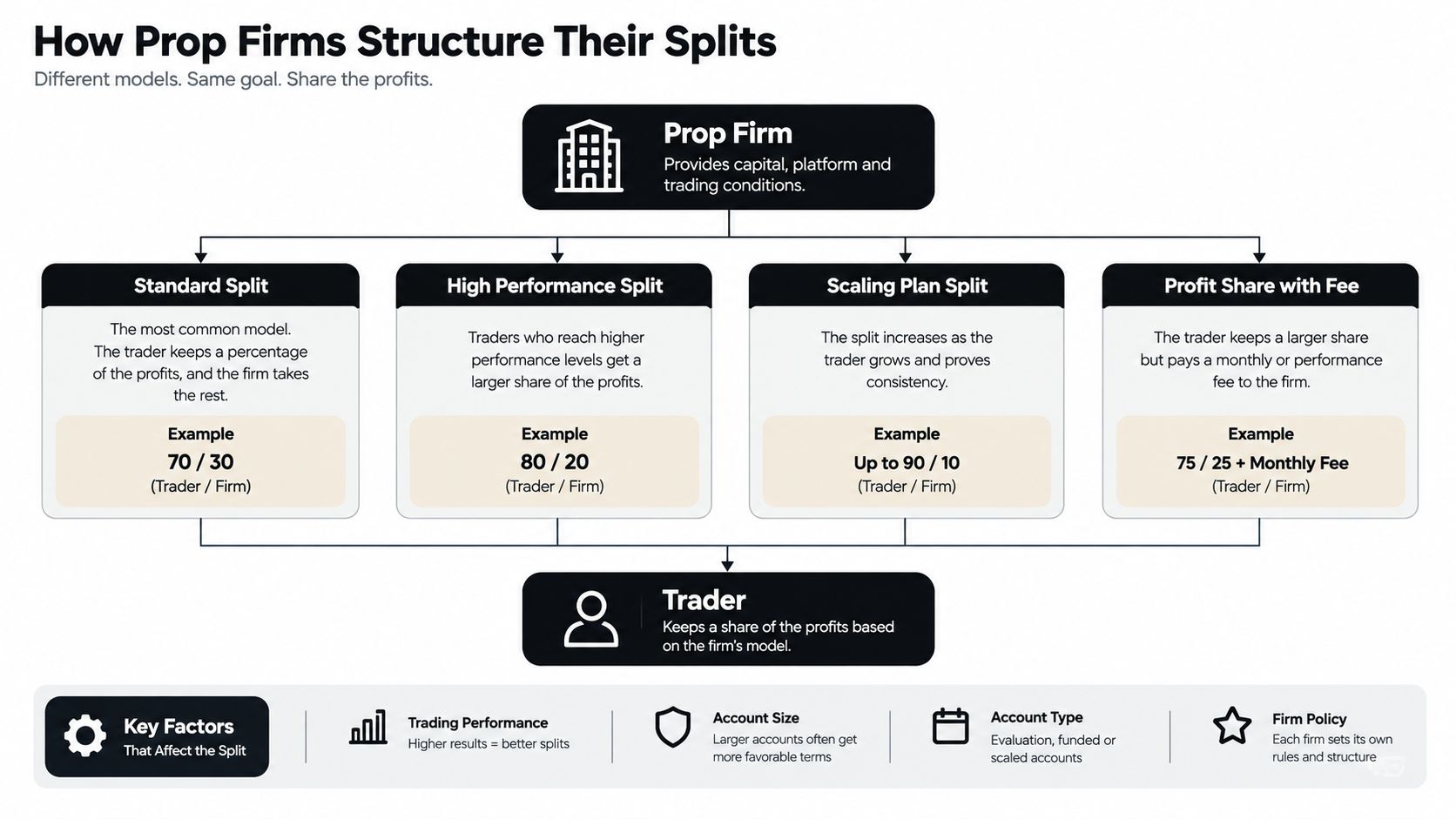
A fixed split is the easiest model to understand. Suppose an agreement states 80/20. If your eligible profit is $5,000, the contract applies the same ratio unless another rule changes the calculation. The advantage is predictability. You can forecast payouts without waiting for a milestone, but your earning share may remain capped even as your record improves.
An upgrade structure starts with one ratio and gives you a path toward a better one. The trigger may be a completed payout cycle, a profit threshold, or a consistency requirement. The key question isn't merely “Can the split increase?” It's “What exact evidence must I provide, and does the improvement apply to future profit only or to the current payout as well?”
Four ways the percentage can change
- Fixed tiers: The split stays constant. Firms use this model because it's simple to explain and administer.
- Upgrades: The trader earns a better share after defined milestones. This can align retention with continued performance.
- Performance-based terms: The firm links a higher share to factors such as consistency, profit quality, or controlled drawdown. These conditions may suit disciplined traders but can make payout planning less certain.
- Scaling plans: The account grows through accumulated performance, and the split may improve alongside that progression. Scaling can reward traders who protect capital instead of chasing a single result.
Some providers blend these features. A plan might begin with a base percentage, offer an optional upgrade, and then apply a scaling schedule. That creates more earning potential, but it also creates more terms to verify.
A higher split isn't automatically better if the route to eligibility forces you to trade outside your normal process.
The broader profit split method has a different meaning in international tax. The OECD includes it among its transactional profit methods, especially where independent comparables are difficult to find and operations are highly integrated with unique contributions. HMRC describes it as a “two-sided” method, allocating profit by reference to what independent enterprises might have expected, while U.S. transfer-pricing rules focus on relative contributions, functions, risks, and resources. This context reinforces a useful principle for prop traders: a split is a division of economic results, not a magic fixed percentage detached from the underlying arrangement. HMRC's transfer-pricing guidance explains that contribution-based allocation.
The structure also affects the firm. A lower starting share can help a provider manage onboarding and payout risk, while a higher share can reward traders who meet stricter conditions. Neither side should judge the ratio without reading the drawdown, payout, and upgrade clauses beside it.
Payout Math Across Common Split Tiers
The cleanest way to compare splits is to hold the trading result constant. The examples below use a 6% monthly return, as required for the comparison, and apply it to funded account sizes of $25,000, $50,000, and $100,000. This is an illustration, not a forecast. Trading results vary, and a loss can reduce or eliminate an otherwise expected payout.
| Account Size | Gross Profit at 6% | 80/20 Trader | 90/10 Trader | 100/0 Trader |
|---|---|---|---|---|
| $25,000 | $1,500 | $1,200 | $1,350 | $1,500 |
| $50,000 | $3,000 | $2,400 | $2,700 | $3,000 |
| $100,000 | $6,000 | $4,800 | $5,400 | $6,000 |
The calculation is straightforward. On a $50,000 account, a 6% result creates $3,000 gross profit. Under an 80/20 split, the trader receives $2,400 and the firm retains $600. Under 90/10, the trader receives $2,700 and the firm retains $300. Under 100/0, the trader receives the full $3,000, subject to the plan's eligibility and other conditions.
The difference between 80/20 and 90/10 is $300 on that $3,000 payout. If the same gross result repeated across twelve monthly payout periods, the simple arithmetic difference would be $3,600 before taxes, payment fees, changing performance, or account-rule effects. That isn't a promise of consistent returns. It shows why a ten-point split improvement can matter when profit is already repeatable.
Use net payout, not headline percentage
Before comparing plans, subtract anything the contract treats as a deduction. Review the firm's profit-sharing examples and check whether the displayed calculation matches your own assumptions.
Then write down:
- Gross trading profit.
- Commissions and trading costs.
- Any permitted deductions.
- Trader percentage.
- Payment or conversion fees.
- Tax obligations in your jurisdiction.
A 100/0 headline can still be less useful than a lower split if qualification takes longer, payout conditions are restrictive, or the plan makes your strategy difficult to execute. The percentage is powerful only after the trading process produces eligible profit.
Honest Pros and Cons for Traders
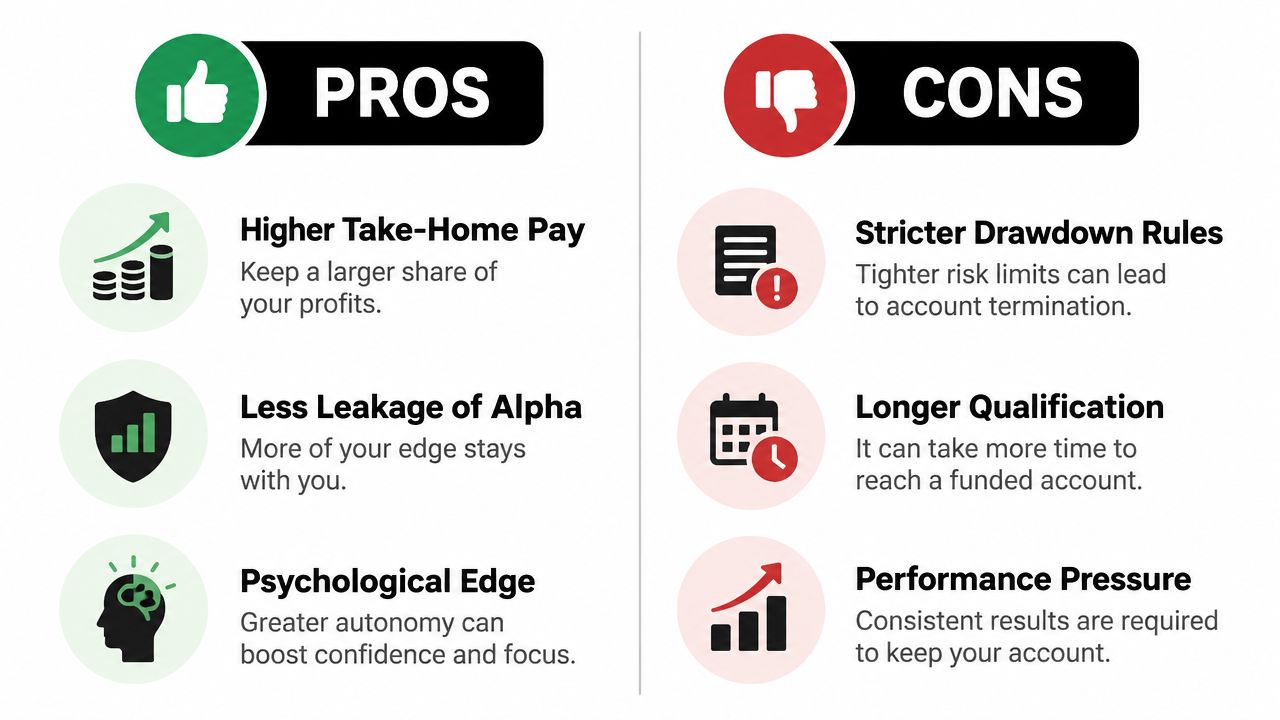
Higher splits give you more of each approved dollar. That can help you build a cash reserve, fund personal trading, or grow into larger account tiers without increasing trade risk. A trader who already has a stable process may value that direct alignment.
The trade-off often appears in the conditions attached to the percentage. A better share may require more verification, stricter consistency, a longer qualification path, or a delayed first payout. Those terms can matter more than the difference between two headline ratios.
What a higher split can improve
- Take-home income: You retain more of the profit your strategy generates.
- Scaling efficiency: More retained cash can support future trading plans without increasing position size.
- Incentive alignment: The firm and trader both benefit when the trader follows a sustainable process.
- Psychological clarity: A transparent calculation reduces uncertainty when you plan around a payout.
The strongest benefit appears when you can repeat your process under the account's rules. If the split encourages you to overtrade, hold positions too long, or chase a milestone, the theoretical advantage can disappear.
What a lower split can offer
A lower starting share isn't automatically a bad deal. It may come with simpler eligibility, quicker access to a first payout, or fewer upgrade conditions. For a trader testing a new market or rebuilding consistency, those features may be worth more than a future percentage that hasn't been achieved.
The cost is the long-term ceiling. If you repeatedly generate approved profit, the retained difference becomes meaningful. You should calculate it using your own average payout rather than assuming a perfect month.
Don't evaluate the split alone. Add these variables to the same worksheet:
- Drawdown limits: The account can fail before the payout if losses breach the rules.
- Payout cadence: A favorable percentage is less useful if you can't access approved profits when your cash flow requires them.
- Evaluation cost: Treat the challenge fee as a real trading expense, not an afterthought.
- Reset and add-on fees: Optional features can change the actual cost of pursuing a higher split.
Trading involves risk of loss. A profit split doesn't remove market risk, execution risk, or the risk of violating account terms.
How to Choose the Best Split for Your Strategy
Start with the way you trade, not the percentage you want. Three inputs usually matter most: trading frequency, average winner size, and payout-cycle tolerance.
A high-frequency scalper may prefer a structure that allows frequent withdrawals and a larger trader share, even if qualification is demanding. The value comes from repeated small outcomes and faster access to retained profit. A swing trader may take fewer positions and wait through larger market moves, making a simpler path with faster initial eligibility more practical.
Match the structure to your operating style
| Strategy profile | What to prioritize | Potential fit |
|---|---|---|
| Frequent scalping | Payout access, execution conditions, and a strong trader share | Higher split if the rules support frequent activity |
| Swing trading | Holding permissions, drawdown room, and uncomplicated eligibility | A faster starting split can be more useful |
| Hybrid trading | Consistency rules and upgrade clarity | A middle structure with transparent milestones |
| Automated or copy trading | Platform compatibility and precise risk limits | A split that permits your execution method |
Treat this as a decision aid, not a universal formula. A scalper can't benefit from a high percentage if the payout schedule or trading restrictions disrupt the strategy. A swing trader shouldn't accept an uncomfortable qualification path merely because the top tier looks attractive.
Questions to ask before signing up
- When can I request the first payout? Check whether the clock starts at funding, at the first profitable period, or after another condition.
- How often are payouts processed? Confirm the stated cycle and whether on-demand requests have separate requirements.
- Is the split locked or improvable? Ask for the exact trigger, not a general promise of an upgrade.
- Are there scaling caps? A higher percentage may apply only within a defined account path.
- What are the reset fees? Include them in your expected cost if a rule breach is possible.
- Which trading styles are allowed? News, weekends, automation, copying, and holding conditions can determine whether the split is usable.
Keep a record of your own average winner, average losing day, payout frequency, and rule violations. Then compare those figures with each plan's actual terms. The right choice is the one your existing process can follow without forcing extra risk.
How MyFundedCapital Structures Its Splits and Upgrades
MyFundedCapital provides simulated-capital funding programs where traders operate under defined risk parameters and receive a share of generated profits. Its published program information describes routes including Instant Funding, 1-Step, and 2-Step Challenges, with account sizes ranging from $5K to $100K and scaling paths up to $500K. The firm supports manual, algorithmic, and copy trading across 350+ instruments, including forex, indices, crypto, and commodities, on DXtrade and cTrader, with MT5 identified as coming soon in the supplied product information.
The split path depends on the program rather than one universal ratio. The supplied product details describe an Instant Funding route that starts at 70/30 and can increase to 80/20 and 90/10 as profit milestones are reached. Paid upgrades may raise the trader share to 90%, 95%, or 100% on eligible plans. Confirm the current terms before purchasing because plan rules and availability can change.
| Account Tier | Starting Split | Upgrade Trigger | Top Split Reached |
|---|---|---|---|
| Instant Funding | 70/30 | Profit milestones | 90/10 |
| Eligible challenge plans | 80/20 | Plan-specific milestones or add-ons | 90%, 95%, or 100% |
| Scaled account path | Plan-dependent | Performance-based scaling | Plan-dependent |
The practical point is that the starting percentage isn't necessarily the final percentage. Your decision should account for how realistic the milestone is for your strategy, whether an upgrade is automatic or paid, and whether the improved split applies immediately or only to later payouts.
MFC also lists a flat 5% daily loss limit and up to 10% maximum drawdown, with optional add-ons for news trading, weekend holding, and faster payouts. Those limits remain central to the decision. A favorable split can't compensate for a risk framework that doesn't fit your method.
Use the MFC 2-Step table to compare the challenge route, account size, and stated progression before you commit. Treat every upgrade as a conditional feature until you've checked its eligibility, cost, and payout effect in the current agreement.
Risks, FAQs, and Your Next Step
A split only matters after you produce eligible profit and remain inside the account rules. Drawdown limits, consistency requirements, prohibited practices, and payout reviews can override the benefit of a higher percentage. Trading involves risk of loss, and this educational article isn't financial advice.
Common questions
Does a higher split mean stricter rules?
Not always, but higher tiers often include additional milestones or performance conditions. Compare the full agreement rather than assuming the percentage tells you how difficult the account is.
Can a payout trigger a split upgrade?
It can, if the plan defines an upgrade around payout history or another milestone. Check whether the new ratio applies to the current request or future approved profits.
Does the split reset on a new account?
It may. A new account can have its own starting tier, even if you previously reached a better ratio. Confirm the treatment of new challenges and replacements.
Do taxes and payment fees affect the result?
Yes. The headline trader share isn't the same as final personal income. Tax treatment depends on your jurisdiction, and payment or conversion fees can reduce what arrives.
Before starting a challenge, record your recent trading frequency, typical winning trade, drawdown behavior, and preferred payout timing. Use those figures to compare realistic net payouts and review the firm's prop firm payout methods before committing capital.
MyFundedCapital offers Instant Funding alongside 1-Step and 2-Step Challenge routes, with split upgrades available on eligible plans and risk parameters published for comparison. Visit MyFundedCapital to review the current account types, payout terms, and upgrade conditions, then choose a structure that matches your actual trading process.
