A 2-step challenge typically means passing two phases: Phase 1 with a 10% profit target and Phase 2 with a 5% profit target, while respecting a 5% daily loss limit and 10% maximum drawdown. If you're comparing funding models right now, the key question isn't which one sounds easiest. It's which rule set matches the way you trade under pressure.
A lot of traders read the 2 step table like it's a checklist. That's a mistake. The table is really a filter. It shows whether you can push for profit without letting one bad session wreck the account, and whether you can repeat that process without needing oversized risk.
Free resources: Prop Trading Challenge Survival Guide (the math behind the rules and the habits that get traders through).
Introduction to the 2 Step Trading Challenge
Most traders looking at prop funding hit the same fork in the road. They see 1-step, 2-step, and instant funding, then start searching for the shortest route instead of the one they can realistically pass.
The 2 step table matters because it turns vague rules into a measurable framework. You need to know the targets, the drawdown limits, and how those limits affect your position size before you place a single trade. If you want a plain-language breakdown of the model itself, this explanation of two stepping is a useful starting point.
The traders who pass consistently don't fight the structure. They build a strategy that fits inside it.
The MyFundedCapital 2 Step Challenge Parameters Table
When traders ask about the 2 step table, they usually want one thing first. They want the rule set in one place.
Below is a clean reference version of the challenge parameters based on the published challenge rules. The percentages apply across account sizes, while exact fees vary by account option.
| Account Size | Refundable Fee | Phase 1 Target | Phase 2 Target | Daily Loss Limit (5%) | Max Loss Limit (10%) |
|---|---|---|---|---|---|
| $5K | Varies by account option | 10% | 5% | 5% | 10% |
| $10K | Varies by account option | 10% | 5% | 5% | 10% |
| $25K | Varies by account option | 10% | 5% | 5% | 10% |
| $50K | Varies by account option | 10% | 5% | 5% | 10% |
| $100K | Varies by account option | 10% | 5% | 5% | 10% |
Treat this as your operating map, not marketing copy. The percentages tell you what the account expects from you. Your job is to translate those limits into trade size, session risk, and weekly pacing.
A practical reading of the table looks like this:
- Profit targets You need enough edge to produce returns without forcing setups.
- Daily loss limit One bad day can't turn into revenge trading.
- Maximum loss limit Your overall campaign has to stay controlled even through a rough patch.
- Fee line Check the live challenge page before buying, because fees depend on the account option you choose.
Understanding Each 2 Step Challenge Rule
The rule table looks simple. Trading it isn't. Each line exists to expose a different weakness.

According to the published MyFundedCapital challenge rules, the 2-Step table uses a 8% Phase 1 target, a 5% Phase 2 target, and a strict 5% daily plus 10% total drawdown. The same page notes that 2025 industry data places 2-step pass rates at 12% to 15%, which fits what experienced traders already know. The model rewards discipline more than aggression.
The profit targets
A profit target sounds straightforward until the clock starts. In Phase 1, the target is high enough that weak execution gets exposed quickly. Traders who drift in and out of mediocre setups usually stall before they get there.
The point of the first phase isn't just to see whether you can make money. It's to see whether you can pursue a meaningful target without breaking your own process.
Practical rule: If your normal strategy only works when you double size after a losing streak, it doesn't fit a 2 step table.
Phase 2 shifts the test. The lower target changes the question from "Can you push?" to "Can you stay controlled after early success?"
The daily loss limit
This is the rule that catches emotional traders. A 5% daily loss limit isn't there to annoy you. It's there to stop one bad session from turning into a full account failure.
On a $100K challenge account, 5% means a daily loss cap of $5,000. That's a large amount in absolute terms, but that doesn't mean you should use all of it. Good traders treat the hard limit as the outer wall, not the daily budget.
A better approach is to define your own stop well before the rule stop. That gives you room for slippage, mistakes, or an open position moving against you faster than expected.
The maximum loss limit
The 10% maximum drawdown is your campaign-level guardrail. It forces you to think in sequences, not single trades. One setup doesn't matter much. Ten unmanaged decisions do.
On a $100K account, 10% equals $10,000. Once you see it that way, the right question becomes simple: how many losing trades can your system take before you're in trouble?
Use that number to reverse-engineer risk.
- If you risk too much per trade, variance can end the challenge before your edge plays out.
- If you risk too little, you may never reach the target with enough efficiency.
- If your risk changes emotionally, you won't know which of those two problems you're actually dealing with.
Why the table is built this way
The structure forces balance. You need enough offense to hit the target and enough defense to survive the path there.
That balance is why many traders do better in a 2-step format than in models that demand everything in one push. The challenge doesn't ask for heroics. It asks for repeatable decision-making.
2 Step vs 1 Step vs Instant Funding
Choosing between these models has less to do with ambition and more to do with personality. Some traders need a phased test. Some want one clean shot. Some already know they'd rather skip evaluation and trade under tighter practical constraints from day one.
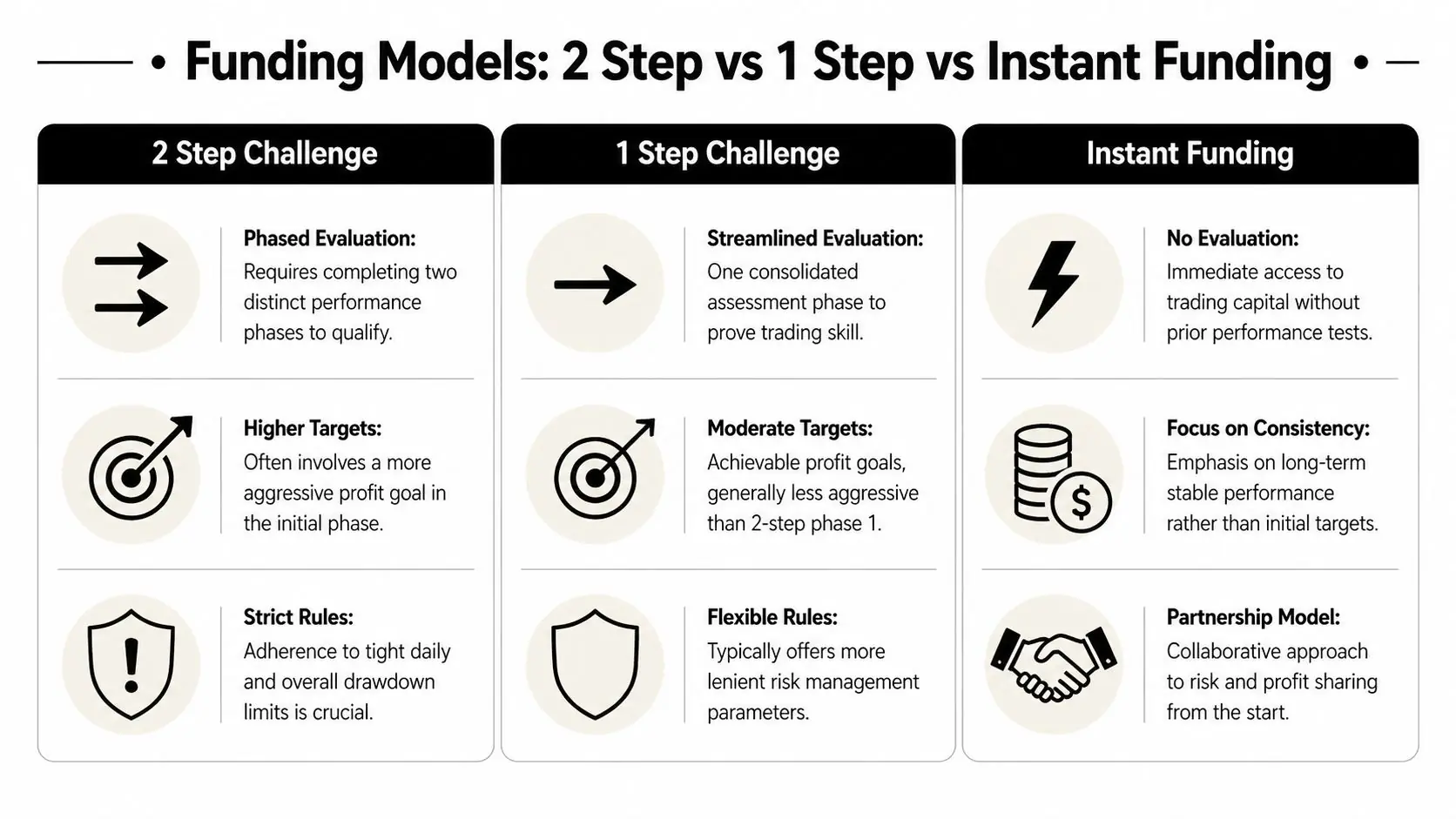
Here's the cleanest way to understand it:
2 step challenge
Best for traders who need structure and can follow a process over time.
- Why it fits Two phases let you prove both profit generation and control.
- What can go wrong Traders often overtrade in Phase 1 because the target feels urgent.
- Who should avoid it Anyone who gets impatient when progress is steady but not fast.
1 step challenge
Best for traders with a stable strategy who want a shorter evaluation path.
A 1-step model can work if you already know how your system behaves under pressure and don't need a phased test to stay disciplined. The upside is simplicity. The downside is that there's less room to recover from poor pacing.
Instant funding
Best for traders who care more about ongoing execution than passing a challenge.
If you want to compare that route in more detail, this overview of prop firm instant funding lays out how it differs from evaluation-based models. Instant funding can suit traders who already have a proven routine and don't want to spend mental energy on passing criteria.
Pick the model that matches your habits on a normal week, not the version of you that only shows up in a spreadsheet.
A Practical Strategy to Pass Phase 1
Phase 1 is where traders usually sabotage themselves. They see the target, feel behind after a couple of flat days, and start trading as if every setup needs to be a winner.
The most practical published guideline comes from MyFundedCapital's risk management guide. It recommends risking 0.5% to 1% per trade, combined with a 1:2 risk-to-reward ratio, as a workable way to pursue the 8% to 10% Phase 1 target while staying inside the 5% daily and 10% maximum drawdown limits.
That framework works because it solves two problems at once. It keeps single-trade damage limited, and it makes your upside large enough that you don't need a high-volume gamble to progress.
A workable Phase 1 checklist
- Start with fixed risk Use the same risk model on every qualified setup. Don't increase size just because you're close to target.
- Trade your best pattern only Phase 1 isn't the place to test new entries, new sessions, or a new market.
- Respect the day's tone If market conditions are messy, protecting capital is a valid decision.
- Track your sequence A challenge is won through a string of acceptable decisions, not one oversized trade.
What usually fails
A few patterns show up again and again:
- Late-day revenge trading
- Adding risk after two losses
- Forcing lower-quality setups because the account feels "behind"
- Trying to finish the target in one session
If you're thinking about one big trade to catch up, you're already off plan.
How to Secure Your Pass in Phase 2
Phase 2 looks easier on paper. That's exactly why traders relax too much and lose control.
The lower target changes the job. You're no longer proving that you can push hard enough. You're proving that Phase 1 wasn't luck, unsustainable pushing, or one unusually strong streak. This phase rewards patience more than output.
The mindset shift
Most traders should tighten up in Phase 2. Not because the strategy changed, but because the objective changed.
Good Phase 2 behavior usually looks like this:
- Be selective Take the cleanest setups and let average ones go.
- Stay mechanically consistent Use the same execution rules that got you through Phase 1.
- Reduce emotional urgency You don't need to rush a smaller target.
- Protect open profit If the account is progressing well, don't give back chunks of it with impulsive trades.
What the firm is really checking
A second phase answers a simple question. Can this trader follow a system after the excitement of the first win?
That matters because funded trading isn't about one explosive period. It's about whether your process survives boredom, impatience, and the temptation to speed things up. If your Phase 1 approach relied on constant pressure, Phase 2 exposes that fast.
A practical rule here is to keep your standards high and your expectations plain. You don't need to impress anyone. You need to finish cleanly.
Your Funded Account Payouts and Scaling Plan
Passing the challenge is only the first milestone. After that, traders care about two things. Getting paid and increasing buying power without changing what already works.
According to the published MyFundedCapital payout terms, profit splits start at 80/20 and can be upgraded to 90/10 or 95/5 with an add-on. The same page states that payouts are available on demand or every 7-14 days, and that 90% of bank or crypto payout requests are fulfilled within an average of 2 hours.
That gives you a straightforward post-pass framework:
What to focus on after passing
- Keep your process unchanged A funded account isn't a signal to suddenly trade bigger or looser.
- Choose a payout rhythm Some traders prefer regular withdrawals. Others leave more room in the account and request payouts on demand.
- Think in scaling terms Growth comes from consistency, not from trying to force one giant month.
If you want the mechanics of account growth, this guide to how scaling works is the place to check the current path and conditions.
The biggest funded-account mistake is treating the payout as permission to abandon the risk model that got you there.
Allowed Trading Conditions and Strategies
Rule clarity matters as much as setup quality. A solid strategy can still fail if it doesn't fit the account conditions.
According to the published MyFundedCapital trading rules, traders can use manual trading, algorithmic trading through EAs, and copy trading. The same rules page states that accounts can access 350+ instruments across forex, indices, crypto, and commodities on DXtrade and cTrader, with scaling up to $500K.
Use that flexibility carefully:
- If you trade manually, keep your execution process documented so your size and entries stay consistent.
- If you use EAs, verify they behave properly under challenge limits before you run them.
- If you copy trade, make sure the source strategy and the account rules match.
- If you switch instruments often, narrow your watchlist. More markets don't automatically mean more edge.
Optional add-ons can change what is allowed around things like news trading or weekend holding, so check the live rule set before trading around those conditions.
Frequently Asked Questions About the 2 Step Challenge
What happens if I breach a rule but end the day in profit?
A rule breach is still a rule breach. Finishing green doesn't undo a violation. That's why serious traders set internal limits tighter than the published hard stops.
How should I think about daily drawdown in practice?
Think of the hard limit as the absolute boundary, not the level you're willing to trade down to. If your strategy regularly gets close to the line, the issue usually isn't bad luck. It's position sizing, trade frequency, or poor session selection.
Can beginners pass a 2 step table challenge?
Yes, but only if they trade small enough and stick to one clear playbook. A beginner who follows a simple process has a better chance than an experienced trader who keeps improvising. The challenge punishes inconsistency faster than it punishes inexperience.
Should I use the same aggression in both phases?
Usually no. Phase 1 asks you to make progress. Phase 2 asks you to prove control. The setups can stay the same, but your urgency should drop.
Start Your Disciplined Path to Funding
The 2 step table isn't complicated once you stop looking at it as a hurdle and start reading it as a trading framework. The targets tell you how much offense you need. The drawdown limits tell you how much discipline you need. Put those together, and you get a fair test of whether your strategy is scalable.
Trading always involves risk of loss. This article is educational only and isn't financial advice.
If you're ready to trade a structured evaluation with clear limits, compare the available programs at MyFundedCapital and choose the account type that fits your strategy, risk tolerance, and trading style.