You've traded manually for a few months, and now you want to automate EUR/USD. Then the practical questions appear: should you use MT5, cTrader, or Python, is a low-cost VPS reliable enough, and will an EA behave differently on a prop firm's DXtrade setup?
This guide connects the code and backtest with the operational details that decide whether a system survives live conditions. You'll learn how to build rules that hold up out of sample, measure latency and slippage, choose deployment infrastructure, and keep an automated strategy inside prop firm risk limits. Trading involves a risk of loss. This is educational content, not financial advice.
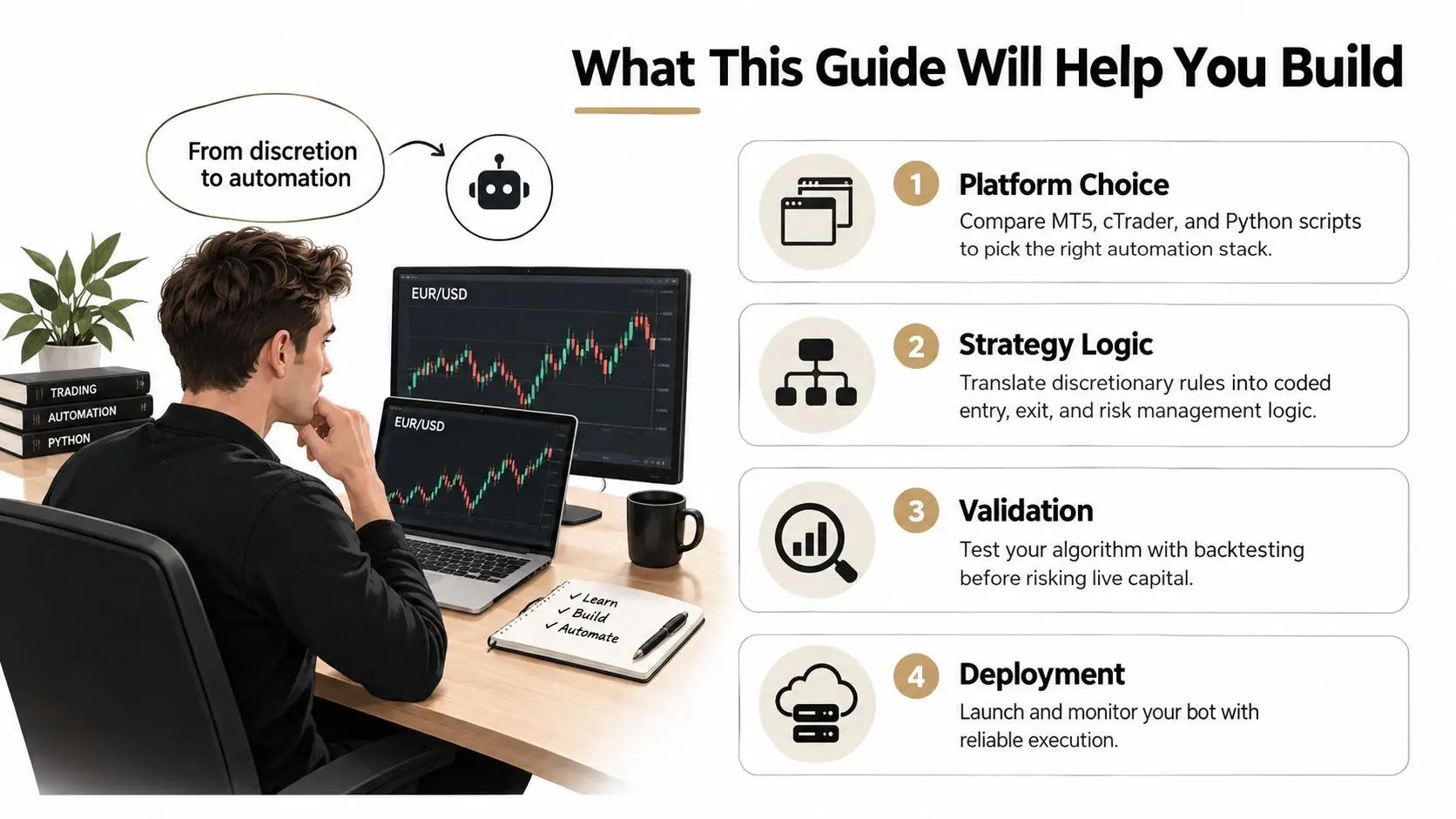
What This Guide Will Help You Build
A discretionary trader can usually describe a setup in plain language: wait for a pullback, confirm momentum, enter near support, and cut the position if the move fails. A computer needs exact conditions. It needs to know which price is used, when a signal becomes valid, how much to trade, where the stop belongs, and what happens if the order isn't filled.
That translation is where most automation projects either become testable or remain vague. The platform matters, but it comes after the logic. MT5 gives you Expert Advisors and native testing, cTrader offers cTrader Automate, and Python gives you flexibility for research and custom integrations. The right choice depends on your strategy, broker connection, data, and prop firm environment.
Three jobs your system must perform
First, build a rule-based strategy that survives unseen data. A profitable-looking backtest isn't enough. You need separate development and validation periods, realistic trading costs, and a process that makes curve fitting difficult.
Second, deploy it with appropriate uptime and latency. A swing EA may tolerate ordinary hosting. A short-horizon breakout system may not. The system should keep running through terminal restarts, connectivity interruptions, and platform maintenance.
Third, make the risk logic match the account. A prop firm account isn't the same as an unrestricted personal account. Daily loss limits, maximum drawdown, news restrictions, holding rules, and consistency requirements can invalidate a strategy even when its market logic is sound.
The approach here assumes basic MT5 or TradingView familiarity, but no coding background. Code can be learned. What can't be skipped is the specification behind the code. Every recommendation is written from the perspective of running EAs on prop capital, where operational mistakes and rule breaches matter as much as entry quality.
Practical rule: Treat the EA, platform, broker connection, and account rules as one trading system. Testing only the entry signal leaves most of the real risk unmeasured.
What Algorithmic Trading Forex Actually Means
Algorithmic trading means that a computer algorithm determines one or more order parameters, such as whether to initiate a trade, when to place it, the price, or the quantity. That boundary is reflected in ESMA's MiFID II consultation paper on algorithmic trading. The important distinction isn't whether you use a charting platform. It's whether code controls part of the order decision or execution.
A manually copied Telegram signal isn't algorithmic trading. Nor is an alert that asks you to click Buy. An EA that reads market data, calculates position size, submits the order, manages stops, and closes according to programmed rules is algorithmic. A semi-automated tool sits between those two cases because a human still approves an important part of the transaction.
The thermostat analogy is useful. A thermostat doesn't forecast the weather. It reacts to a defined temperature threshold, turns heating on or off, and follows the same instruction each time. A weather forecast expresses an expectation about what may happen. An automated strategy can incorporate forecasts or model outputs, but its trading identity comes from the rules that convert inputs into orders.
The three layers inside a forex algorithm
A workable system needs three separate layers:
- Signal logic Defines the market condition that permits a trade. This might use moving averages, volatility, session timing, price structure, or a statistical relationship.
- Position sizing Converts risk into volume. It should account for stop distance, contract specifications, available margin, and the account's drawdown limits.
- Execution logic Decides how to send, modify, and cancel orders. It handles order types, retries, rejected orders, spread filters, and protection during abnormal conditions.
Keeping these layers separate makes debugging easier. If the entries look reasonable but realized results deteriorate, you can inspect execution and sizing without rewriting the signal. If a prop firm changes its rules, risk controls can be updated without changing the market hypothesis.
Algorithmic systems have a long history in foreign exchange. A market overview referencing Federal Reserve-documented FX activity describes algorithmic participation reaching nearly 60% of EUR/USD and USD/JPY trading volume, and about 80% of EUR/JPY volume by the end of 2007. The broader lesson is structural: major FX markets have been highly compatible with electronic and automated execution for years.
Core Strategy Families Used in Forex Algorithms
Most retail forex systems are variations of four families. The family matters because each one expects a different market environment. A trend system needs persistence, a mean-reversion system needs stability, a breakout system needs expansion, and statistical arbitrage needs synchronized execution.
| Family | Best Market Condition | Example Pair | Typical Holding | Main Failure Mode |
|---|---|---|---|---|
| Trend following | Sustained directional movement | GBP/USD | Several hours to several days | Repeated losses in sideways markets |
| Mean reversion | Stable range around a changing average | EUR/CHF | Minutes to several days | Large loss when a range breaks into a trend |
| Breakout | Volatility expansion after compression | EUR/JPY | Minutes to several hours | False breaks and spread expansion |
| Statistical arbitrage | Temporary divergence between related prices | AUD/NZD | Minutes to several days | Correlation changes and imperfect hedge execution |
Trend following
A trend EA might use a 200-period EMA on GBP/USD with a pullback entry on the H4 chart. It can work when rate expectations or central bank divergence create a sustained directional move. Its cost is patience. The system may surrender open profit during retracements and accumulate small losses when price repeatedly crosses the trend filter.
Trend systems usually have less dependence on millisecond execution than scalpers. Their biggest threat is not a slightly worse fill. It's a change in market character that turns directional rules into a sequence of whipsaws.
Mean reversion
A Bollinger Band fade on EUR/CHF daily charts assumes that price will return toward a central value after moving too far from it. The strategy needs orderly conditions, manageable volatility, and a range that remains meaningful.
The failure mode is asymmetric. Several modest reversions can create confidence, then one persistent trend carries price beyond the strategy's expected envelope. A stop, exposure cap, and regime filter are more important than adding another entry indicator.
Breakouts
A London-session range break on EUR/JPY is designed for a different event. It waits for compression and attempts to participate when volatility expands. The entry needs a spread filter, a rule for news conditions, and protection against entering after the move has already travelled too far.
Breakout EAs often look strong in clean historical periods and disappoint when the market produces alternating false breaks. Execution quality matters because the system may have only a narrow window in which the entry remains attractive.
Statistical arbitrage
An AUD/NZD z-score spread strategy buys one leg and sells the other when their relationship moves away from its historical norm. The logic sounds market-neutral, but the hedge can fail. Correlations change, one leg may fill before the other, and retail infrastructure may not provide the synchronized execution required.
A useful comparison of strategy design and implementation trade-offs is available in this guide to strategies for algo trading. For most new developers, a slower trend or carefully constrained mean-reversion model is easier to validate than an arbitrage system that depends on institutional-style execution.
Backtesting and Walk-Forward Validation That Survives True Performance
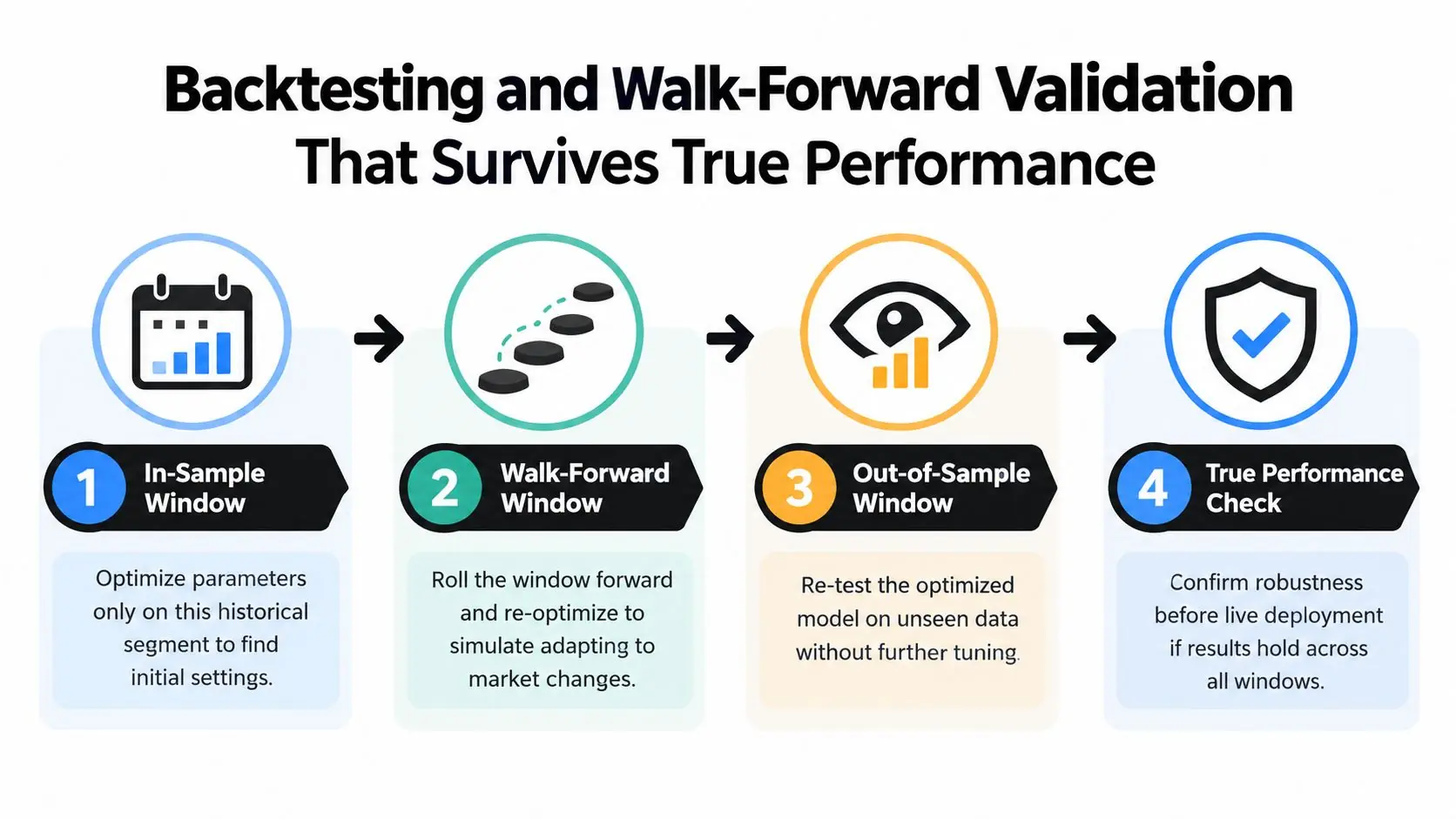
A backtest should answer a narrow question: how did this exact rule set behave on data it wasn't allowed to see during development? If the same data chooses the parameters and judges the result, the test measures adaptation to history, not predictive reliability.
Build the validation pipeline
- Create an in-sample window. Use this period to define rules and optimize limited parameters. Record every change in a research log.
- Roll through walk-forward windows. Re-optimize only according to a pre-declared schedule, then test the next segment. This simulates adapting without looking ahead.
- Reserve an out-of-sample window. Don't tune the strategy after seeing these results. Treat the period as a one-time examination.
- Run a review. Compare returns, drawdowns, trade distribution, losing streaks, and execution assumptions across every window.
The backtesting guide for trading strategies is useful for organizing that process, but the core discipline is simple: separate discovery from judgment.
Why attractive EAs fail live
A strategy can fail because the developer optimized an entry threshold too precisely, used unrealistic spread assumptions, relied on poor tick data, or selected symbols that were convenient only in hindsight. Ask-only data is particularly dangerous for testing limit orders because the bid may determine whether a sell-side order filled.
Model rollover swaps and financing. Include rejected orders, spread widening, partial fills where relevant, and the actual symbol specifications of the intended broker. Don't add a new filter after reviewing the out-of-sample results and then call the result independent. That filter has already benefited from information it shouldn't have had.
Monte Carlo reshuffling adds another useful test. Reorder the trades many ways and examine the range of possible drawdowns, losing streaks, and recovery paths. A single equity curve can hide how uncomfortable the same expectancy becomes when losses arrive in a different sequence.
Use a demanding internal standard: at least five years of tick data and more than 700 out-of-sample trades, with the data and threshold supported by the stated validation methodology. Then document what happens after a drawdown. Define when the EA reduces risk, pauses, or is disabled, rather than inventing a recovery promise after the fact.
Execution Mechanics That Decide Whether Your Edge Holds
A signal isn't a fill. Between the moment an EA identifies an entry and the moment the broker confirms execution, price can move, the spread can change, or the order can be rejected.
The three mechanical variables to measure are routing latency, effective spread, and realized slippage. Effective spread is more informative than the displayed quote because it compares the execution price with the mid-price immediately before execution. Academic FX microstructure research also shows that bid-ask spread behavior around market open and close isn't fully explained by standard information models, so session-aware execution logic matters. The FX microstructure research on effective spreads and session behavior provides useful background.
A short-horizon strategy can lose its edge through small costs repeated many times. Don't assume that a faster signal automatically creates a better trade. Measure the entire path from decision to confirmation.
| Strategy | Typical Holding Time | Latency Sensitivity | Avg Slippage (pips) |
|---|---|---|---|
| Swing trend EA | Several hours to several days | Low | Measure from live-like testing |
| Intraday mean reversion | Minutes to several hours | Medium | Measure by session and order type |
| Session breakout | Minutes to several hours | High | Measure around entry bursts |
| Statistical arbitrage | Minutes to several days | Very high | Measure each leg separately |
The table intentionally leaves average slippage as a measurement task. A universal figure would be misleading because broker, pair, session, order size, and volatility change the result.
Choosing the order type
- Market orders prioritize immediate execution, but the final price can differ from the quote.
- Limit orders can control entry price and reduce unwanted market impact, but they may never fill.
- Stop orders become market orders after activation and can slip sharply in volatile conditions.
- Stop-limit orders constrain price, but the trade may remain unfilled during a fast move.
A simple latency budget might include 5 ms for broker round-trip time, 3 ms for order acknowledgement, and 2 ms for fill confirmation. Those figures describe a target budget, not a guaranteed result. News-driven requotes and spread changes can dominate the budget regardless of a fast server.
For additional engineering context on the systems behind automated execution, see this Blocsys guide to algorithmic trading from Blocsys Technologies. Before risking capital, run the EA on demo and log timestamped signal, submission, acknowledgement, fill, expected price, actual price, spread, order type, and market session. Review the distribution, not just the average. A few extreme fills can determine whether a prop account survives an event.
Infrastructure for Deployment and Latency Control
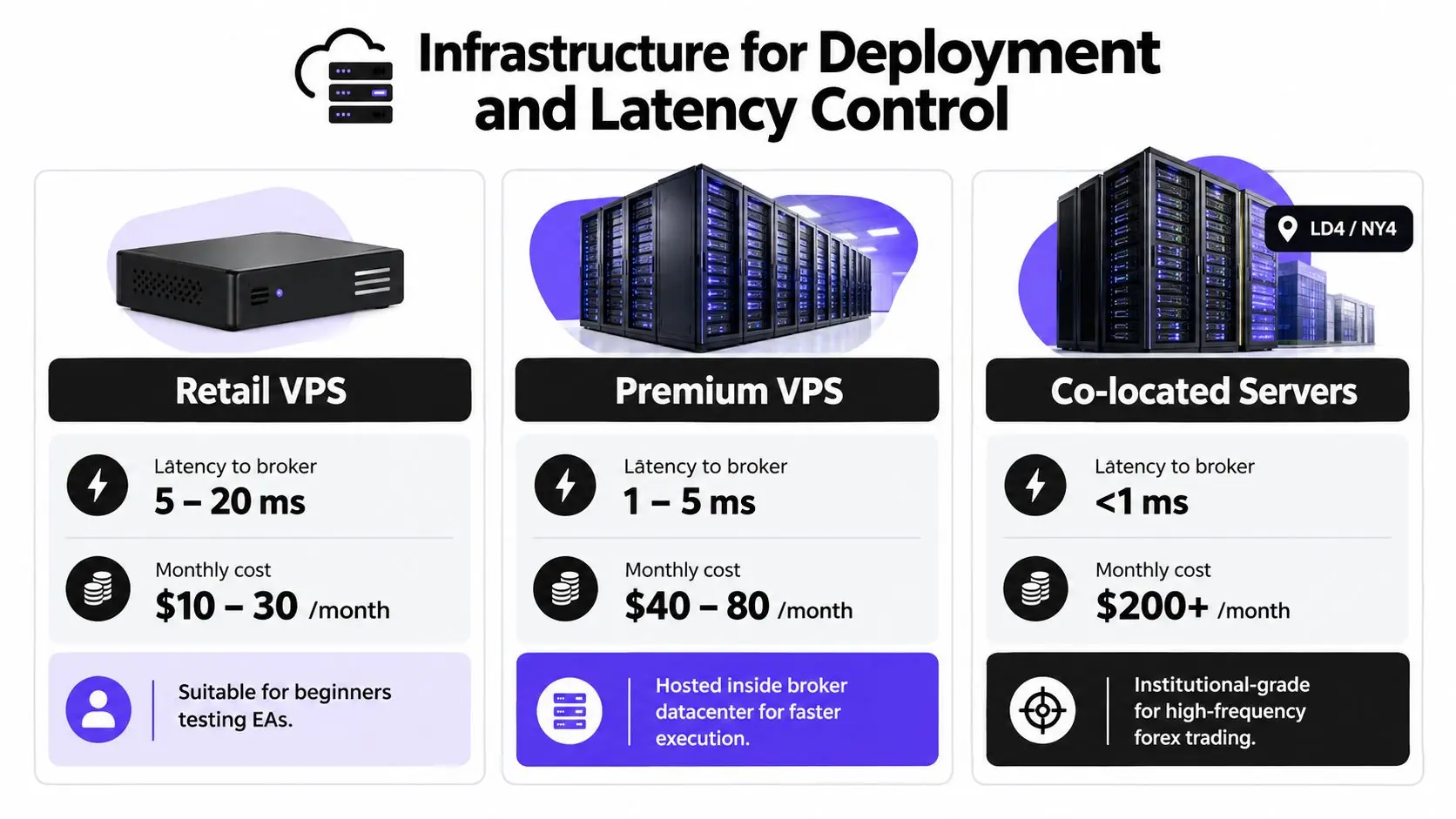
Choose infrastructure based on the holding period and execution dependency, not on the lowest advertised price. A swing EA may run acceptably on a retail VPS. A fast breakout system needs a shorter and more stable route to the broker.
| Deployment tier | Approximate latency | Approximate cost | Suitable use |
|---|---|---|---|
| Retail VPS | 5 to 20 ms | $10 to $30 per month | Swing and slower intraday EAs |
| Premium broker-datacenter VPS | 1 to 5 ms | $40 to $80 per month | Latency-sensitive intraday systems |
| Co-located server at LD4 or NY4 | Sub-1 ms | $300+ | Institutional-style low-latency execution |
These figures come from practical infrastructure guidance, and actual results depend on broker routing and network conditions. A fintech engineering guide for technical decision-makers offers broader context on reliability and production system design.
Deployment audit
- Terminal settings Limit unnecessary chart history, disable unwanted news features, and keep logs manageable without deleting records needed for incident review.
- Availability Look for a VPS uptime SLA above 99.9%, redundant power, and a documented maintenance process.
- Recovery Configure automated terminal restart after a crash and verify that the EA restores its intended state rather than duplicating an order.
- Risk control Add a kill switch that closes positions or prevents new orders when the defined drawdown threshold is reached.
- Monitoring Send alerts for disconnections, rejected orders, abnormal spreads, missing ticks, and unexpected position changes.
Shared VPS neighbors can create inconsistent performance. Remote desktop delay can make the terminal feel slow even when the trading process is running normally. A home fiber connection may work during quiet hours and fail exactly when volatility increases. Test the failure mode, not just the normal mode.
Matching Your EA to the Right Prop Firm Platform
Platform selection becomes a risk decision when an EA must respect a daily loss limit, trailing drawdown, minimum trading days, or consistency target. The platform needs to expose the account state clearly enough for the algorithm to stop before the firm's calculation does.
| Feature | DXtrade | cTrader | MT5 |
|---|---|---|---|
| Native automation | API-driven automation | cTrader Automate | Expert Advisors |
| API access | REST and FIX gateways | Platform automation and APIs | MQL5 with limited Python bridge |
| Backtesting | No native tick-data tester | Strong automation testing tools | Deep integrated tester |
| Main strength | Multi-asset portfolio workflows | Fast, modern algorithm deployment | Mature EA ecosystem and legacy ports |
| Main risk | More external engineering required | Instrument and depth-of-market quirks | Hedging versus netting differences |
cTrader Automate is a natural fit for scalpers who want native C#-based automation and direct platform integration. MT5 suits traders porting existing MT4 or MT5 EAs, particularly when the strategy depends on the platform's tester and symbol ecosystem. Check whether the account uses hedging or netting mode because position handling, stop management, and ticket logic can change.
DXtrade can suit multi-asset EAs that use REST or FIX connectivity, but the lack of a native tick-data tester means research and execution testing may need external tooling. cTrader users should verify how depth of market behaves on each instrument, especially where the quoted market is synthetic or broker-specific.
For a broader explanation of automated trading systems in a prop environment, see this overview of the forex expert advisor. Choose the platform that matches the EA's assumptions, not the one with the most familiar interface.
Risk Reality, FAQ, and Your Action Plan
AI can help write code, classify sessions, or adjust a narrow execution rule. It doesn't turn a non-stationary market into a predictable machine. Regime shifts, changing spreads, altered correlations, and limited execution capacity can all weaken a model that looked intelligent in development.
Retail algorithmic trading also has a difficult outcome distribution. One industry summary reports that 70% to 80% of retail algorithmic traders lose money over multi-year periods, while disclosures from ESMA-regulated brokers commonly state that 65% to 80% of retail CFD accounts lose money over annual periods. See the discussion of forex robot profitability and retail losses. Automation removes hesitation, not market risk.
Pre-deployment checklist
- Verify the firm and platform Confirm that EAs, instruments, news trading, weekend holding, and copying are permitted for the account type.
- Validate the EA Keep the source code or vendor documentation, record the test data, and preserve walk-forward results.
- Map every rule Convert daily loss, maximum drawdown, position limits, and trading-day requirements into code-level controls.
- Measure execution Run demo tests near the intended broker connection and review spread and slippage by session.
- Start conservatively Use small risk while verifying order handling, restart behavior, and account-state calculations.
Common questions
How much capital do I need?
There isn't a universal minimum. Your requirement depends on the broker or prop firm, strategy risk, margin, and the loss you can tolerate. Validate the system on demo before committing money.
Does MyFundedCapital allow EAs?
Its published offering supports manual, algorithmic, and copy trading on supported platforms, subject to its risk rules and platform restrictions. Check the current terms before deployment.
How much latency can my strategy tolerate?
A swing system can tolerate more delay than a scalper. Infrastructure guidance commonly treats sub-10 ms as excellent for many automated strategies and 1 to 5 ms as ideal for latency-sensitive scalping EAs. See this latency and backtesting guidance.
How should I size a prop firm challenge?
Size from the firm's loss limits backward. Define the worst expected losing sequence, include slippage, and keep a coded buffer below the formal threshold. Test the exact rule logic on demo before attempting the challenge.
Run the EA on demo, document the rules, complete a challenge only when the live-like results remain acceptable, and scale within funded limits. Never treat a backtest or AI-generated code as proof of future performance.
MyFundedCapital offers Instant Funding plus 1-Step and 2-Step Challenge paths, with support for algorithmic trading across supported platforms and instruments under defined drawdown rules. Compare the available account types and current platform terms, then visit MyFundedCapital to choose a funding path that fits your EA's execution and risk controls.