

 AR
AR
 NL
NL
 FR
FR
 DE
DE
 ES
ES
 IT
IT
 PL
PL
 SV
SV
 PT
PT


You've found a trading setup that works, but your personal account is too small to make the returns meaningful. A forex funded program can address that gap, but only if you understand what you're buying, how drawdown rules work, and whether you can keep an account long enough to receive payouts. This guide explains the models, costs, profit splits, qualification process, and the risk discipline that matters more than chasing a target.
Introduction What a Forex Funded Program Solves for Traders
A trader with a small account often faces an uncomfortable choice. Trade larger and risk damaging the account, or trade responsibly and accept that even a good month may produce little money. A forex funded program changes the size of the trading environment without removing market risk, rule risk, or the possibility of losing the evaluation fee.
The basic arrangement is straightforward. You pay for an evaluation, trade within defined rules, and may receive access to a larger simulated account after meeting the requirements. If your performance qualifies for a reward, the firm pays you an agreed share of the simulated profits. You aren't depositing money into a brokerage account, and you shouldn't treat the account balance displayed on the platform as cash you own.
The modern retail model accelerated after 2018 and 2019, as MetaTrader-based challenge firms expanded, and became mainstream during the 2020 to 2022 retail-trading boom. Industry tracking estimates that active users grew by more than 400% from 2020 to 2024, with managed capital reaching about $6.7 billion in 2024. The same snapshot estimated 350,000 or more active funded traders globally in 2024 and more than 100 challenge-based prop firms. These figures come from industry tracking of prop trading statistics, but market size doesn't prove that any particular program is fair or suitable.
This guide will help you:
- Understand the model: Separate simulated evaluation from regulated brokerage capital.
- Compare access routes: Decide whether Instant Funding, a 1-Step Challenge, or a 2-Step Challenge matches your habits.
- Calculate cost: Look beyond the entry fee and headline profit split.
- Read the risk rules: Understand daily loss, maximum drawdown, floating equity, and reset timing.
- Estimate payout survival: Judge whether your process can protect an account after qualification.
You can also review a plain-language explanation of what a funded account means before comparing providers. Trading involves risk of loss, and this article is educational content, not financial advice.
How a Forex Funded Program Actually Works
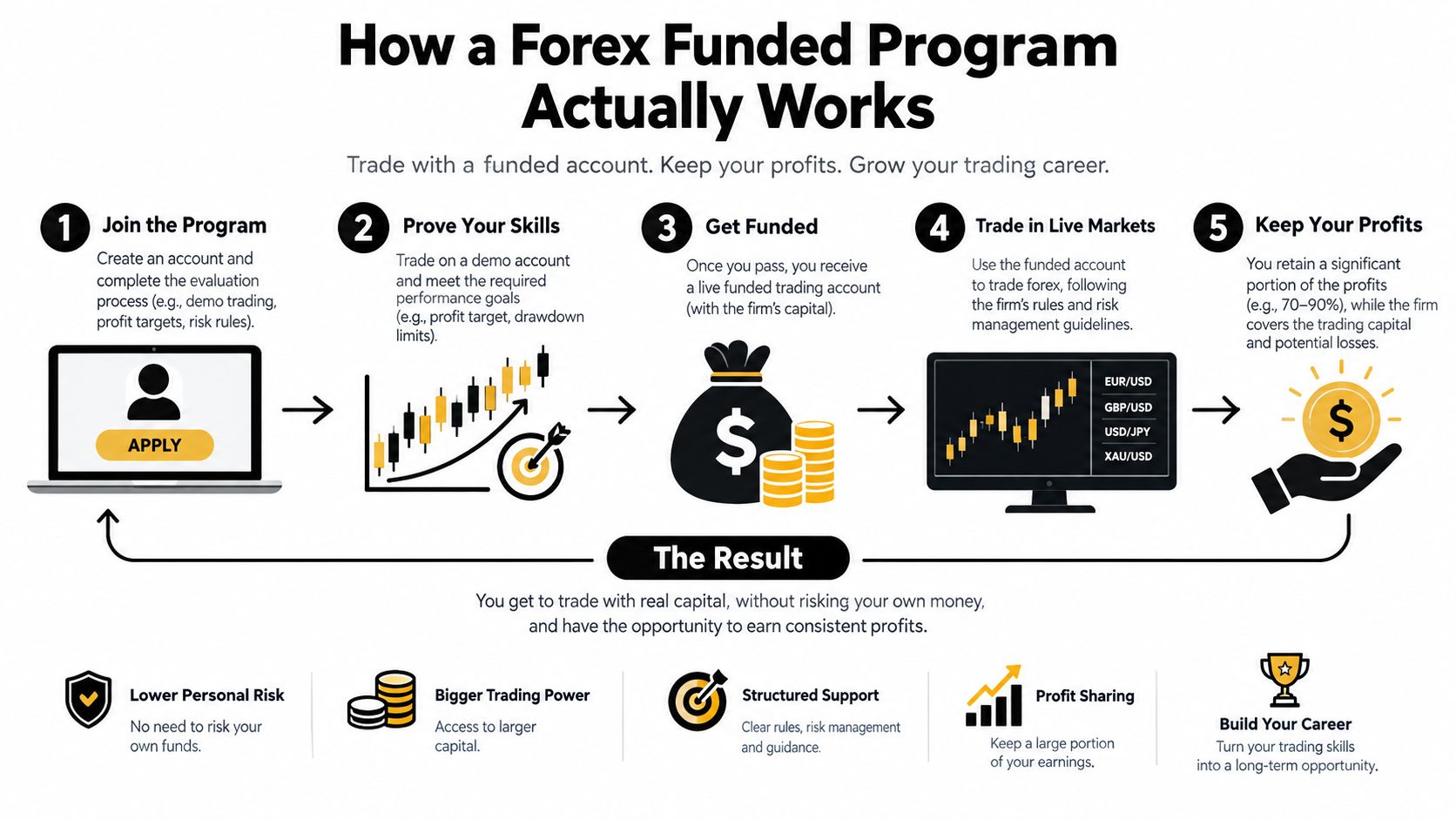
Think of the process like a driving test. The firm provides the vehicle and sets the road rules, but you still have to demonstrate that you can operate safely under pressure. In a forex funded program, the quotes and market conditions are designed to reflect real trading, while the evaluation account itself is generally a demo environment.
The process normally follows these stages:
- Select a program: Choose an account size, platform, drawdown model, and trading permissions.
- Buy the evaluation: Your fee purchases access to a rules-based assessment. It isn't a deposit into a personal brokerage account.
- Trade within limits: You must pursue the target without breaching daily loss, maximum drawdown, consistency, news, or holding restrictions.
- Complete the requirements: A single-stage or multi-stage model may require target achievement and other conditions.
- Request rewards: If you remain compliant and generate eligible simulated profits, the firm applies its payout rules and profit split.
Why the rules are strict
The firm isn't only testing whether you can predict EUR/USD or gold. It's testing whether your position size, stop placement, exposure, and behavior remain controlled when the market moves against you. A trader can have a profitable strategy and still fail because one volatile session pushes equity below the permitted floor.
That distinction also explains why you must ask whether the program is an evaluation product or access to regulated capital. A demo-based evaluation isn't the same as opening a brokerage account protected by a local financial-services framework. Regulatory treatment varies, and independent coverage says retail prop models are moving toward the regulatory perimeter in the US, EU, UK, and Australia. The CFTC's My Forex Funds case was dismissed, which created uncertainty rather than a universal answer. Regulatory coverage of prop trading also notes that EU, UK, and Australian retail CFD caps remain around 30:1, while US retail forex is capped at 50:1.
Before paying, read the legal entity details, terms, payout conditions, dispute process, and jurisdiction. A large account label doesn't tell you what protections or complaint channels are available.
Practical rule: Treat the displayed account balance as a trading limit, not as money sitting in your name.
Choosing Your Path Instant Funding Versus 1 Step and 2 Step Challenges
The right route depends less on the advertised account size than on how you handle pressure. Instant Funding removes the evaluation stage, but it may cost more and impose tighter conditions. A 1-Step Challenge shortens the qualification path. A 2-Step Challenge spreads the proof of consistency across multiple phases, which can reduce the temptation to gamble for one quick result.
Challenge account sizes commonly range from $5,000 to $100,000, with scaling paths reaching up to $500,000 at some providers, including the options described by MyFundedCapital. Those figures describe program structures, not guaranteed personal capital or income.
| Feature | Instant Funding | 1-Step Challenge | 2-Step Challenge |
|---|---|---|---|
| Access | Start trading immediately after purchase | Trade one evaluation phase before funding | Complete two evaluation phases |
| Cost profile | Usually higher upfront because there's no qualification stage | Often positioned between Instant Funding and 2-Step | Often lower entry pressure, but requires more time and patience |
| Target pressure | No challenge target, but account rules still apply | One target concentrates the qualification pressure | Targets are divided across stages |
| Best fit | Traders with a tested process who dislike evaluation deadlines | Traders who can follow rules consistently in one structured phase | Traders who want a slower proof of discipline |
| Main risk | Paying more before demonstrating current readiness | Overtrading to finish one phase quickly | Losing focus or changing strategy between phases |
When Instant Funding makes sense
Instant Funding may suit a trader who already has a stable routine, understands the platform, and can accept the higher initial cost. It doesn't make the trading safer. You still need to know the daily loss calculation, drawdown type, payout conditions, and prohibited behavior before placing a trade.
A crypto swing trader might prefer this route if waiting through an evaluation would interfere with a strategy that needs time. A scalper may choose it for a different reason, provided the execution rules and minimum trade conditions match the system.
When a 1-Step or 2-Step Challenge fits better
A 1-Step Challenge suits someone who can maintain a repeatable process but wants a shorter path than a two-phase assessment. A 2-Step Challenge can be more comfortable for a developing trader because it rewards repeatability rather than one aggressive push toward a target.
Read what a Step Challenge involves before choosing. Then write down your expected average trade risk, maximum trades per day, preferred instruments, and worst normal losing streak. If those details don't fit the program's loss limits, the larger account size won't solve the problem.
Fees Profit Splits and Payouts Explained With Real Numbers
The entry fee is only the first line in the economics. One industry report tracking 23 prop firms found a median evaluation cost of $419 for a $100,000 evaluation, a median profit split of 90%, and a median first-phase target of 5%. The same report found that 86% of firms used trailing maximum drawdown and 87% offered Instant Funding. You can review the prop-firm industry report for the methodology and scope.
A profit split looks attractive until you calculate what must happen first. Suppose a program offers an 80/20 split. If eligible simulated profit reaches $1,000, the trader's share would be $800 before any applicable conditions or deductions. A higher tier might move to 90/10, and some structures can progress toward 100%, but those upgrades depend on the firm's scaling and payout rules. The split doesn't protect you from a breach.
What the fee actually purchases
Your evaluation fee generally buys access to the platform, account rules, data environment, and assessment period. It may not include every optional permission. News trading, weekend holding, or faster payouts can require add-ons, so check the terms before you assume your normal strategy is allowed.
Payout schedules also vary. Some programs offer withdrawals every 7 to 14 days, while others require a minimum waiting period, a set number of profitable days, or a performance condition before the next request. Bank and crypto methods can have different processing and compliance requirements. Never budget household expenses around an unrequested or unapproved payout.
For traders comparing the cost of analytics or other trading tools alongside a challenge, view SemDash subscription costs and add any recurring software expense to your own evaluation budget.
A simple payout checklist
- Split definition: Confirm whether the advertised percentage applies from the first payout or only after scaling.
- Payout timing: Identify the earliest request date and the required profitable-day conditions.
- Account survival: Calculate how much profit must remain after withdrawals to preserve a usable cushion.
- Rule changes: Save the terms that applied when you purchased and check how amendments are handled.
- Total budget: Include the fee, possible reset, platform costs, data costs, and optional add-ons.
For worked illustrations of how different splits affect take-home rewards, review profit-sharing examples. The headline split matters, but the account's ability to survive between withdrawals matters more.
Risk Rules That Decide If You Pass or Fail
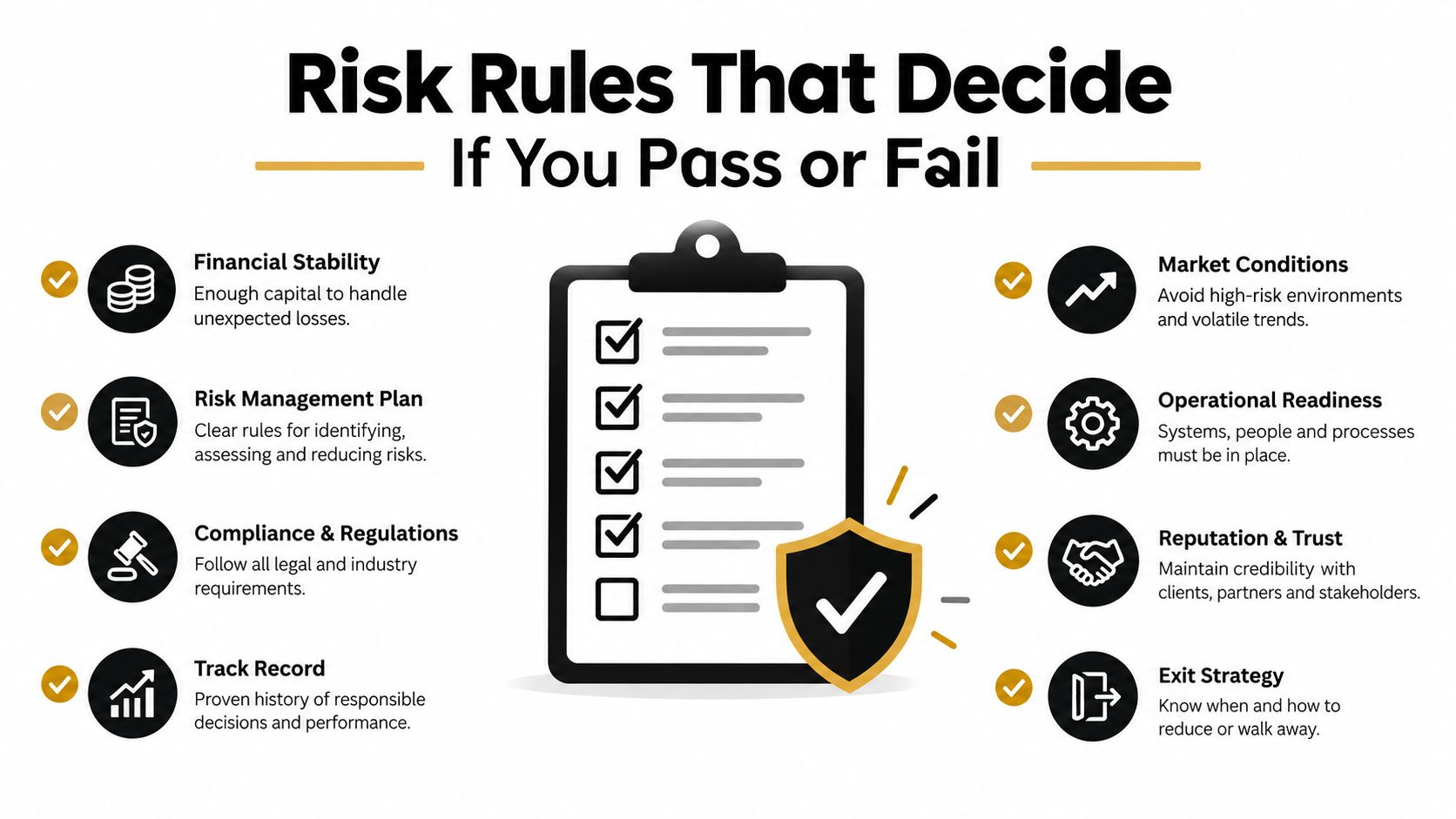
Most traders don't lose an evaluation because their market direction is always wrong. They lose because one oversized position, a cluster of correlated trades, or a volatile session breaches the account's risk boundary. Industry guides estimate that roughly 55% to 65% of failures result from daily or overall drawdown breaches, with common daily limits around 3% to 5% and maximum drawdown around 6% to 10%. See the prop-firm failure and risk-rule statistics for that industry estimate.
MyFundedCapital uses a flat 5% daily loss limit and up to 10% maximum drawdown, according to the program information provided for this article. The daily limit generally resets at a fixed cutoff, often broker or server midnight, rather than exactly 24 hours after you open a trade. That timing can surprise traders who hold positions across the reset.
Equity is the number that can end the account
Many programs measure equity, not just closed balance. Floating losses count, so an open position that later recovers can still breach the rule while it is underwater. An explanation of prop-firm risk rules highlights why real-time equity monitoring matters.
For a simple illustration, assume a $100,000 account with a 5% daily loss limit. A 5% loss equals $5,000. If three correlated positions each show a $1,800 floating loss, the combined equity loss is $5,400, even if each individual trade appears manageable. The account can breach before any trade closes.
Build a personal safety margin
Don't use the firm's maximum as your operating target. Create your own internal stop, such as a daily loss point below the official limit, and stop trading when you reach it. The exact level should match your strategy, but the principle is universal: leave room for spread, slippage, commission, and equity movement.
Use this pre-trade checklist:
- Calculate total exposure: Include open trades and pending orders.
- Group correlated positions: EUR/USD, GBP/USD, and USD-related index exposure may respond to the same event.
- Check the reset time: Know when the daily calculation starts again.
- Watch equity: Don't rely only on closed P/L.
- Stop after a damaged session: Revenge trading turns a manageable loss into a rule violation.
Operational processes matter in any performance-based business, including efforts to protect your affiliate program. The same principle applies here: clear controls and documented rules reduce avoidable disputes.
Platforms Instruments and Strategies You Can Actually Use
A strategy can be profitable in one environment and unusable in another. Before paying for a forex funded program, verify the platform, spread and commission conditions, holding permissions, news rules, and whether automated or copied trades are allowed.
MyFundedCapital supports 350 or more instruments across forex, indices, crypto, and commodities on DXtrade and cTrader, with MT5 listed as coming soon in the supplied product information. It supports manual, algorithmic, and copy trading, but you should confirm the exact rules for your chosen account rather than assuming every method is permitted.
The account should fit your strategy, not the other way around.

Match the environment to your method
- Manual intraday trader: Check execution speed, spread behavior, maximum daily loss calculation, and whether scalping is allowed.
- EA trader: Confirm algorithmic permissions, expert-advisor restrictions, latency rules, and whether trade copying between accounts is limited.
- Crypto swing trader: Verify weekend holding, gap treatment, and whether the instrument remains available during the periods you trade.
- News trader: Check whether news trading is prohibited by default or available through an add-on.
- Multi-asset trader: Confirm contract specifications, trading hours, commissions, and the symbols available on your exact platform.
DXtrade and cTrader are not interchangeable from a workflow perspective. Exported indicators, order controls, templates, and automated systems may require adjustment. Run your process in the actual platform environment before starting the evaluation.
The same check applies to position holding. A strategy that keeps trades open through major announcements needs a different rule set from a strategy that closes before scheduled volatility. Don't buy first and investigate later. Download the terms, list every strategy dependency, and mark each one as permitted, restricted, or unclear.
Your Next Steps to Qualify and Keep Your Funded Account
Start with the rulebook, not the target. Write down the daily loss calculation, maximum drawdown type, reset time, equity treatment, payout conditions, news policy, weekend policy, and prohibited strategies. Then test your own routine against those limits using a demo environment and realistic market quotes.
Your preparation checklist is short:
- Choose a compatible route: Instant Funding, 1-Step, or 2-Step.
- Set a personal loss ceiling: Keep it below the official breach point.
- Trade one repeatable setup: Don't change systems to chase a phase target.
- Track equity continuously: Floating losses can matter before a trade closes.
- Model payouts: Include the split, waiting period, minimum profitable days, and account cushion.
- Verify the provider: Read the legal terms and jurisdiction details before payment.
Payout survival is the test. Industry commentary citing a dataset of 300,000 accounts across 10 firms reported that 7% ever reached a payout, while 60% to 70% of funded traders lost accounts within three months because of rule violations. Those figures are from independent commentary on prop-trading payouts and account survival, and they reinforce a useful question: can your risk process protect the account after you qualify?
Frequently asked questions
Is the account real capital?
Many evaluation and funded accounts operate in demo environments with real market quotes. That means the trading performance is assessed against market movements, but the displayed balance isn't necessarily cash held in a regulated brokerage account for you.
Are payouts guaranteed?
No. A payout depends on eligible performance, compliance with every rule, and the provider's stated process. Check withdrawal conditions before buying and never risk money needed for essential expenses.
Does regulation protect every trader?
No universal protection applies to every forex funded program. Regulatory treatment depends on the provider, activity, and jurisdiction. Review the legal entity, terms, disclosures, and available complaint channels before paying.
How should a beginner prepare?
Trade a test account under the program's exact limits, including equity-based losses and the daily reset time. If you can't follow those rules without rushing, you're not ready to pay an evaluation fee.
Educational publishing also benefits from clear sourcing and transparent explanations, as shown in this finance SEO guide. The same standard is useful when you evaluate a trading provider. Look for precise terms, identifiable responsibilities, and no promises of guaranteed returns.
MyFundedCapital offers Instant Funding alongside 1-Step and 2-Step Challenge options, with account sizes from $5,000 to $100,000 and scaling paths up to $500,000. Review the permitted strategies, loss limits, payout terms, and platform options first, then visit MyFundedCapital to compare account types and decide whether starting a challenge fits your risk plan.
