A step challenge in prop trading is a time-bound evaluation where you must hit a profit target while staying within strict drawdown limits. It comes in a 1-step format, with one evaluation phase, or a 2-step format, with two verification phases.
The popular advice is to choose the fastest route and trade aggressively until the target is reached. That approach misunderstands the test. A challenge usually exposes rule friction, not just poor market analysis. You can read the market correctly and still fail by overtrading, revenge trading, or allowing one volatile session to breach a loss limit. This guide explains how challenge structures shape trader behavior, which rules matter, and how to match an evaluation to your actual execution style. Trading involves risk of loss, and this article is educational only, not financial advice.
Free resources: Prop Trading Challenge Survival Guide (the math behind the rules and the habits that get traders through).
What a Step Challenge Actually Is
Most traders first ask, “what is a step challenge?” In proprietary trading, it's a structured evaluation that tests whether you can generate returns while respecting predefined risk controls. You trade under a simulated account framework, follow the firm's rules, and try to reach a stated profit objective without exceeding daily or overall drawdown limits.
The firm isn't only testing whether you can predict direction. It's testing whether you can repeat a controlled process when the account is under pressure. That distinction matters because a profitable strategy can still be unsuitable for a challenge if it relies on oversized positions, uncontrolled news exposure, or extended periods of recovery trading.
The real purpose of the evaluation
A prop firm uses an evaluation to filter for risk management, consistency, and rule adherence. Profitability is necessary, but it's only one part of the assessment. The trader also has to preserve the account while dealing with losing trades, changing volatility, and the psychological pressure created by a fixed target.
The most common failure is often not a bad market read. It's what happens after the bad read:
- Overtrading The trader increases frequency to recover a loss or reach the target sooner.
- Revenge trading A losing position becomes an emotional reason to enter another position without a valid setup.
- Poor session discipline The trader continues after reaching a personal loss limit or after market conditions deteriorate.
- Concentrated exposure Too much of the evaluation result depends on one position, one session, or one event.
A step challenge is therefore a behavior test disguised as a profit test. The target gives you a destination, while the drawdown rules define the road you're allowed to take.
Why the word “step” matters
The word can describe a staged path to funding, rather than a single trade or strategy. One-step challenges are single-phase evaluations with one profit target and tighter risk limits, while two-step challenges add a second verification phase that can reduce pressure but lengthen the path to funding, as described in this comparison of one-step and two-step trading challenges.
That structure changes how you should trade. A one-step account may encourage faster progress, but the compressed format can tempt traders to increase risk. A two-step account gives you another checkpoint, yet the longer process can create impatience and unnecessary activity. Neither format removes risk. Each one tests whether your normal process survives its particular restrictions.
1-Step vs 2-Step Challenge Structures
The number of evaluation phases changes how traders behave under pressure. A 1-step challenge compresses the path to funding into one pass, so each losing trade can feel more consequential. A 2-step challenge spreads the evaluation across two stages, giving traders more time, but also creating another checkpoint where discipline must hold.
A 1-step challenge has one evaluation phase and one profit target. A 2-step challenge divides the evaluation into two stages, usually with separate objectives and risk conditions. Common prop-firm structures place the first-stage target around 8–10%, with later stages often requiring less, while drawdown limits commonly fall within the 5–10% range, according to this overview of prop-firm challenge rules.
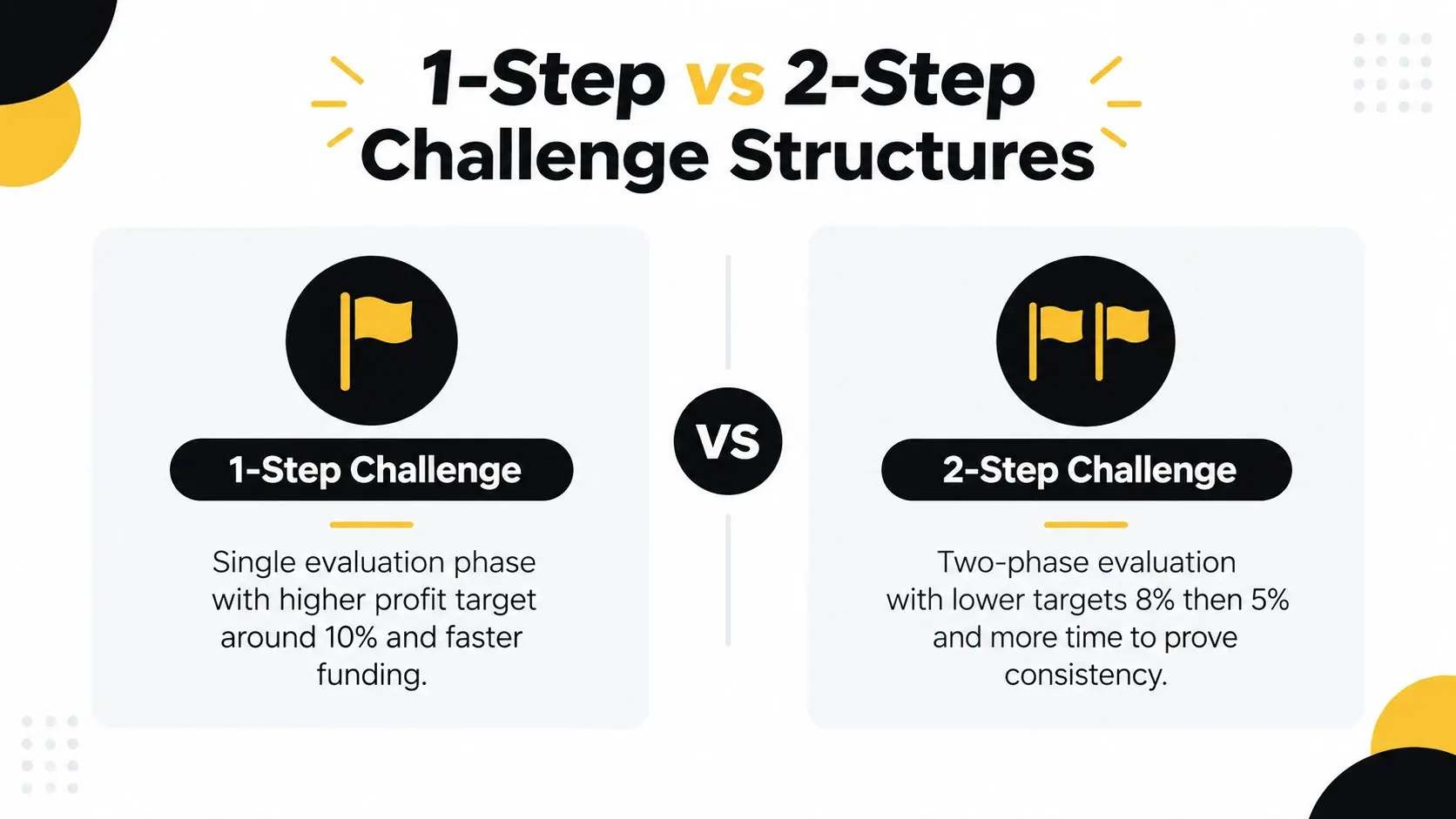
Side-by-side comparison
| Feature | 1-Step Challenge | 2-Step Challenge |
|---|---|---|
| Evaluation phases | One phase | Two verification phases |
| Profit objective | Usually one fixed target, often around 10% | Often a higher first-stage target followed by a lower second-stage target |
| Risk pressure | More compressed, often with tighter intraday controls | Spread across two stages, which can reduce single-phase pressure |
| Drawdown measurement | May use static or trailing rules | May differ by phase and account model |
| Funding path | Potentially faster | Longer, with another verification checkpoint |
| Best fit | Traders with controlled, repeatable execution | Traders who benefit from more time to demonstrate consistency |
These are broad structures, not a universal rulebook. Each firm can set its own target, daily loss limit, drawdown calculation, trading-day requirement, and permitted strategies. Read the official rules before purchasing an evaluation. This explanation of what two-stepping means also clarifies how the staged format works.
How structure changes behavior
One-step models create urgency. A trader who sees one target and one phase may increase position size, trade more often, or accept marginal setups to reach the objective sooner. That approach can produce quick progress, but it leaves less room for a normal losing sequence and makes a single execution error more damaging.
Two-step models shift the failure pattern. The first phase may feel like the main hurdle, leading some traders to relax after passing it. Others become impatient during the longer process and manufacture trades during quiet conditions. The second phase still requires the same control over entries, stops, exposure, and daily stopping rules.
The better choice depends on your execution rhythm. Traders with frequent, small, rule-based setups may prefer the clearer, faster path of a 1-step structure, provided they can resist increasing risk. Traders who wait for selective setups may fit a 2-step structure better, because the extra phase can reduce pressure to force trades. Holding period and firm rules still matter. A structure that looks easier on paper can conflict with how you manage positions.
Key Rules and Risk Parameters
A challenge's profit target is easy to see, but the loss mechanics decide whether your strategy remains usable. Translate every rule into a daily operating limit before choosing an account. The target belongs in your plan. The drawdown calculation belongs in your execution platform, journal, and stop-trading routine.
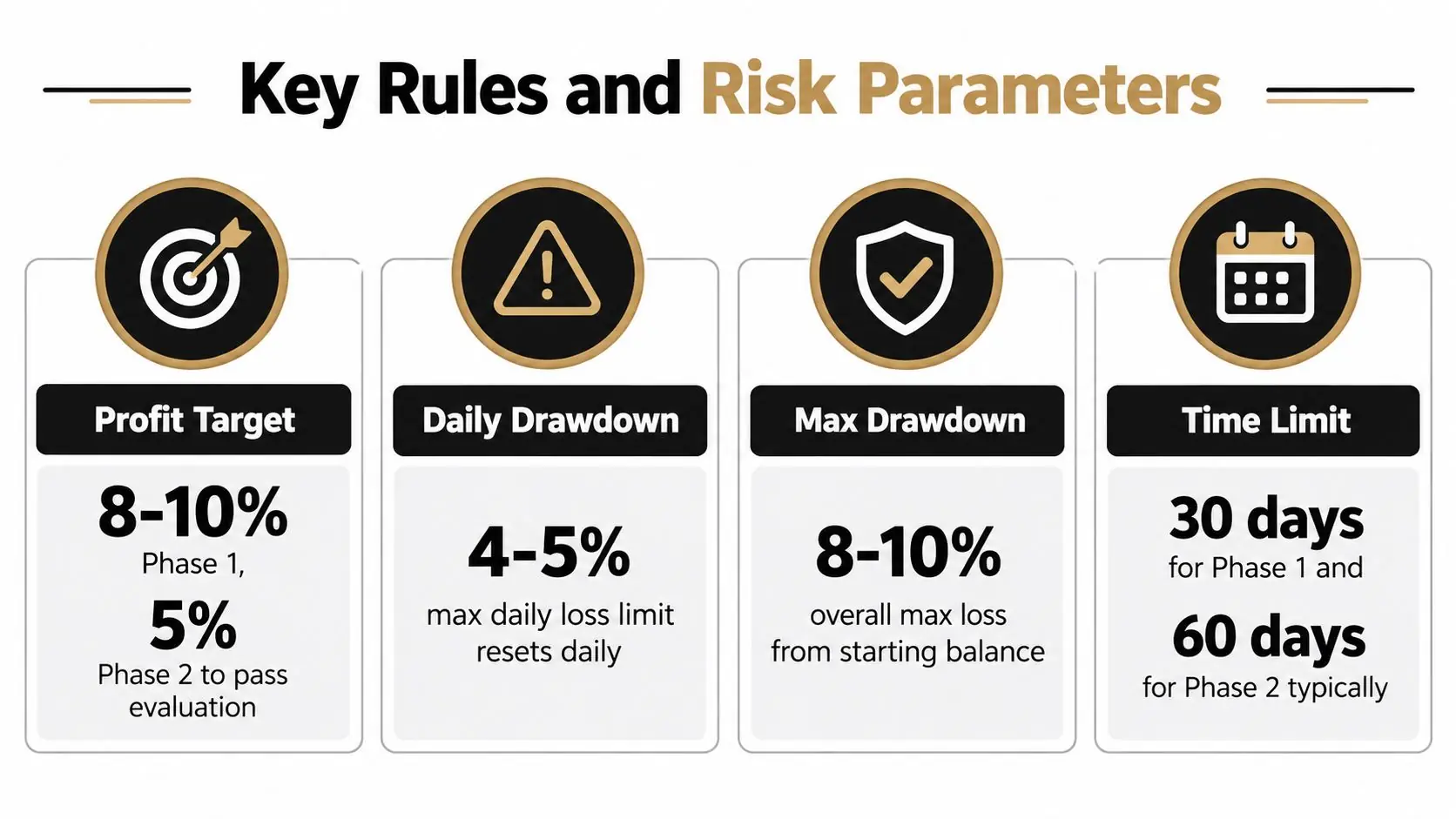
The rules that change your execution
Profit target: Use the target as a finish line, not a daily quota. If your trading plan requires a certain result every session, you will eventually increase size or accept a weak setup. Set a personal risk limit and let valid opportunities determine your trading frequency.
Daily loss limit: The firm's limit is the breach point, not your working stop. Set your own lower threshold so spread changes, slippage, and open-trade fluctuations do not push the account over the line. Confirm how floating losses are counted and when the daily calculation resets. A reset that occurs during your active session can change how much risk remains available.
Maximum drawdown: Identify whether the limit uses the starting balance, current balance, equity, or highest account value. Static and trailing limits produce different behavior. A trailing floor can rise after profitable trades, leaving less room for a later position even if the account remains above its starting level. Position size should reflect the remaining distance to that floor, not only the original account size.
Time and trading-day rules: A deadline or minimum trading-day requirement changes session selection. A multi-session strategy may become impractical if positions must be closed quickly, while a minimum activity rule can tempt selective traders into unnecessary entries. Check holding restrictions before adapting the strategy.
Review the firm's step challenge rules and write each condition as a setting in your journal or risk calculator.
Turn rules into operating decisions
- Drawdown basis If the limit trails equity, reduce size after gains because the account floor may have moved higher. If it is static, calculate risk from the remaining fixed buffer.
- Daily reset Record the reset time in your platform. Stop opening new positions before the limit becomes difficult to calculate across sessions.
- Position rules If stop losses are required, place them as part of the entry process. If tick-scalping or latency-based methods are restricted, remove those setups from the plan rather than treating them as exceptions.
- Holding rules If weekend or multi-session exposure is restricted, close positions according to the rule and avoid building a strategy around unavailable holding time.
- Payout conditions Caps, cycles, and consistency requirements affect how quickly you can reduce exposure after reaching a profit threshold.
A published rule set can permit news trading and omit a required stop loss while restricting copy trading to the trader's own positions. It can also specify a 5% profit cap per cycle, a 5% maximum withdrawal per cycle, and 10% maximum drawdown from the initial balance, as described in this two-step challenge FAQ. The product name does not tell you how the account behaves. Only the written rulebook does.
Why Traders Fail Step Challenges
The belief that traders fail because they lack a profitable strategy is incomplete. Many failures occur after the trader has identified a valid setup but violates the account's operating limits while managing the position.
A fixed target creates a measurable gap between the current result and the required result. When that gap feels too large, traders often increase trade frequency. After a loss, they may increase size. After a winning streak, they may become overconfident and loosen their filters. The account fails because the process changes, not necessarily because the market analysis was useless.

The failure sequence
A common sequence looks like this:
- The trader starts with a valid setup and takes a loss.
- The trader treats the loss as a problem to solve immediately.
- A lower-quality entry appears, and the trader takes it with larger size.
- Volatility expands, the daily limit approaches, and decision quality deteriorates.
- The trader keeps trading because stopping feels like accepting failure.
That sequence is rule friction. The trader's normal habits collide with the account's constraints. A discretionary trader who usually holds through major events may be exposed to a breach if news trading isn't allowed. A swing trader may struggle if weekend holding is prohibited. A news trader may have a valid event-driven edge, but still face unacceptable execution risk when spreads widen.
Volatility and psychological pressure
High-impact releases such as NFP, FOMC, and CPI can produce rapid price movement. A correct directional thesis doesn't protect an account from a drawdown breach if the entry experiences an adverse spike, widened spread, or poor fill. That's why pre-planning around economic events matters more than reacting after volatility has already expanded.
Psychology compounds the problem. Revenge trading, FOMO, and overconfidence after winning streaks can all move a trader away from the written plan. A rule-based system can reduce these impulses by blocking entries during excluded events and stopping after a predefined session loss. A discretionary trader needs a manual equivalent, such as a written event checklist and a mandatory platform shutdown.
The challenge doesn't reward the trader who can make the most in one session. It rewards the trader whose process remains intact when the account is not going their way.
The uncomfortable conclusion is that a challenge rewards a particular risk-management style. Adapt your process to the rules before you adapt your strategy to the target.
How to Pass a Step Challenge
Passing starts before the first position. Download the rulebook, mark every hard limit, and write a smaller personal limit beneath each one. If the firm permits a daily loss of around 5%, your own stop should be conservative enough that a final spread adjustment or open-trade move won't create an accidental breach.
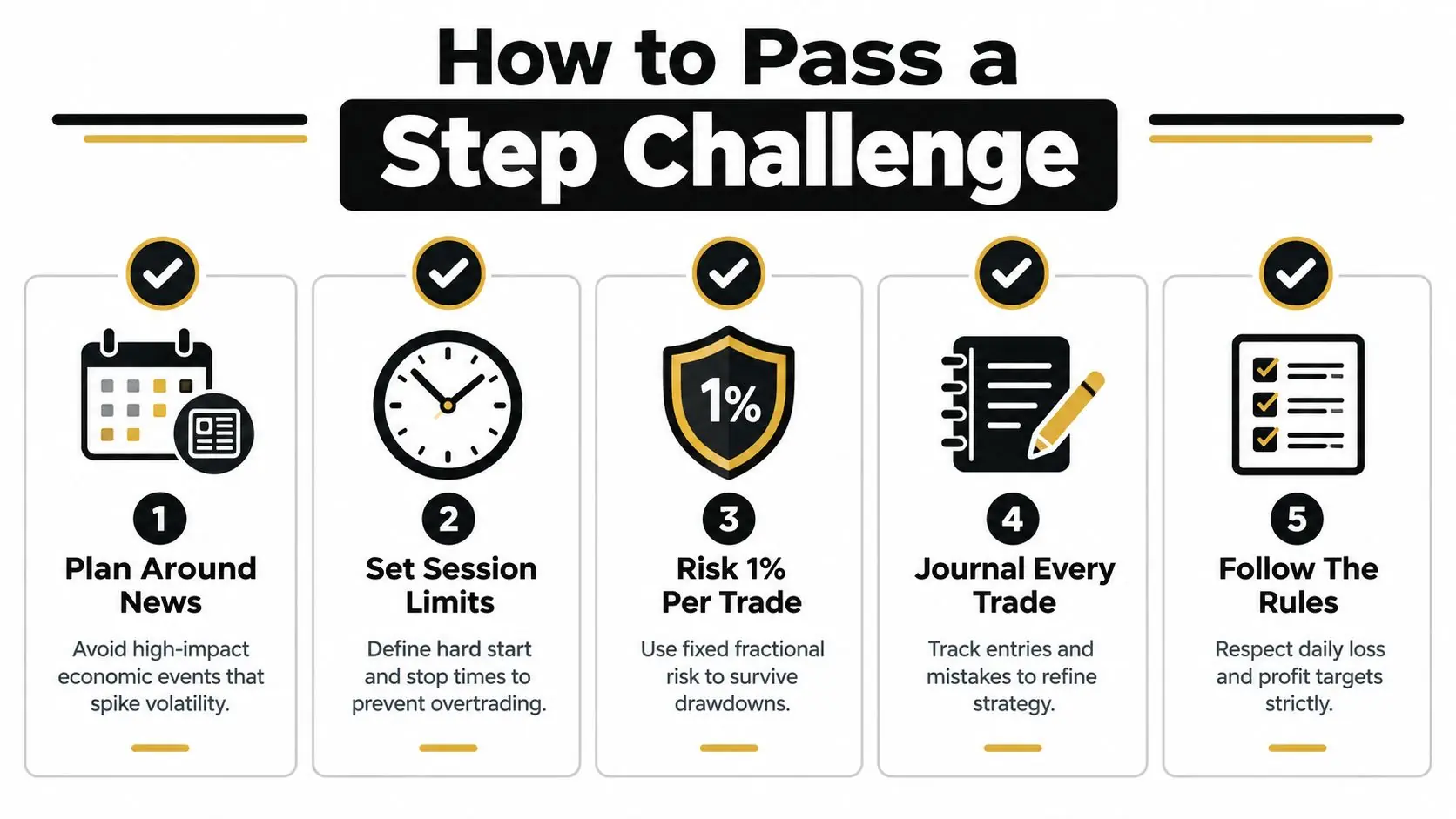
Prepare the operating plan
Plan around news: Mark NFP, FOMC, CPI, and other high-impact events before the trading week begins. If the account restricts news trading, flatten positions according to the firm's exact policy rather than relying on memory.
Set session limits: Define the time you'll trade, the maximum number of attempts, and the loss that ends the session. A stop time matters because fatigue often turns a reasonable strategy into impulsive execution.
Size for the worst case: Calculate position size from the stop distance and the account's drawdown structure. Don't size from the profit target. The target is an outcome; risk is the variable you control.
The infographic suggests 1% per trade as a fixed-fractional reference, but that figure must be treated as a planning example, not a universal recommendation. Your appropriate risk depends on the firm's limits, strategy, instrument, correlation, and execution quality.
Make discipline visible
Systematic traders can encode stops, session limits, and event filters into an expert advisor or execution layer. That doesn't eliminate risk, but it reduces the chance that an emotional decision overrides the operating plan.
Discretionary traders need equivalent checkpoints:
- Before entry Confirm setup, stop, size, event status, and available drawdown.
- After a loss Wait for the next planned setup instead of trying to recover immediately.
- After a win Keep the same size unless the written plan permits a change.
- At the session limit Close the platform and record the result.
- At the target Review the firm's rules before continuing to trade.
Journal every trade with the reason for entry, exit, market conditions, and any rule deviation. A journal should expose the behavior that creates breaches, not just collect screenshots of winning trades. Traders comparing a staged evaluation can also review this step-one breakdown before deciding whether the single-phase format suits their process.
Your best challenge plan is boring by design. It prevents one emotional decision from becoming an account-level event.
Choosing the Right Challenge for Your Style
Choose the evaluation around your execution pattern, not the advertised speed. The right structure reduces the number of situations in which your normal method conflicts with the rules.
Match the format to the method
A systematic or algorithmic trader may prefer a one-step challenge when the thresholds are clear and the system can enforce daily stops, event filters, and position limits automatically. The advantage isn't that one step is easier. It's that a codified process can handle a compressed evaluation without relying on discretionary restraint.
A discretionary intraday trader should inspect the daily loss calculation, reset time, and restrictions around news. If the strategy requires multiple attempts during a session, a tight intraday limit can become more important than the headline profit target.
A swing trader needs to verify weekend holding, overnight exposure, and trailing drawdown mechanics. A two-step structure may provide more room to demonstrate selective execution, but only if the holding rules accommodate the strategy.
Check specialist requirements
News traders should confirm whether NFP, FOMC, CPI, and other high-impact events are permitted, including whether positions may remain open during releases.
Crypto traders need to check weekend conditions, instrument availability, spreads, and whether the account's drawdown calculation behaves differently during continuous markets.
Copy-trading practitioners should verify whether copying is allowed, whether trades must originate from their own account, and whether the firm restricts third-party signals or account mirroring.
Algo traders should test platform compatibility, execution behavior, and whether the strategy uses tick-level methods that the rulebook restricts.
The same account can be suitable for one trader and structurally hostile to another. Don't choose a two-step challenge just because it appears more forgiving, and don't choose one step merely because the funding path sounds faster. Compare the restrictions with your actual trade duration, event exposure, average frequency, and stopping behavior. Trading involves risk of loss regardless of the format.
Frequently Asked Questions
Do step challenges reward skill or a specific risk style?
Both, but the evaluation strongly favors traders who can control exposure. A strong market read doesn't compensate for excessive concentration, revenge trading, or a drawdown breach.
Should I change my strategy for the challenge?
Change the execution framework first. Add event filters, hard session limits, and conservative sizing before deciding that the underlying strategy needs replacing.
Is a 1-step challenge always easier?
No. A one-step model can shorten the path, but it may apply tighter risk controls and create more pressure around one target. A two-step model takes longer and adds another checkpoint, which can suit traders who need more time to prove consistency.
What should I compare before starting?
Read the complete rules for profit targets, daily loss, maximum drawdown, its calculation basis, news trading, weekend holding, copy trading, minimum trading days, and payout conditions. Then choose the structure your process can follow without improvisation.
MyFundedCapital offers Instant Funding alongside 1-Step and 2-Step Challenges, with simulated trading environments, manual, algorithmic, and copy-trading support across a broad range of instruments. Visit MyFundedCapital to review the funding programs, compare account types, and start a challenge only after confirming that its rules fit your execution style.