Confidence doesn't come from repeating positive statements until doubt disappears. For traders, it comes from evidence: documented decisions, simulated execution, controlled position sizing, repeatable routines, honest loss analysis, and responsible progression. These confidence building strategies can strengthen trust in your process, but trading involves risk of loss, this material is educational only, and no strategy guarantees profits. If anxiety or attention challenges affect your self-belief, you may also find this guide to boost confidence with ADHD useful as broader personal-development context.
Free resources: Trading Psychology Drills (six five-minute exercises for before, during and after a session).
1. Track and Review Your Trading Journal Daily
A trading journal turns vague confidence into an observable record. For every position, capture the setup, entry and exit, stop placement, target, market context, reason for entry, emotional state, and whether you followed your rules. The outcome matters, but the quality of the decision matters just as much.
Daily review helps you separate a losing trade from a bad trade. A valid setup can lose, while an undisciplined trade can win. That distinction prevents one fortunate outcome from reinforcing poor habits.
A structured journal can include:
- Pre-trade confidence Record a confidence estimate from 0 to 100% before entering, then compare it with the eventual result. This follows a calibration approach described in research on measuring trading confidence.
- Execution quality Mark whether you entered, managed, and exited according to the plan.
- Emotional state Note fear, urgency, boredom, frustration, or calmness in plain language.
- Context Record session, instrument, timeframe, volatility conditions, and relevant news.
- Review cadence Log the trade soon after closing, while the reasoning and emotions are still accessible.
A spreadsheet, Google Sheet, Edgewonk, or Tradervue can all work. The tool matters less than consistent entries. Over time, the journal can show whether your confidence is supported by repeatable execution or inflated by a short run of favorable outcomes.
Practical rule: Use journal evidence to update your trading plan periodically, not to second-guess every individual setup.

A useful explanation of the practice appears in this guide to what a trading journal is. The central benefit is simple. You're no longer asking, “Am I good at this?” You're asking, “Which decisions do I execute well, and which conditions repeatedly expose weaknesses?”
2. Establish and Test a Documented Trading Plan Before Going Live
Live confidence often collapses because the trader is building the decision while managing the position. A written plan removes that improvisation. It should define the setup, entry trigger, invalidation point, stop-loss method, profit-taking rule, trading hours, instruments, and conditions that cancel a trade.
Write rules that another trader could understand. “Enter when the chart looks strong” is too subjective. “Enter after a defined breakout, confirmation, and stop placement” is testable, provided the terms are clearly defined.
Test the logic, not just the story
Backtesting and demo execution can reveal whether a plan survives different conditions. Record the number of trades tested, win rate, average win and loss, maximum consecutive losses, drawdown, and every deviation from the rules. The self-efficacy research associated with Albert Bandura supports a broader principle relevant here: confidence grows most reliably through repeated mastery experiences, not reassurance alone.
Your plan should also contain a deviation log:
- Rule broken State exactly what changed.
- Trigger Identify fear, greed, boredom, urgency, or outside influence.
- Immediate result Record the trade outcome without using it to excuse the violation.
- Repair Decide whether the issue needs a behavioral intervention or a plan revision.
A plan that wins in historical testing but cannot be followed in real time isn't complete. Conversely, a losing trade doesn't automatically invalidate the plan. The evidence must distinguish normal variance from a flawed assumption.

Before risking capital, test the plan under more than one market condition. A trader who wants to practice structured currency trading on a demo account can use the process to compare intended behavior with actual execution. The result isn't certainty. It's a clearer estimate of what the strategy can and cannot do.
3. Use Demo or Simulated Trading to Build Execution Confidence Without Capital Risk
Backtesting answers a historical question. Demo trading answers a live-market execution question without exposing the account to the same financial loss. Prices move in real time, alerts trigger imperfectly, entries can be missed, and the trader still has to manage hesitation, impatience, and the urge to interfere.
Treat simulation as a rehearsal, not entertainment. Use the same instruments, sessions, rules, and intended position-sizing method that you'd use later. If you practice with unrealistic trade sizes or ignore losing periods, the confidence you build may not transfer to live conditions.
Make the rehearsal demanding enough
A useful simulated-account review should include:
- Platform fidelity Practice on the platform you expect to use, such as DXtrade, cTrader, or MT5.
- Process fidelity Use the same checklist, alerts, stop logic, and exit rules.
- Emotional notes Record hesitation, early exits, revenge-trading impulses, and overconfidence after wins.
- Decision checkpoints Review results at regular intervals and extend the practice period when execution remains inconsistent.
- Failure rehearsal Study how you respond to drawdown, missed trades, slippage, and consecutive losses.
The distinction between confidence and self-efficacy matters here. Confidence may fluctuate by task or situation, while self-efficacy develops through mastery, encouragement, observation, and anxiety regulation. A 2025 university study discussed by the University of Michigan highlights those mechanisms, which helps explain why repeated, controlled practice is more useful than motivational slogans.
You can also practice Bitcoin and Ethereum trading in a simulated setting before deciding whether the volatility suits your plan. The trade-off is clear. Demo trading reduces financial exposure, but it may not reproduce every emotional response associated with real loss. Use it as a bridge, not proof that live trading will feel identical.

4. Start With Micro-Sized Positions and Scale Up Gradually
Position size can overpower a sound strategy. If one ordinary loss feels personally threatening, the trade is probably too large for your current psychological tolerance. Smaller sizing gives you room to execute the plan without allowing fear or excitement to dictate the next decision.
A commonly used risk-control rule is to limit risk on a single trade to 1% to 2% of account equity, as described in this risk-management guidance for traders. That rule doesn't make a strategy safe or profitable, and it shouldn't be treated as universal advice. It does provide a concrete boundary that can stop confidence from turning into recklessness.
Use a staged approach:
- Define the maximum loss Calculate the intended account risk before placing the order.
- Set the stop first Position size should respond to the stop distance, not the other way around.
- Keep size fixed Don't increase exposure because of a winning streak.
- Set a progression checkpoint Scale only after your journal shows consistent rule adherence and acceptable behavior.
- Stop after a defined daily loss Continuing to trade in an emotionally impaired state can turn a controlled loss into a larger one.
Position sizing is also a confidence test. If you repeatedly want to move the stop, widen risk, or recover losses immediately, your size may be too large or your plan may not be trusted. Reducing exposure can reveal whether the problem is strategy quality or emotional overload.
Confidence should make you more consistent, not more aggressive.
The strongest progression is usually boring. Prove that you can execute at a manageable size, review the evidence, and scale only when the larger exposure remains psychologically and mathematically tolerable. Trading involves risk of loss at every size.
5. Develop a Pre-Trade and Post-Trade Routine to Anchor Mental Discipline
A routine creates a pause between market movement and trader reaction. Without one, a trader can enter because of urgency, move a stop because of fear, or take another position to erase the emotional discomfort of a loss.
A pre-trade routine might take only a few minutes. Read the setup rules, check scheduled market conditions, confirm the entry and invalidation point, calculate position size, and ask whether the trade still qualifies. A short breathing exercise can help you notice activation, but it shouldn't override a risk rule or turn an invalid setup into a valid one.
Keep the post-trade review factual
Immediately after closing, record:
- Execution Did the entry and exit match the plan?
- Emotion Were you calm, forced, lucky, fearful, or impatient?
- Management Did you interfere with the position?
- Lesson What single process point deserves attention next time?
- Reset What action ends the trade psychologically before the next decision?
Scalpers may need a brief reset between positions. Swing traders may have more time to review context and management. The routine should fit the strategy, because an elaborate ritual that you skip has less value than a short checklist you consistently complete.
A practical implementation intention can be written as an if-then rule: “If I feel an urge to increase size after a win, then I will pause, reread my risk limit, and recalculate the order.” This makes the response specific before pressure arrives.
Track routine compliance separately from profitability. A profitable trade taken outside the plan is not evidence that the routine is unnecessary. A losing trade taken exactly according to the plan may still represent good process.
6. Study Market Failures and Your Trading Losses to Identify Root Causes
Loss analysis should answer one question: What failed, and what can be changed without distorting the evidence? Blaming the market protects the ego but leaves the process unchanged. Blaming yourself for every loss is equally unhelpful because valid setups can lose.
Classify each losing trade as one of four categories:
- Plan The rules were followed, but the underlying idea may be weak.
- Execution The trader entered late, exited early, moved the stop, or broke another rule.
- Risk The position was too large, the stop was unsuitable, or exposure was concentrated.
- External News, liquidity, platform behavior, or execution conditions affected the trade.
This classification prevents a common analytical error. Traders often redesign a profitable system after an execution mistake, then repeat the same behavioral error under the new system.
Review the pattern, not just the last loss
A single loss rarely proves much. Group losses by instrument, session, setup, market condition, and emotional state. Look for repeated causes across the journal. A trader who sees that losses cluster around impulsive entries has a different repair task from one whose losses occur despite clean execution during a specific market regime.
The research on overconfidence in trading and investing describes miscalibration as a situation in which investors overestimate the precision of their information. That insight has a direct practical implication. Confidence should narrow only when the record supports narrower expectations, not because a trader feels certain.
After a losing day, write a short diagnosis and one corrective action. Then test the correction rather than changing several variables at once. This approach protects learning from emotional overreaction.
7. Join a Trading Community or Accountability Partner for Shared Learning and Honest Feedback
Trading alone can make normal uncertainty feel like personal failure. A trustworthy community gives you a second perspective on process, but it shouldn't become a source of signals, pressure, or social proof.
Choose accountability based on behavior rather than prediction. A useful partner asks whether you followed the plan, respected the risk limit, logged the trade, and reviewed the result. They don't need to forecast the next candle to help you improve.
Use community support without outsourcing judgment
A productive arrangement might include:
- Pre-session commitment State the instruments, setups, and maximum intended exposure.
- Post-session report Share whether you followed the rules, not only the profit or loss.
- Loss review Present the evidence and invite challenge to your diagnosis.
- No signal dependence Make your own trade decision and document the reasoning.
- Privacy boundaries Don't share sensitive account details or follow unverified claims.
A community can normalize difficulty, expose rationalizations, and show alternative ways to solve a process problem. It can also damage confidence when members display only wins, encourage oversized trades, or treat losses as proof of incompetence. The environment matters.
MyFundedCapital describes an active Discord community and multilingual support as part of its operating model, which may be relevant for traders who want a structured place to discuss routines and rule interpretation. Still, community feedback is not independent validation of a strategy. Your journal remains the primary evidence.
Confidence grows when outside feedback improves your decisions without replacing your responsibility for them.
8. Leverage MFC Funding Structure and Evaluation to Build Practical Confidence
A funding evaluation can function as a structured test of discipline, but it shouldn't be treated as a shortcut to confidence. MyFundedCapital offers Instant Funding and 1-Step or 2-Step Challenges, with account sizes described from $5K to $100K and scaling paths up to $500K in the publisher information. These figures describe available program structures, not expected earnings or a promise of access.
The relevant question is whether your process can operate within the rules. MFC's stated risk parameters include a 5% daily loss limit and up to 10% maximum drawdown, according to the publisher information. A trader should review the current terms directly because rule interpretation, instruments, platform conditions, and optional features can affect execution.
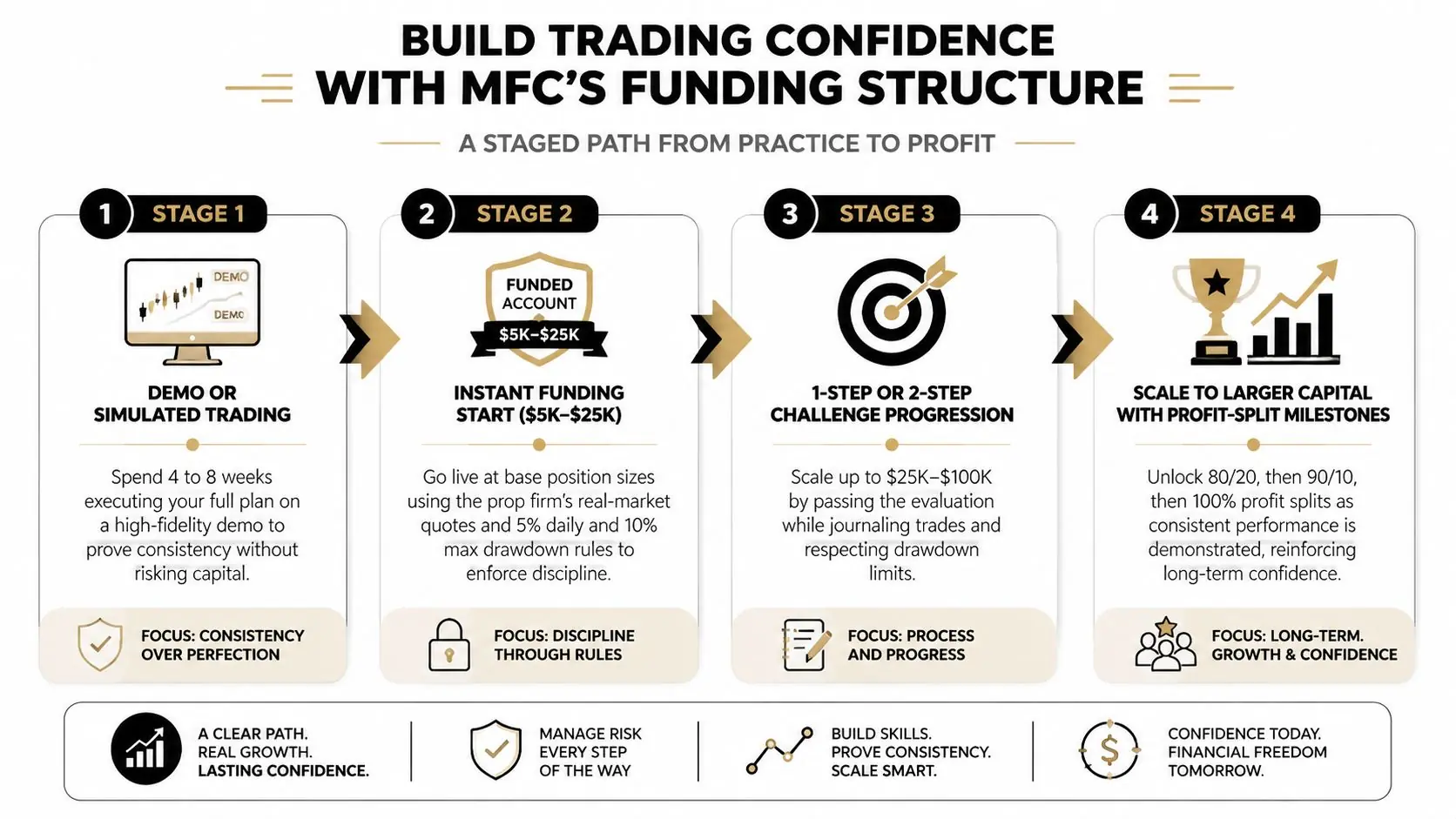
Use the structure as a sequence of checks:
- Read the rules Study daily loss, maximum drawdown, holding, news, payout, and platform requirements.
- Match the account to your process Don't choose a format solely because the nominal account size looks attractive.
- Rehearse constraints Test your strategy with the same practical restrictions before paying for an evaluation.
- Track rule distance Record how close each session comes to a loss limit.
- Scale cautiously Increase exposure only after repeated evidence of disciplined execution.
You can review the MFC 1-Step Challenge rules before making a decision. Evaluation results are useful evidence, but they still don't prove permanent profitability. Funding accounts described by MFC operate in demo environments with real market quotes, so traders should understand exactly what that means for execution, payouts, and risk before participating.
9. Use Mental Skills Training to Regulate Fear, Urgency, and Overconfidence
Mental skills training works best when it supports a defined trading process. It can help you notice fear, urgency, or excessive excitement before those states alter your behavior. It can't convert a weak strategy into a strong one, remove market uncertainty, or guarantee calm execution.
Use short exercises that are easy to repeat:
- Paced breathing Spend a few minutes slowing your breathing before the session or after a stressful trade.
- Visualization Rehearse following the stop-loss and accepting a valid loss without interference.
- Implementation intentions Write an if-then response for common impulses, such as revenge-trading or increasing size after wins.
- Pause rule Step away when emotional intensity makes your written rules difficult to follow.
- Process measurement Record checklist completion and rule adherence rather than judging yourself only by the trade result.
A trader might write, “If I want to increase position size after two wins, I'll pause and verify the original risk limit.” Another might rehearse, “A valid stop-loss is an operating cost, not a personal verdict.” The value comes from testing whether these prompts improve decisions, not from repeating them as magical affirmations.
Confidence also needs emotional boundaries. If anxiety affects daily functioning or repeatedly prevents you from following your plan, consider qualified support such as anxiety counselling in Kelowna. Trading decisions should never be used as a substitute for mental-health care.
9-Point Confidence-Building Strategies Comparison
| Practice | 🔄 Implementation Complexity | ⚡ Resource Requirements | ⭐📊 Expected Outcomes | 💡 Ideal Use Cases | Key Advantages |
|---|---|---|---|---|---|
| Track and Review Your Trading Journal Daily | 🔄 Moderate, 15–30 min/day discipline | ⚡ Low, spreadsheet or journaling software, daily time | ⭐📊 Clear pattern ID, improved calibration, reduced emotional trades | 💡 Traders scaling accounts; funded-challenge prep; continuous improvement | ⭐ Objective evidence, faster learning, accountability |
| Establish and Test a Documented Trading Plan Pre‑Live | 🔄 High, 10–20 hrs to write & backtest; ongoing updates | ⚡ Moderate, backtesting tools (TradingView/MT5), demo, 50+ trades | ⭐📊 Proven rules, measurable metrics (win rate, profit factor), less second‑guessing | 💡 New live traders; challenge applicants; strategy validation | ⭐ Rule-based decisions, measurable benchmarks, psychological anchor |
| Use Demo or Simulated Trading to Build Execution Confidence | 🔄 Moderate, 4–8 weeks of disciplined demo trading | ⚡ Medium, high‑fidelity demo, journal, time commitment (weeks) | ⭐📊 Execution muscle memory, real‑time fills/slippage insight, safer transition to live | 💡 Moving from backtest to live; EA validation; practicing execution | ⭐ Low‑risk practice; reveals execution gaps before capital risk |
| Start with Micro‑Sized Positions and Scale Up Gradually | 🔄 Low–Moderate, set size rules and scaling milestones | ⚡ Low, position‑size calculator, clear scaling plan | ⭐📊 Reduced psychological impact, fewer catastrophic losses, steady scaling | 💡 Small accounts; funded progression; risk‑averse builders | ⭐ Protects psychology; enforces discipline; mirrors prop‑firm scaling |
| Develop a Pre‑Trade and Post‑Trade Routine to Anchor Discipline | 🔄 Low, short repeatable rituals (5–10 min pre, 2–3 min post) | ⚡ Minimal, checklist, timer, journal | ⭐📊 Less impulsivity, higher rule adherence, fewer revenge trades | 💡 Traders prone to emotional trading; those under daily loss limits | ⭐ Automates focus, prevents tilt, improves consistency |
| Study Market Failures and Your Trading Losses to Identify Root Causes | 🔄 Moderate, systematic, honest post‑loss analysis | ⚡ Low, spreadsheet, 20–30 min per loss review | ⭐📊 Root‑cause fixes, fewer repeat mistakes, clearer system vs. execution issues | 💡 Traders with recurring losses or unexplained drawdowns | ⭐ Turns losses into actionable improvements; separates skill from luck |
| Join a Trading Community or Accountability Partner | 🔄 Low, join, post, and check in regularly | ⚡ Low, time for meetings/forums, shared resources | ⭐📊 Faster learning, external feedback, reduced isolation and shame | 💡 Isolated traders; those needing honest feedback or motivation | ⭐ Reality checks, shared knowledge, accountability |
| Leverage MFC Funding Structure and Evaluation | 🔄 Moderate, follow Challenge/Instant Funding rules and stages | ⚡ Medium, challenge fees, adhere to 5% daily & 10% DD, demo prep | ⭐📊 Measured progression to larger capital, enforced discipline, realistic simulated pressure | 💡 Traders seeking funded accounts and staged scaling | ⭐ Stagewise roadmap, real‑market quotes, profit‑split incentives |
| Use Mental Skills Training to Regulate Fear and Overconfidence | 🔄 Low–Moderate, short, repeatable exercises needing practice | ⚡ Low, 2–5 min techniques, optional coach | ⭐📊 Better emotional regulation, fewer impulse and size‑increase errors | 💡 Traders who tilt after wins/losses or during drawdowns | ⭐ Creates pause, supports adherence to rules, complements technical controls |
Turn Confidence Into a Repeatable Trading Process
The most reliable confidence building strategies create a chain of evidence. First, record decisions in a journal. Then test a written plan, practice execution in simulation, reduce position size until you can follow the rules calmly, and build routines that make good behavior easier under pressure. After losses, diagnose the cause instead of protecting your pride or replacing the system impulsively.
The sequence matters. A trader who joins a community before developing independent records may absorb other people's certainty without learning their own patterns. A trader who chooses funding before testing the applicable drawdown rules may confuse account access with readiness. A trader who increases size after a winning streak may mistake favorable variance for durable skill.
The workplace evidence in the Pew-related confidence discussion also points to an important general principle. Confidence affects advancement behaviors such as speaking up, requesting opportunities, and negotiating. In trading, the equivalent behaviors are operational: placing the planned trade, accepting the planned stop, recording the result, and refusing an invalid setup. Confidence becomes useful when it changes behavior in a controlled direction.
FAQ
How long do confidence building strategies take to work?
There isn't a universal timetable. Confidence develops as you collect enough consistent evidence across planning, execution, risk control, and review. A short winning run can feel encouraging, but it shouldn't be treated as proof that a process is solid.
Is demo trading enough?
Demo trading is valuable for testing live execution without risking capital, but it may not reproduce every emotional response associated with real financial loss. Combine simulation with journaling, rule-based review, and conservative sizing if you later move to live-style conditions.
How much should I risk per trade?
A commonly used rule is 1% to 2% of account equity on a single trade, as outlined in this risk-management source. That's a reference point, not personalized financial advice. Your size should also reflect strategy volatility, account rules, experience, and your ability to remain disciplined during losses.
How does confidence differ from overconfidence?
Confidence is calibrated trust in a process. Overconfidence appears when certainty exceeds the evidence, information is treated as more precise than it is, or risk expands without justification. A forecast log, position-sizing rule, and loss review can expose that gap.
MyFundedCapital may be relevant to traders who want to test their process within a defined funding structure, but trading involves risk of loss and participation doesn't guarantee payouts or profits. Review the current rules, platform conditions, drawdown limits, and account format before deciding whether a challenge or funding option fits your experience. This article is educational only, not financial advice.
MyFundedCapital offers Instant Funding and 1-Step or 2-Step Challenges designed for traders who want to practice disciplined execution within stated risk parameters. Review the available account types and rules, then visit MyFundedCapital to compare the options and start a challenge only if the structure fits your documented process.