Staring at a live trading chart with your own money on the line is daunting. This is where demo currency trading comes in, acting as a high-fidelity flight simulator for your trading career. This guide will show you how to stop clicking buttons aimlessly and start practicing with a purpose to prepare for real-world trading and funded account challenges.
What Is Demo Currency Trading Really For?
It’s easy to dismiss a demo account as a trading video game—a place to rack up huge, imaginary profits with zero risk. While it’s true that you aren’t risking real money, its true value is as a professional training ground. This isn't about winning a game; it's about preparing for a career.
A demo account gives you a stash of virtual money and streams real-time market data, creating a perfect sandbox to learn the ropes. This risk-free practice is essential for building a solid foundation before facing the psychological pressure of live markets or a prop firm challenge. Trading involves a significant risk of loss and is not suitable for all investors.
Master the Fundamentals Without Risk
The core purpose of a demo account is to build competence and confidence without financial penalty. It’s your dedicated space to experiment, make classic mistakes, and learn from them. This is critical because trading has a steep learning curve, and those early mistakes are practically guaranteed.
Think of it like this: no airline would let a new pilot fly a jumbo jet full of passengers without first logging hundreds of hours in a simulator. You shouldn't risk your capital—or a funded account opportunity—without first proving your strategy and discipline in a demo environment.
By using a demo, you can get laser-focused on your process instead of the monetary outcome. That separation is the key to developing the objective mindset needed for long-term success.
Key Objectives for Your Demo Practice
Instead of placing random trades, your time on a demo account needs to be structured. Treat every action as if real money were at stake.
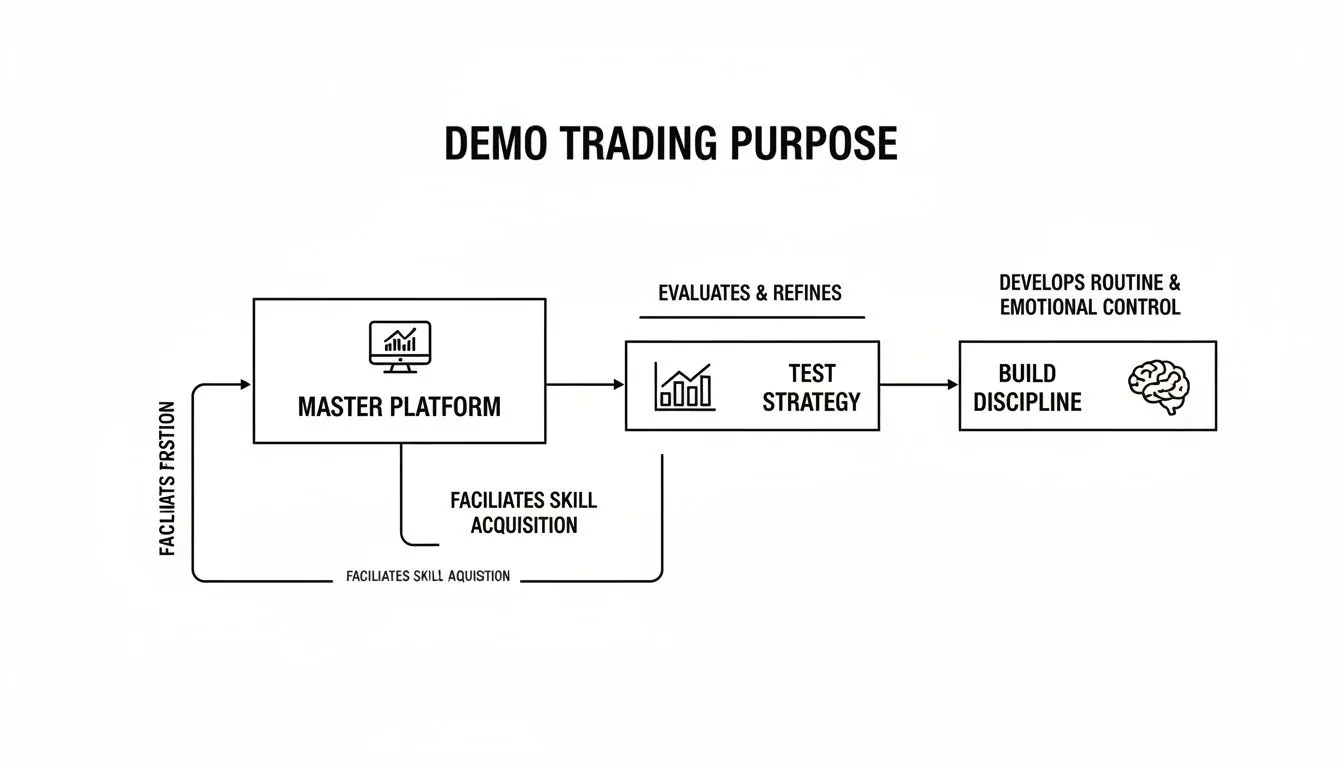
Your main goals should be:
- Platform Mastery Get to know your trading platform inside and out, whether it's DXtrade, cTrader, or Match-Trader. You should be able to place orders, use charting tools, and manage positions until it feels like second nature.
- Strategy Testing This is your personal lab. Use it to develop and fine-tune your trading strategies. For example, test a moving average crossover strategy on EUR/USD, gather data on its win rate, and adjust your stop-loss from a fixed 20 pips to using the Average True Range (ATR) to see how it affects performance.
- Building Discipline This is arguably the most important skill. Practice following your trading plan to the letter—respecting every risk management rule and resisting emotional decisions like revenge trading, even when no real money is involved.
When you take this structured approach, demo trading transforms from a game into a powerful tool for professional development.
Why Demo Trading Isn't Real Trading
A classic story: a trader crushes it in a demo account, only to find that success vanishes when they switch to a live account. This isn't bad luck. It's because demo currency trading, while an incredible learning tool, simply isn't the real thing.
Think of a demo account as a high-end flight simulator. You can learn the controls and practice maneuvers, but you never feel the gut-wrenching tension that comes with flying through a real storm. Live trading is that storm.
The All-Important Psychological Gap
The single biggest difference between demo and live trading has nothing to do with your charts or strategy—it’s all in your head. When real money is at stake, powerful emotions like fear and greed suddenly appear.
You might follow your trading plan perfectly with virtual money, but the fear of losing your own cash can make you close a winning trade too early. Conversely, greed can convince you to hold a losing position, hoping it will turn around.
This psychological pressure is the number one killer of trading accounts. It's why so many "demo millionaires" struggle to break even when they go live.
Execution: The Simulated World vs. Market Reality
Beyond the mental game, the mechanics of how trades are executed in a demo are a sanitized version of live market reality. These subtle differences add up and can dramatically affect your results.
While the goals above are correct, the simulation itself has limitations you must be aware of:
- Slippage Ever click "buy" at 1.0850 but get filled at 1.0851? That's slippage. It’s common in fast-moving live markets but almost non-existent in a demo, where fills are instant and perfect.
- Spreads Demo accounts show live spreads, but they often fail to replicate the sudden widening during major news events. A 1-pip spread on GBP/USD can instantly become a 10-pip spread during an inflation report announcement.
- Liquidity In your demo, a large order gets filled instantly. In the live market, trying to push a large order through a less-liquid pair can be difficult, or the order itself might move the price against you.
Demo Account vs. Live Account Comparison
The table below breaks down the key distinctions every trader needs to understand.
| Feature | Demo Currency Trading Account | Live Trading Account |
|---|---|---|
| Execution | Fills are instant and perfect. No slippage. | Fills depend on market liquidity. Slippage is common. |
| Psychology | Emotion-free. No real risk of loss. | Driven by fear and greed. Real money is on the line. |
| Spreads | Shows live spreads but may not reflect sudden widening. | Spreads are dynamic and can widen significantly during news. |
| Capital | Virtual funds. Losses have no financial consequence. | Real, hard-earned capital. Losses are financially painful. |
| Market Impact | Your trades have zero impact on the market. | Large orders can affect price, especially in thin markets. |
Understanding these points isn't about discouraging you; it's about preparing you for what's to come. Use the demo environment to build habits that hold up under real-world pressure.
How to Simulate a Prop Firm Challenge
Passing a prop firm challenge requires targeted training. To get funded, you must turn a standard demo currency trading account into a boot camp—a simulator that mimics the exact evaluation you’re about to face. This is where you move beyond just backtesting a strategy and start building the discipline to perform under pressure.
Setting Up Your Prop Firm Simulator
First, you have to get your demo account settings dialed in.
Step 1: Set a Realistic Balance.
If you’re aiming for a $100,000 funded account, set your demo balance to exactly $100,000. Don't start with a fantasy million-dollar account. This forces you to think about position sizing and risk management in a practical way from the very first trade.
Step 2: Master the Platform.
Get comfortable with the trading platform you'll be using for the challenge. Prop firms often specify platforms like DXtrade, cTrader, or Match-Trader. Practicing on the exact software removes technical guesswork, so your only focus during the challenge is execution.
Manually Enforcing Critical Risk Rules
This is the most crucial part of your training. Prop firm challenges live and die by their risk rules, especially the daily and maximum drawdown limits. Your demo account won’t enforce these, so you must do it yourself with absolute discipline.
Trader's Drill: Before trading each morning, do the math. On a $100,000 account with a 5% daily drawdown rule, your hard stop for the day is $95,000 in equity. If your account equity dips to that amount—even for a second—you stop trading. Period. No exceptions.
Keep a trading journal or spreadsheet to track your performance against these rules:
- Daily Drawdown Log your starting equity and the lowest point your account hit, including unrealized losses. Did you respect your limit?
- Maximum Drawdown Keep an eye on your account's high-water mark. If your max drawdown is 10%, your equity can't fall below $90,000 on a $100k account.
- Profit Target Set the firm's profit goal (e.g., 10% for a 1-step challenge) and track your progress.
The forex market is an absolute behemoth. Official Nasdaq data reports show currency pairs like USD/JPY seeing daily volume increases of over $60 billion year-over-year. By simulating a challenge, you're training to perform within this massive, volatile environment under a strict set of rules. For any trader serious about getting funded, understanding these rules is the first step. You can learn more by reading our guide on what a prop firm challenge entails.
Testing Your EAs Without Losing Your Shirt
For an algo trader, a simple backtest on historical data is not enough to prepare an Expert Advisor (EA) for the live market or a prop firm challenge. A backtest only proves your strategy worked in the past. To see how it will actually behave now, you need to use forward-testing in a demo environment.
Forward-testing means letting your EA run in real-time on a demo currency trading account. It uses live market data but without risking any capital. This is how you spot critical flaws a backtest will always miss. For a deeper dive into tools that can complement this process, check out our guide on choosing the right back-test software.
The EA Pre-Flight Checklist
Before letting an EA touch a live funded account, it must pass this exam. Treat your forward-testing phase like a strict, pass/fail test.
- Platform Compatibility Does your EA work flawlessly on the prop firm's required platform, like cTrader, DXtrade, or Match-Trader? Look for glitches, errors, or unexpected behaviors that could get your account flagged.
- Spread and Slippage Sensitivity How does the bot handle chaos? Watch what happens when spreads on a pair like Gold (XAU/USD) blow out during a news release. A demo lets you see if those sudden cost increases turn your profitable strategy into a money pit.
- Rule Compliance Verification Prop firms have strict rules. Use the demo to confirm your EA doesn’t accidentally break them. Many firms prohibit strategies like high-frequency scalping, hedging across multiple accounts, or certain grid and martingale systems.
A good rule of thumb is to forward-test your EA in a demo for at least 30-60 days. This gives it enough time to trade through different market conditions—strong trends, choppy ranges, and high-volatility spikes—providing a clearer picture of its real-world performance.
Following this checklist ensures your automated strategy is battle-tested and ready to perform when a funded opportunity is on the line.
Common Demo Trading Mistakes That Destroy Real Accounts
A demo account is a sandbox, but it’s dangerously easy to build bad habits that will wreck a real account. Too many traders treat demo currency trading like a video game, taking wild risks, only to get a brutal reality check when real money is on the line. The goal is to train like a professional, not become a "demo millionaire."
Mistake 1: Overleveraging and YOLO Trading
With a massive virtual balance and zero risk, the temptation is to crank leverage to 100:1 and "YOLO" into a trade. This trains you to be a gambler, not a trader.
The Fix: Be disciplined. Use the exact same leverage and position size you would with real money. If you’re aiming for a $50,000 funded account and your rule is to risk 1% per trade, your risk on every demo trade should be exactly $500.
Mistake 2: Ignoring Stop Losses
In a demo, letting a losing trade run feels painless. This is a catastrophic habit because you're teaching yourself to be comfortable with massive drawdowns. A live account won’t be as forgiving; a small loss you refuse to cut can easily spiral and wipe you out.
The Fix: Make it a non-negotiable rule: no trade is ever placed without a stop loss. It must become muscle memory. This single habit is your best defense for protecting your capital.
Mistake 3: Revenge Trading After a Virtual Loss
Even with fake money, watching a trade go wrong stings. The impulse to immediately jump back into the market to "win it back" is called revenge trading. This is pure emotional decision-making and is poison for any trading account.
The Fix:
- Implement a Cooling-Off Period After any significant loss, even a virtual one, step away from the charts for at least an hour.
- Analyze the Loss Go back and figure out what went wrong. Was it a bad entry? Did you break a rule?
- Stick to Your Plan Don’t re-enter the market until your strategy—not your emotions—gives you a clear signal.
FAQs: Your Demo Trading Questions Answered
How long should I practice on a demo account?
There is no magic number. You should practice until you achieve consistent profitability for at least 30-60 days while perfectly following your simulated prop firm rules (e.g., daily drawdown, max loss). One great week is luck; two months of disciplined execution shows you have a robust process.
Can I earn real money from a demo account?
No, you cannot. A demo account uses virtual funds, and any profits are not real. The purpose of a demo isn't to make fake money; it's to build the real-world skills needed to pass a funded challenge and manage a live account where you can earn real profits.
Are all demo currency trading accounts the same?
Not at all. A good demo account should:
- Use the same platform your target prop firm requires (DXtrade, cTrader, Match-Trader).
- Simulate real-world conditions like slippage and spread widening, not just perfect fills.
- Offer the same assets (forex, indices, crypto) that you plan to trade.
If I'm profitable on a demo, will I succeed live?
Not necessarily, and this is the most important lesson. Being profitable in a demo proves your strategy has a technical edge. However, it doesn’t prepare you for the emotional pressure of having real money on the line. Your demo performance shows you're ready to start, but your live performance is what proves you can handle the psychological stress.
Ready to put your disciplined practice to the test? At MyFundedCapital, we provide the platform for skilled traders to prove their edge and get funded.
Learn about our funding programs and start your journey today.