Most prop firms are legal businesses operating in a regulatory gray area. The industry data is harsh, with 79.7% of traders failing one-phase challenges and 88.2% failing two-phase challenges, while another market summary says only about 7% of traders who pass an evaluation reach a payout.
You're probably asking because you've paid an evaluation fee, reached the profit target, and now want to know whether the withdrawal email will arrive. This guide shows how the prop-firm model works, what regulation does and doesn't prove, how to read the rules, and how to apply a repeatable due-diligence process to MyFundedCapital without confusing marketing with evidence.
What Traders Really Mean When They Ask if a Prop Firm Is Legit
When traders search “is prop firm legit,” they usually aren't asking whether a website exists. They're asking whether the company will enforce its rules consistently, honor an approved withdrawal, and remain available long enough to process disputes.
Those are operational questions. Regulation matters, but it's only one part of the answer.
A prop firm's legitimacy has three separate layers:
- Legal existence The company is incorporated under a recognizable business structure, such as an LLC or Ltd.
- Operational behavior The firm publishes understandable rules, applies them consistently, and has verifiable evidence of paying traders.
- Regulatory status The firm holds licenses required for activities that fall within broker, investment, or capital-management regulation.
Most retail prop firms sell access to evaluations on simulated accounts rather than accepting client deposits like traditional brokers. That structure often places them outside direct SEC, CFTC, NFA, or FCA-style investor-protection frameworks, according to this explanation of prop-firm legality and regulation. A company can therefore operate legally while offering limited regulatory recourse if it disputes a payout or closes.
Practical rule: Don't treat “not broker-regulated” as automatic proof of fraud. Treat it as a reason to demand stronger evidence about contracts, payout history, ownership, and dispute handling.
The economics deserve equal attention. A widely cited industry analysis summarized by Finance Magnates through TradingView reported failure rates of 79.7% for one-phase challenges and 88.2% for two-phase challenges. Another market summary says only about 7% of traders who pass an evaluation ever reach a payout. Those figures don't prove that every firm is dishonest, but they show why the business model needs careful examination.
The right question is not, “Does this firm advertise a large account?” Ask instead: What exactly does the fee buy, what causes a breach, how are payouts approved, and what evidence shows traders receive withdrawals?
How Prop Firms Actually Work Behind the Marketing
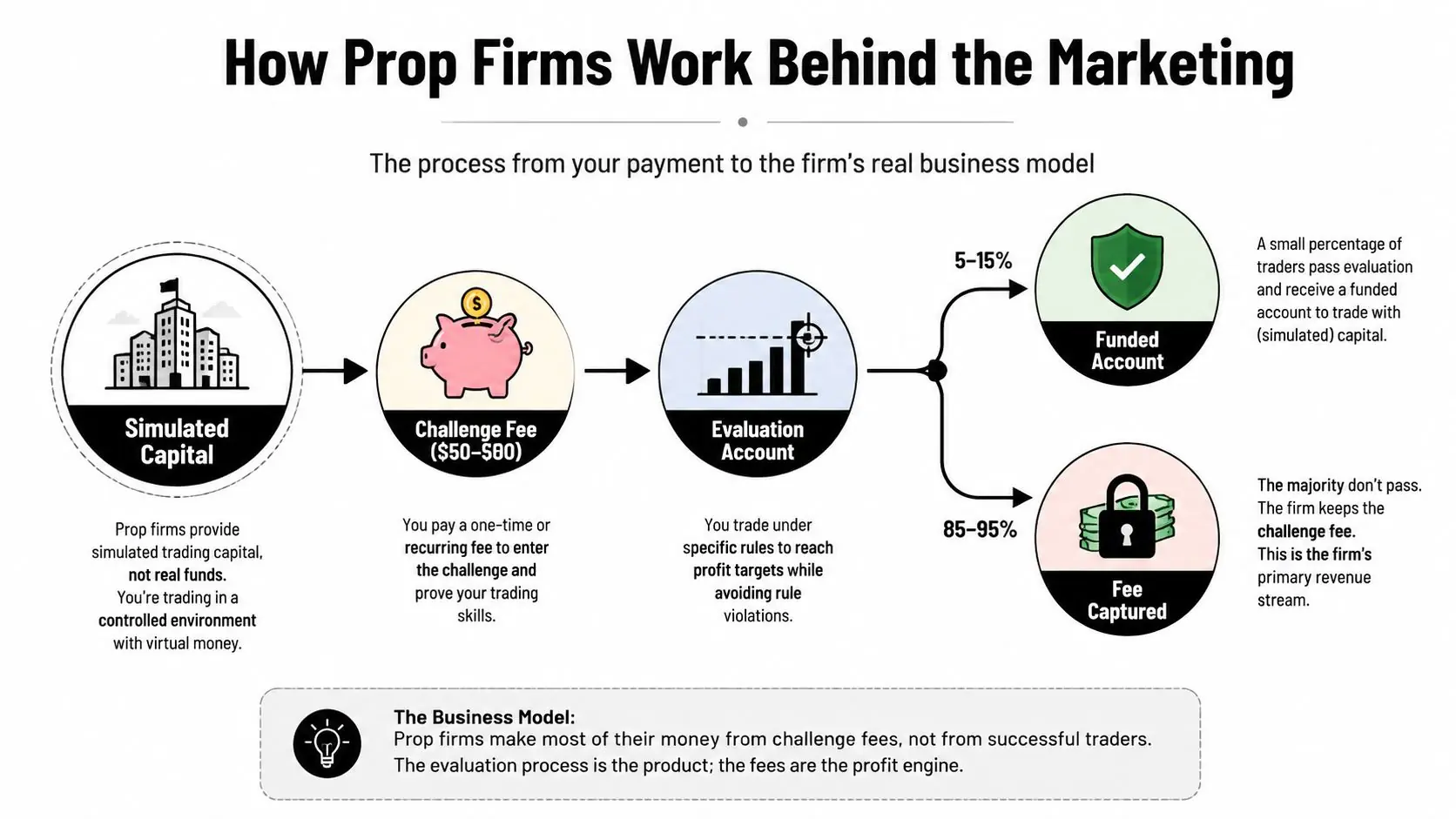
The cleanest way to understand a prop firm is to separate account size from cash placed at risk. A displayed account balance may represent simulated capital used to test your discipline under a defined loss limit. It doesn't necessarily mean the firm has deposited that full amount into a brokerage account for you.
Most evaluation firms charge for access to a challenge. The firm then sets a profit target and risk constraints. Traders who breach those constraints lose access, while traders who meet the conditions may progress to a simulated funded account or another stage of review.
Industry guidance commonly describes daily loss limits of about 2% to 5% and maximum overall drawdown of about 5% to 10% of the starting balance, as explained in this overview of prop-firm profit splits and risk rules. A daily limit may pause trading until the next session. A maximum drawdown breach generally ends the account.
That makes the advertised balance a poor comparison point. Compare the actual loss budget, drawdown calculation, news restrictions, minimum trading days, and payout conditions instead.
The fee-driven economics
High failure rates are part of the commercial structure. The cited industry analysis found that most participants fail before becoming eligible for a withdrawal, and the second market summary reports that only about 7% of evaluation passers reach payouts. A firm can use fees from unsuccessful evaluations to cover operating costs and payouts, but a legitimate operator still needs to disclose the model clearly.
The MyFundedCapital explanation of proprietary trading firms is useful background because it distinguishes evaluation access from conventional brokerage activity.
Before you buy, ask:
- Does the firm disclose whether accounts are simulated?
- Does it publish the exact drawdown formula?
- Does it explain how payout approval works?
- Does it disclose pass rates and the proportion of traders paid?
- Does customer support answer rule questions with specific written terms?
A large account label isn't proof of funding. A low fee isn't proof of value. The contract and the payout process matter more than the headline balance.
The Legal and Regulatory Picture Most Articles Skip
A prop firm isn't automatically a broker. A broker typically holds or routes client money and provides access to financial markets under a regulated framework. A retail evaluation firm usually charges for simulated trading access and evaluates performance under its own rules.
That distinction explains the gray area. Independent industry coverage describes evaluation-based prop trading as jurisdiction-specific across the UK, EU, and Australia, with different parts of the activity potentially touching existing rules rather than falling under one universal prop-firm license. You can read a detailed discussion in this analysis of prop-firm regulation.
Standard legal obligations still matter. Company law governs incorporation and business conduct. Consumer-protection and fraud laws can apply when a company misrepresents its services, hides material conditions, or uses deceptive sales practices. Contract law governs the agreement you accept when purchasing an evaluation.
The firm's activity may also change its regulatory position. A company that operates a brokerage arm, partners with a regulated broker, manages outside investor capital, or allocates real capital to external traders may trigger requirements that don't apply to a basic simulated evaluation.
Prop firm vs broker regulatory scope at a glance
| Jurisdiction | Broker license required? | Standard company law? | Consumer fraud law applies? |
|---|---|---|---|
| United States | Not automatically for a simulated evaluation, but the activity can change the analysis | Yes | Yes |
| United Kingdom | Not automatically for a simulated evaluation, subject to the firm's activities | Yes | Yes |
| European Union | Not automatically for a simulated evaluation, subject to local implementation and activity | Yes | Yes |
| Australia | Not automatically for a simulated evaluation, subject to the firm's activities | Yes | Yes |
The practical answer is simple: regulation can support legitimacy, but it doesn't guarantee a payout. Conversely, the absence of a broker license doesn't by itself establish that an evaluation business is fraudulent. Review the company identity, terms, marketing claims, payout evidence, and dispute process together. This guide to prop-firm regulation provides another useful starting point for that review.
Reading the Offer Like a Contract Before You Pay a Fee
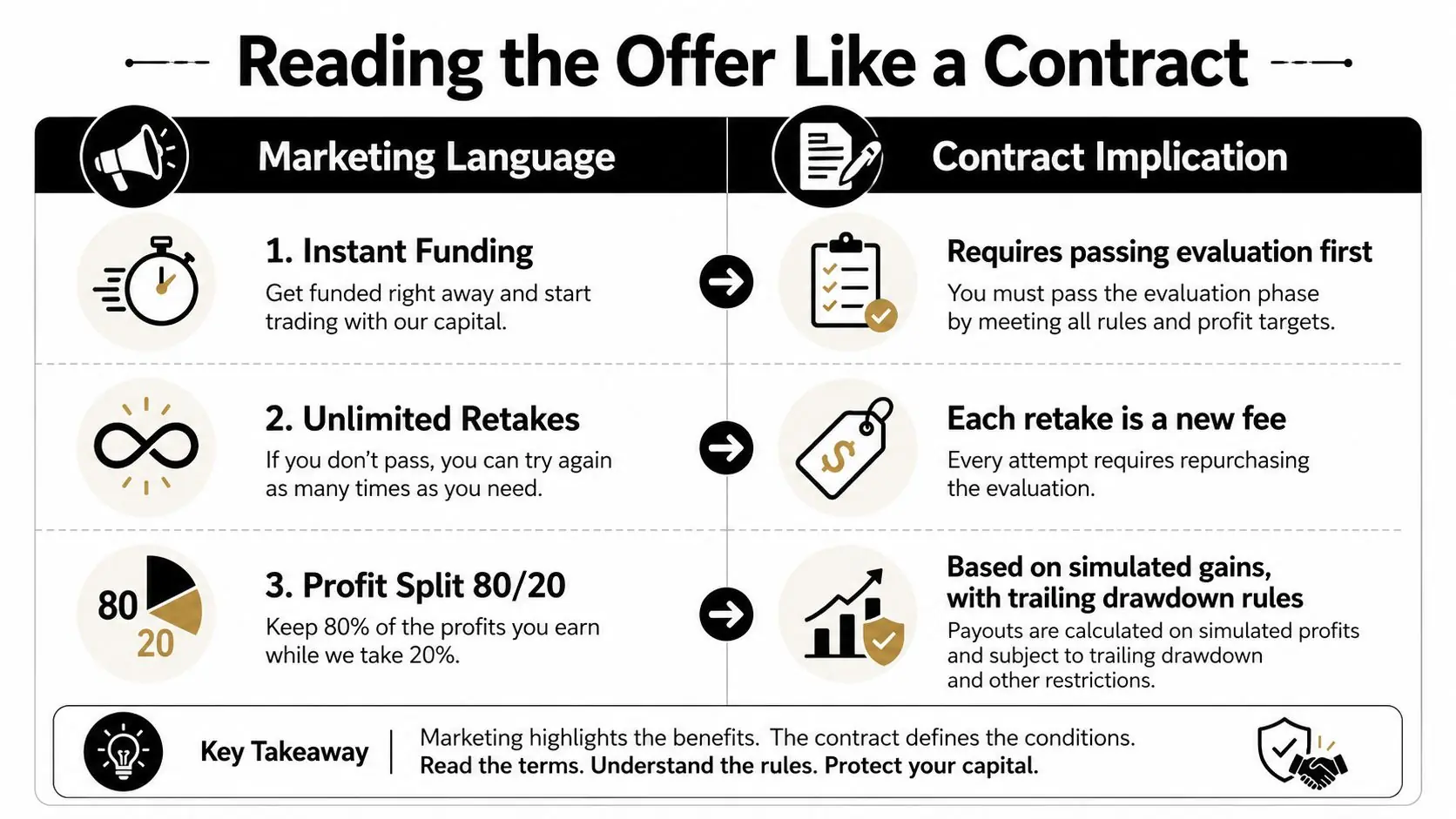
A challenge page is sales material. The rules page is the document that determines whether you get paid.
Start with the loss mechanics. A firm may use a static drawdown, an equity-based drawdown, or a trailing drawdown. Those terms aren't interchangeable. A trailing threshold can move upward as your account grows, which may turn an apparently profitable position into a breach if the rule tracks intraday equity rather than closed balance.
Industry guidance also highlights extra payout conditions such as minimum trading days, consistency requirements, profit thresholds, and withdrawal cycles that reset after a payout. Examples include 5 or 10 minimum trading days, a minimum profit threshold such as $100 or 1% of account size, and limits on how much of total profit can come from one trading day, as detailed in this guide to funded-trader payout rules.
Clauses that deserve a close read
- Fee terms Confirm whether the fee is refundable, recurring, or charged again after a reset.
- Profit split A higher split can improve your share of eligible simulated profits, but it doesn't remove drawdown rules or payout approval conditions.
- Breach language Look for definitions of daily loss, maximum loss, prohibited strategies, news trading, copying, and inactivity.
- Payout timing Identify the first eligible date, processing window, minimum withdrawal, and any reset conditions.
- Consistency rules Find out whether a profitable day can contribute too much of the total required gain.
Rules involving news events deserve special attention. A trader can finish net profitable and still fail because a position violated a restricted-news window, exceeded the daily limit, or breached a strategy prohibition. That's why you should treat account rules like a commercial contract, not a motivational brochure.
Save the terms before paying. Copy the rules page, screenshot it with a date stamp, and store the sections covering drawdown, payouts, and breach conditions. If the wording changes later, you'll have a record of what you accepted. If the agreement is complex or you're committing meaningful money, a resource on how a business lawyer helps with contracts can help you identify ambiguity before you sign.
Legit Firm vs Scam Patterns You Can Verify Today
A legitimate operating pattern is visible before payment. The firm identifies its legal entity, publishes complete rules, lists working support channels, explains how payouts are processed, and answers difficult questions without forcing you straight to checkout. If these details are missing, treat the firm as unverified.
Scam patterns depend on urgency and limited information. Common signs include exaggerated account-size marketing, selective payout screenshots, hidden breach conditions, and withdrawal requirements that were unclear during purchase. Industry failure rates discussed earlier apply broadly to this pattern, but a trader still needs to verify how the individual firm handles accounts and payouts.
Legit firm vs scam pattern comparison
| Indicator | Legit firm | Scam pattern |
|---|---|---|
| Company identity | Legal entity and jurisdiction are disclosed | Operators remain anonymous |
| Rules | Complete terms with identifiable versions or updates | Important restrictions appear only after purchase |
| Payout evidence | Multiple independent, recent examples | Screenshots without verification or context |
| Support | Staff answer specific questions consistently | Replies are vague, delayed, or purely promotional |
| Pricing | Terms remain clear without pressure | “Act now” discounts dominate the sales message |
| Domain and branding | Established identity and coherent history | Cloned pages, copied branding, or confusing redirects |
Match each concern with a specific verification action. Search the firm's name with “payout proof”, check its registration number in the stated jurisdiction, review domain ownership history through a reputable WHOIS service, and compare the site with established branding. Tools described as best authenticity checkers can support the website review. They cannot confirm payout practices or replace contract analysis.
Support quality also gives you useful evidence. Ask a precise question about a breach or withdrawal, save the written response, and compare it with the published terms. Vague answers, contradictory explanations, or pressure to pay before receiving clarification are reasons to stop.
Do not use a single Trustpilot rating as proof. Read recent reviews, look for detailed withdrawal timelines, compare complaints with company responses, and search independent trading communities. A polished homepage proves almost nothing. Consistent evidence from unrelated channels is much harder to fabricate, and it gives you a repeatable standard for checking firms such as MyFundedCapital.
Due Diligence Checklist Applied to MyFundedCapital
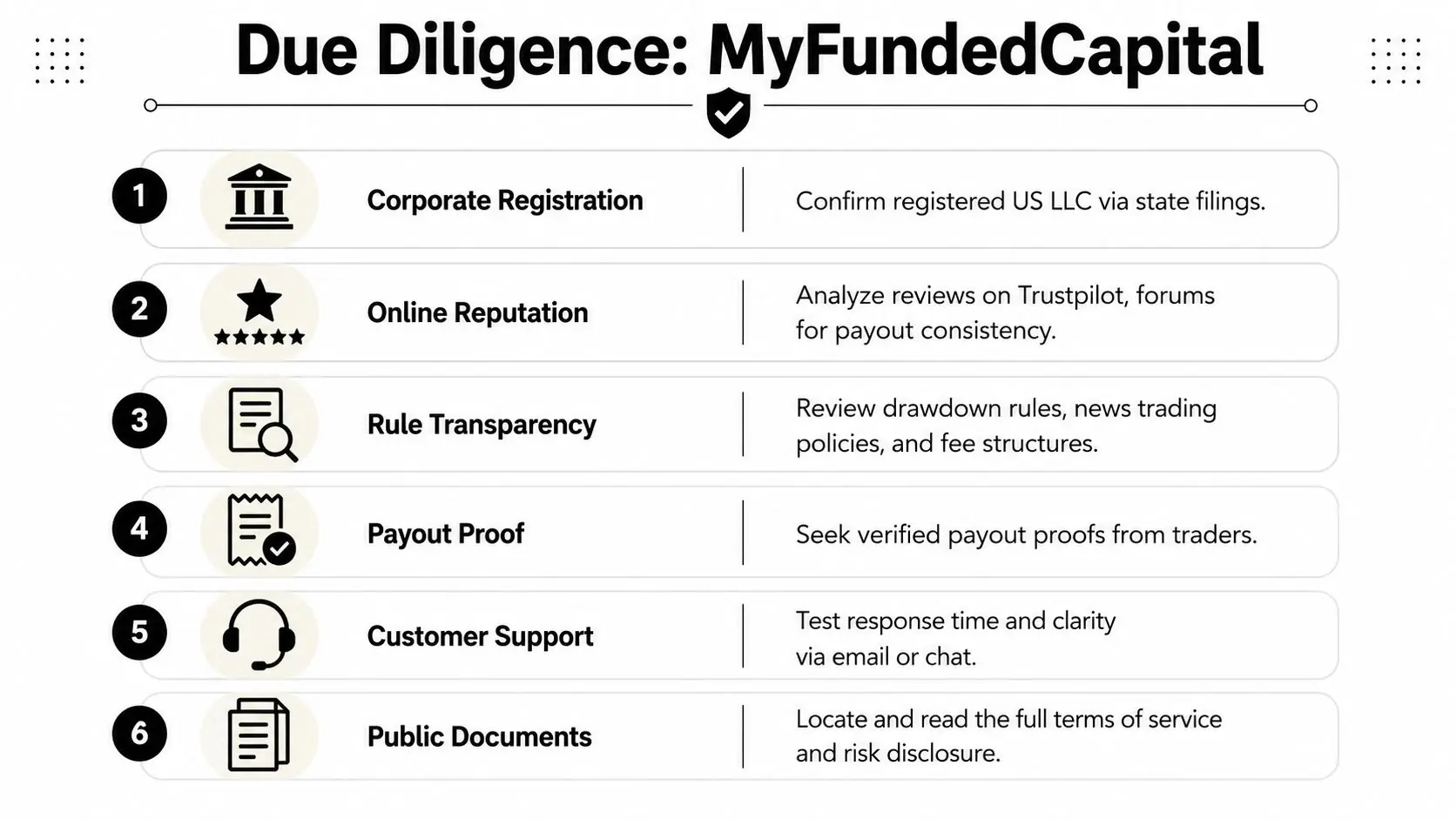
Use the same process for every firm, including MyFundedCapital. The point isn't to manufacture certainty. The point is to collect enough evidence to decide whether the risk fits your budget and trading style.
Six checks before purchase
- Confirm the corporate entity. Check the stated US LLC against public state filings. The name, status, and operating identity should align with the website's legal documents.
- Inspect the domain history. Use a WHOIS lookup to review registration age, ownership changes, and whether the current site appears connected to the stated business.
- Gather independent payout evidence. Search Trustpilot reviews dated within 60 days, then look for Myfxbook records or third-party payout tracker screenshots. Treat screenshots as leads, not final proof.
- Read the full rules. Focus on the trailing-drawdown calculation, daily loss limit, prohibited strategies, news and weekend conditions, and payout schedule.
- Test support. Ask two written questions before paying, one about scaling and one about breach rules. Save the answers and compare them with the agreement.
- Start small. Use the smallest challenge size you can afford to lose. Test the account experience and payout pipeline before considering larger fees.
For MyFundedCapital, review the public payout schedule, the published 2-Step Scaling Plan up to $500K, and the 35% consistency rule on funded accounts, under which no single day may contribute more than 35% of total profit. Also verify the current terms directly before purchase, because trading conditions and optional features can change.
The company describes simulated evaluation and funded environments using real market quotes, with identity verification and security checks included in its terms. Its published offering includes Instant Funding and one-step or two-step challenges, with account sizes from $5K to $100K and scaling paths up to $500K, as stated in the publisher information. Those are product descriptions, not proof of future earnings or payout approval.
You can use the funded trading accounts review as one source while doing your own checks. A checklist creates evidence. It does not guarantee that a firm will approve every withdrawal or remain available indefinitely.
Risk, Pass Rates, and How to Choose the Right Next Step
The first-attempt pass-rate range cited in industry coverage is only 5% to 10% in one 2026 market summary, while other market analyses place common evaluation outcomes in a broader failure range. The same summary says 80 to 100 prop firms closed in 2024, following platform and regulatory pressure, and estimates that roughly 13% to 14% of global operators disappeared in one year. Those figures create two separate risks: you may fail the evaluation, or the operator may fail while you're relying on its payout process. See the industry statistics summary for that market context.
Retail trading itself carries serious loss risk. The CFTC warns that most individual futures and foreign-currency traders lose money after fees and taxes, and a recent report citing CFTC figures says about two out of three retail forex traders lose money each quarter, as covered by Finance Magnates.
Before clicking buy:
- Verify the firm against the company, rules, payout, support, and domain checks above.
- Match the fee to money you can lose without affecting rent, debt payments, or essential savings.
- Start with a smaller evaluation and treat the fee as a business expense with an uncertain outcome.
- Confirm that the drawdown model fits your actual strategy, especially if you hold positions through news, weekends, or volatile sessions.
MyFundedCapital is one option to evaluate through that process. It offers simulated-account evaluations, Instant Funding, one-step and two-step programs, multiple trading styles, and published payout and risk conditions, but no program removes the risk of loss or guarantees a withdrawal.
Review the current MyFundedCapital funding programs, compare account types and rule sets, and choose only an evaluation whose fee and drawdown limits fit your trading plan. Visit MyFundedCapital to examine the terms directly before starting a challenge.