You're comparing platforms because switching between a forex terminal, a crypto exchange, and separate tools for indices is slowing you down. The hard part isn't finding one login for every market, it's deciding whether that convenience preserves the execution quality and risk control a prop trader needs. This guide breaks down how multi asset trading platforms work, which features matter by strategy, and how to test one before strict drawdown rules turn a platform problem into a trading loss.
If you are still deciding which asset class fits your schedule and risk tolerance, start with this overview of the main trading markets before comparing platforms.
What Multi Asset Trading Platforms Actually Do
A multi asset trading platform gives you access to several asset classes through one trading environment and one account. Instead of maintaining separate interfaces for forex, indices, commodities, crypto, stocks, futures, options, or bonds, you can view markets, place orders, monitor positions, and review reports from a connected system. That definition is consistent with the practical overview of multi-asset platforms, which describes a shared environment built for multiple markets.
If commodities are a primary focus, a general multi-asset feature list is not enough. Review the dedicated commodity trading platform criteria before choosing the execution environment for metals, energy, or agricultural markets.
The immediate benefit is operational. Suppose you're long EUR/USD and want to hedge part of your exposure with an equity index position. On separate platforms, you may need to check margin in one account, execute the hedge in another, and reconcile your overall risk manually. A unified platform can put both positions, their unrealized profit and loss, and relevant margin information in one workspace.
The same applies if you trade crypto alongside traditional markets. You might use a volatility move in an index to frame a Bitcoin trade, but switching applications creates opportunities for missed orders, stale information, and inconsistent position sizing. Multi asset trading platforms reduce that friction. They don't remove market risk, and they don't guarantee better fills, but they can make your decision process easier to control.
The shared systems underneath
Modern platforms commonly rely on:
- One order-management system Parent orders, amendments, cancellations, and allocations can follow a common workflow.
- A shared risk engine Margin, exposure, and position limits can be assessed across instruments rather than in isolated silos.
- Connected APIs Pricing, execution, account data, reporting, and integrations can move through consistent interfaces.
- Unified reporting Trade history, costs, fills, and performance analysis are easier to review in one place.
That architecture matters to brokers and prop firms as much as it matters to traders. If you want a deeper explanation of how trading software is designed and connected, this fintech software development guide provides useful technical context.
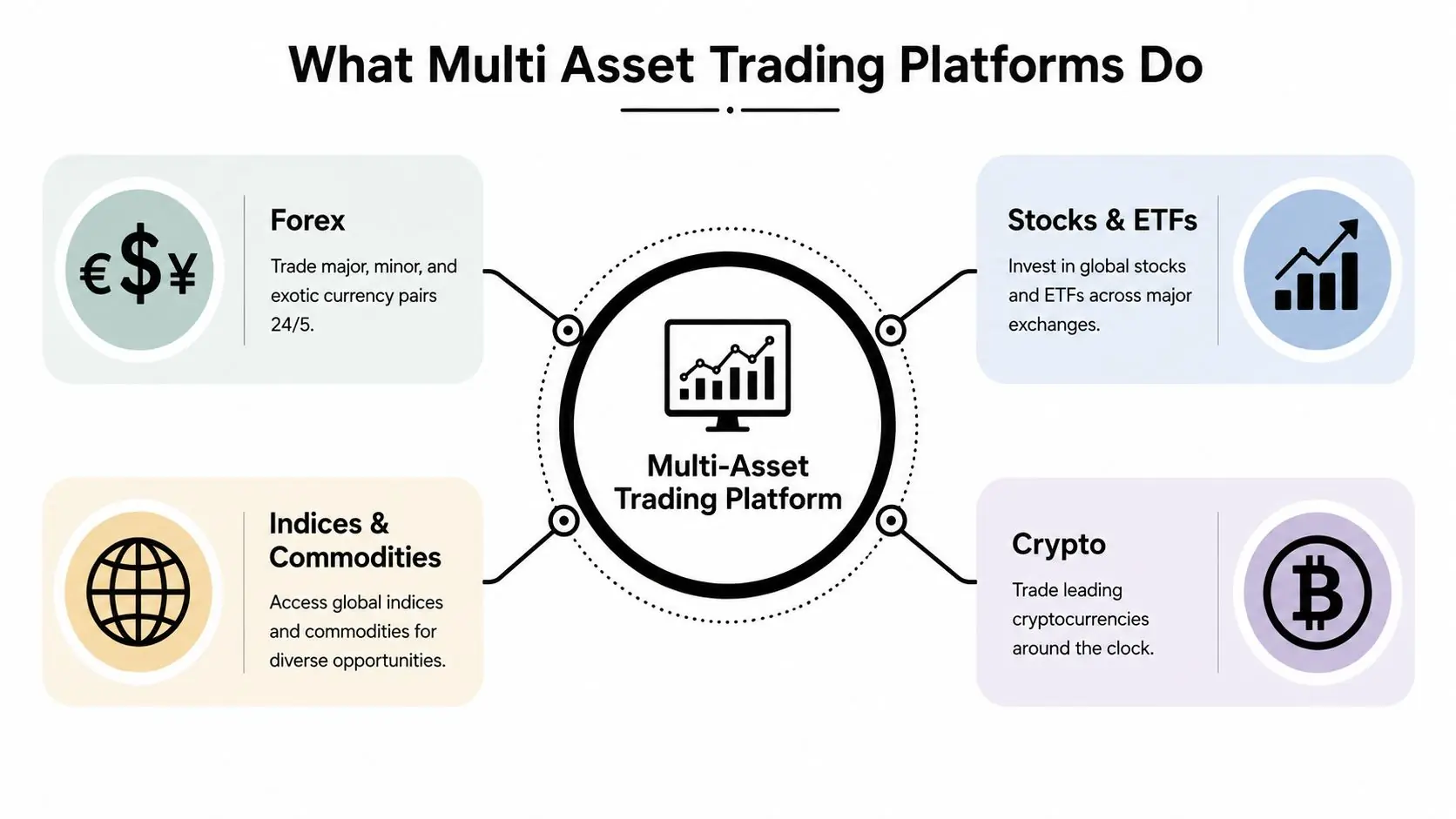
The key distinction is simple: a platform that merely displays several products isn't necessarily integrated. You want consistent order handling, risk visibility, and reporting across the markets you trade.
The Architecture Behind Modern Trading Platforms
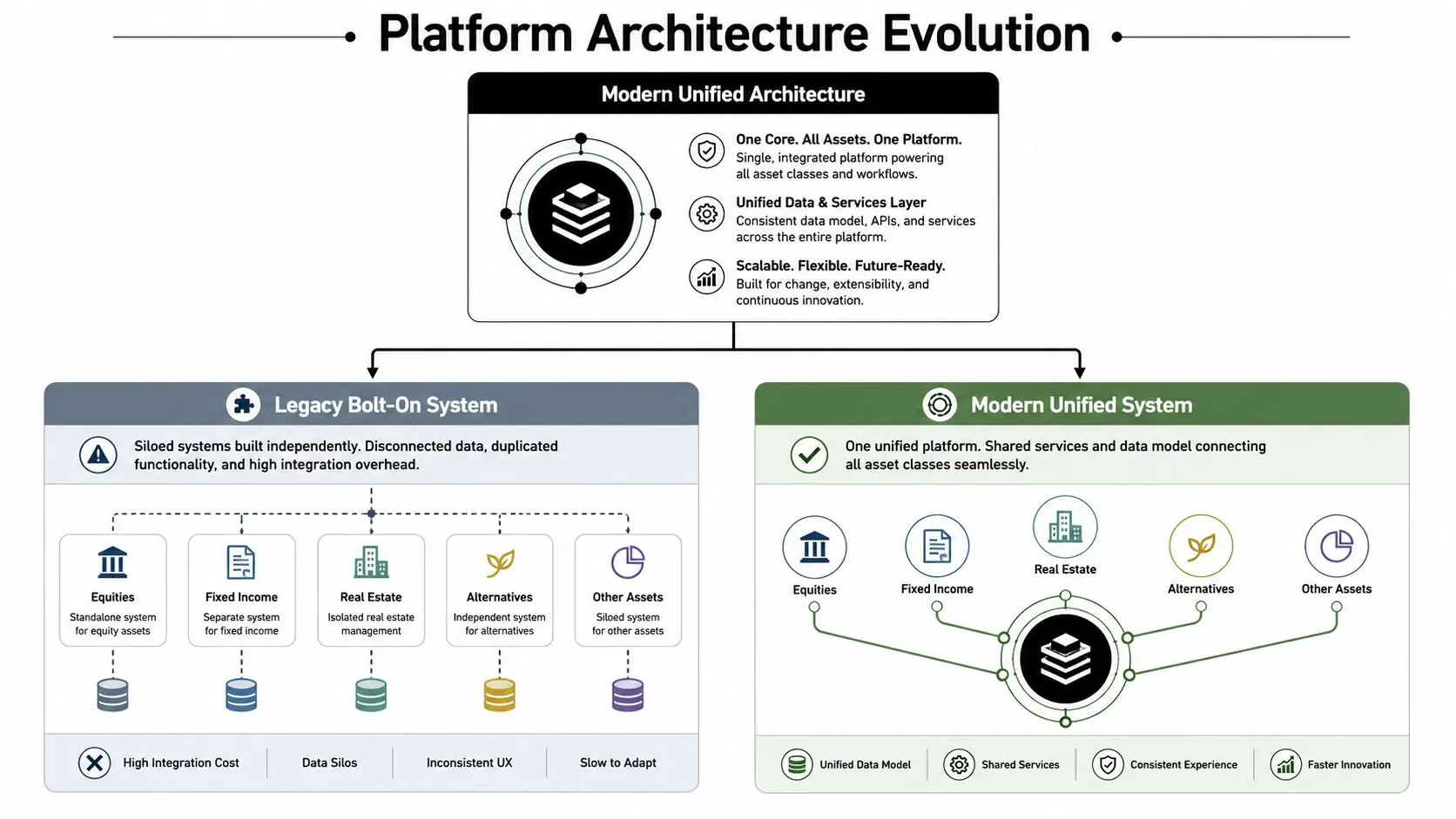
A platform can look unified on the screen while remaining fragmented underneath. Legacy systems often add asset classes as separate modules, each with its own data model, execution path, and reporting logic. That approach can work for basic access, but it creates more points where orders, fills, and account states can diverge.
A modern architecture aims to combine the Order Management System, or OMS, with the Execution Management System, or EMS. A unified O/EMS can eliminate the inter-system FIX handoff between order management and execution. Separate OMS to EMS routing adds another layer where latency, reconciliation work, and data-model mismatches can appear, as explained in this comparison of OMS, EMS, and O/EMS architectures.
Why the data model matters
With a shared real-time model, the platform can maintain the relationship between:
- Parent orders and child orders
- Executed fills and remaining quantities
- Allocations and position updates
- Transaction cost analysis, or TCA
- Amendments, cancellations, and execution status
That consistency becomes important when liquidity is distributed across venues. A fast route is of limited value if the rest of the system takes too long to update exposure or shows an incomplete order state. Prop traders also need accurate account information because a delayed equity figure can lead to oversized positions under a daily loss limit.
Cloud infrastructure has become a major part of this transition. One market estimate valued the multi-asset trading platform market at $7.4 billion in 2025 and projects $16.8 billion by 2034, with software representing 63.2% of the market in 2025. The same source says 55.7% of workloads were hosted on cloud infrastructure in 2025, with that share projected to exceed 72% by 2034. These figures are from Straits Research's market analysis, and they describe industry adoption, not a promise that every cloud platform will execute better.
Speed is only one part of execution
A technical study reported average tick-to-trade latency of 32 microseconds, with the top 90% at 32.1 microseconds and the worst 5% at 44 microseconds on a dual 6-core Xeon Linux server. The technical study on low-latency trading systems%20(1)%20(1)%20(1).pdf) emphasizes direct market-data ingestion, FIX execution messaging, monitoring, server load distribution, and multiple co-location sites.
That example illustrates the right lesson. Low latency isn't just a headline number. You need stable performance when data bursts, orders increase, and multiple asset classes compete for system resources.
Which Platform Features Matter for Your Trading Style
The right platform depends on how you trade, not how many instruments appear in the product menu. A day trader and a swing trader can use the same interface, but they'll judge its weaknesses very differently.
| Trading Style | Must-Have Features | Nice-to-Have Features |
|---|---|---|
| Day trading | Fast order entry, clear positions, real-time P&L, dependable execution during volatility | One-click trading, hotkeys, customizable workspaces |
| Algorithmic trading | Stable API, EA support, automation permissions, reliable hosting | Backtesting, optimization tools, webhook integrations |
| Copy trading | Position risk controls, transparent provider records, copy-size settings | Leaderboards, social feeds, strategy filters |
| Swing trading | Strong charting, multi-timeframe analysis, financing visibility, alerts | Fundamental data, advanced watchlists, news calendars |
| Crypto trading | Suitable market hours, spot or derivative access as needed, clear custody and margin rules | Wallet connectivity, token filters, on-chain tools |
Match the platform to the decision you make
For a day trader, the critical test is the distance between seeing a setup and controlling the resulting position. One-click entry, fast modification, visible stop placement, and live equity monitoring matter more than a large social feed. If you trade around volatile releases, spread behavior and order rejection deserve more attention than decorative chart themes.
An algorithmic trader should start with the API and execution rules. Can your existing Expert Advisor connect? Are automated strategies permitted? Does the platform expose order status, fills, and errors clearly? A platform with excellent manual charting may still be a poor choice if your strategy depends on stable automation.
Copy traders need a different form of control. A leaderboard doesn't prove that a signal provider's risk fits your account. You need controls for copied volume, stop conditions, exposure, and disconnection. If you're comparing brokers and terminals, this guide to FX trading platforms can help frame the evaluation around actual trading needs rather than product count.
Swing traders should focus on what happens while they're away from the screen. Review overnight financing, gap behavior, alerts, and rules for holding through news. Crypto traders need to verify whether the platform offers spot, derivatives, or only price-based products, plus how margin and custody work.
A feature is valuable only when it supports your process. If you never automate, deep API documentation won't compensate for weak position visibility. If you hold for days, a small improvement in click speed won't matter as much as transparent financing.
The Real Trade-Off Between Convenience and Execution Quality
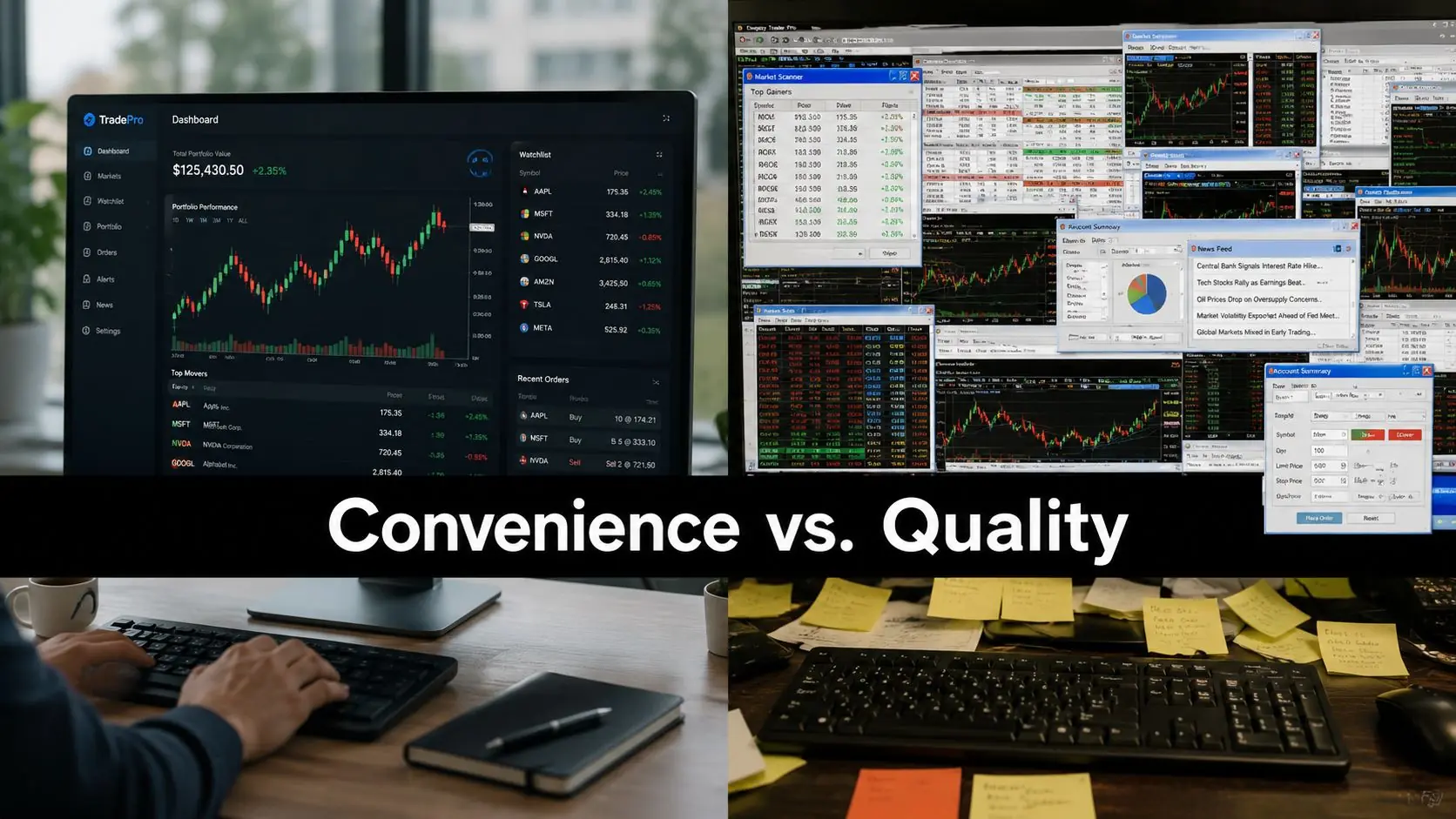
More markets in one dashboard don't automatically produce better trading outcomes. The platform may give you access to forex, indices, crypto, and commodities, yet provide deeper liquidity, better routing, or more reliable pricing in only some of those products.
Market forecasts focus heavily on expansion. One estimate puts the online trading platform market at USD 10.90 billion in 2025 and projects USD 19.87 billion by 2033, while North America accounted for 36.1% of the regional share in 2025, according to Grand View Research. Those figures show commercial growth, not improved slippage or execution for an individual trader.
A separate market summary projects the multi-asset trading platform market from $12.3 billion in 2025 to $22.8 billion by 2034, with cloud deployment at 62.4% share and crypto revenue growing at a 31.8% CAGR. The Market Intelo coverage also highlights the important gap: these market summaries don't quantify slippage, latency, routing quality, or hidden fragmentation costs across asset classes.
The specialist versus all-in-one decision
A specialized forex platform plus a separate crypto exchange may suit a trader who needs deep FX execution and only occasional crypto exposure. The extra login is inconvenient, but it may be acceptable if the specialist venue offers clearer spreads, better order types, or more consistent fills for the primary strategy.
An all-in-one platform may be more practical for a trader who actively hedges across markets and values centralized margin and reporting. The advantage comes from reducing operational friction, not from automatically improving every trade.
Ask one question before choosing:
Does cross-asset access reduce enough friction to outweigh weaker product depth in the markets that drive your results?
Liquidity fragmentation makes that question more important in less-traded instruments. Multiple venues can mean different prices, available sizes, and execution paths. A clean dashboard can hide that complexity, so test actual orders rather than judging the platform by its instrument list.
How to Evaluate a Multi Asset Trading Platform
Treat platform selection like a trading experiment. Don't accept a broker's product page as evidence of execution quality. Use a demo account first, record what happens, and compare the results with the conditions your strategy faces.
Start with execution
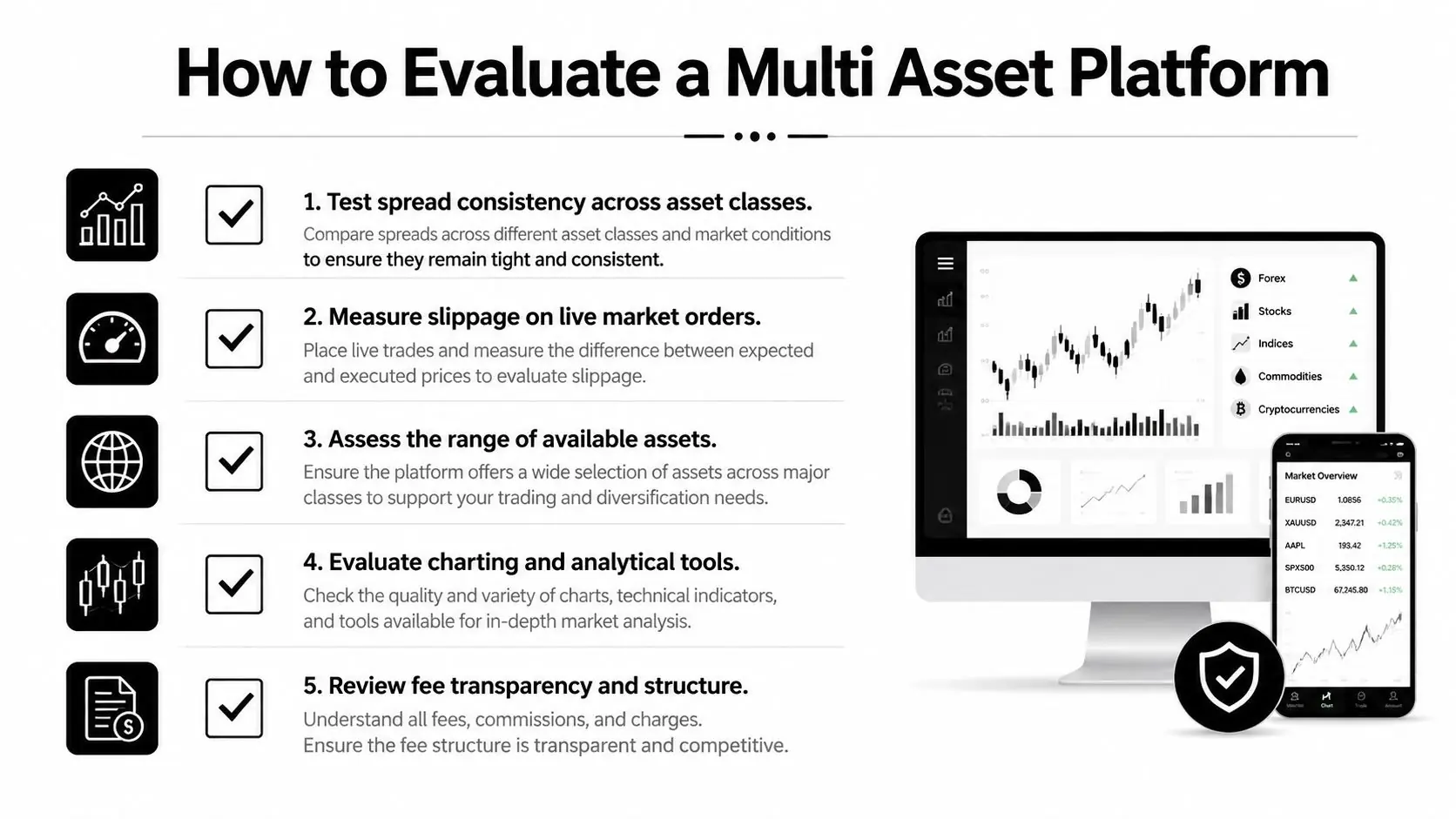
Test the same instrument types during calm and fast markets. Watch spread consistency, market-order slippage, fill speed, rejected orders, and stop execution. A guaranteed stop-loss, where available, may change the fee structure or carry specific terms, so read the conditions instead of assuming the label explains everything.
Your checklist should include:
- Spread behavior Compare quoted spreads across forex, indices, commodities, and crypto rather than checking only the most popular pair.
- Market-order fills Record requested price, filled price, and the surrounding market conditions.
- Order controls Confirm whether you can set stops, limits, trailing stops, partial closes, and position reductions as needed.
- Account visibility Make sure equity, margin, free margin, exposure, and open risk update clearly.
Then test the risk layer
Position-size calculators and customizable alerts are useful only if they reflect the platform's contract specifications and margin rules. Set alerts before you need them. A trader who waits until the account is near a loss limit is already operating too late.
Review the legal and operational details as carefully as the interface:
- Confirm the firm's regulatory status and understand the applicable protections.
- Read fund segregation and custody information.
- Map spreads, commissions, overnight financing, inactivity charges, and withdrawals.
- Test support during active market hours.
- Review trade reports for timestamps, fills, fees, and position history.
The day-trader platform comparison is a useful starting point, but your own demo testing should make the final decision.
Integrating Multi Asset Platforms with Prop Firm Trading
A multi-asset platform can put forex, indices, crypto, and commodities in one workspace, but that convenience matters only if orders, prices, and risk figures update reliably. For prop traders operating under strict loss limits, a delayed position update or duplicate order can reduce the available buffer before the mistake is obvious.
A common rule structure uses a 5% daily drawdown limit and a 10% maximum loss limit, with the daily limit resetting each trading day. The drawdown guidance for prop traders explains why intraday risk should remain well below the stated cap. Evaluation phases generally use virtual capital before a funded phase. Rules may include profit targets around 5% to 10%, maximum drawdown limits around 5% to 10%, and time limits often between 30 and 60 days, according to this overview of prop-firm evaluation rules. Read the exact account terms instead of assuming every firm uses the same model.
What funded traders should verify
The platform must fit the program's permitted trading behavior:
- News trading Check whether positions may be opened or held around scheduled releases.
- Weekend holding Confirm restrictions for each market, including crypto and instruments that close.
- Automation Verify EA permissions, API stability, and copy-trading rules. The guide to prop firms that allow copy trading provides a useful reference.
- Reporting Confirm that fills, fees, and order changes appear clearly for challenge verification.
- Risk monitoring Make sure daily loss and total drawdown are visible without manual reconstruction.
MyFundedCapital supports manual, algorithmic (by agreement with support), and copy trading across 350+ instruments, including forex, crypto, and commodities, through DXtrade and cTrader, with MT5 coming soon. Its programs include Instant Funding and 1-Step or 2-Step Challenges, with account sizes from $5K to $100K and scaling paths up to $500K. Verify current platform availability, add-ons, and rules before starting.
Profit splits start at 80/20 and may be upgraded to 90/10 or 100% under the applicable terms. That makes execution quality financially relevant, while the platform still cannot remove loss risk. Size positions according to the firm's limits and the actual behavior of the instruments you trade.
Common Questions About Multi Asset Trading Platforms
Do I need a multi asset platform if I only trade forex?
Not necessarily. If forex is your only market and you don't hedge with indices, commodities, or crypto, a specialized FX platform may provide everything you need. Cross-asset access becomes useful when you actively compare markets, hedge correlated exposure, or manage positions across instruments from one account.
Don't choose a multi asset trading platform just because it lists more symbols. Choose it when the shared risk view, reporting, and workflow solve a problem you have.
Are multi asset platforms more expensive?
The interface itself may not determine your total cost. Compare spreads, commissions, overnight financing, contract specifications, conversion charges, and withdrawal fees. A convenient platform can still be expensive if its spreads widen more than alternatives or if its pricing model is difficult to audit.
Track costs on the instruments you trade most. A lower advertised commission won't help if the relevant market has poor fills or wide effective spreads.
Can I use existing EAs and indicators?
Compatibility depends on the platform, programming language, broker connection, and account rules. Confirm whether your EA can run without modification, whether the platform supports the required indicators and order types, and whether automation is permitted during evaluations and funded trading.
Run the strategy in a demo environment and compare signals, order placement, stop handling, and error messages. Never assume that an EA written for one terminal will behave identically on another.
How do I test execution for prop trading?
Use small, controlled demo tests across normal and volatile conditions. Record spread, requested price, fill price, rejection messages, stop behavior, and the time needed for equity and margin to update. Then compare those observations with your firm's drawdown methodology.
Professional day-trading guidance commonly recommends risking only 1% to 2% of account equity per trade and maintaining a hard daily loss limit, as outlined in this day-trading risk management guidance. Multi-asset access doesn't reduce risk. It changes the number of exposures you must monitor, so keep total correlated and cross-market risk within the rules of your account.
MyFundedCapital offers Instant Funding and 1-Step or 2-Step Challenges with access to multiple markets through supported platforms, including forex, crypto, and commodities. Visit MyFundedCapital to compare account types, review the current trading conditions, and choose a challenge or funding route that matches your platform and risk-management process.