

 AR
AR
 NL
NL
 FR
FR
 DE
DE
 ES
ES
 IT
IT
 PL
PL
 SV
SV
 PT
PT


Saturday morning is when a lot of traders get restless. The chart still looks active, a setup is forming, and your first instinct is to ask whether you can act before Monday. The answer depends on the market, the platform, and whether you're holding risk through a session that many venues do not run.
When the Exchange Closes But the Trader Doesn't
A trader staring at a Saturday chart often mixes up three different questions. Can the market trade right now, can the platform accept an order, and should you carry the position? Those are not the same thing, and weekend confusion usually comes from treating them like one question.
Start with the market structure
For major U.S. stocks, weekend execution is generally off the table. The NYSE and Nasdaq regular session runs Monday through Friday, 9:30 a.m. to 4:00 p.m. ET, and Fidelity says the U.S. stock market is closed on weekends and most federal holidays (Fidelity stock market hours). So if you see a weekend chart move in a stock, your broker may let you stage the order, but the market itself usually won't fill it until Monday.
That distinction matters because traders often mistake order entry for actual trading. You can type the ticket, attach a stop, and wait, but that's not the same as getting a real weekend fill in stocks. The order is usually waiting in line, not participating in live price discovery.
Separate hype from live liquidity
Weekend trading does exist, but it lives in narrower venues. IG describes weekend windows for select instruments such as indices, spot gold, forex pairs, and cryptocurrencies, with sessions beginning at 4 p.m. Saturday (UTC+8) and running until Monday morning for some products, while crypto can continue until the next Saturday (IG weekend trading). Robinhood also states that its 24 Hour Market allows trading from 8 p.m. ET Sunday to 8 p.m. ET Friday, which shows how access has expanded around the old five-day rhythm even though standard stock exchanges remain closed on Saturdays and Sundays (Robinhood 24 Hour Market).
If you want a broader context for where this market structure could keep expanding, the article on the future of 24/7 finance is a useful read.
Practical rule: if the venue doesn't explicitly support weekend liquidity for that instrument, assume you're staging an order, not trading the tape.
Which Markets Are Actually Open on Weekends
The fastest way to stop guessing is to sort markets into three buckets. Closed, restricted-access, and continuous. Once you do that, most weekend confusion disappears, because you can tell whether you're dealing with a real session or a platform that only looks open.
Closed markets
U.S. equities sit in the closed bucket. The NYSE core session is 9:30 a.m. to 4:00 p.m. Eastern on non-holiday weekdays, and weekend stock orders are generally queued until the next open rather than filled immediately (Investopedia on weekend and holiday trading). That's a hard market-structure limit, not a broker preference.
If you trade stocks and want a Sunday-night reaction, the honest answer is still Monday. You can prepare the ticket on Saturday, but the market won't print until it reopens. For traders who want to understand Sunday timing in FX specifically, the guide on what time does forex open on Sunday is a useful companion.
Restricted-access markets
Some brokers offer weekend windows for select products only. IG's weekend session starts at 4 p.m. Saturday (UTC+8) for certain instruments, including indices, spot gold, forex pairs, and cryptocurrencies (IG weekend trading). That sounds broad, but it isn't full-market access. It's a curated session with limited instruments and a narrower liquidity pool.
Continuous markets
Crypto lives in the continuous bucket, and that's where weekend trading is most familiar to active traders. Robinhood's 24 Hour Market also extends access from 8 p.m. ET Sunday to 8 p.m. ET Friday (Robinhood 24 Hour Market). The point isn't that everything is always tradable, it's that the market clock is no longer tied to a traditional stock exchange close.
| Asset Class | Weekend Status | Typical Hours | Caveats |
|---|---|---|---|
| U.S. stocks | Closed | Monday through Friday, 9:30 a.m. to 4:00 p.m. ET | Weekend orders usually queue for Monday open (Fidelity stock market hours) |
| Select CFD and FX products | Restricted access | Weekend windows can begin Saturday afternoon in some venues | Availability depends on the exact instrument and broker (IG weekend trading) |
| Crypto | Continuous or near-continuous | Often available through the weekend | Liquidity and costs can still change sharply |
| 24 Hour U.S. stock access on supported venues | Extended access | 8 p.m. ET Sunday to 8 p.m. ET Friday | Not the same as a full weekend stock exchange |
How Brokers Handle Weekend Order Entry
A weekend ticket can look live on your screen even when the underlying market is asleep. That's where a lot of new traders get tripped up. The platform UI is open, but the instrument may still be closed, restricted, or only partially liquid.
Order entry is not the same as execution
For stocks, most brokers allow you to enter an order on Saturday or Sunday, but they don't fill it right away. Fidelity's market-hours guidance and Bitget's explanation both point to the same operational reality, the order is queued and usually executes when the market reopens, often at the next Monday open (Fidelity stock market hours, Bitget weekend stock buying explanation). That's important because your fill price may differ from the screen you saw over the weekend.
Crypto platforms work differently because the venue itself is live. If the exchange supports the asset, the order can fill continuously. CFDs and FX sit in between, since weekend tickets may stay open only for the instruments with actual weekend liquidity.
Check the exact instrument before you size it
A platform can offer weekend access on one product and reject another right next to it. That's why weekend traders should check the instrument, not just the app name. If the broker only supports a short list of weekend markets, your order either gets held, redirected, or rejected.
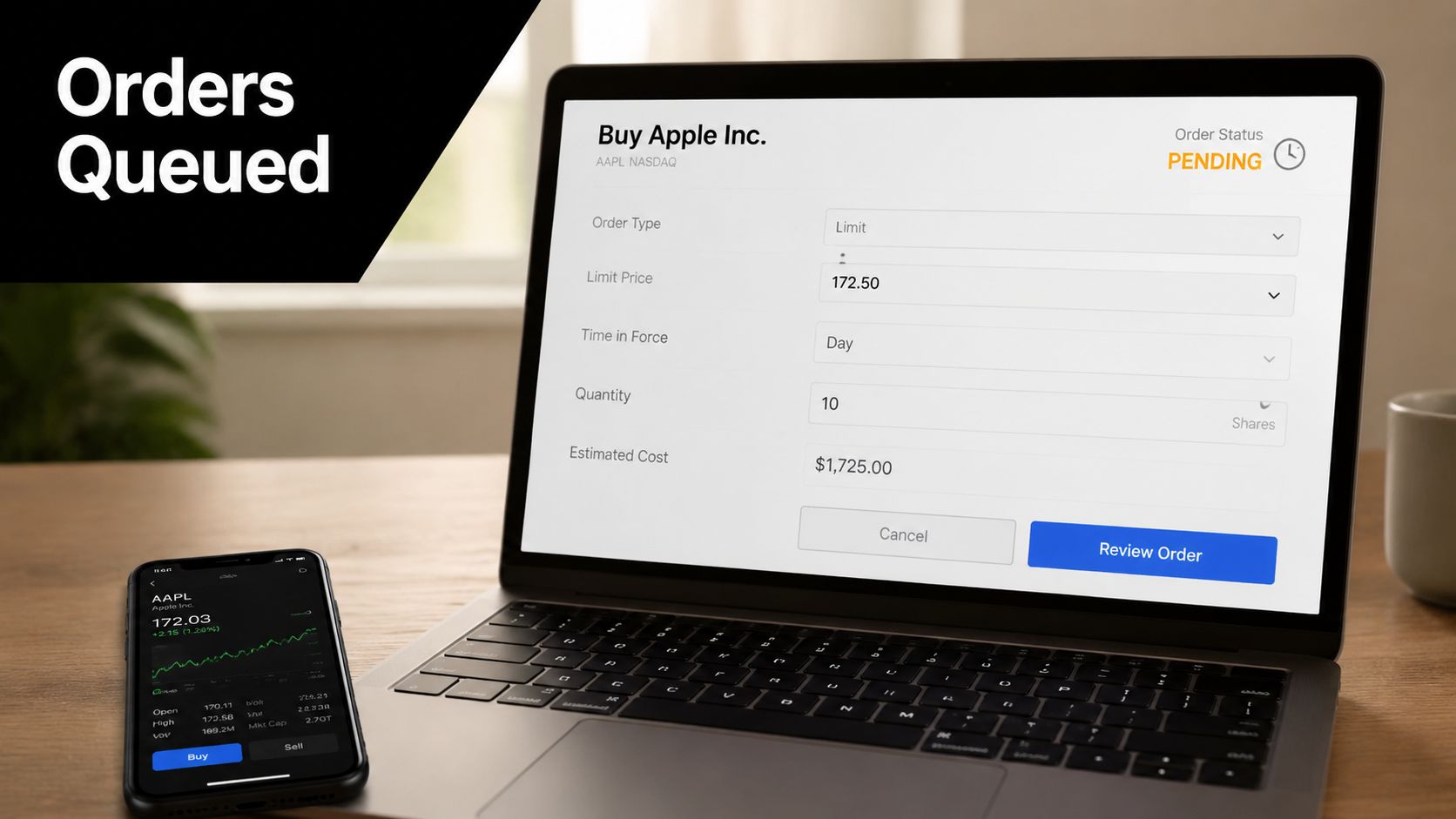
Use the ticket as a question, not a promise. If the venue doesn't advertise live weekend execution for that asset, assume Monday is the real fill date.
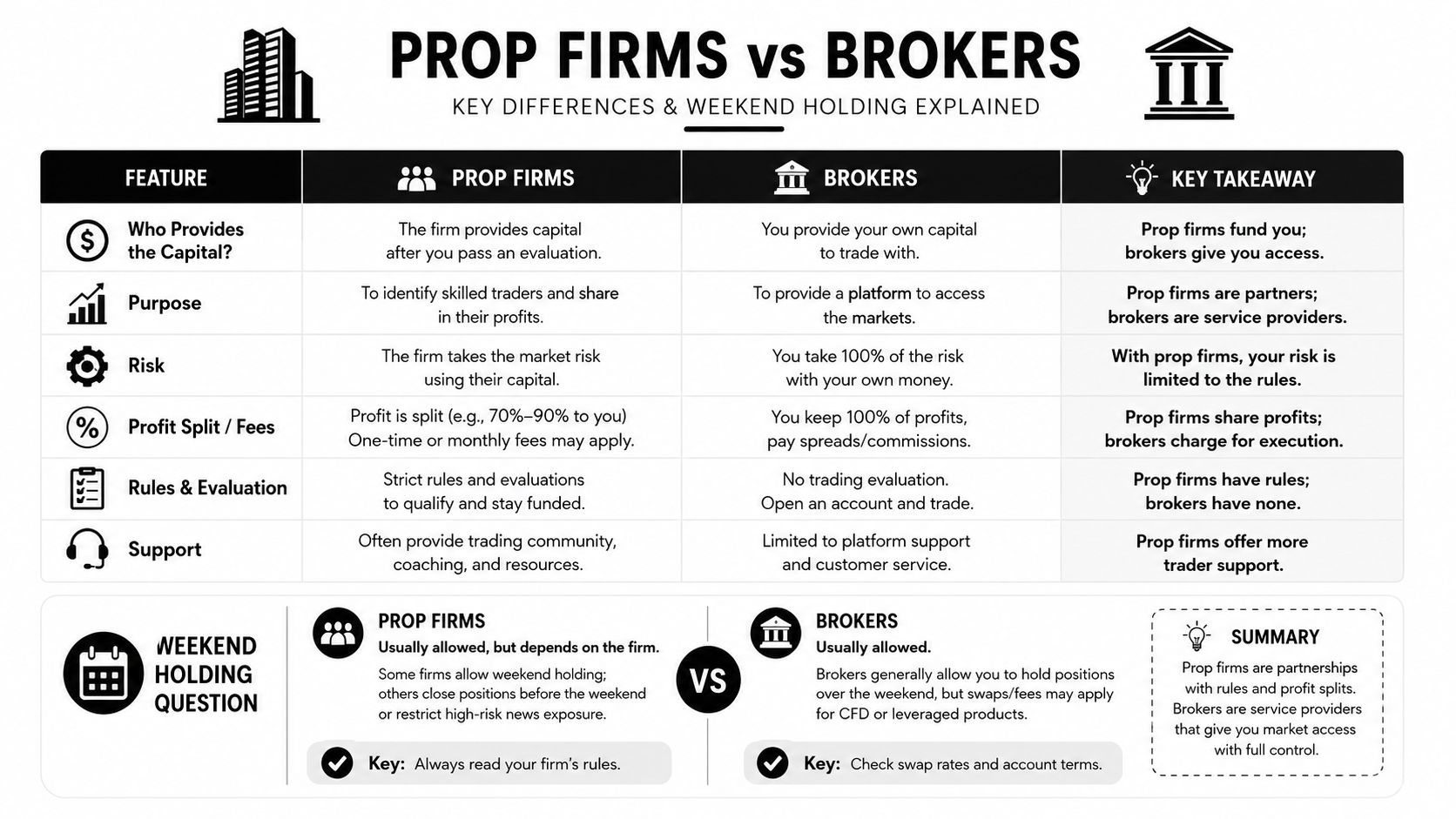
Prop Firms, Brokers, and the Weekend Holding Question
Weekend trading becomes more than a platform issue. With a broker, the question is usually whether the market is open. With a prop firm, the question is whether the firm lets you carry risk through the weekend at all.
Why prop rules matter more than most traders think
Most prop firms treat weekend holding as a policy choice because weekend gaps create a different risk profile from weekday intraday trading. Some firms ban it, some allow it only on certain accounts, and some make it an add-on. That's not marketing noise, it's a rule-set that changes whether your strategy even fits the account.
MyFundedCapital offers an optional Weekend Holding add-on, which is useful for traders who need exposure through Saturday and Sunday, especially in crypto or swing-style setups. The firm also uses a 5% daily loss limit and up to 10% maximum drawdown, so weekend exposure still has to fit inside the same risk envelope as any other trading day. If you hold over the weekend, your buffer matters before the market reopens, not after.
The practical takeaway is simple. If your edge depends on keeping a position alive through a Friday close, weekend policy is a dealbreaker, not a minor account feature. You don't want to discover that rule after you've already sized the trade.
Compare the rule before you compare the payout
A prop account that forbids weekend holding may be fine for pure intraday execution. A swing trader or crypto trader usually needs a different setup. For a closer look at how swing-style rules are framed, the internal guide on best prop firm for swing traders gives helpful context.
| Provider Type | Default Weekend Rule | Weekend Holding Available? | Notes |
|---|---|---|---|
| Retail stock broker | Weekend stock execution is usually closed | Usually no, for equities | Orders may queue until Monday |
| Crypto exchange | Continuous access | Yes, if the asset trades | Liquidity can still thin out |
| CFD or FX broker | Instrument-specific weekend access | Sometimes, on select products | Check each symbol separately |
| Prop firm | Policy-driven account rule | Sometimes via add-on | Risk limits still apply |
Liquidity, Spreads, and the Real Cost of Weekend Trades
Even when a market is open, weekend execution isn't the same as weekday execution. The order book is thinner, quotes can widen, and the price you want is often not the price you get. That's why weekend traders need to think in terms of execution quality, not just availability.
The costs show up in the fill, not the headline
Dukascopy notes that weekend trading can bring higher volatility, lower liquidity, wider costs, and slippage around Friday-to-Sunday gaps, especially when markets reopen after news flow or maintenance windows (Dukascopy weekend trading article). In plain English, that means your stop-loss can get hit far from the level you planned, and your market order can chase a worse price than you expected.
For execution-sensitive traders, that changes everything. A setup that looks acceptable on a chart can become poor risk management if the spread is wide enough to distort your entry and exit. If you trade frequently, the spread itself is part of your edge, so this isn't a side issue.
Adjust how you trade, not just what you trade
Weekend conditions call for a different playbook.
- Reduce position size. If you're unsure about weekend liquidity, cut exposure before the move reaches your account.
- Prefer limit orders. A market order in thin conditions can fill at a bad level very quickly.
- Recheck stops. A stop-loss that looks clean on Friday may be too tight once liquidity thins.
- Avoid “set and forget” on fragile events. If a venue has maintenance windows or the market reopens into fresh news, the fill can move hard.
If you want a deeper look at how quoted costs change in live markets, the guide on spreads in trading is worth reading before you hold risk into Saturday.
Trading through the weekend is a liquidity decision first. If the order book is thin, your idea can be right and your execution can still be wrong.
A Practical Weekend Trading Playbook
A weekend routine should feel boring. If it feels exciting, the sizing is probably too large or the market is doing too much of the decision-making for you. Keep the process mechanical so Monday doesn't turn into damage control.
Build the checklist before Friday close
- Review open exposure. Know which positions are still live and whether they're meant to survive the weekend.
- Confirm the venue. Make sure the instrument is tradable on the weekend, not just visible in the app.
- Cut size early. A good baseline is to trade at half your weekday size or less when weekend conditions matter.
- Choose the order type. Use a limit order whenever possible, especially in thin liquidity.
- Check the calendar. Don't hold blindly through scheduled maintenance, major news, or a venue-specific session change.
- Plan Monday reconciliation. Review the fill against the Monday open and document any gap risk in your journal.
Add the prop-firm check before you click submit
- Weekend-holding status. Confirm whether your account allows it or needs an add-on.
- Daily loss room. Make sure a Sunday gap won't push you into a rule breach at the next open.
- Drawdown buffer. If your max drawdown is already tight, weekend risk gets much harder to justify.
- Payout timing. If your firm pays on a cycle, know whether weekend exposure affects your next payout plan.
Traders who overlap weekend positions with tax-sensitive activity should also watch for duplicate or replacement transactions. If that's relevant to your workflow, the note on avoiding wash sale pitfalls is a useful reference point.

Choosing the Right Setup for Weekend Exposure
The right answer to weekend trading depends on your style, not on the loudest marketing page. If you're a day trader, staying flat by Friday close is often the cleanest decision. If you're a swing trader or crypto trader, weekend exposure may be part of the strategy, which means the account rules matter as much as the chart.
Match the account to the strategy
Weekend access is still a market-structure question, not just a broker preference, as the earlier exchange-hours section showed. That's why some traders are perfectly fine with a standard broker, while others need a funded account that allows holding risk through Saturday and Sunday. If your plan relies on that flexibility, choosing a firm that treats weekend holding as an option can save you from constant workarounds.
For traders who want a funded path with account sizes from $5K to $100K and scaling paths up to $500K, MyFundedCapital is one option to compare against other providers. The important part is to read the weekend rules before you compare the payout split or the challenge format, because account structure only helps if it fits the way you trade.
A simple decision filter
Ask yourself three questions:
- Do I need weekend exposure at all? If not, stay flat and reset on Sunday.
- If I do, which instrument supports it? Stocks, crypto, and FX don't all behave the same way.
- Will the account rules survive my plan? If the answer is no, the setup is wrong.
That filter keeps you out of the trap where a trader picks a good platform but the wrong rule set. The weekend is where mismatches show up fastest.
Frequently Asked Questions About Weekend Trading
Can you really buy stocks on the weekend?
You can usually enter a stock order over the weekend, but that's not the same as getting a weekend fill. For major U.S. stocks, the market is closed, and most orders are queued for the next open, usually Monday.
Do crypto trades settle on weekends?
Crypto markets can trade through the weekend, so order execution can happen then. Bank rails are a separate issue, so deposits, withdrawals, or fiat settlement may still depend on the provider's processing schedule.
Does weekend trading change pattern-day-trader rules?
Weekend stock trading itself doesn't create a special exception. U.S. equity markets are closed on weekends, so what matters is how your broker records weekday equity trades, not whether you clicked the ticket on Saturday.
What risk should I watch before using a weekend-holding add-on?
Watch the gap between Friday close and the next live session, because weekend liquidity can be thinner and fills can move fast. If your drawdown buffer is already tight, or your setup depends on precise stops, weekend holding deserves extra caution.
MyFundedCapital offers funded trading programs, optional weekend holding, and account paths that can fit swing traders, crypto traders, and disciplined intraday traders who want clear risk rules. If you're deciding whether a weekend-friendly setup makes sense for your strategy, visit MyFundedCapital to compare account types and start a challenge with the rules in mind.
