

 AR
AR
 NL
NL
 FR
FR
 DE
DE
 ES
ES
 IT
IT
 PL
PL
 SV
SV
 PT
PT

Your trading group probably started with energy. A few charts got shared, a few wins got posted, and everyone said they wanted accountability. Then the chat turned into noise, lurkers took over, and the only active posts were low-quality signals or screenshots with no context.
That's why most trading communities fail. They collect people, but they don't build habits, standards, or trust. Strong community engagement tips aren't about posting more often. They're about creating a structure people want to return to, contribute to, and learn from. This guide gives you 10 practical ways to do that in a trading or fintech setting, with playbooks you can run. If you want a broader planning model first, Coachful's community engagement framework is a useful starting point.
1. Build a Trader Discord Community Around Your Strategy
A trading community works better when it has one home base. For most active retail and prop traders, that's Discord. It's already used as a thread-based discussion space in trading communities, and active participation with regular recognition helps keep it self-sustaining, according to Watchers on community engagement strategy.

A good server isn't a random pile of channels. It needs to be organized around how traders work. That usually means separate spaces for pre-market plans, live trade discussion, post-trade reviews, psychology, platform questions, and challenge progress. If you want a practical example of how firms structure this, study a dedicated day trading Discord community rather than a generic social server.
What to set up first
Start lean. You don't need fifty channels. You need a few channels with clear rules and active moderation.
- Implement strict rules: Ban pump-and-dump calls, guaranteed profit claims, and screenshot bragging without context.
- Require loss reviews: A wins-only culture kills trust fast. Ask members to post losing trades with the same detail they use for winning ones.
- Pin risk rules: Keep your drawdown rules, challenge rules, and posting format pinned where everyone can see them.
- Recognize useful members: Give roles for members who help others, share clean analysis, or consistently post structured reviews.
Practical rule: If a channel would still make sense without screenshots, it probably has a purpose. If it only exists for hype, remove it.
Real examples are easy to spot. Strategy-based Discord groups for manual traders, TradingView-focused communities, and algorithmic trading groups discussing EA and cBot backtests all work better when the conversation is tied to a method, not just a market.
2. Host Weekly Live Trading Sessions and Challenge Progress Updates
A trader joins your Discord after blowing a challenge account on a news spike. They do not need another motivational thread or a screenshot of a perfect entry posted after the fact. They need to watch how a real trader prepares, waits, skips bad setups, and protects the account when conditions turn.
That is why weekly live sessions work. Regular contact keeps members engaged better than one-off interactions, and the National Coalition for Dialogue & Deliberation points to sustained communication as a core part of stronger community participation in its community engagement resources.
For prop firms and fintech communities, the session format matters more than the platform. A loose market recap turns into noise fast. A structured session becomes training, moderation support, and retention content at the same time.
What a useful live session looks like
Use the same agenda every week so members know what to expect and moderators know what to enforce.
- Pre-market context: Review market conditions, high-impact news, key levels, and the setups that are valid for the day.
- Live execution commentary: Explain entries, no-trades, partials, and size reductions in real time. Say why a trade is being passed on, not just why one is taken.
- Challenge progress update: Give members a short format to report status, rule breaches, and one process goal for the next week.
- Loss review: Break down one losing trade or missed trade with the same detail used for winners.
- Risk reminder: Close with the account rules that mattered most that week, especially daily drawdown, revenge trading, and news exposure.
Keep it tight. Sixty minutes is enough for most communities. Ninety minutes is usually too long unless the last half is a Q&A with clean moderation.
MyFundedCapital-style communities benefit from treating these sessions as operating reviews, not entertainment. That means fewer hot takes and more process checks. It also means moderators should shut down copy-trade behavior in chat. Members can discuss the setup logic, but they should not treat a live session like a signal room.
A simple progress template helps:
- Current challenge phase
- Weekly P&L range
- Rules broken, if any
- Best decision made
- One fix for next week
This keeps updates useful and reduces bragging. It also gives you a clean paper trail of recurring problems. If half the room keeps failing after CPI releases or late-session trades, you have a content plan for the next webinar and a moderation issue to address before it gets worse.
Show the quiet parts. Waiting, reducing size, and ending the session flat are often more useful to watch than a clean winner.
Record every session and tag it by topic: news trading, drawdown recovery, overtrading, missed entries, rule breaches, and challenge pacing. Over time, that library becomes a practical training archive for new members and a reality check for struggling ones.
3. Create a Transparent Challenge Tracking Leaderboard
Leaderboards can help or hurt. A bad one pushes traders into performance theater. A good one rewards discipline, progress, and consistency.
The fix is simple. Don't rank only by profit. Include risk behavior and improvement. In digitally native communities, trust is built through transparent data and proof rather than face-to-face presence, and a gap remains in guidance built for platform-based groups, where only 12% of engagement guides address those audiences.
Build a leaderboard traders will actually respect
Make it opt-in. Some traders will want a public profile. Others will only participate under an alias. That's fine.
Track a few fields that matter:
- Current progress: Profit status, challenge stage, and recent completion milestones
- Risk behavior: Daily rule breaches, near-miss days, or clean execution streaks
- Improvement: Recovery after a rough week, not just top-end returns
- Commentary: A short note on what changed in their process that week
Weekly updates are better than daily updates. Daily ranking encourages obsession. Weekly tracking gives members enough visibility without pushing them into reckless trades for a small bump on the board.
A useful real-world model is the public performance ranking style used by prop firms and strategy platforms, but adapted for community health. Add a “Most Improved” slot and a “Best Risk Management” slot. That changes what people compete for.
4. Launch Monthly Trading Challenges Within Your Community
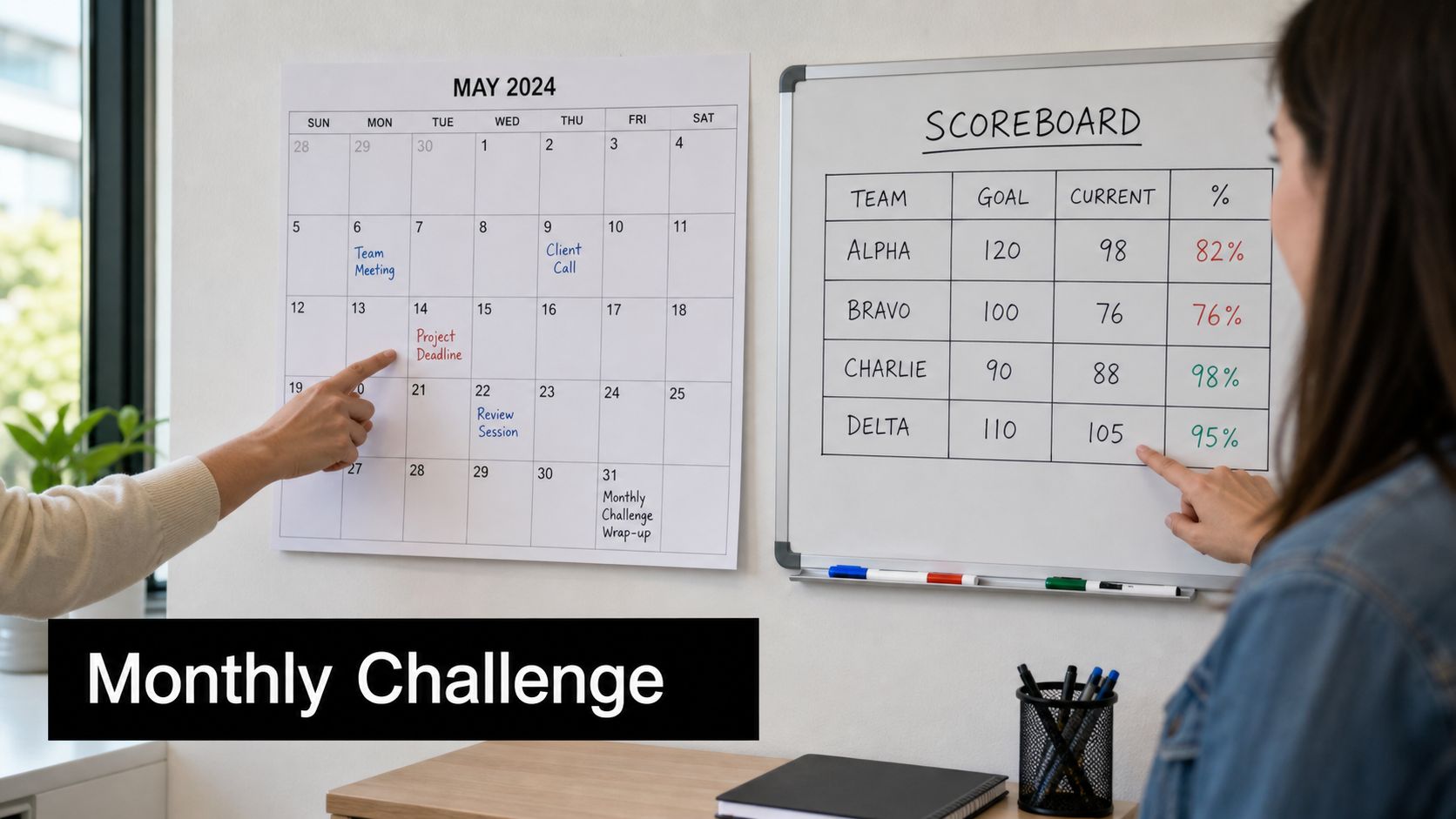
A monthly challenge can steady a community after a volatile week. One trader is pressing to recover losses, another is sitting out after a rule breach, and newer members are watching without participating. A well-run challenge gives all three a clear way back in. It turns attention toward process, not chest-thumping.
Official prop evaluations already carry enough pressure. Community challenges should train one behavior at a time and keep the cost of joining low. In a prop trading or fintech group, that usually means short cycles, clear scoring, and zero ambiguity about what counts as a win.
Keep the challenge tight and the proof clear
Run one theme per month. Ask for one type of submission. Verify results the same way every time.
That structure works better than broad competitions because it lowers moderation overhead and reduces disputes. In communities shaped by funded-account rules, members lose trust fast when scoring feels subjective or easy to game. MyFundedCapital-style communities do best with formats that reward behavior members can repeat under real evaluation conditions.
Use challenge formats like these:
- Lowest Drawdown Challenge: Score traders on capital protection and rule adherence over the month
- Execution Quality Challenge: Judge one annotated trade review each week using a fixed rubric
- Consistency Challenge: Reward traders who follow their plan across a minimum number of sessions
- Recovery Challenge: Highlight members who corrected bad habits after a setback and stayed within limits
- Risk Manager of the Month: Recognize the trader with the cleanest sizing, stop discipline, and no unnecessary breaches
Spell out the rules in plain language. Include start date, end date, eligibility, evidence required, and disqualifiers. If traders need to ask five follow-up questions, the setup is too loose.
A simple moderation template helps:
- Goal: One sentence on what behavior the challenge rewards
- Submission: Screenshot, journal entry, broker export, or trade recap
- Scoring: Three to five criteria with fixed weights
- Review window: Exact deadline for mods to verify entries
- Disputes: One channel for appeals, one cutoff date, final mod decision
Rewards should match the culture you want. Cash prizes can attract low-quality participation and fake reporting. Recognition usually works better in trading communities because it strengthens status without pushing reckless behavior.
Use rewards such as a featured community spotlight, a Discord role for the month, priority access to a live review session, or the chance to walk through a trade plan with the group. Those rewards also create material for future education, which matters more than handing out a small prize and hoping it changes behavior.
The challenge should not live in one format only. Higher education community teams have found that blended online and offline engagement supports stronger participation and connection in digital-first groups, according to EDUCAUSE's review of hybrid and blended community-building practices. For a trading community, that means the submissions can happen in Discord, the mid-month checkpoint can run on a live stream, and the final review can go out by email or webinar.
Keep the workload realistic. One monthly challenge run well beats four half-managed contests that create arguments, inconsistent judging, and moderator burnout.
5. Develop Case Studies and Success Stories from Challenge Graduates
A trader passes a challenge, posts a payout screenshot, gets a burst of congratulations, and the channel moves on by the next day. That does almost nothing for retention. A real case study gives the community something they can study, question, and apply.
Trading communities do better with proof of process than proof of outcome. In prop and fintech groups, members want to see the full sequence. What the trader traded, where they nearly lost control, how they handled firm rules, and what they changed after a bad week. That kind of story creates discussion because it is useful, not because it is polished.
Use a repeatable format. MyFundedCapital-style communities get better participation when graduate stories read like post-trade reviews instead of ads.
What to include in a real trader case study
Interview the trader the way a risk lead or moderator would. Keep the questions concrete, and ask for receipts.
Include details such as:
- Strategy type: Day trading, swing trading, algorithmic, or copy trading
- Account context: Challenge phase, account size, instruments traded, and active session hours
- Hard moments: Biggest drawdown stretch, worst execution mistake, and what changed after it
- Rule handling: How the trader stayed inside limits, used a daily stop, or cut size after a rough session
- Execution habits: What conditions trigger a trade, and what conditions make them stand down
- Artifacts: Journal entries, annotated charts, dashboard screenshots, or a short recorded walkthrough with consent
The strongest stories are rarely the cleanest ones. A graduate who failed once, rebuilt their routine, and passed on the next attempt usually teaches more than someone who makes the process look easy. That matters in prop trading because members are not just chasing wins. They are trying to stay funded without breaking rules.
Keep the edit honest. If the trader had a near-breach day, include it. If they switched from overtrading open volatility to waiting for one A-grade setup, show that decision clearly. Communities trust specifics.
A simple template helps moderators collect these stories without turning the process into a full content production job:
- Start: Trader background and challenge conditions
- Problem: The habit or weakness that kept showing up
- Adjustment: What changed in risk, routine, or execution
- Result: Pass, payout, improved consistency, or better rule compliance
- Lesson for members: One behavior to copy, one mistake to avoid
Tie every story back to risk. Link the case study to your community's risk management best practices for funded traders so the lesson does not drift into hero worship.
This also gives moderators better material to work with. Instead of vague praise, they can point newer members to a case study on sizing down after two losses, pausing after rule pressure, or recovering from an impulsive trade. That keeps success stories grounded in behavior the community should repeat.
Publish them on a schedule. One solid graduate story each month is enough if it is honest, structured, and tied to actual trading decisions.
6. Establish Monthly Webinars on Risk Management and Drawdown Recovery
If you run a trading community and don't teach risk management constantly, the loudest voices will drift toward hype. That's what usually happens in under-moderated groups.
A monthly webinar fixes that. It gives members a scheduled place to work through position sizing, drawdown response, and rule interpretation in detail. For a practical baseline, point members toward clear best practices for risk management before the webinar, then use the live session to apply those principles to real scenarios.
Focus the webinar on situations traders actually face
Keep each session narrow. Broad “trading psychology” talks tend to blur into generic motivation.
Better topics include:
- How to size down after a losing streak
- How to stop revenge trading after one bad execution
- How to rebuild confidence without increasing risk
- How to review a near-breach day step by step
- How to separate a valid setup from boredom trading
For prop traders, you explain rules in practical terms. If someone is close to a loss limit, what changes today? Fewer trades? Smaller size? No lower-quality setups? Those are the decisions members need help with.
Field note: The best risk webinar usually isn't the one with the fanciest slides. It's the one that dissects an ugly week honestly.
Record every webinar. Then cut short clips for Discord and email. The same topic can serve live members, replay viewers, and newer traders who join later.
7. Create a Peer Mentorship Matching Program
A trader passes evaluation rules on paper, then keeps failing for the same reason. Oversizing after one good day. Forcing entries during dead sessions. Ignoring the daily loss limit because a setup "looks clean." More content does not fix that pattern. Consistent peer review often does.
A mentorship program works best when it is built around accountability, not status. In prop and fintech communities, that distinction matters. Newer members do not need signal sellers or pseudo-coaches. They need a more experienced trader who can review execution, call out rule drift, and show what disciplined process looks like inside a funded or evaluation environment.
The strongest mentors are usually steady members with credibility in the group. Funded traders help, but funding alone is not enough. Pick people who explain their decisions clearly, respect risk rules, and can give blunt feedback without turning every conversation into a performance.
Build the match around process, not personality
Keep the format tight so it does not turn into unpaid coaching.
Use a simple operating model:
- Screen mentors first: Approve traders with a documented process, clean community conduct, and a track record of following firm rules.
- Match by trading style: Pair intraday traders with intraday traders, swing traders with swing traders, and challenge-phase members with someone who recently cleared that stage.
- Set a fixed term: Eight to twelve weeks is usually enough to spot behavior changes without creating open-ended obligations.
- Define the scope: Mentors review plans, journals, and execution. They do not give trade signals, manage accounts, or promise payouts.
- Require a shared template: A short weekly check-in works well. Planned setups, mistakes, rule breaches, and one adjustment for next week.
At MyFundedCapital-style communities, the best pairings are often built around the same rule pressure. A mentor who understands trailing drawdown, consistency targets, and news restrictions can give useful feedback fast because the context is already familiar.
Written feedback often beats live calls. It leaves a record, lowers scheduling friction, and gives moderators something to audit if a pairing goes off track. Ask mentees to submit one or two reviewed trades each week using the same structure they would use in a proper trading journal format.
Scheduling still matters. Once multiple mentors, time zones, and check-ins are involved, basic tools become messy fast. If you need a simple explanation of that problem, this breakdown of the limitations of Google Calendar for scheduling covers the operational gaps well.
One warning. Mentorship can create risk if you do not moderate it. Some mentors drift into calling trades. Some mentees become dependent and stop building their own process. Prevent that early with written rules, moderator oversight, and a clear reporting path when boundaries get crossed.
Done well, mentorship gives your community new leaders, faster habit correction, and better retention for traders who might otherwise disappear after a rough month.
8. Build a Shared Trade Analysis Repository Wins and Losses
Most traders journal alone. That helps, but it's slow. A shared repository speeds up learning because the whole group can see repeated mistakes and recurring strengths.
This can be a Notion database, a private website library, or a Discord submission workflow that gets cleaned up by moderators. The format matters less than the discipline. What matters is that the examples are searchable and honest. If you want members to improve the quality of their submissions, show them how a proper trading journal is structured first.

What to collect in each entry
Keep it simple enough that people will submit.
Ask for:
- Chart screenshot: Entry, stop, and target if relevant
- Trade logic: A short explanation of why the trade was taken
- Risk detail: Position size and whether the trade fit the trader's plan
- Outcome: Win, loss, scratch, or rule violation
- Lesson learned: One clean takeaway
Anonymity helps here. Plenty of traders will share more candidly if their name isn't attached. That's especially true for bad losses, hesitation, and repeated mistakes.
Review the repository monthly and pull patterns into your content. If you keep seeing oversized trades around news events or repeated FOMO entries after missed moves, that should become a webinar or discussion topic.
9. Launch a Monthly Newsletter with Community Wins, Market Insights, and Rule Reminders
Newsletters still work when they have a job. In a trading community, that job is to connect activity across the month, recognize useful contributions, and bring members back into the loop.
A weak newsletter is all announcements. A strong one feels like a clean briefing. It highlights community wins, summarizes good insights, reminds people of key rules, and asks for replies. Teams should track engagement over time and improve using surveys, post analysis, and direct outreach to loyal members, as recommended by CMX on rules of engagement.
What to include every month
Use a repeatable structure so readers know what they're opening.
- Community wins: Challenge completions, funded milestones, clean recovery stories, or standout trade reviews
- Market note: A short summary from a trusted community contributor
- Risk reminder: One rule or behavior issue worth reinforcing
- Best community post: Link to a useful breakdown from a member
- Reply prompt: Ask what members are struggling with right now
Many members won't catch every Discord discussion or live session. A newsletter provides a low-friction way for them to re-engage.
It also helps close the loop. If someone shared a lesson publicly and it later becomes part of the newsletter, they feel seen. That recognition keeps contributors contributing.
10. Organize Quarterly In-Person or Virtual Meetups for Funded Traders
Some communities stay active online for years. Others get much stronger once members meet live, even if it's virtual first.
Quarterly meetups work because they create a deadline, a shared event, and a stronger sense that real people are behind the usernames. Effective strategies also need multiple channels that fit different preferences and capabilities, rather than assuming everyone wants to engage the same way, as noted in Destinations International's guide to community engagement.
Start virtual, then test local demand
Virtual-first is usually the sensible move. It's easier to run, easier to attend, and more inclusive for a global trading audience.
A useful meetup agenda might include:
- Short trader panels: Focus on process, not promotion
- Networking breakouts: Pair newer traders with experienced ones
- Rule and platform Q&A: Give members a direct line for practical questions
- Community recognition: Highlight useful contributors and mentors
If demand is strong in one city, test a regional meetup. Keep it small. The point isn't to impress people with production. The point is to deepen relationships.
If you later run hybrid events, think through the setup carefully so remote members don't become an afterthought. This guide to planning a hybrid event is helpful for avoiding the usual coordination mistakes.
Top 10 Community Engagement Tips Comparison
| Initiative | Implementation Complexity 🔄 | Resource Requirements ⚡ | Expected Outcomes 📊 | Ideal Use Cases 💡 | Key Advantages ⭐ |
|---|---|---|---|---|---|
| Build a Trader Discord Community Around Your Strategy | Moderate, server setup + ongoing moderation | Low–Medium, community managers, bots, platform integrations | Higher engagement, peer validation, improved retention | Real‑time feedback, peer accountability, onboarding new traders | Accountability, networking, scalable organic growth |
| Host Weekly Live Trading Sessions and Challenge Progress Updates | Medium, recurring production and scheduling | Medium, streaming gear, hosts, editors | Greater transparency, trust, repurposable content | Education, marketing, sustained community touchpoints | Live demonstrations, strong engagement, content repurposing |
| Create a Transparent Challenge Tracking Leaderboard | Low–Medium, data collection and UI | Low–Medium, dev or spreadsheet upkeep, data verification | Motivation, social proof, increased platform visits | Gamification, showcasing success, recruitment funnels | Visible progress, healthy competition, discovery of leaders |
| Launch Monthly Trading Challenges Within Your Community | Medium, rules, verification, prize ops | Medium, admin, prize budget, verification processes | Sustained engagement, targeted skill improvement | Off‑cycle engagement, skill-building, onboarding new members | Flexible goals, multiple paths to recognition |
| Develop Case Studies and Success Stories from Challenge Graduates | Medium, interviews, editing, permissions | Low–Medium, interviewer, editor, consent management | Credibility, SEO traffic, higher conversion rates | Marketing, trust-building, aspirational onboarding | Deep social proof, replicable roadmaps, long‑form content |
| Establish Monthly Webinars on Risk Management and Drawdown Recovery | Medium, content prep, promotion, guest coordination | Medium, expert speakers, slides, webinar tech | Lower failure rates, improved discipline, evergreen resources | Educating traders on rules and psychology, onboarding | Actionable risk training, authority building, reusable assets |
| Create a Peer Mentorship Matching Program | High, vetting, matching algorithm, ongoing program mgmt | High, vetted mentors, admin support, matching tools | Higher pass rates, long‑term retention, improved performance | Personalized development, accelerated learner progress | 1‑on‑1 accountability, leadership opportunities, retention boost |
| Build a Shared Trade Analysis Repository (Wins & Losses) | Medium, submission system, curation, moderation | Medium, analysts, storage, moderation workflow | Accelerated collective learning, pattern identification | Collective post‑mortems, searchable examples for new traders | Large sample learning, normalized failure analysis |
| Launch a Monthly Newsletter with Community Wins, Market Insights, and Rule Reminders | Low–Medium, editorial calendar and production | Low, writer, email platform, contributor inputs | Regular engagement, re‑activation of users, awareness of rules | Ongoing communication, onboarding, event promotion | Scalable touchpoint, celebrates wins, drives clicks to events |
| Organize Quarterly In‑Person or Virtual Meetups for Funded Traders | High, event planning, logistics, scheduling | High, venue/sponsorship, staffing, travel or streaming tech | Stronger relationships, high‑value networking, PR content | Community bonding, regional networking, flagship events | Deep engagement, word‑of‑mouth growth, high‑quality content |
From Community to Funded Your Next Steps
A trader passes phase one, posts a payout screenshot, then disappears after the first rough week. Another trader keeps posting full reviews, including bad entries, rule mistakes, and position sizing errors. Six months later, the second trader is still active, still improving, and far more likely to hold funding. Community structure usually explains that difference.
In prop trading and fintech, engagement has to reinforce process. If the room rewards noise, unchecked bravado, and selective screenshots, newer traders copy bad habits fast. If the room rewards rule compliance, review quality, and honest loss analysis, members build habits that hold up under pressure.
The ten tactics above work because they create operating systems for behavior. A strategy-led Discord gives members a reason to return. Weekly live sessions turn abstract advice into visible decision-making. A leaderboard based on consistency, rule adherence, and review quality creates productive competition instead of PnL theater. Case studies, drawdown webinars, mentorship, trade repositories, newsletters, and meetups then keep the learning loop active between major milestones.
That takes work.
A serious trading community needs written moderation standards, escalation rules, and documented consequences. I have seen good communities lose credibility because the operator tolerated fake fills, ignored account-flipping claims, or let unproven members give reckless challenge advice. Transparency builds trust only if staff act on what members can now see.
The commercial upside is real, but the risk is real too. Communities can improve retention, support, and customer lifetime value when members get practical help from the group. They can also increase support load, moderation pressure, and reputation risk if rules are vague. CMX's annual community research tracks how community teams are tying their work more closely to business outcomes, which fits what prop firms and fintech brands already see in practice: members who attend events, contribute useful reviews, and follow the rules tend to stay engaged longer than members who only show up for announcements. See the latest findings from CMX's Community Industry Report.
Use metrics that reflect trader behavior, not vanity activity. Track live session attendance, challenge completion, mentor check-ins, newsletter clicks, repeat posting from members who submit full trade reviews, and dispute volume around rule misunderstandings. Review those trends monthly. If reactions and chat volume rise while workshop attendance and detailed post-mortems fall, surface activity is going up while useful engagement is dropping.
For prop trading communities, the next step is tighter design. Write moderation templates for payout claims, account verification requests, and rule disputes. Build leaderboard categories for best weekly discipline, cleanest execution, and strongest recovery after a controlled drawdown. Publish content that teaches members how to avoid violations, reduce overtrading, and document mistakes clearly. MyFundedCapital's community angle points in the right direction. Risk-first education, visible challenge progress, and structured peer review give traders something more valuable than hype.
Trading involves significant risk of loss and isn't suitable for everyone. This article is educational only and not financial advice.
Frequently Asked Questions (FAQ)
Q1: How do I start a trading community with zero members?
Start smaller than you want. Recruit an initial group you can moderate and support, even if that is only 10 to 20 traders. Give them a defined role from day one: post one structured trade review per week, attend a live session, or test your rule-clarity checklist. In prop trading, early members set the standard for how people talk about losses, rule breaches, and risk. Choose people who can handle that responsibly.
Q2: What are the most important KPIs to track for community engagement?
Track return behavior first. Look at weekly active members, live session attendance, challenge sign-ups, challenge completion, mentor participation, newsletter clicks, and the share of members posting full reviews instead of screenshots alone. Then check whether engagement connects to outcomes that matter in this field: fewer repeated rule violations, better recall of challenge limits, stronger retention after a losing streak, and better quality support questions.
Q3: How do I handle toxic members or misinformation?
Write plain-language rules and enforce them consistently. Remove guaranteed-profit claims, unverified payout flexing, personal attacks, copy-trading pitches, and advice that encourages traders to break challenge rules or ignore drawdown limits. Use templates so moderators respond the same way each time. In prop and fintech communities, inconsistency creates compliance risk and damages trust with serious members.
Start Your Trading Journey
If you want to see how this works in a prop trading setting, MyFundedCapital provides a practical example. The firm combines public risk parameters, trader education, and an active Discord-based community. Traders can choose Instant Funding or take a 1-Step or 2-Step Challenge, with account sizes from $5K to $100K and scaling paths up to $500K, based on the company's public program information. The specific format matters less than the operating standard. Traders usually perform better in an environment with clear rules, honest review, and daily reinforcement of risk management habits.
If you want a prop trading environment built around clear rules, active community support, and practical trader development, explore MyFundedCapital to compare account types, review the funding programs, and start a challenge when you're ready.
