

 AR
AR
 NL
NL
 FR
FR
 DE
DE
 ES
ES
 IT
IT
 PL
PL
 SV
SV
 PT
PT

You're probably in a familiar spot. You've got a strategy that works well enough on your own account, but when you look at prop firm funding, the path feels crowded with rules, pressure, and the temptation to rush.
A good trade fast track approach isn't about forcing speed. It's about choosing the right route, sizing risk so one bad session doesn't end the run, and building the kind of discipline that survives both challenge phases and funded trading. Trading involves risk of loss, and this is educational only, not financial advice.
Choose Your Fastest Path to a Funded Account
Most traders slow themselves down before they even place the first trade. They pick a funding path that doesn't match how they trade.
If your habits, patience, and confidence level don't match the account structure, you'll feel friction from day one. That friction turns into overtrading, hesitation, revenge trades, or trying to force a setup that isn't there.
What each path really asks from you
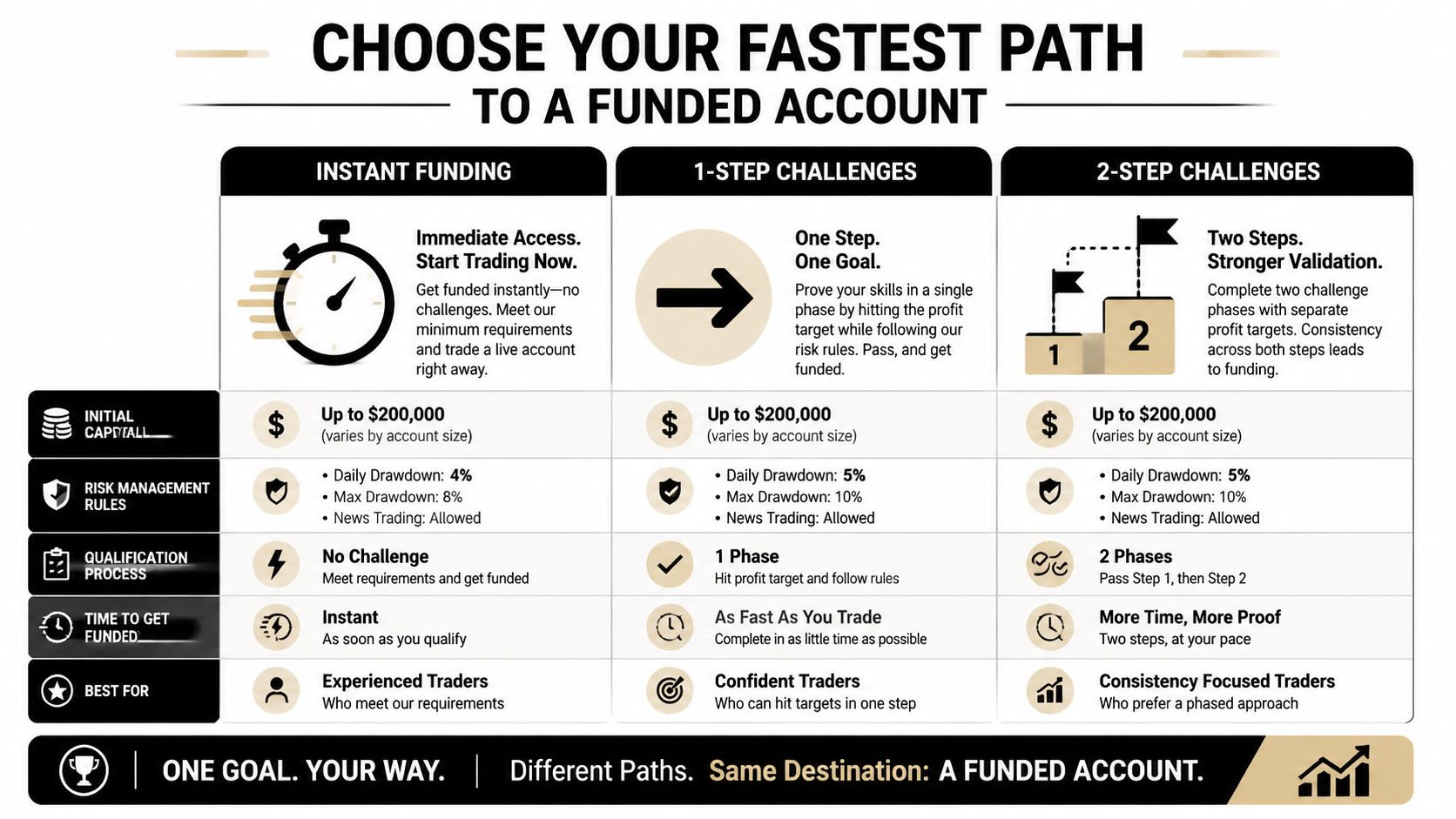
Instant Funding suits traders who already trust their process and want to start managing a funded-style account without waiting through an evaluation. Psychologically, this path sounds easiest, but it isn't forgiving if you're still inconsistent. The pressure is immediate because every mistake feels more “real” from the first session.
1-Step Challenge works well for traders who are already close to consistency but still need a clean structure to prove it. It's simple on paper, which makes it mentally dangerous for impatient traders. One phase can trick people into thinking they should finish fast, and that often leads to oversized trades.
2-Step Challenge is usually better for traders who need a steadier runway. The phased structure tends to reward patience and routine. The downside is obvious. More process means more chances to get tired, bored, or careless before the finish line.
Practical rule: The fastest path is the one you can follow calmly, not the one with the fewest steps on a landing page.
Funding path comparison
| Feature | Instant Funding | 1-Step Challenge | 2-Step Challenge |
|---|---|---|---|
| Access speed | Immediate start | Fast if you pass quickly | Slower because there are two phases |
| Best fit | Traders with proven discipline | Traders who want a direct evaluation | Traders who perform better with a staged process |
| Main psychological pressure | Protecting capital from day one | Forcing quick results | Staying focused across multiple phases |
| Common mistake | Trading too aggressively because access is immediate | Treating one phase like a sprint | Losing discipline after a strong start |
| Better for | Confident execution and routine | Clear setups and selective trading | Methodical traders who prefer structure |
For traders comparing immediate access options, it helps to review a dedicated instant funding prop firm overview and then ask a harder question. Can you trade the same way after two losses in a row, or do you start improvising?
How to choose without lying to yourself
Use this quick filter.
- Choose Instant Funding if you already follow a written risk plan, rarely move stops impulsively, and don't need the “test” of a challenge to stay disciplined.
- Choose a 1-Step Challenge if your edge is clear, your execution is clean, and you want a direct route without the mental drag of a second phase.
- Choose a 2-Step Challenge if you tend to improve after the first few sessions, need time to settle into rhythm, or know that impatience is still one of your weak points.
What works and what doesn't
What works:
- Matching path to personality: Swing traders, intraday traders, and scalpers all handle pressure differently.
- Starting with realistic expectations: A fast track still requires restraint.
- Treating the account as a risk container: The job isn't to “win funding fast.” The job is to protect downside while letting valid setups play out.
What doesn't:
- Picking the biggest or flashiest route because it looks impressive
- Changing strategy to fit marketing language
- Confusing urgency with progress
A trader who can stay boring for a month usually beats the trader who tries to be brilliant in three days.
Adapt Your Strategy to Prop Firm Rules
You take two losses in the first hour. The third setup looks clean, but now intense pressure starts. The danger is not the market. It is the urge to make the day feel normal again by forcing size, skipping a filter, or widening a stop.
A funded account rewards traders who can stay the same person after a loss.
Build your strategy around the rulebook
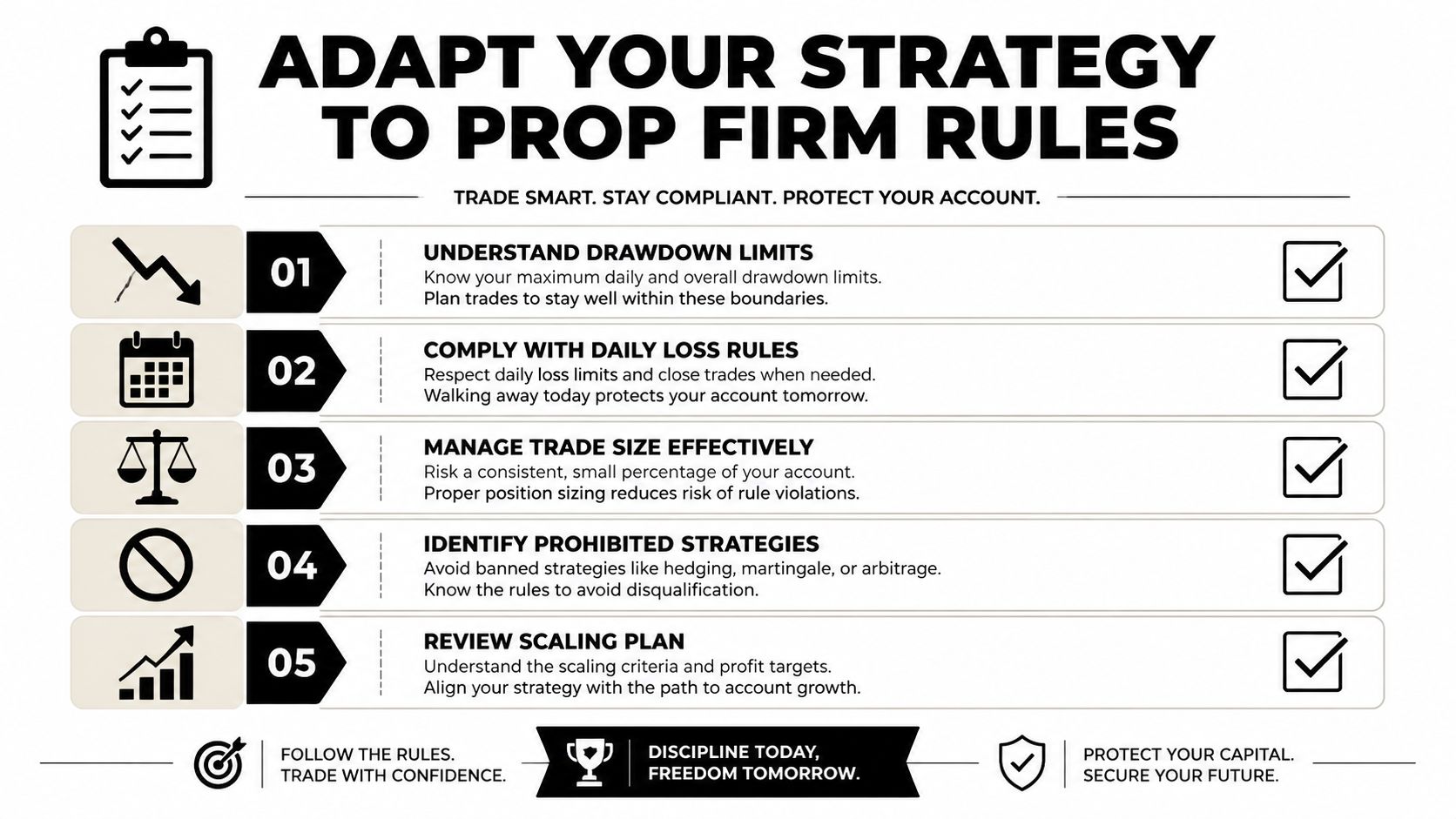
Prop firm rules change the job. A setup can still be valid and still be a bad trade for that account if the stop, session context, or combined exposure puts too much pressure on your drawdown.
That is the adjustment many traders miss. They keep the same chart pattern, same entries, and same targets, but fail to adapt the decision process around them.
The useful question is simple. How much room does this idea consume if it fails?
For many traders, that means reducing aggression across the board. For others, it means trading fewer instruments, skipping low-quality sessions, or cutting out the second entry after an initial stop-out. If your platform choice affects how you execute or test those adjustments, it helps to compare MetaTrader 4 vs MetaTrader 5 for prop trading workflows before you lock in a routine.
Adjust risk before you adjust entries
Most challenge failures come from behavior under stress, not from a weak setup model. The trader starts the day with a plan, takes a loss, then begins making exceptions.
Use a process that removes as many exceptions as possible:
Set a personal stop for the day before the open
Keep it tighter than the firm limit. That buffer covers slippage, bad execution, and the decisions that get worse when you are frustrated.Cap risk at a size you can tolerate
If one stop-out changes your mood or makes you want immediate revenge, the position is too large.Reduce size when conditions get messy
Choppy sessions, news spikes, and thin liquidity punish traders who insist on trading normal size in abnormal conditions.Count correlated trades as one idea
Three positions in related markets can create one oversized directional bet.End the session when decision quality drops
Prop rules measure drawdown. Experienced traders also measure focus.
That last point matters more than many admit. A trader can stay inside the hard rule and still do serious damage with tired, emotional decisions.
Match your psychology to your style
Scalpers usually face a different discipline problem than swing traders. The scalper's risk is overtrading. The swing trader's risk is rationalizing a wider stop because the higher timeframe story still looks good.
Both mistakes come from the same place. Ego wants flexibility right when the account needs structure.
The fix is specific to the style:
- Scalpers need tighter daily trade limits, cleaner kill zones, and a hard rule on when to stop after consecutive losses.
- Intraday traders need clear rules on re-entry, session selection, and maximum exposure during volatile windows.
- Swing traders need smaller size, more patience, and strict rules for holding through news and overnight movement.
A good adaptation feels restrictive at first. That is usually a sign you are removing the behavior that used to cost you money.
What disciplined traders do differently
The outside view of a good prop trader often looks dull. That is the point.
- Stops are placed before the trade is live.
- Size is based on account risk, not conviction.
- A missed trade stays missed.
- After a rough start, the trader gets more selective, not more active.
- Winning days do not lead to sudden risk increases.
If discipline disappears the moment you feel pressure, the strategy is unfinished.
Common mistakes that break good traders
| Mistake | What it usually leads to |
|---|---|
| Trading the same size in every condition | A normal stop becomes too expensive during volatile sessions |
| Adding “just one more” setup after a bad run | Lower-quality decisions and faster drawdown |
| Ignoring correlation across positions | Several trades behave like one large bet |
| Widening stops after entry | A planned loss turns into an emotional one |
| Treating the daily limit as usable risk | No room for slippage, mistakes, or loss of focus |
The mindset that gets accounts through evaluation
Passing gets easier when you stop trying to pass quickly.
The better mindset is preservation first. Protect the account, protect your decision quality, and let the statistics of your edge work over a series of clean trades. That sounds less exciting than chasing a payout screenshot. It is also how traders stay in the game long enough to get funded and keep the account.
Optimize Your Platform for Flawless Execution
Execution errors don't usually look dramatic. They look like entering the wrong size, forgetting a stop, clicking market instead of limit, or missing a partial because your workspace is cluttered.
That's why platform setup matters more than many traders admit. A trade fast track approach depends on removing friction before the market opens, not while price is moving.
Build a workspace that reduces mistakes
Whether you're on DXtrade or cTrader, the goal is the same. Put only the information you use in front of you.
A clean layout usually beats a “professional-looking” one loaded with extra panels. If you scalp, you need fast order entry, clear position visibility, and price levels you can read instantly. If you swing trade, you need room to see structure across timeframes without overloading the screen.
A practical setup checklist:
- Keep one primary watchlist: Don't scan too many instruments at once if you only trade a few well.
- Save chart templates: Use the same colors, indicators, and session markings every day.
- Make position data visible: Floating P&L, open risk, and order status should be easy to spot.
- Enable one-click trading carefully: Speed helps, but only if your order size presets are already correct.
- Use alerts: Price alerts reduce impulsive chart watching and help you wait for your zones.
DXtrade and cTrader habits that help
DXtrade is often easier for traders who want a straightforward interface with quick access to positions and account metrics. cTrader tends to appeal to traders who like detailed charting and more advanced order workflow.
What matters isn't which one sounds more advanced. It's which one lets you execute your actual process with fewer errors.
For traders still comparing platform ecosystems, this guide on MetaTrader 4 vs MetaTrader 5 is useful context because it clarifies how platform design affects order flow, chart handling, and routine.
Use orders to protect yourself, not just enter trades
A lot of traders treat order types as entry tools only. That's incomplete.
Use platform features to create structure:
- Stop-loss orders keep the worst-case outcome defined.
- Limit orders help avoid chasing price.
- Take-profit levels remove some decision fatigue.
- Partial exits can reduce emotional pressure during live management.
Your platform should make the right action easy and the reckless action harder.
Pre-session platform audit
Before every session, check these points:
| Item | What to confirm |
|---|---|
| Order size preset | It matches your plan for the day |
| Stop-loss function | It's active and easy to place |
| Charts | Only the needed indicators are loaded |
| Internet and device stability | No obvious issues before volatility hits |
| Economic calendar awareness | You know when conditions may change sharply |
The best traders I've seen don't “wing” platform setup. They build a repeatable cockpit, sit down, and execute from it.
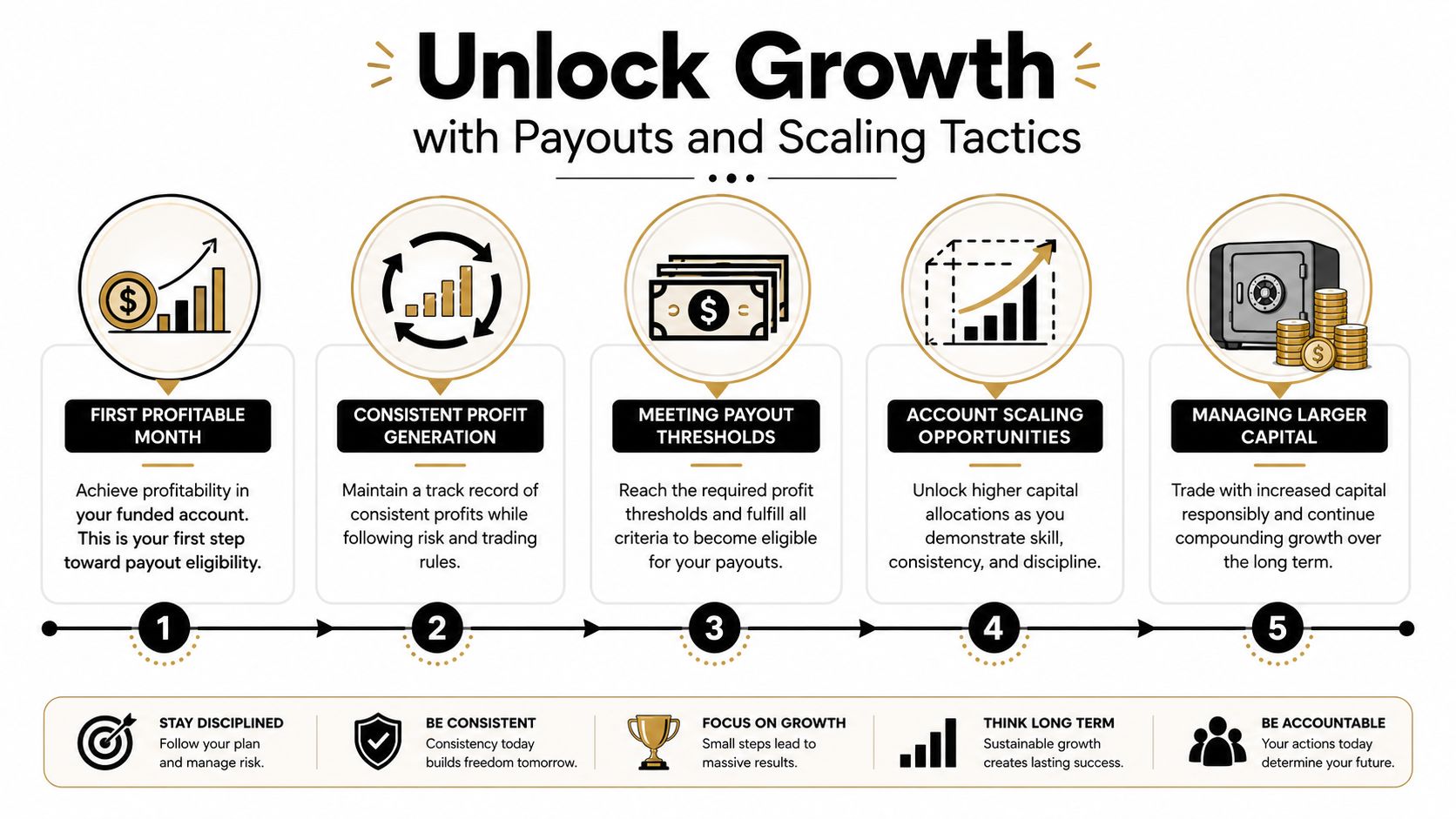
Grow Your Account with Payouts and Scaling Tactics
You pass the evaluation, string together a solid week, and then the intense pressure begins. Profit is sitting in the account, a payout is available, and every decision suddenly feels heavier. Traders often lose their footing here, not because the strategy stopped working, but because money changed the way they think.
Decide what this account is supposed to do
A funded account can serve two different jobs. It can pay you now, or it can help you earn access to more capital later.
Problems start when traders try to force one account to do both at the same time without a plan. They withdraw after every good run, then feel undercapitalized and push too hard. Or they keep every dollar in the account chasing a bigger size tier, then trade with a strange mix of greed and fear because none of the gains feel real yet.
Make the decision early. Income account or growth account.
That choice shapes your behavior more than people admit.
Build a payout rule before emotions get involved
A payout policy should reduce pressure, not create it. If regular withdrawals help you stay calm and treat trading like work, use them. If leaving profits in the account supports a deliberate scaling plan and you know you will not start gambling with cushion, keep more capital in play.
Three rules keep this clean:
- Set a payout schedule in advance. Do not let one strong day tempt you into changing the plan.
- Define a minimum buffer you want left in the account. That keeps one withdrawal from changing your whole risk posture.
- Judge the month by execution quality first, payout size second. Traders who obsess over withdrawals often start forcing trades to “make the period worth it.”
As noted earlier, some firms offer frequent payout windows and structured scaling paths. That sounds attractive, but the key question is whether you can stay mentally steady inside that rhythm. Fast access to profits helps disciplined traders. It can also tempt impatient traders into short-term thinking.
Scaling exposes every bad habit
Bigger capital does not fix weak execution. It amplifies it.
A trader who cuts winners early at a smaller size usually does the same thing after scaling, except now the emotional noise is louder. A trader who revenge trades after a red day will feel even more urgency once the account size increases. The habits come with you.
The traders who handle scaling well are usually boring in the best way. They keep position sizing logic stable. They do not become aggressive after a payout. They treat a larger account as a larger responsibility, not as permission to act bigger.
The skill is not getting more buying power. The skill is staying the same trader after you get it.
Where traders usually slip
I see the same failure points again and again:
- They protect recent profits so tightly that they stop taking valid setups.
- They withdraw, then trade scared because they feel they must “rebuild” immediately.
- They chase the next scaling milestone and abandon the process that got them there.
That is why traders exploring automated trading programs for prop firm accounts need to review payout behavior and drawdown behavior together, not just entry logic. The same applies if you are studying the best copy trading platforms. A smooth equity curve means very little if the risk model falls apart after a withdrawal or during a scaling phase.
The practical mindset is simple. Take money out with a plan. Leave money in with a purpose. Keep your behavior as consistent as possible while the account gets bigger. That is how funded traders last.
Automate and Optimize with Algo and Copy Trading
Automation can help a trader become more consistent, but only if the system fits the environment. In prop trading, an EA or copy setup doesn't get judged by how clever it is. It gets judged by whether it can operate inside firm rules without creating avoidable risk.
That means a profitable retail bot can still be a bad prop bot. The difference usually comes down to drawdown behavior, recovery logic, and how the system behaves when markets get messy.
What to test before you trust an algo
A useful automation review starts with behavior, not performance headlines.
Ask these questions:
- How does the system behave during losing streaks? A strategy that “recovers later” may still violate account rules first.
- Does it add to losers? Grid and martingale logic can create hidden risk concentration.
- Can it handle spreads and execution variation? A fragile scalping bot often looks better in backtests than in live-style conditions.
- Does it trade too often? More trades don't always mean more edge. They often mean more ways to make an operational mistake.
The cleanest algo setups in prop environments tend to have simple logic, controlled exposure, and defined invalidation points.
Copy trading needs risk matching, not hero worship
Copy trading creates a different trap. Traders often choose a master account because the equity curve looks smooth, then discover the risk profile doesn't match the prop account structure.
If you're evaluating providers, study how they handle drawdowns, correlated positions, and event risk. A curated guide to best copy trading platforms can help you compare infrastructure and tooling, but the key issue is still risk compatibility. A good copier setup should mirror a disciplined process, not outsource judgment entirely.
Where traders usually get disqualified
Most failures with automated systems come from predictable issues:
| Pitfall | Why it matters |
|---|---|
| Recovery systems that add size after losses | Drawdown can accelerate quickly |
| Correlated trades across multiple symbols | Risk looks diversified but behaves as one bet |
| Latency-sensitive entries | Small execution differences can change outcomes |
| No hard shutdown conditions | The bot keeps trading when conditions degrade |
For traders exploring prop-friendly automation, it makes sense to review dedicated automated trading programs and then test with a stricter lens than usual. Don't ask only whether the bot can profit. Ask whether it can stay controlled when the market stops behaving well.
The discipline automation still demands
Automation doesn't remove psychology. It relocates it.
You still need discipline to stop a system, lower allocation, pause copying after a structural change, and avoid overriding rules because “the model should recover.” The traders who use automation well stay involved at the risk level, even if entries and exits are machine-assisted.
Trade Fast Track FAQ
Is instant funding always the best trade fast track option
A trader takes instant funding because it feels like the quickest route, then loses composure after the first red day and gives the account back in a week. That happens more than new traders expect.
Instant funding is fastest only if your decision-making is already stable. Traders who can follow size rules, stop after a sloppy session, and accept small losses without revenge trading usually handle it well. Traders who still fight tilt often perform better in a challenge model because the structure forces patience. A slower-looking path can be the faster one if it fits your psychology.
Should I change my strategy completely for a prop firm
Keep the edge. Change the parts that break under rules.
For most traders, that means smaller size, fewer marginal setups, and tighter control over total exposure. If your strategy depends on moving stops wider, adding into losers, or trading every impulse, the issue is not the setup. The issue is discipline under constraint. Prop rules expose weak habits fast, so the adjustment is usually behavioral before it is technical.
Can swing traders still use a trade fast track approach
Yes, but only if the account terms support how you hold risk.
As noted earlier, some firms offer optional permissions for news trading and weekend holding. That matters because swing traders do not just need time in the market. They need consistency between the strategy and the rule set. If you are forced to flatten before the move develops, you are no longer swing trading. You are running a compromised version of it, and that usually leads to second-guessing, poor exits, and broken confidence.
Is algo or copy trading easier than manual trading
Algo and copy trading shift the pressure point. They do not remove it.
Manual traders usually break rules in the moment. System traders break rules before the session starts by trusting a model they have not stress-tested well enough. The discipline is different. You need the patience to reduce size when performance degrades, pause a copier when correlations tighten, and shut a system down when execution starts slipping. Traders who treat automation like supervision, not autopilot, tend to last longer.
Choose the funding path that matches your habits under pressure. Ego picks the account that looks fastest. Discipline picks the one you can keep.
