Choosing between MetaTrader 4 and MetaTrader 5 can be confusing, as the newer version isn't a simple upgrade. This guide provides a direct comparison to help you understand the practical differences in features, performance, and best use cases. You'll learn which platform aligns with your specific trading style, whether you're a forex specialist, an algo trader, or aiming for a funded account.
The core of the MT4 vs MT5 debate boils down to a trade-off: MT4 offers battle-tested reliability and massive third-party support for forex trading, while MT5 provides enhanced features and multi-asset capabilities for the modern trader. Your trading style, strategy, and long-term goals will determine the right choice. Remember, trading involves a significant risk of loss and is not suitable for all investors; this content is for educational purposes only and is not financial advice.
For a full overview of the platforms we support, explore our detailed guide on the trading platforms we offer.
Core Differences: MetaTrader 4 vs MetaTrader 5 at a Glance
To start, let's break down the fundamental distinctions. This table gives you a quick snapshot of where each platform stands on the most important features.
| Feature | MetaTrader 4 (MT4) | MetaTrader 5 (MT5) |
|---|---|---|
| Primary Use | Forex Trading | Multi-Asset (Forex, Stocks, Futures, etc.) |
| Timeframes | 9 standard timeframes | 21 total timeframes |
| Technical Indicators | 30 built-in | 38 built-in |
| Pending Order Types | 4 types | 6 types (adds Buy/Sell Stop Limit) |
| Programming Language | MQL4 | MQL5 (more advanced, not backward-compatible) |
| Backtesting | Single-threaded, slower | Multi-threaded, faster, uses real tick data |
| Economic Calendar | No | Built-in |
As you can see, MT5 offers more of everything right out of the box—more markets, more analytical tools, and more order flexibility. However, the true story is in the details.
Why MT5 Isn't Just an "Upgrade" to MT4
To understand the MT4 vs MT5 debate, you have to know why each platform was built. When MetaTrader 4 launched in 2005, it revolutionized retail forex trading. Its real power came from the MQL4 programming language, which allowed a massive community to build and share custom indicators and automated trading robots, known as Expert Advisors (EAs). This ecosystem made MT4 the undisputed industry standard for over a decade.
A Successor Built for a Different Purpose
In 2010, MetaQuotes released MetaTrader 5. Many assumed it was just a better MT4, but it was a complete rebuild. MT5 was designed as a multi-asset platform to connect to centralized exchanges for trading stocks and futures, not just decentralized forex markets.
The catch? MQL5, the new programming language, was not backward-compatible with MQL4. This meant the thousands of EAs and custom tools that made MT4 so popular were useless on MT5 without being completely rewritten. This single decision dramatically slowed its adoption, as traders and brokers were unwilling to abandon their trusted tools.
Where the Platforms Stand Today
Even now, MT4 remains incredibly popular, with some brokers reporting over 60% of their retail forex volume still running on the older platform, according to market share analysis on Onfin.io. Traders stick with what works, especially if their strategies rely on old MQL4 EAs.
However, MetaQuotes no longer issues updates or new licenses for MT4. All development is focused on MT5, which offers superior speed, security, and features. For this reason, most brokers and prop firms are now encouraging a transition to MT5, as it's better equipped for the demands of modern trading.
Algorithmic Trading: MQL4 vs. MQL5
For traders who build or use EAs, the choice between MT4 and MT5 comes down to the programming language and testing environment. This is where your strategy's performance is made or broken.
MQL4: Simple and Widely Supported
- Language MQL4 is a procedural language, making it relatively simple to learn for basic EAs.
- Ecosystem A massive library of existing EAs and indicators, many available for free or for purchase.
- Limitation It struggles with complex, multi-layered strategies.
MQL5: Powerful and Built for Complexity
- Language MQL5 is an object-oriented programming (OOP) language, similar to C++. It allows for creating more sophisticated, modular, and robust EAs. A great video breakdown of these differences shows this in action.
- Functionality Supports more complex logic and can handle partial order fills, giving you more precise control over risk management.
- Limitation Requires rewriting old MQL4 code, which can be a barrier for traders reliant on legacy EAs.
Backtesting: The Clear Winner is MT5
The Strategy Tester in MT5 is its single biggest advantage for algo traders. It completely outclasses MT4's older engine.
Here’s a practical breakdown of why:
- Speed MT5 is 64-bit and multi-threaded, using all of your computer’s power to run tests. MT4 is a 32-bit, single-threaded application that can be painfully slow, especially with complex EAs. An MT5 backtest can be up to 20x faster.
- Accuracy MT5 allows testing on real tick data, giving a much more accurate simulation of live market conditions. This helps close the gap between how an EA performs in backtests versus live trading.
- Versatility You can test a single EA on multiple currency pairs or instruments simultaneously. This is impossible in MT4 without clunky workarounds.
For anyone looking to pass a funded account challenge, this speed and accuracy are crucial. You can run hundreds of optimizations in MT5 in the time it takes to run a few in MT4. To enhance this process, consider specialized back-test software that can further refine your strategy. You can also improve execution with tools like trading proxy services to reduce latency.
Which Platform Is Best for Prop Trading?
For traders aiming to get funded, your choice of platform directly impacts your ability to manage risk and execute your strategy effectively.
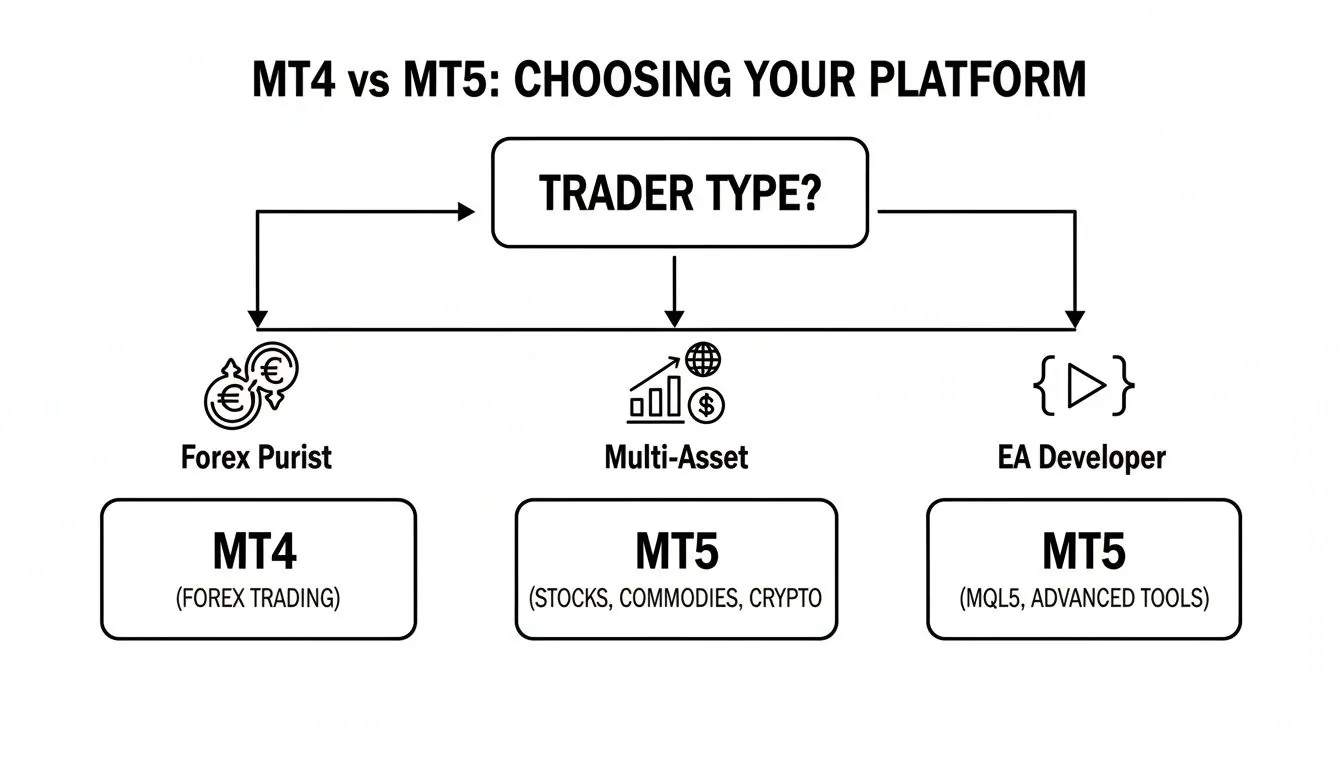
Many traders default to MT4 out of habit. If your strategy is purely forex-based and you rely on an old, trusted MQL4 EA, it can still be a viable option.
However, modern prop firms, including ours, offer a range of instruments beyond forex, such as indices, metals, and cryptocurrencies. This is where MT5's design as a multi-asset platform gives you a clear edge.
Why MT5 is the Professional's Choice
MT5 gives you a professional-grade toolkit that can make a real difference in performance:
- More Analytical Tools With 21 timeframes (vs. MT4's 9) and 38 built-in indicators (vs. 30), you can perform more granular market analysis.
- Advanced Order Types MT5 includes 6 pending order types, adding Buy Stop-Limit and Sell Stop-Limit. These give you more precision in executing entries around key price levels.
- Depth of Market (DOM) This feature provides a live view of an instrument's order book, which is critical for assessing liquidity and minimizing slippage, especially when trading indices or stocks.
- Built-in Economic Calendar See high-impact news events directly on your charts, helping you manage risk without switching screens.
For a career in prop trading, your platform should be an asset, not a limitation. While MT4 gets the job done for basic forex, MT5 offers the superior risk management and multi-asset capabilities needed to pass an evaluation and scale a funded account. For a deeper dive, check out our available funded forex trading accounts.
FAQ: MetaTrader 4 vs MetaTrader 5
Here are answers to some of the most common questions traders ask when choosing between MetaTrader 4 (MT4) and MetaTrader 5 (MT5).
Can I use my MT4 Expert Advisor on MT5?
No, you cannot. EAs built with the MQL4 programming language are not compatible with MT5, which uses MQL5. The code must be completely rewritten by a developer to work on the newer platform. This is the single biggest reason many traders have been slow to switch.
Which platform is better for beginners?
MT4 is often suggested for beginners due to its simpler interface. However, this is shortsighted advice. If you are serious about trading as a long-term endeavor, starting with MT5 is the smarter move. It prevents you from having to learn a new, more complex platform later and gives you access to more powerful tools as your skills grow.
Is MT4 being phased out?
Yes. MetaQuotes, the developer, no longer sells new MT4 licenses or releases any feature updates. All new development is focused on MT5, making MT4 a "legacy" platform. Brokers continue to support it due to its large user base, but it is not the platform of the future.
Why do some prop firms still offer MT4?
Prop firms offer MT4 to cater to the large number of traders who are already comfortable with it and have strategies built around its MQL4 ecosystem. It's a business decision based on existing demand. However, forward-thinking firms are prioritizing MT5 because it offers superior back-end performance, better risk management tools, and access to a wider range of markets—all essential for a modern trading career.
Ready to put your strategy to the test on a modern platform designed for professional traders? Explore our funding programs and start your trading challenge today.