You're probably doing at least one of these right now. Moving a stop because “it'll come back,” taking a setup that wasn't in your plan because you missed the first move, or promising yourself you'll be disciplined tomorrow after one more impulsive trade today.
That cycle doesn't break with motivation. It breaks with structure. If you want to learn how to stay disciplined in trading, you need rules that hold up when you're tired, frustrated, bored, or overconfident.
Free resources: Trading Psychology Drills (six five-minute exercises for before, during and after a session).
The Blueprint for Discipline Your Trading Plan
A trader without a written plan isn't undisciplined. A trader without a written plan has nothing to be disciplined to.
That's the first hard truth. You can't measure execution against a vague intention like “I'll trade carefully today.” You need a document that acts like a pilot's checklist. It tells you what gets done before the trade, during the trade, and after the trade, in the same order, every time.
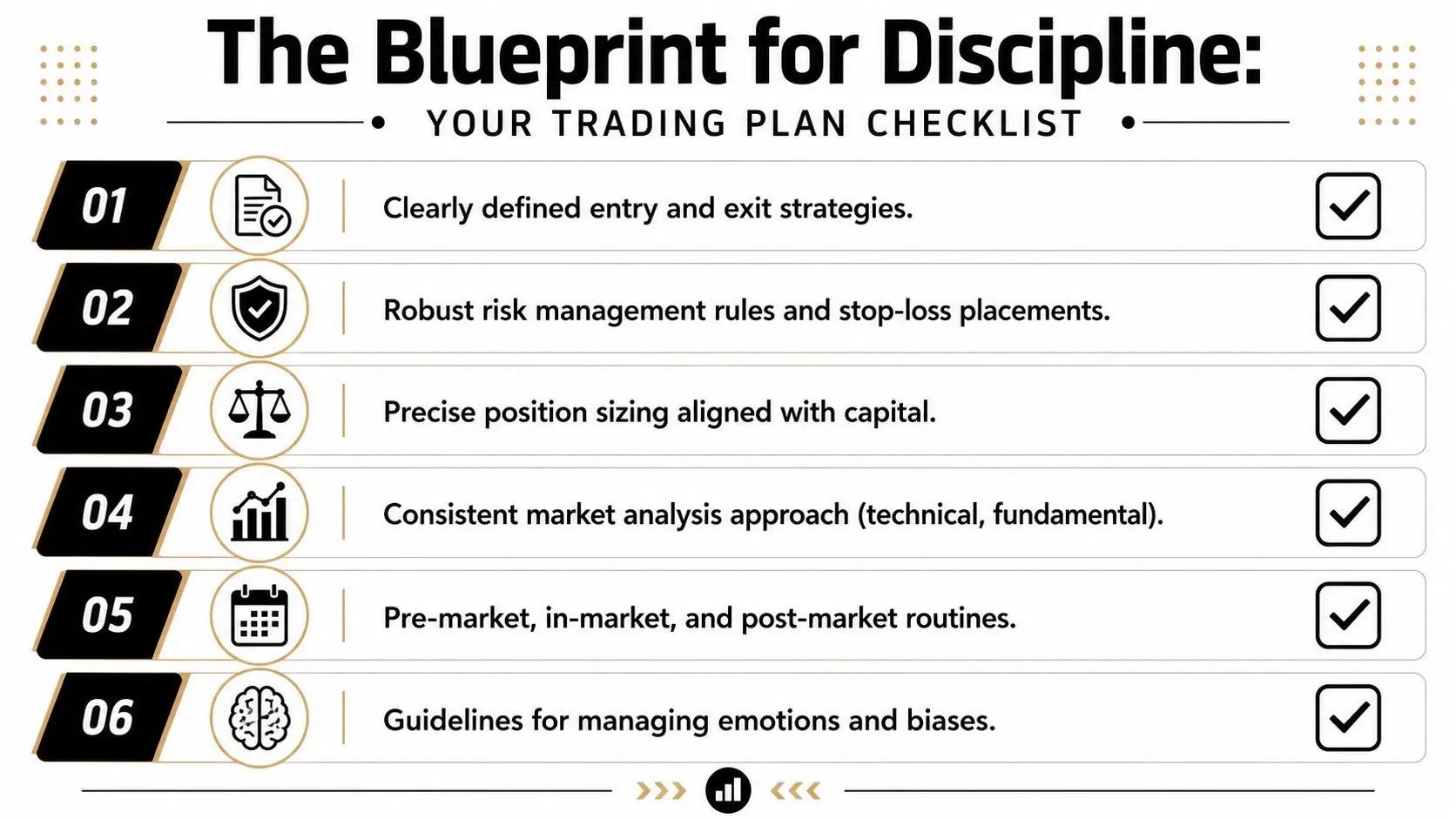
A documented plan is an essential requirement for discipline because it defines entry and exit criteria, risk management parameters, and the maximum number of trades allowed per day or week to prevent overtrading and emotional decisions, as outlined in FXView's discussion of discipline and patience in trading.
What your trading plan must include
Your plan should be simple enough to follow under pressure and specific enough to remove debate.
Setups you're allowed to trade
Define the exact pattern, context, and confirmation you need. If you trade breakouts, write what counts as a breakout. If you trade pullbacks, define what invalidates the pullback.Entry and exit rules
Write the trigger. Write the stop placement. Write the target logic. “I'll know it when I see it” is how traders justify bad trades.Risk rules
State your risk per trade, your maximum daily loss, and your maximum number of trades. If those aren't written down, emotion will rewrite them for you in real time.Markets and sessions
Pick the products and time windows that fit your strategy. Don't jump from forex to indices to crypto just because one chart looks exciting.Routine and review
Include pre-market preparation, in-market rules, and post-market journaling. Discipline isn't just about entries. It's about what you do before and after them.Psychology notes
Write down your known weaknesses. FOMO after missed moves. Revenge trading after losses. Oversizing after a winning streak. Good traders know their technical edge. Better traders know their behavioral leaks.
Practical rule: If a decision matters enough to affect your account, it belongs in writing.
A usable template beats a perfect plan
Most traders make one of two mistakes. They either never build a plan, or they build a giant document they won't use when the market opens.
Start with one page. If you need help structuring it, use this trading plan template from MyFundedCapital as a working model and customize it to your own process.
A clean plan often looks like this:
| Element | What to define |
|---|---|
| Market | The instruments you trade |
| Session | The hours you're active |
| Setup | The exact pattern and context |
| Risk | Per-trade loss and daily cutoff |
| Limits | Max trades and stop conditions |
| Review | What you journal after the session |
Treat the plan like a contract
Your plan is not a motivational document. It's a contract with yourself.
If you break it, the damage usually doesn't come from one dramatic mistake. It comes from small exceptions. One late entry. One oversized trade. One refusal to stop after the day is clearly off. Discipline erodes before it fails publicly.
If you want to know how to stay disciplined, stop asking how to feel stronger. Ask how to make the next decision obvious.
Building Your Daily Trading Rituals
You wake up convinced you will trade clean today. Then the open gets fast, one candle rips without you, and five minutes later you are chasing a setup that was never in your plan. That is how discipline usually fails in prop trading. Not through one dramatic blowup, but through a rushed morning and a loose first decision.
Daily rituals fix that problem by reducing the number of decisions you have to make under pressure. That matters even more in a funded challenge, where one impulsive trade can breach a daily drawdown rule and end the account. Research from the American Psychological Association on stress and decision-making supports the basic point that stress degrades judgment, which is why repeatable routines matter before the market tests you.
Before the open
A disciplined session starts long before the first order ticket.
The goal is simple. Arrive with fewer unknowns, fewer temptations, and a clear line between valid opportunity and noise. Traders who skip this step spend the first hour reacting. Traders who prepare can wait.
A solid pre-market routine answers four questions:
What am I trading today
Pick the instruments in advance. In a prop environment, adding random pairs or indices mid-session is a common way to force trades outside your edge.What matters on the chart
Mark the levels, session structure, higher-timeframe bias, and invalidation points that define your setup. If price is between levels and your read is unclear, write that down too.What kind of day am I prepared for
Trend, range, news-driven chop, or no-trade. "No trade" protects capital. It also protects your evaluation account from death by boredom.What condition am I in
Fatigue, frustration, overconfidence after a green day, and urgency after a red day all distort execution. If your state is off, cut size or stand down.
Morning routines help because they create order before the market creates stress. If you want a useful comparison outside trading, you can learn about weight loss without willpower. The principle is the same. Systems beat mood.
During the session
Once the session starts, your ritual should get smaller, not looser.
Do not ask whether a trade feels good. Ask whether it qualifies. Keep a short checklist beside your platform and use it every time. For a practical version, use this daily trading checklist for pre-trade execution.
A good live checklist includes:
- Is this one of my approved setups
- Is the market context aligned
- Is the stop placed before entry
- Is the position size correct
- Am I still inside my daily loss and trade limits
- Am I acting from patience rather than urgency
If one answer is no, pass.
That sounds strict because it is. In prop firm trading, discipline has to survive real constraints. Daily drawdown limits, max position rules, and evaluation pressure punish freelancing. A routine gives you something concrete to follow when FOMO starts arguing.
After the close
The session is not over when you flatten your position. It is over when you review what happened and shut the process down on purpose.
Keep the post-market ritual short enough to do every day:
- Log each trade with screenshots, setup notes, and your emotional state
- Score execution against the plan, not against profit
- Record rule breaks separately from normal losses
- End the session cleanly so you do not drift into random trades, chart watching, or second-guessing
Traders commonly find the pattern behind the pain. Missed trades lead to chasing. One small green day leads to size creep. A sloppy first trade poisons the next two. You do not catch those loops in the moment. You catch them in review, then build the next day's safeguards around them.
A good ritual is plain and repeatable. That is the point. In a funded account challenge, boring process keeps you in the game long enough for skill to matter.
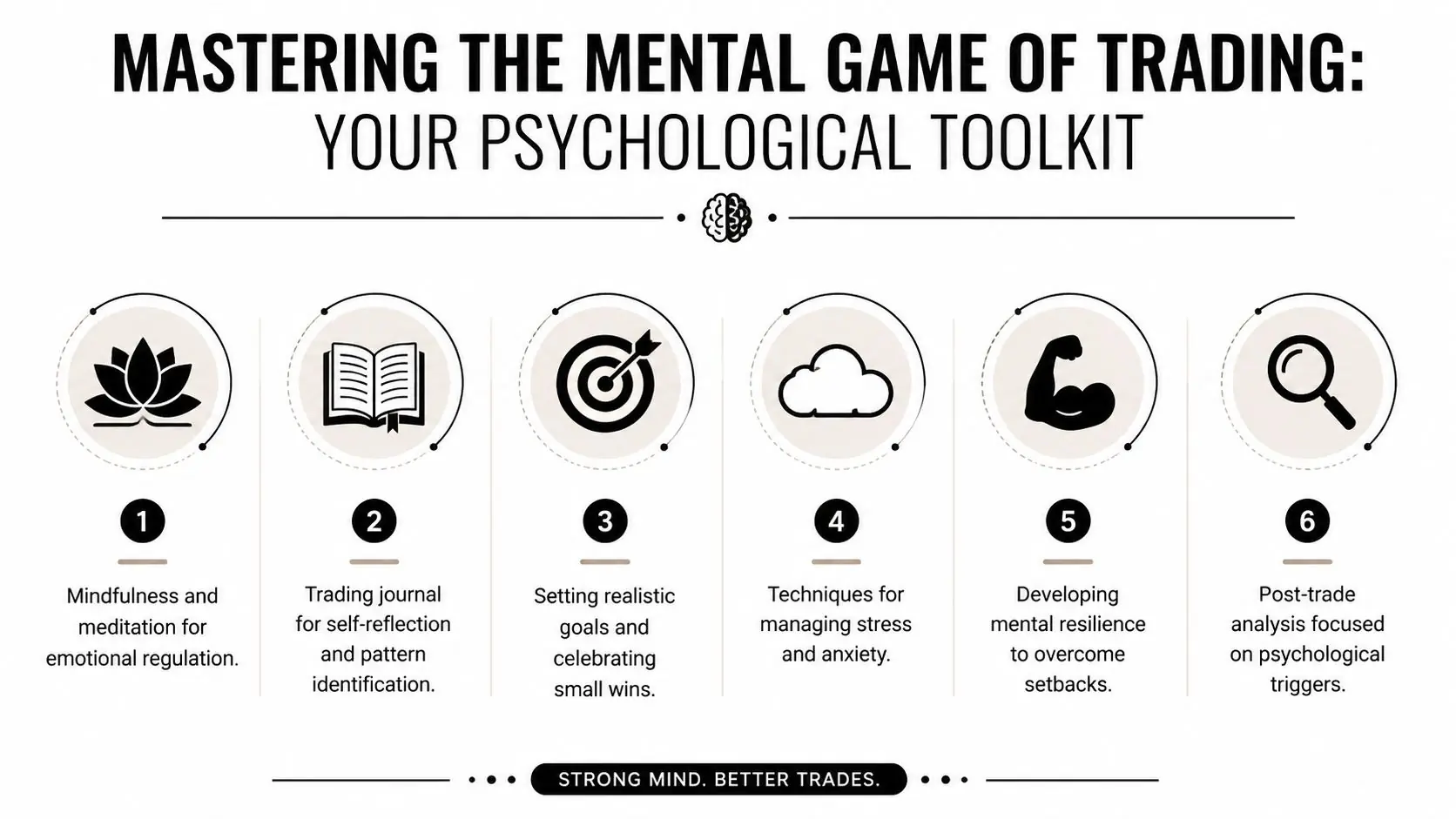
Mastering the Mental Game of Trading
You follow your plan for an hour, take one clean loss, miss the next move by a few seconds, then feel the urge to make it back fast. That is where funded traders usually damage an otherwise solid day. In a prop firm challenge, one emotional decision can do more harm than five normal losses because it often comes with a late entry, bigger size, or a moved stop.
The biggest myth in trading discipline is that strong traders have more willpower. They don't. They just waste less of it.
Willpower breaks down under stress, fatigue, and repetition. Trading creates all three. By the time a trader is frustrated, staring at a runner they missed, or trying to recover after a sloppy trade, judgment is already weaker. Serious traders do not rely on feeling strong in those moments. They build responses in advance.
Replace intention with if-then rules
One of the most useful tools here is the implementation intention. It is a written response to a predictable mistake. Research reviewed by the British Psychological Society on implementation intentions and habit formation supports a simple point. People follow through more often when they decide in advance what they will do in a specific situation.
In trading, that means removing debate before the pressure hits.
Instead of writing, “I'll try not to revenge trade,” write rules like these:
- If I lose two trades in a row, then I stop for a 15-minute review break.
- If I miss an entry, then I wait for a fresh setup that fits the plan.
- If I want to increase size after a win, then I trade the same fixed risk I started with.
- If I break a rule, then I end discretionary trading for the session.
That structure matters more in prop firm trading than in a personal account. At home, traders can talk themselves into “one more shot.” In a challenge account, that kind of freelancing runs straight into drawdown limits and consistency rules.
Shrink the habit until you cannot avoid it
A lot of traders fail at the mental side because they make the fix too ambitious. They promise a full journal review, psychology notes, chart markup, trade grading, and lesson tracking every night. Then they skip all of it after a draining session.
Start smaller.
- Write one line in the journal
- Save one screenshot
- Tag one rule break
- Review one losing trade before platform close
Small habits keep the process alive on bad days. That is what matters. Discipline is less about intensity and more about repeatability, especially during a funded evaluation where one reckless afternoon can erase a week of good work.
Mental script: “I don't chase. I don't move stops. I don't trade to feel better.”
Use language like that on purpose. It is clear, short, and useful under pressure.
Treat emotional mistakes like recurring system faults
FOMO, tilt, and revenge trading are not personality flaws. They are recurring failure patterns. Handle them the way a disciplined operator handles execution errors. Identify the trigger, define the response, and reduce the chance of repeat damage.
| Problem | Common trigger | Better response |
|---|---|---|
| FOMO | Missed entry or sharp move without you | Wait for the next planned setup or stand down |
| Revenge trading | Two losses close together | Pause, review the trades, and reset before any new order |
| Overconfidence | Winning streak | Keep risk fixed and follow the same setup criteria |
| Tilt | Rule break, sharp loss, or lack of sleep | End the session if judgment is compromised |
I have seen traders improve fast once they stop asking, “How do I feel less emotional?” and start asking, “What action do I take when this emotion shows up?” That is a much better question.
If you want a broader framework for that side of performance, read this guide on developing a trading mindset for consistent execution. The same principle shows up outside trading too. If you want a simple parallel, you can learn about weight loss without willpower. The lesson is the same. Systems hold up better than motivation when stress rises.
Using Technology to Enforce Discipline
Some traders hear “be more disciplined” and think the answer is to get mentally tougher. Sometimes that's true. Often it's incomplete.
A better question is this. What can you automate so you don't have to trust your weakest moment?
Hard safeguards beat good intentions
The cleanest way to reduce human error is to turn your rules into platform-level constraints.
Disciplined forex traders follow the 1% to 2% risk principle, never exposing more than that share of total capital on a single position, as described in Dukascopy's article on trading discipline. In practice, that means you shouldn't be calculating size casually in your head while price is moving.
Use tools that make the correct size the default:
- Position size calculators that convert stop distance into lot size before every order
- Bracket orders that place stop-loss and target immediately with entry
- Platform templates for repeatable execution on your approved setups
- Alerts for price levels so you're not glued to every tick and tempted to force trades
Build your personal kill switch
A kill switch is any rule or tool that stops you when you're no longer trading well.
That can mean:
- A daily lockout rule after your predefined loss threshold
- An automatic flatten-and-close process if your platform supports it
- Session timers that end your trading window when your edge usually fades
- Website blockers to keep news feeds, Discord chatter, and social media from hijacking attention during execution
This isn't weakness. It's professional design.
Good discipline doesn't rely on feeling strong. It relies on making bad decisions harder to execute.
Remove friction from good behavior
Technology should also make the right actions easier.
Set one-click access to your journal. Save chart templates. Use a structured naming system for screenshots. Build an end-of-day note template with the same prompts every session. Traders often think discipline means adding pressure. In reality, a lot of discipline comes from removing unnecessary friction around the process you want to repeat.
If you're serious about how to stay disciplined, don't just train your mind. Build a trading environment that protects you from your own worst habits.
Discipline Under Pressure Succeeding in Funded Challenges
A funded evaluation exposes every weak spot in your process. Not because the rules are unfair, but because the environment is unforgiving. You're trading under clear limits, in a performance setting, often alone, with no manager watching over your shoulder.

That's where discipline either becomes real or gets exposed as talk.
Data cited in a newsletter on discipline under isolation says 74% of self-funded traders fail evaluations due to lack of internal systems when working without oversight, and argues that discipline in that setting must be built on essential, doable micro-habits rather than motivation, as discussed in this piece on staying disciplined when no one's watching.
Translate firm rules into stricter personal rules
One mistake newer prop traders make is trading right up against the hard limits. That's reckless.
If the rule says your account has a flat 5% daily loss limit and up to 10% maximum drawdown, your personal operating rules should be tighter than that. Give yourself buffer. The point is to survive long enough for your edge to play out, not to see how close you can get to the line.
Your challenge rules should become personal rules like:
- Stop well before the hard daily limit
- Reduce size after a rough session
- Never try to “win back” a red day in one trade
- Pause after any rule break, even if the trade made money
The real pressure is isolation
In a regular job, someone notices if you drift. In prop trading, nobody reaches through the screen to stop you.
That creates a specific kind of danger. You can break a rule in private, justify it, and keep going. By the time the damage shows up in the account, the bad behavior already feels normal.
The fix isn't more hype. It's a few small behaviors that you treat as law:
- Read your plan before the session
- Use the same pre-trade checklist every time
- Journal immediately after the session
- Stop trading after your cutoff, even if you want another shot
Those sound basic. That's why many traders ignore them. Then they fail for reasons that were obvious in hindsight.
Funded challenges don't mainly test chart reading. They test whether you can follow your own rules when nobody is there to enforce them.
Think like a risk manager, not a gambler
A challenge account isn't the place to prove bravery. It's the place to prove control.
That means respecting simulated capital like it's scarce. It means understanding that one impulsive afternoon can undo weeks of patient execution. It means taking pride in flat days, small green days, and clean no-trade days when that's what your system gives you.
Plenty of traders know how to spot a setup. Fewer know how to protect an opportunity. In funded trading, that second skill matters more.
Frequently Asked Questions About Trading Discipline
How do I stay disciplined after a losing streak
A losing streak creates two bad urges at the same time. One is to trade bigger and get the money back. The other is to change your method before you have evidence that the method is the problem.
Start with execution. Pull the last several trades and separate them into two piles: losses taken according to plan, and losses caused by rule breaks. That distinction matters. Planned losses are part of trading. Undisciplined losses are a behavior problem.
Then tighten the operating environment for a few sessions:
- Cut size
- Trade one market if possible
- Take only your best setup
- Stop after the first rule break
The goal is not to win it back. The goal is to trust your own process again. In a prop challenge, that reset matters even more because one revenge session can do more damage than the losing streak that triggered it.
What should I do when I feel FOMO during a fast move
Fast moves make impulsive traders feel late, then careless.
FOMO usually starts before the click. You see price running, you picture the profit you missed, and your standards drop. In a funded account, that sequence is expensive because bad entries often come with wider stops, worse location, and sloppy size decisions.
Use a short interrupt routine:
- Say the problem clearly “I want this trade because it is moving, not because it matches my setup.”
- Wait one full minute
- Check the setup against your written rules
- Skip it if the entry is gone
Missing a move does not hurt your account. Chasing one often does.
I tell traders this all the time. You do not need every move. You need the moves you can execute cleanly, with acceptable risk, under the rules you agreed to before the market opened.
Can I build discipline if I've already broken a lot of rules
Yes. Traders rebuild discipline the same way they build any useful habit. Through repetition under pressure, not through promises made after a bad day.
Start with one rule that protects the account immediately. Good examples include:
- No entry without a stop
- No adding to a losing position
- No trade outside your session hours
- No more than your daily loss limit
Pick the rule you break most often, or the one that has caused the most damage, and track it daily. One clean week of obeying a rule is worth more than a dramatic speech about becoming a new trader overnight.
That is how traders pass evaluations, too. They stop trying to become perfect and start becoming reliable.
What's the difference between discipline and rigidity in trading
Disciplined traders follow rules. Rigid traders follow stale rules after market conditions have changed.
The difference is timing. Discipline happens during the session. You execute the plan you prepared. Rigidity happens when you refuse to review and adjust the plan after enough evidence says it needs work.
A disciplined trader can say, “My setup did not appear today, so I stayed flat.” A rigid trader can say, “I took the same setup anyway, even though volatility, spread, or session conditions were clearly wrong for it.”
Use this filter:
- During the session follow the plan exactly
- After the session review whether the plan still fits current conditions
- After a meaningful sample adjust one variable at a time, then test again
That balance matters in prop firm trading. Firms such as MyFundedCapital reward consistency, not random improvisation. But consistency does not mean stubbornness. It means stable execution paired with deliberate review.
This article is educational only and not financial advice.