If you trade from the US or Europe, the evening can feel dead. Then Asia opens, and the quiet tape turns into a sequence of distinct auctions driven by Japan, Hong Kong, and mainland China.
That's why the question what time does asian stock market open has no single answer. What matters isn't just the clock time. It's which exchange is opening, what instruments respond, and whether that volatility fits your risk rules, sleep schedule, and trading style.
Free resources: Forex Trading Cheat Sheet (major pairs, sessions and order types on one page).
Introduction
Most newer traders think of the Asian session as one block. In practice, it's a chain of openings with different drivers, different liquidity conditions, and different trade quality.
For a prop trader, that distinction matters. The Tokyo open can behave very differently from the Hong Kong and Shanghai open. Add lunch breaks, shifting time conversions, and the need to stay inside a daily loss cap, and a simple session schedule turns into a risk-management problem.
If you want a usable answer to what time does asian stock market open, start by dropping the idea of a single “Asian market.” Then build your plan around the exchanges that move the instruments you trade.
Why The Asian Market Is a Misconception
A trader in New York logs in at 8:45 PM ET, sees “Asia is open,” and hits an index CFD with the same risk size he uses in London. That shortcut gets expensive fast. By then, Tokyo has already started setting the tone, Hong Kong and Shanghai are still ahead, and the instrument on the screen may not respond to the next open the way he expects.
Asia trades as a sequence of local markets with different participants, policy risk, and liquidity conditions. For prop traders, that matters less as a geography lesson and more as a question of timing, spread, and whether the setup is worth using part of your daily loss limit.
The three exchanges that shape most overnight equity and macro flows are:
- Tokyo Stock Exchange
- Hong Kong Stock Exchange
- Shanghai Stock Exchange
They do different jobs in the session. Tokyo often drives the first clean move in Japan-linked products and JPY crosses. Hong Kong is a global conduit for China exposure and can produce sharper reactions in Hong Kong index products and broader risk sentiment. Shanghai matters because mainland headlines and local participation can spill into commodities, AUD-related pairs, and China-sensitive indices.

The big three don't open at the same time
What traders call the Asian session is really a chain of opening auctions and liquidity shifts. Tokyo comes first. Hong Kong and Shanghai arrive later. Each one can reset momentum, tighten participation in one product, and leave another product barely changed.
That sequencing matters for execution. If you trade too early, you can end up forcing a position in thin conditions. If you trade too late, the cleanest part of the move may already be gone and you are left chasing after spreads normalize and early participants start taking profit.
For a funded trader, that is not a small detail. A bad entry during the wrong open can mean wider stops, poorer fills, and more heat on the trade than the setup ever justified.
Different opens affect different products
The practical question is simple. Which open moves what you trade?
- JPY pairs usually have a clearer response around Tokyo participation, especially when Japan rates, bonds, or equity sentiment are in play.
- AUD/USD and gold CFDs often react once China-linked flows start to matter, because traders quickly price changes in demand expectations and regional risk tone.
- Japan 225, Hong Kong 50, and China-related index CFDs tend to behave best around their own cash-market opens, where local order flow gives the move more structure.
That is the part newer traders miss. Session labels are broad. Instruments are specific.
Why beginners get this wrong
The common mistake is treating the whole block of hours as interchangeable. It isn't. Liquidity changes, spreads change, and the quality of follow-through changes as each exchange comes online and then breaks for lunch.
That has direct P&L consequences. Traders overtrade the dead zones, size too aggressively into the noisiest minutes, or stay awake for every open and end up making tired decisions by the time the best setup appears. In a prop environment with daily drawdown rules, the right schedule usually beats the maximum screen time approach.
A better way to frame the session is to map your instrument to the exchange that drives it, then decide whether that open fits your risk limits, your time zone, and your ability to trade it consistently.
Asian Stock Market Open Times A Traders Cheat Sheet
If you are in New York, London, or Europe and trying to trade Asia before bed or before the workday starts, guessing the open is expensive. A one-hour timing error can put you into thin liquidity, wider spreads, or the wrong market altogether. Use the table below as the base layer, then build your routine around the exchange that drives your instrument.
Major Asian stock market trading hours
| Exchange (Ticker) | City | Local Time (Open-Close) | Lunch Break (Local) | UTC Time | Eastern Time (ET) |
|---|---|---|---|---|---|
| Tokyo Stock Exchange (TSE) | Tokyo | 9:00 AM to 3:00 PM JST | 11:30 AM to 12:30 PM JST | 00:00 UTC to 06:00 UTC | 8:00 PM to 2:00 AM EST |
| Hong Kong Stock Exchange (HKEX) | Hong Kong | 9:30 AM to 4:00 PM local | 12:00 PM to 1:00 PM local | 01:30 UTC to 08:00 UTC | 9:30 PM to 4:00 AM EST |
| Shanghai Stock Exchange (SSE) | Shanghai | 9:30 AM to 3:00 PM local | 11:30 AM to 1:00 PM local | 01:30 UTC to 07:00 UTC | 9:30 PM to 3:00 AM EST |
These hours answer the calendar question. Traders still need the execution question answered. Which open is worth your risk, and which one just creates noise on your platform?
What these times mean for actual trades
Tokyo starts the institutional handoff for the region. If you trade yen pairs, Nikkei-linked products, or overnight risk sentiment, that first hour matters because the market begins showing whether price is auctioning cleanly or whipping around on thin positioning.
Hong Kong and Shanghai come online later, and that second wave often matters more for traders focused on China-related indices, commodities tied to China demand, and broader Asia risk tone. In practice, many setups become clearer once more regional participation joins the tape.
For prop traders, that distinction matters. A clean move during the right open can fit a daily loss limit. Chasing a messy first spike can burn a meaningful chunk of your drawdown before the session has really developed.
How to use the opens without overtrading
The open is a decision point, not an automatic entry.
A useful process is simple:
- Mark the first 15 to 30 minutes around your target exchange open.
- Watch spread behavior and whether price accepts above or below the opening range.
- Size smaller if volatility is expanding faster than liquidity.
- Skip the trade if the move is already extended before your setup forms.
That approach protects capital and fits prop firm rules better than treating every bell as a signal.
Lunch breaks change execution quality
Asia's midday breaks matter because order flow changes around them. Price can slow down before the pause, then reset once local participants return.
That creates two practical effects. First, momentum trades opened late in the pre-lunch stretch often lose quality fast. Second, the post-lunch reopen can offer a fresh move with better structure than the final minutes before the break.
If you also trade currencies around session transitions, compare these stock hours with the broader weekly FX handoff in this guide on when forex opens on Sunday. The habit that helps most is tracking handoffs, not memorizing one isolated market clock.
Pick one reference clock and stay with it
Use UTC or your platform time for alerts, journal entries, and pre-market prep. Traders who switch between local time, exchange time, and ET make avoidable mistakes, especially when daylight saving changes in the US or Europe.
Keep the clock standard. Then match your schedule to the products that pay you. That is how this cheat sheet becomes useful for P&L instead of just trivia.
Navigating Time Zones Daylight Saving and Lunch Breaks
You line up for the Tokyo or Hong Kong open, coffee ready, risk plan set, and then realize your alert fired an hour late because New York changed clocks and Tokyo did not. That mistake is boring, but it costs real money. You end up chasing the first move, paying wider spreads, and taking a trade outside the part of the session your playbook was built for.
Japan, China, and Hong Kong keep their local exchange hours steady while traders in the US and Europe deal with daylight saving shifts. So the exchange has not changed. Your working session has.
Why time conversion errors hit P&L
A trader based in London or New York can trade the same Asian open for months, then suddenly be early or late by an hour after a clock change at home. That is enough to break a routine. The pre-open prep gets rushed, alerts trigger at the wrong time, and entries drift from planned levels to reactive fills.
This matters even more inside prop firm rules. If you trade with tight daily drawdown limits, one sloppy chase at the open can do more damage than three well-managed scratches. Traders who survive these sessions treat time conversion like risk control, not admin.
If your week also includes FX, compare your stock-market routine with the broader Sunday forex market opening schedule. Session handoffs matter more than memorizing one headline open time.
Lunch breaks change execution quality
Midday pauses in Asia are not a side note. They change who is active, how clean the tape looks, and whether continuation setups still have fuel.
The practical pattern is straightforward. The opening phase often gives the cleanest price discovery. The stretch into lunch can turn choppy as participation thins. After the reopen, you sometimes get a second, cleaner setup because the order book rebuilds and local traders reprice the morning move.
For a prop trader, the trade-off is simple. Holding through lunch can work if the position already has cushion and the catalyst is still live. Opening a fresh momentum trade right before the break is usually poor business. You are asking for weaker follow-through while still carrying full risk.
A schedule that traders can actually stick to
Use one reference clock for everything. UTC works well. Platform alerts, journal notes, and pre-market checklists should all match that clock.
Then mark three windows on your chart:
- Opening range
- Pre-lunch slowdown
- Post-lunch reopen
That review process shows where your edge really sits. Many traders find they make money in one segment, give it back in another, and blame the strategy instead of the timing.
There is another trade-off here. Chasing every open across Tokyo, Hong Kong, and Shanghai sounds productive, but it often creates sleep debt and lower decision quality. A sustainable schedule usually beats maximum screen time. The same discipline applies if you are testing relative-value ideas or low-risk arbitrage profits. Good timing and repeatable execution matter more than trying to trade every bell.
If your alert structure is sloppy, your risk management is sloppy. In prop trading, those are the same problem.
Key Trading Opportunities During the Asian Session
A trader in London takes a breakout in AUD/USD at the Hong Kong open, then gives back the gain by forcing a second trade in a dead patch 40 minutes later. That pattern is common in Asia. The edge is usually in the first clean repricing around a local catalyst, not in staying busy for the rest of the session.
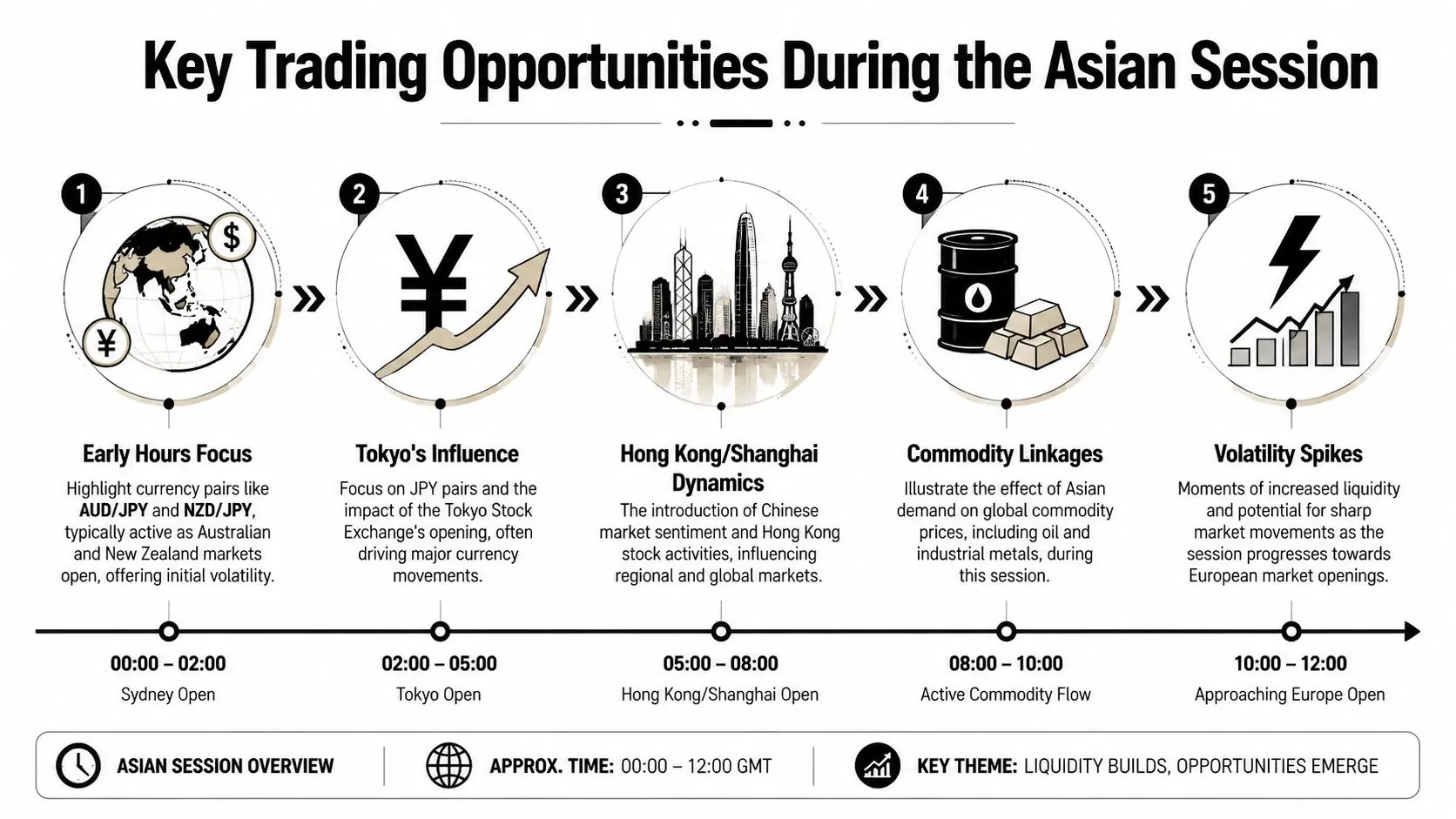
The practical opportunity during the Asian session comes from alignment. Match the instrument to the exchange that is driving flows, then size the trade so a failed opening move does not put you in a hole before Europe even wakes up. For prop traders, that matters more than memorizing a list of market opens. A decent setup with controlled downside is usable. A great-looking setup that risks a rule breach is not.
Where the session usually pays
The cleanest trades often show up in a short list of instruments:
- JPY pairs strongest when Tokyo cash equity flows and local risk sentiment start shaping price.
- AUD/USD and other China-sensitive FX pairs useful when Hong Kong and mainland China equities reset expectations for growth and risk.
- Japan 225, Hang Seng, and China-related index CFDs the most direct read on local equity sentiment, and often cleaner than trading a loose FX proxy.
The trade-off is straightforward. Direct instruments usually give cleaner signals but can move fast enough to punish poor entries. Proxy trades can offer easier execution, but the relationship is often weaker just when you need it most.
The best setups are usually event-linked
Tokyo open can create early momentum in JPY pairs and Nikkei-linked products when local desks react to overnight US moves, central bank headlines, or a gap in futures. Hong Kong and Shanghai open often matter more for traders focused on China-sensitive assets, especially when there is fresh policy news, weak data, or a sharp move in US-listed China names from the prior session.
What matters for P&L is the source of the move. If the catalyst is local and your instrument is directly tied to that order flow, follow-through is more believable. If price is drifting without a clear driver, the trade quality drops fast.
What usually works, and what usually costs money
What tends to work better:
- Trading the first structured move after the open, not the first random spike
- Waiting for spreads to settle before entry
- Defining the invalidation level before placing the order
- Taking partials faster than you would in London or New York if liquidity is thinner
- Cutting stale trades early when the opening impulse fails
What usually hurts traders:
- Chasing a candle because the market finally moved
- Trading three correlated Asia instruments as if they are separate ideas
- Holding size through a slowdown with no fresh catalyst
- Assuming the Asian session is "safe" and widening stops to avoid getting tagged
- Ignoring prop firm drawdown rules because the session feels slower
That last mistake ends accounts. At firms with hard daily loss limits, one sloppy open can do more damage than five disciplined scratches.
Good Asian-session trading is selective, a little boring, and very easy to explain in the journal.
A simple filter before you take the trade
Run through four questions:
- Which exchange open or local catalyst is behind this move?
- Am I trading the direct instrument, or a weaker proxy?
- Has liquidity improved enough to justify entry and normal stop placement?
- If this fails immediately, does the loss stay well inside my daily risk limits?
That last question matters most in a prop environment. A setup can be technically valid and still be a bad trade if the spread, slippage, or stop distance makes the risk ugly under firm rules.
If you trade cross-market dislocations around Asia opens, this guide to low-risk arbitrage profits is a useful companion because it focuses on temporary pricing gaps rather than pure directional calls.
For traders balancing Asia with other sessions, this breakdown of the best times to trade forex helps frame when the Asian window offers real opportunity and when it is smarter to wait.
Building a Practical Schedule for Trading the Asian Markets
Most traders outside Asia don't fail because they can't read charts. They fail because they try to trade the whole session, wreck their sleep, and become sloppy after a few nights.
A sustainable routine beats heroic effort. If you live in the US or Europe, you don't need to cover every minute from Tokyo open to the Europe handoff.
Three workable approaches
Focus on one open only
This is the cleanest option for many traders. Pick either the Tokyo open or the Hong Kong and Shanghai open, then ignore the rest.
That does two things. It protects your energy, and it gives you a tighter data set for review. You'll learn one playbook faster than three half-baked ones.
Use alerts and pending orders
If your setups are level-based, you don't need to stare at the screen for hours. Mark levels, set alerts, and decide in advance whether the trade is breakout, fade, or no-trade.
A written process matters. A simple trading plan template helps because it forces you to define session, setup, invalidation, and stop conditions before fatigue kicks in.
Automate the repetitive parts
If you use EAs or semi-automated execution, the main edge isn't speed. It's consistency. Automation can handle alerts, order placement, or scale-out logic while you focus on whether the opening condition is present.
Sample checklist for a US-based trader
Use something like this before the session:
- Check the exact open you care about don't assume tonight matches last month's clock conversion.
- Review your instrument list one index CFD, one JPY pair, one China-sensitive FX pair is enough for most traders.
- Mark lunch break times especially if you plan to hold beyond the initial move.
- Set risk before entry if the setup needs too much room, skip it.
- Choose your cut-off time when that time hits, stop trading and sleep.
What a professional routine looks like
A professional doesn't try to “catch everything.” They choose a narrow window, track the same instruments, and review whether the trade came from the planned open or from boredom.
That matters even more in prop trading. Discipline is part of the strategy.
Frequently Asked Questions About Asian Market Hours
Is the Asian session always quieter than London or New York
Not in the way many beginners assume. Some parts of the session are quieter, but the major opens can be sharp and efficient. The mistake is judging the whole session by the dead periods between event windows.
If you trade around the actual exchange open, price can move quickly enough to punish late entries and oversized positions.
Which Asian open matters most for forex traders
It depends on the pair. Tokyo tends to matter more for yen-related products. Hong Kong and Shanghai can matter more for China-sensitive sentiment and commodity-linked reactions.
The right question isn't “Which open is biggest?” It's “Which open has the closest connection to my instrument?”
Should I trade through the lunch break
Usually, newer traders shouldn't build their plan around that period. Lunch breaks often reduce tape quality and can distort the behavior of related CFDs or FX proxies.
If you're already in a strong trade with a clear reason to hold, that's different. Entering fresh positions during a low-quality patch is where many avoidable mistakes happen.
Do I need to stay awake all night to trade the Asian markets
No. Most traders do better when they trade one specific opening window and leave the rest alone.
A short, repeatable routine usually beats an exhausted all-night grind. If your performance drops when you're tired, the edge from the session can disappear fast.
Conclusion Start Trading the Asian Session with Confidence
The answer to what time does asian stock market open is simple on the surface and more useful when you treat it like a trading workflow. Tokyo opens first. Hong Kong and Shanghai follow. Each open creates different conditions, and those conditions matter more than the label “Asian session.”
If you want better results, stop thinking in broad session names and start thinking in specific event windows, specific instruments, and specific risk rules. That's how traders turn market hours into actual decision-making instead of trivia.
Trading involves substantial risk of loss. This article is for educational purposes only and isn't financial advice.
If you want a prop environment built for disciplined traders, explore MyFundedCapital. You can compare account types, review risk parameters, and choose a challenge or instant funding path that fits your trading style.