ES
ES
 DE
DE
 FR
FR
 AR
AR
 IT
IT
 NL
NL
 PL
PL
 SV
SV

Losing trades are an unavoidable part of the market, but catastrophic losses don't have to be. A stop loss trade is your pre-set exit plan to automatically close a position when the price moves against you, protecting your capital from significant damage. This guide will show you exactly what a stop loss is, how to set one, and how to use it as the foundation of a disciplined trading strategy.
Free resources: Forex & Prop Trading Glossary (drawdown, breach, lot, pip and the rest in plain words), and the free Drawdown Calculator.
What a Stop-Loss Trade Really Means
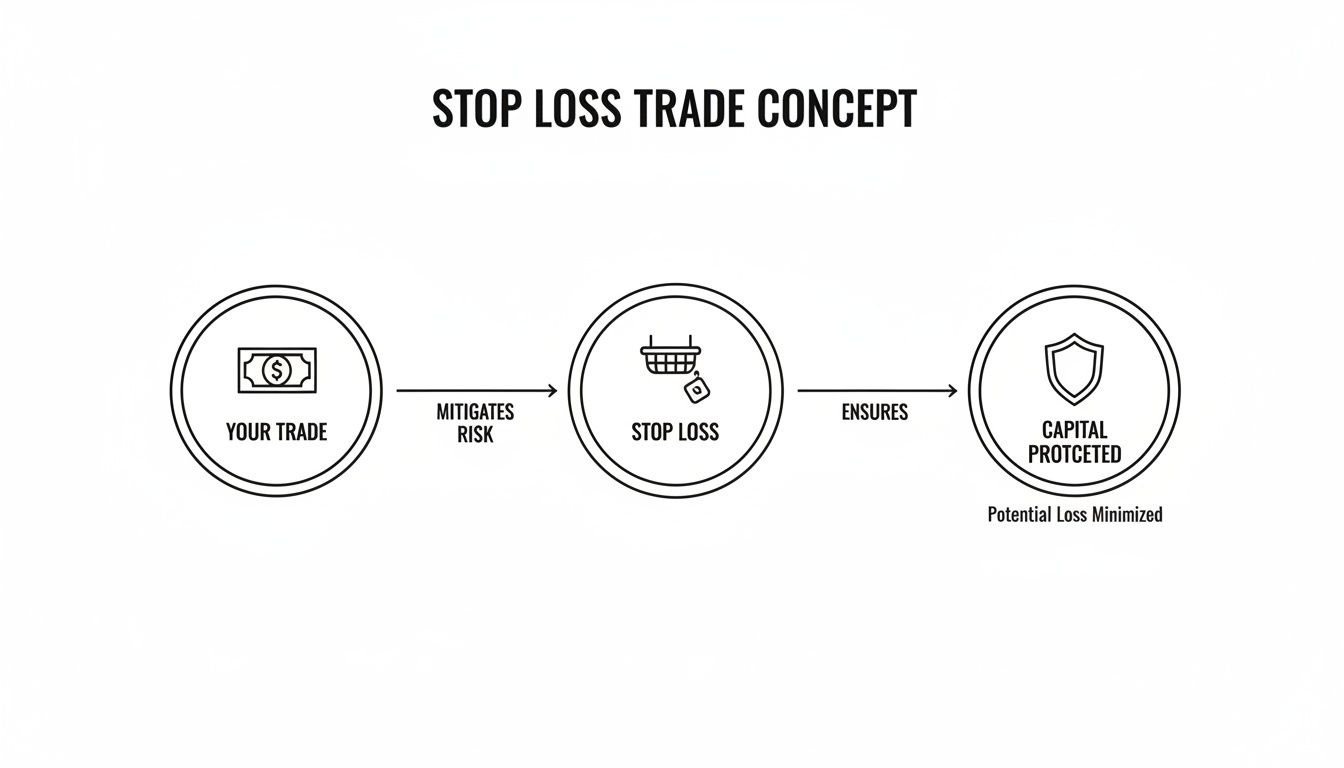
At its core, a stop loss is an order you place with your broker to automatically sell an asset once it reaches a certain price. It's your line in the sand—the maximum loss you're willing to accept on a single trade. By defining your exit point before you enter a trade, you turn vague worries about risk into a concrete, manageable number.
This simple action removes emotion from the decision-making process. When a trade turns against you, it's human nature to hope for a reversal. A stop loss bypasses that hope, executing your plan without hesitation and shielding your account from a devastating drawdown. In today's volatile forex and CFD markets, this tool isn't just helpful; it's essential for survival.
Disclaimer: This article is for educational purposes only and does not constitute financial advice. All trading involves a significant risk of loss, and you should not risk more than you can afford to lose.
The Different Types of Stop Orders
While the basic concept is simple—get out of a losing trade—there are a few different types of stop orders. Each one offers a unique way to manage your exit. Understanding the difference is key to applying the right tool for the right market conditions.
Here’s a practical breakdown of the three types you’ll use most often:
- Standard Stop Loss (Stop-Market Order) This is the most common type. Once the market hits your designated stop price, your order instantly becomes a market order and closes the trade at the next available price. Its main purpose is to get you out, fast.
- Stop-Limit Order This is a two-part order. You set a stop price that activates the order and a limit price that specifies the worst price you’re willing to accept. It gives you control over your exit price but doesn't guarantee your order will be filled if the market moves too quickly.
- Trailing Stop Order This is a dynamic stop that follows a profitable trade. You set it to trail the market price by a specific distance (e.g., 20 pips or 1%). As the price moves in your favor, the stop moves with it, locking in gains. If the price reverses, the stop stays put and closes the trade.
How to Strategically Place Your Stop Loss
Knowing what a stop loss is and knowing where to place it are two different skills. A poorly placed stop is just as bad as not using one at all. Here are three practical methods for setting your stop loss based on a clear, logical plan.
1. The Percentage Method
This is the simplest and most common method, perfect for beginners building discipline. You decide to risk a fixed percentage of your total trading capital on any single trade. A widely accepted rule among professional traders is to risk no more than 1% to 2% per trade.
Here’s how it works in practice:
- Account Balance $10,000
- Risk Per Trade 1% (which is $100)
- Asset You want to buy EUR/USD at 1.0800.
- Position Size You decide to trade 1 mini lot (10,000 units), where each pip is worth $1.
- Calculation To risk $100, your stop loss needs to be 100 pips away ($100 risk / $1 per pip).
- Stop Loss Placement You place your stop loss at 1.0700 (1.0800 – 100 pips).
This method automatically adjusts your risk as your account grows or shrinks, ensuring consistency.
2. The Technical Analysis Method
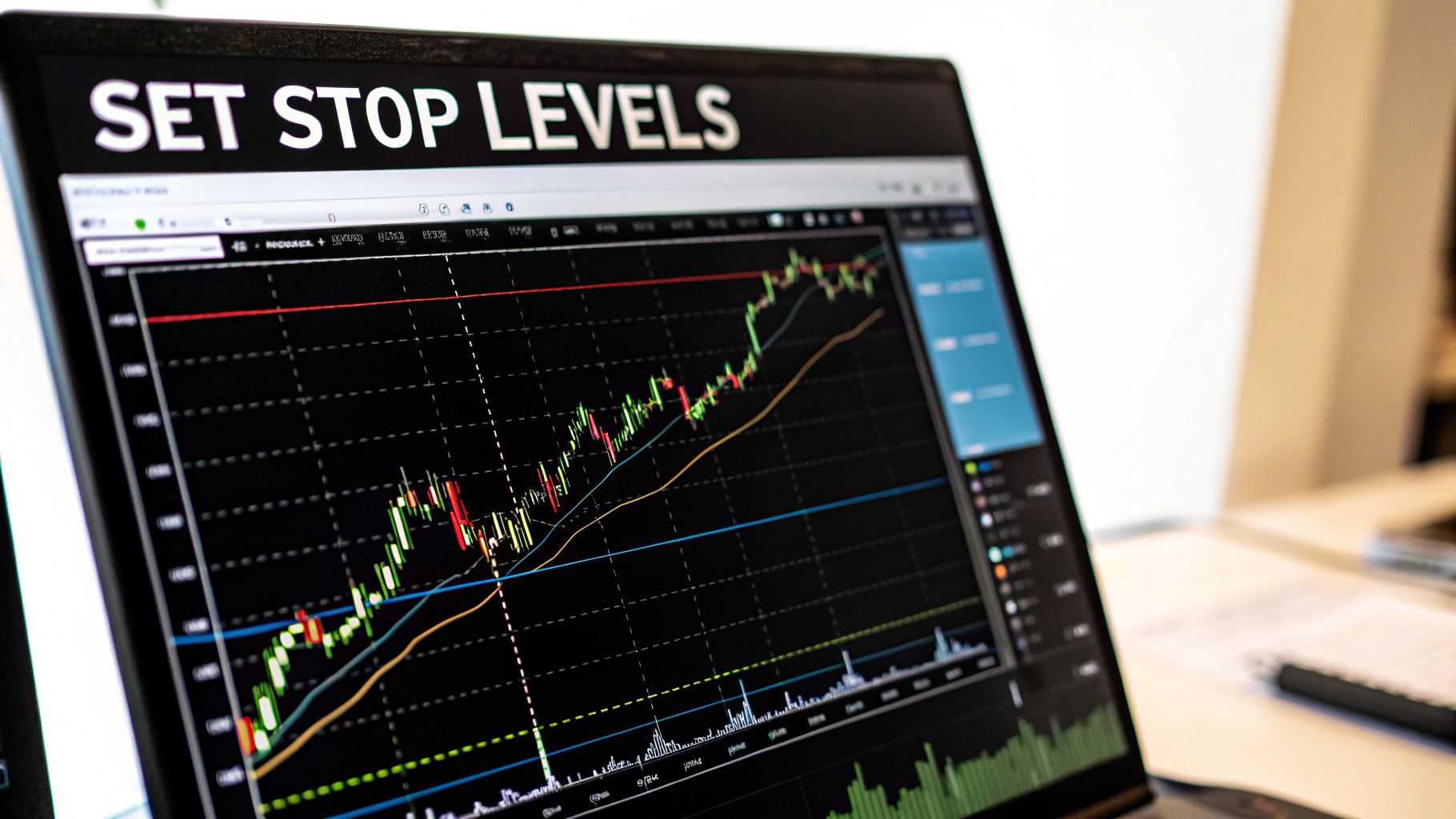
This approach uses the market's own structure to determine where to place your stop. Instead of an arbitrary percentage, you place your stop at a logical price level that would invalidate your trade idea.
Common technical levels for stop placement include:
- Below a support level for a long (buy) trade.
- Above a resistance level for a short (sell) trade.
- Just past a recent swing high or swing low.
- On the other side of a key moving average.
By using technical levels, your stop isn't just a random number; it's the point where the market proves your initial analysis was wrong. This forces you to have a clear reason for every trade you take.
3. The Volatility-Based Method (ATR)
Markets are not static; their volatility changes. This method adapts your stop loss based on how much the market is currently moving. The most common tool for this is the Average True Range (ATR) indicator.
The ATR measures the average price movement over a specific period (typically 14 periods).
- High ATR Indicates high volatility. You should use a wider stop to avoid being shaken out by random noise.
- Low ATR Indicates low volatility. You can use a tighter stop.
Example Calculation:
- Entry Price (Long on GBP/JPY) 198.50
- Current 14-day ATR 1.20 (or 120 pips)
- ATR Multiplier 2 (a common setting)
- Stop Distance 2 x 120 pips = 240 pips
- Stop Loss Placement 198.50 – 2.40 = 196.10
This data-driven approach helps you give trades enough room to breathe based on actual market conditions. To ensure your risk per trade remains consistent (e.g., 1%), use a lot size calculator to determine the correct position size for your calculated stop distance.
Stop Loss Rules for Prop Firm Traders
For traders using a prop firm's capital, understanding what is a stop loss trade is not optional—it's mandatory for survival. Prop firms enforce strict risk rules, primarily the daily loss limit and maximum drawdown. A stop loss is your primary tool for ensuring you never breach these limits.
Let's use a real-world example. Imagine you're trading one of our funded trading accounts with a $100,000 balance and the following rules:
- Daily Loss Limit 5% ($5,000)
- Maximum Drawdown 10% ($10,000)
Your entire trading plan must operate within these boundaries. If you decide to risk 1% on a trade, you must place your stop loss at a level where the maximum loss is capped at $1,000. This ensures that even a string of several losing trades won’t push you anywhere near the daily loss limit.
For a prop firm trader, your stop loss doesn't just manage the risk of a trade. It manages the risk to your career. A bad day should never become your last day.
Always account for slippage—the potential difference between your stop price and the actual execution price. To be safe, build a small buffer into your calculations. If your maximum risk is $1,000, set your stop to risk $950. That small cushion can prevent an unexpected price gap from ending your challenge.
Common Stop Loss Mistakes to Avoid
A stop loss is a tool, and like any tool, it can be misused. Avoiding these common errors is critical for effective risk management.
- Setting Stops Too Tight: Placing your stop too close to your entry price means you'll get knocked out by normal market "noise." Your trade needs room to breathe.
- Setting Stops Too Wide: Placing your stop too far away defeats its purpose. A single loss can wipe out numerous wins, destroying your risk-to-reward ratio. Your stop should be at a point that logically invalidates your trade idea.
- Moving Your Stop to Avoid a Loss: This is the cardinal sin. Once a stop is set based on your plan, moving it further away from the price is no longer trading—it's gambling on hope. This is how small, controlled losses turn into account-ending disasters.
- Placing Stops at Obvious Levels: Everyone else is placing their stops at obvious round numbers (like 1.1000) or major support/resistance. These areas are often targets for "stop hunts." Consider placing your stop just beyond these obvious levels to avoid getting swept up with the crowd. For more on this, read about how stop orders influence market dynamics.
FAQ: What is a Stop Loss Trade
Should I use a stop loss on every trade?
Yes. Every single trade should have a pre-defined stop loss. It's the cornerstone of disciplined risk management and ensures that no single trade can cause significant damage to your account. Trading without a stop loss is gambling, not professional trading.
Can a stop loss guarantee I won't lose more than intended?
No, and this is a critical point. A standard stop loss becomes a market order when triggered. In fast-moving or illiquid markets, this can result in "slippage," where your trade is closed at a worse price than you intended. While it can't guarantee a specific price, it will get you out of the trade and prevent further losses.
How does a stop loss affect my risk-to-reward ratio?
Your stop loss placement defines the "risk" part of your risk-to-reward ratio. The distance between your entry price and your stop loss is the amount you are risking. To maintain a positive ratio (e.g., 1:2 or 1:3), your profit target must be a multiple of that stop distance. A wider stop requires a larger profit target to be a worthwhile trade.
Master Your Risk Before You Master the Markets
A stop loss is more than just an order type; it’s a mindset. It's your commitment to preserving capital and treating trading as a business. You cannot control the market, but you can always control how much you're willing to lose. For any trader, especially those operating under the strict rules of a prop firm, non-negotiable use of a stop loss is what separates amateurs from professionals.
Disciplined risk management in forex trading is the foundation of long-term success. It ensures that losing trades are just a small, manageable cost of business, not a catastrophic event.
Ready to apply disciplined risk management in a professional trading environment? Explore our funded account programs and see how our rules are designed to foster successful trading habits.