

 AR
AR
 NL
NL
 FR
FR
 DE
DE
 ES
ES
 IT
IT
 PL
PL
 SV
SV
 PT
PT

Executing trades without a clear exit plan is a fast track to draining your account. This guide provides a direct, no-nonsense look at how to use stop loss and take profit orders to manage risk, protect capital, and trade with discipline. You'll learn practical methods to calculate and place your exits based on market data, not emotion.
Your Foundation for Disciplined Trading
Many traders fail because they let emotions like fear and greed dictate their actions. Using stop loss and take profit orders correctly is the first step toward trading with a clear, logical plan. It's about preserving your capital so you can stay in the game long enough to be profitable.
For any serious trader, especially those in a prop firm environment with strict risk parameters, these orders aren't just a good idea; they're essential. By deciding your exit points before you enter a trade, you shift from emotional gambling to methodical risk management. This discipline is what separates consistently profitable traders from the rest.
A well-placed stop loss and take profit are not just technical orders; they are your pre-commitment to a disciplined trading plan, insulating you from the fear and greed that derail most traders.
This guide will walk you through the practical, no-nonsense methods for setting effective exit points. To see how these orders fit into the bigger picture, you might want to check out this complete guide to risk management for a wider perspective.
Ultimately, these tools are the bedrock of any solid trading plan. To dive deeper into building a comprehensive strategy, we've got a detailed article on risk management in forex trading.
Understanding Your Core Trading Orders
At the heart of every trade, you need two clear exit points: one for when you're right and one for when you're wrong. A stop loss is your automated safety net—an order telling your platform to close a losing trade at a specific price to prevent further losses. On the other side, a take profit order automatically closes your position to lock in gains once the price reaches your target.
Using both is what separates disciplined trading from guessing. It removes emotion from your exit decisions.
Stop Loss Orders: Your First Line of Defense
A stop loss is like an insurance policy for your trade. Its main job isn’t to make you money—it’s to protect the capital you've worked hard to build. Trading without one exposes you to catastrophic risk on a single position, one of the fastest ways to blow up an account.
There are two main types:
- Stop-Market Order: The moment the market hits your stop level, it triggers a market order to close your position at the best available price. It guarantees an exit, though the exact price can slip in fast-moving markets.
- Stop-Limit Order: This gives you more control. When your stop price is hit, it places a limit order. You specify the worst price you’ll accept, but if the market gaps past your price, your order might not get filled at all.
Take Profit Orders: Securing Your Gains
A take profit order does exactly what its name implies—it ensures you actually take your profits before the market has a chance to take them back. It's a limit order that waits for the price to hit your target, then automatically closes the position.
This is a critical tool for fighting greed. It’s easy to see a trade going your way and think, "Just a little more…" A pre-set take profit shuts down that impulse and forces you to stick to the plan you made with a clear head.
A trade without a stop loss is a gamble. A trade without a take profit is a wish. A disciplined trader uses both to define their risk and reward before ever clicking the buy or sell button.
Combining Orders with OCO
Many modern platforms, including DXtrade and cTrader, offer a feature called a One-Cancels-the-Other (OCO) order. This lets you place both your stop loss and take profit orders at the same time, linked together.
If the market hits your take profit target, that order fills and automatically cancels your stop loss. Conversely, if the trade moves against you and triggers your stop loss, your take profit order is immediately canceled. It’s a clean, efficient way to manage your exits for a complete stop loss and take profit strategy.
How to Calculate Your Stop Loss and Take Profit
Setting your stop loss and take profit levels shouldn't be guesswork. Experienced traders use simple math to define their exits, removing emotion from the equation. This process is a non-negotiable skill, especially when navigating the strict rules of a prop firm challenge, as it ensures every trade fits within your risk parameters and the firm's drawdown limits.
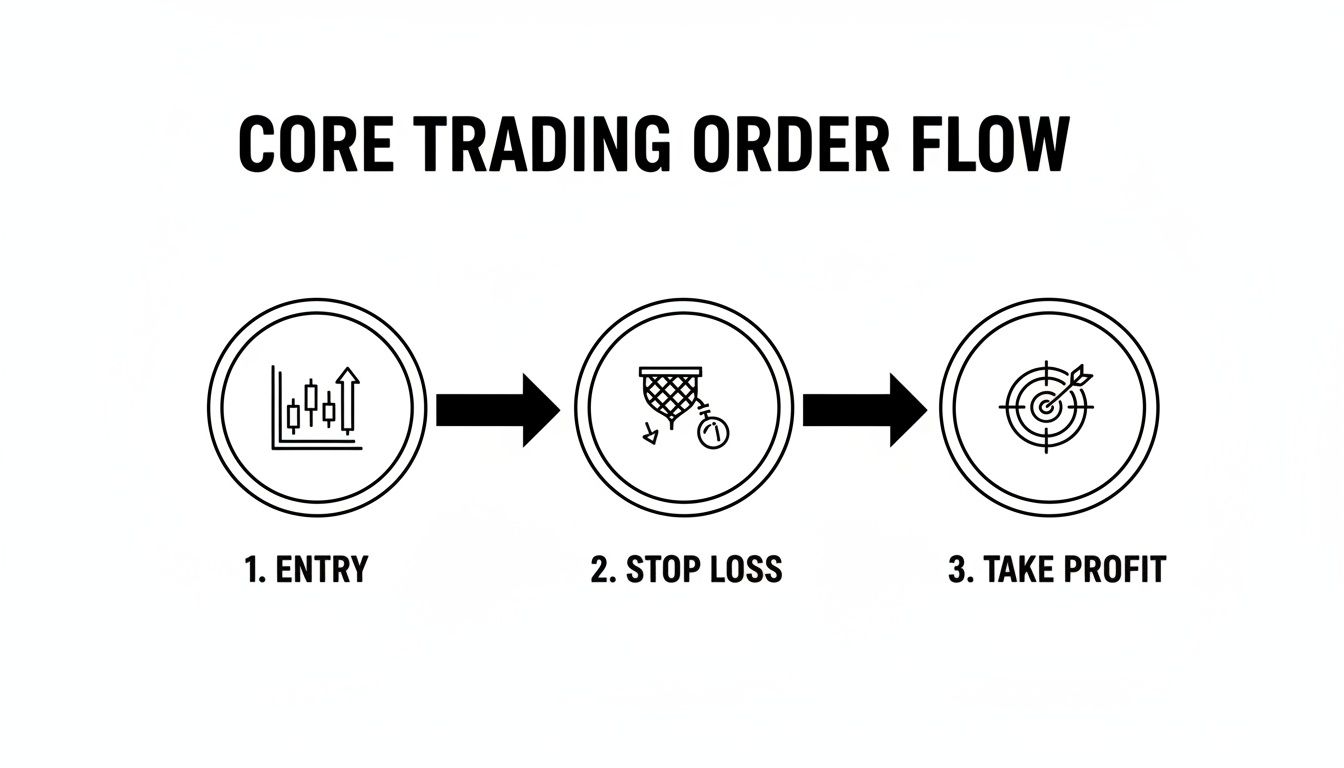
The process involves defining three things before you enter a trade: your entry, your maximum acceptable loss (stop loss), and your profit goal (take profit).
Step 1: Calculate Position Size Based on Your Stop Loss
This is the most important calculation in trading. First, decide the maximum dollar amount you are willing to lose on a single trade.
Let's walk through a concrete example. Imagine you have a $50,000 account and a personal rule to never risk more than 1% per trade.
- Max Risk per Trade: $50,000 * 0.01 = $500
Now, say your analysis suggests entering a EUR/USD long trade at 1.0750, with a logical stop loss at 1.0700 (a 50-pip distance).
The formula for your position size is:
Position Size = (Dollar Risk) / (Stop Loss in Pips * Pip Value)
Assuming a standard account where 1 pip in EUR/USD is worth $10 per lot:
- Position Size = $500 / (50 pips * $10/pip) = 0.10 lots
This calculation ensures that if your stop is hit, you will lose exactly $500—no more, no less. This is the bedrock of disciplined trading and essential for passing any funding challenge.
Step 2: Choose a Stop Loss Placement Method
Once you know your dollar risk, you need to decide where to place that stop on the chart. Here are three common, data-driven methods.
| Method | How It Works | Best For | Potential Downside |
|---|---|---|---|
| Percentage-Based | Set a stop loss at a fixed percentage (e.g., 2%) below your entry price. | Long-term investors or traders who prefer a simple, hands-off approach. | Ignores market volatility and structure; can be too tight in wild markets or too wide in calm ones. |
| Volatility-Based (ATR) | Use a multiple of the Average True Range (ATR) to set a stop that adapts to the market's current volatility. | Day traders and swing traders who need stops that respect market "noise." | Can result in wider stops (and smaller position sizes) during periods of high volatility. |
| Structure-Based | Place the stop just beyond a key technical level, like a support/resistance line or a recent swing high/low. | Technical traders whose trade ideas are based on specific chart patterns. | Can be vulnerable to "stop hunts" where price briefly spikes past a level to trigger orders. |
The most robust strategies often combine volatility and structure-based approaches.
Using Volatility with the Average True Range (ATR)
Markets have calm periods and volatile periods. Using a fixed-pip or percentage stop loss ignores this reality. The Average True Range (ATR) indicator is a tool built to measure market volatility. By setting your stop loss at a multiple of the ATR, your stops automatically adjust to the market's current conditions.
Here’s a practical example:
- Add the ATR(14) indicator to your chart. Let's say you're looking at Tesla (TSLA) and its current ATR value is $5.50.
- Pick a multiplier. A 2x ATR multiple is a common starting point.
- Calculate the stop. If you're buying, subtract the value from your entry. If selling short, add it.
Example: Buying Tesla (TSLA)
- Entry Price: $180.00
- Current 14-day ATR: $5.50
- Stop Loss Distance: $5.50 * 2 (your multiplier) = $11.00
- Your Stop Loss Price: $180.00 – $11.00 = $169.00
To maintain a 1:2 risk-to-reward ratio, your take profit would be double your risk ($22.00) above your entry, placing your target at $202.00. You can dive deeper into this concept in our guide on how to calculate risk-reward ratio.
Using Structure with Support and Resistance
Another powerful method is to use the market's own structure—key support and resistance levels. These are price zones where buying or selling pressure has historically reversed the trend.
The logic is simple: if you buy at support, your trade idea is valid as long as that level holds. If the price breaks significantly below it, your idea is wrong, and that's where your stop loss should be.
- For a long trade: Place your stop loss a few pips or cents below a clear support level.
- For a short trade: Place your stop loss a few pips or cents above a clear resistance level.
This small buffer helps protect against market noise and "stop hunts"—brief price spikes designed to trigger orders. Learning how to set stop losses with these logical methods builds a much more resilient trading framework.
Advanced Techniques for Optimizing Your Exits

Once you've mastered basic stop placement, you can move beyond a "set it and forget it" approach. Advanced exit strategies are about adapting to the market as it moves, helping you let winners run without giving back all your gains.
Protect Your Profits with a Trailing Stop
A trailing stop is a dynamic stop loss that automatically follows the price as a trade moves in your favor. It’s a powerful tool for trend traders that protects accrued profits.
Here’s how it works:
- For a long (buy) trade: You might set a trailing stop 50 pips below the current market price. As the price climbs, your stop moves up with it, maintaining that distance. If the price falls, your stop stays put, ready to lock in your profit.
- For a short (sell) trade: The trailing stop is placed a fixed distance above the price and follows it down, but it will never move back up.
This automation takes emotion out of the decision to close a winning trade, preventing you from exiting too early out of fear or too late due to greed.
A standard stop loss protects your initial capital. A trailing stop loss protects your profits. Mastering the latter is key to capturing large moves without taking on excessive risk.
Getting Dynamic: The Chandelier Exit
A fixed-point trailing stop doesn't adapt to changing volatility. The Chandelier Exit, developed by Chuck LeBeau, uses the Average True Range (ATR) to set a more intelligent trailing stop. It "hangs" your stop from the peak of a trend.
A common setup is to place the stop 3x ATR below the 22-day high for a long trade. As the market makes new highs, the stop ratchets up. The stop's distance automatically widens in volatile conditions and tightens when the market calms down, helping you ride a strong trend without being stopped out by normal market noise.
The Best of Both Worlds: Scaling Out with Partial Profits
One of the most effective strategies is taking partial profits. Instead of closing your entire position at one target, you "scale out" by closing pieces of it at different levels.
Here’s a popular three-step approach:
- Set Your First Target (TP1): Close a portion of your trade (e.g., 50%) at your first logical profit level, such as a key resistance area or a 1:1 risk-to-reward ratio.
- Make the Trade Risk-Free: Immediately move the stop loss on your remaining position to your original entry price. The rest of your trade is now risk-free.
- Let the Rest Run: With profit booked and risk eliminated, let the remaining 50% run. Aim for a more ambitious second target (TP2) or use a trailing stop to capture as much of the trend as possible. You can learn how to identify secondary targets in our guide on how to draw Fibonacci retracements.
This hybrid strategy reduces the stress of managing a winning position and ensures you walk away with a profit, even if the market reverses.
Tailoring Your Exits to Your Trading Style
Your stop loss and take profit strategy must be tailored to your specific trading approach. A scalper's exit plan is vastly different from a swing trader's, even though they use the same tools. The key is to match your exit strategy to your trade's expected duration and profit potential.
Exit Strategies for Scalpers
Scalping demands speed and precision. You are hunting for small, frequent profits, so risk management must be airtight.
- Stop Loss Placement: Very tight, often just a few pips from entry. For a EUR/USD trade, this might be 3-5 pips.
- Take Profit Target: Proportional to the risk, typically aiming for a 1:1 or 1:1.5 risk-to-reward ratio. If you risk 4 pips, you aim for 4 to 6 pips.
Example: A EUR/USD Scalp
- Entry: Long EUR/USD at 1.0725.
- Stop Loss: Placed at 1.0721 (4 pips risk).
- Take Profit: Target set at 1.0731 (6 pips gain).
Exit Strategies for Day Traders
Day traders hold trades for hours, closing before the market shuts. They use wider stops to absorb intraday volatility and aim for larger targets.
- Stop Loss Placement: Often placed beyond a recent swing high/low on a 5- or 15-minute chart, or calculated as 1.5x the ATR.
- Take Profit Target: Aimed at the next significant intraday level, often targeting a 1:2 risk-to-reward ratio or better.
Example: A DAX 40 Day Trade
- Entry: Short DAX 40 at 18,550 after a rejection of resistance. The 15-minute ATR is 20 points.
- Stop Loss: Placed at 18,580 (30 points risk, or 1.5 x ATR).
- Take Profit: Target set at the next support level at 18,490 (60 points profit).
Exit Strategies for Swing Traders
Swing traders hold positions for days or weeks to capture a larger market "swing." This requires much wider stops to avoid being shaken out by daily market noise.
- Stop Loss Placement: Placed below a major weekly support zone or a significant swing low on the daily chart. Using 2x or 3x the daily ATR is a popular method.
- Take Profit Target: Set at a major resistance area on the weekly chart or calculated to achieve a high risk-to-reward ratio, like 1:3 or more.
Historical data shows that while a stop loss is essential for preventing catastrophic losses, setting take-profit targets too aggressively can hurt performance. You have to give winning trades room to run.
Taming Volatility in Crypto Trading
Crypto markets are known for extreme volatility, which requires a different mindset for your stop loss and take profit. Tight stops used in forex will result in frequent, unnecessary losses. Crypto traders must adapt by using wider stops and often taking profits in stages.
A study on S&P 500 data found that stop losses were effective at avoiding major crashes, but take-profit orders often capped upside potential. This drives home a key point: use stops to protect capital, but be flexible with profit targets. You can learn more from the study on how stop loss placement impacts returns.
Example: An Ethereum (ETH) Trade
- Entry: Buy ETH at $3,500. The daily ATR is $150.
- Stop Loss: Set a wide stop at $3,200 (2x the ATR below entry).
- Partial Take Profit: Set a take-profit order for 50% of your position at $3,800. Once hit, move the stop loss on the remaining position to your entry price ($3,500), making the trade risk-free.
- Final Take Profit: Let the remaining 50% run with a trailing stop toward the $4,000 psychological level.
Common Stop Loss and Take Profit Mistakes to Avoid
Even the best strategies can fail if you fall into common psychological traps. Knowing these pitfalls is the first step to avoiding them. One of the worst habits is moving your stop loss further away from your entry because a trade is losing. This turns a small, calculated risk into a large, uncontrolled one and is a primary cause of blown accounts.
Setting Stops Too Tight
Setting your stop loss too close to your entry price may feel safe, but it ignores the natural "noise" of the market. This leads to being stopped out of a good trade by a random price spike, only to watch it move toward your original target.
Your stop loss should mark the point where your trade idea is proven wrong. If normal market fluctuation can take you out, your stop is too tight.
Unrealistic Profit Targets
Setting profit targets that are pure fantasy is equally damaging. Greed leads traders to aim for home runs on every position, ignoring what the asset can realistically move. The price often gets close, stalls, and then reverses, turning a potential win into a small gain or even a loss.
Historical data analysis on S&P 500 returns found that the best performance came from a 12% stop-loss; anything tighter actually underperformed a simple buy-and-hold strategy. This is a powerful reminder that trades need space. Discover more on how stop placement affects returns.
A disciplined stop loss and take profit strategy is grounded in what you are willing to risk and what the market is likely to give.
FAQ: Stop Loss and Take Profit
Here are answers to some of the most common questions traders have about setting stop loss and take profit orders.
What is a good risk-to-reward ratio?
A 1:2 risk-to-reward ratio (aiming to make $2 for every $1 risked) is a solid starting point, but the optimal ratio depends entirely on your strategy's win rate. A high-win-rate scalping strategy might be profitable with a 1:1 ratio, while a low-win-rate trend-following strategy may need 1:3 or higher to be successful. The goal is to find a ratio that gives your specific strategy a positive expectancy over time.
Should I place my stop exactly on a support or resistance level?
No. Placing a stop loss directly on an obvious support or resistance level makes it a target for "stop hunting," where price is briefly pushed to trigger these orders. Always place your stop beyond the key level, giving it a buffer. Using a measure like 1x the Average True Range (ATR) to determine the buffer distance is an effective technique.
How does market volatility affect my stop loss placement?
Volatility is a critical factor. In high-volatility markets, you need to use wider stops to avoid being knocked out by large price swings. In low-volatility, quiet markets, you can use tighter stops. This is why volatility-based indicators like the ATR are so valuable—they help you adapt your stop loss and take profit levels to current market conditions.
Can I trade without a stop loss?
No. Trading without a hard stop loss is extremely risky. A "mental stop" is unreliable, as it is easy for emotion to take over during a losing trade. At a prop firm, a pre-set stop loss is a non-negotiable discipline tool. A single runaway loss can violate your daily or maximum drawdown limit, resulting in the termination of your challenge or funded account. It is never worth the risk.
It’s Time to Trade With Discipline
Mastering stop loss and take profit orders is about building the foundation of disciplined trading. By using these tools, you replace emotional, impulsive decisions with a clear, systematic plan. This gives you the confidence to execute your strategy, knowing you have predefined exits for every scenario. It is what separates amateur guesswork from professional execution.
Think you’re ready to apply these principles in a professional trading environment? Our funding programs are designed for traders who take risk management seriously and are ready to prove their skills.
Ready to trade with a plan? Check out the funding programs at MyFundedCapital to find the perfect fit for your disciplined strategy.
All trading involves a substantial risk of loss and is not suitable for every investor. The content of this article is for educational purposes only and should not be considered financial advice.
