

 AR
AR
 NL
NL
 FR
FR
 DE
DE
 ES
ES
 IT
IT
 PL
PL
 SV
SV
 PT
PT

You've probably watched a red-folder release whip price around, then spent the next hour wondering whether you should've traded it, faded it, or stayed flat. That's the core problem with economic calendar trading, the calendar is easy to see, but hard to rank. The useful edge comes from knowing which releases deserve attention, which ones only matter as risk events, and which ones can be used as a trigger.
Why the Economic Calendar Feels Overwhelming
A packed calendar can make even disciplined traders freeze at the wrong moment. The screen fills with CPI, claims, PPI, retail sales, central-bank speeches, GDP, and smaller releases, and the usual response is to ignore everything or treat every red folder as if it carries the same risk.
The problem is ranking, not access
The calendar itself is not the issue. The missing piece is a ranking system that tells you whether a release is a filter, a fade candidate, or a trigger. That matters because the schedule is not just a date list, it is a decision tool built around exact release times, including minute-specific U.S. prints such as Consumer Price Index at 08:30, Initial Claims at 08:30, Producer Price Index at 08:30, Advance Retail Sales at 08:30, and the New York Fed Staff Nowcast at 12:45 on the New York Fed's indicators calendar (New York Fed indicators calendar).
Treating every release as if it deserves the same response is a mistake. A payrolls report can change the tone for FX, rates, and indices. A minor speech or a low-tier print may only add noise unless price is already stretched or the market is waiting for a reason to break.
Practical rule: if you cannot explain why a release matters before the print, do not invent a trade after it.
Three ways the calendar can work
A workable plan gives each event one of three jobs.
- Filter: stay out of weak trades before and just after the release.
- Fade: wait for the spike, then trade the overreaction once it starts to stall.
- Trigger: use the release itself as the reason to enter, but only when the thesis is already defined.
Most newer traders lose money by mixing these modes inside the same session. They flatten one day, chase the next, and fade a third release with no rule behind it. Economic calendar trading gets simpler once you stop treating every red folder as the same kind of event.
That discipline is partly a mindset problem. The practical side is knowing which releases can carry follow-through and which ones should only keep you flat, and the piece on developing a trading mindset is a useful companion to that process.
Reading an Economic Calendar the Right Way
A calendar only helps when you know what each field is doing to your decision. The release time tells you when volatility can hit, the consensus forecast tells you what the market is likely leaning toward, the previous reading gives you the baseline, and the importance tier tells you whether the event has enough weight to matter beyond the headline crowd.
The four columns that matter
An economic calendar is more than a list of dates. In practice, it gives you timestamp, consensus forecast, previous release, and importance tier, and those are the fields worth checking before you decide whether to act (OANDA on reading an economic calendar). If the timestamp does not match your broker server time, your prep is already off. If the forecast is stale, the surprise calculation is off too. If the previous value is ignored, you lose context and end up reacting to the wrong thing.
A CPI print is a clean example. Traders care about inflation because it can shift rate expectations, and rates then spill into FX, gold, bonds, and equity indices. That is why the calendar matters more than the headline number alone. The release is not the trade, it is the input that can change what the market is willing to pay for risk.
What the headline doesn't tell you
Markets do not react to the number in isolation. They react to the gap between actual and forecast, and they often care just as much about the subcomponents. A CPI release can land close to consensus and still move hard if core inflation or wage-linked pieces alter the policy outlook in a meaningful way.
Markets trade the surprise, not the press release banner.
The practical mistake is treating every release like the same kind of event. A major policy print can carry through the entire session. A smaller release may only matter if positioning is already stretched or the market is waiting for a catalyst. That is where the calendar becomes a filter first, and a trigger only when the setup already has structure behind it.
Common mistakes show up fast once you have watched enough releases.
- Local time vs broker time: if your chart platform and news calendar do not match, you can miss the first reaction.
- Old revision ignored: a revised prior reading can change the context even when the new print looks ordinary.
- Tier confusion: a lower-tier country release can matter locally, but it is not the same as a top-tier U.S. macro event or a central-bank decision.
For traders who want to line up the best session windows before the print, the guide on best times to trade Forex fits neatly with this timing work.
Filter, Fade, or Trigger
Most guides stop at “avoid news” or “trade news.” That's too blunt. The same release can do three different jobs, and the right one depends on the event, the market, and whether your setup has already been tested.
The decision matrix that actually helps
Use the calendar as a filter when your edge is built on clean technical structure and you don't want the release noise. Use it as a fade tool when the first move is visibly stretched and the market is likely to retrace once the spike exhausts. Use it as a trigger only when you already know what surprise condition you're trading and what invalidates it.
| Calendar modes compared | Best release type | Entry timing | Risk cap per event | Typical outcome |
|---|---|---|---|---|
| Filter | Tier 1 releases with messy two-way risk | Before the print, stay flat. After the print, wait | Low, because the goal is to avoid damage | You skip noise and preserve capital |
| Fade | Releases that overreact, then stall | After the first spike loses momentum | Low to moderate, with tight stops | You trade the reversion if the move exhausts |
| Trigger | Clean surprises with clear policy relevance | On the first directional confirmation after the print | Low, pre-defined before the event | You join the move if the surprise is strong enough |
The practical edge is knowing that triggers work best on clean surprises, fades work best on noisy overreactions, and filters are the default when the release hasn't been proven on your book yet. That last point matters more than most traders admit. If you haven't backtested an event, treating it as a trigger is just guesswork dressed up as conviction.
How to pick the mode
A simple rule helps.
- Use filter mode for your first pass on any release you haven't studied.
- Use fade mode when the event often whipsaws and then settles into mean reversion.
- Use trigger mode only when your event history shows repeatable follow-through.
Economic calendar trading gets dangerous when traders try to force one mode onto every release. A clean central-bank statement can behave nothing like a routine labor print, and a routine labor print can behave nothing like a surprise inflation miss. The calendar is more useful when it tells you what not to do.
Matching Releases to the Right Asset
The same release doesn't hit every market equally. A CPI print can move gold one way, USD/JPY another, and U.S. indices in a third pattern. That's why calendar work needs an asset map, not just an event list.
Where the same print shows up first
Rate-sensitive markets usually move earliest. Gold and bonds often react fast because they reprice the policy path directly, while FX can follow with a cleaner second-wave move once the dollar side is fully repriced. Equity indices can react in a more mixed way, especially if the release changes the rate outlook but doesn't change growth expectations as much.
That's why the same CPI release can produce different tape on EUR/USD, XAU/USD, USD/JPY, US500, and US10Y. The event is one data point, but the pricing channel changes by instrument.
Prioritizing overlapping releases
When two economies publish at the same time, rank them in this order.
- Tier 1 status first.
- Market liquidity second.
- Prior surprise distance third.
That ranking keeps you from overreacting to a headline that looks loud but isn't positioned to move your instrument. It also helps when session overlap matters. London open into U.S. data often gives the clearest follow-through because participation is broad enough to absorb the print.
For a broader cross-market calendar workflow, Trading Economics says its calendar covers 196 countries and 300,000 economic indicators (Trading Economics calendar). That breadth matters because the same release can matter differently in FX, commodities, and rates, and the calendar only works when you know which market you're trying to trade.
For traders who monitor large product sets or compare macro events across multiple screens, a retail price monitoring proxy can be a useful reference point for thinking about structured, timestamped observation across markets.
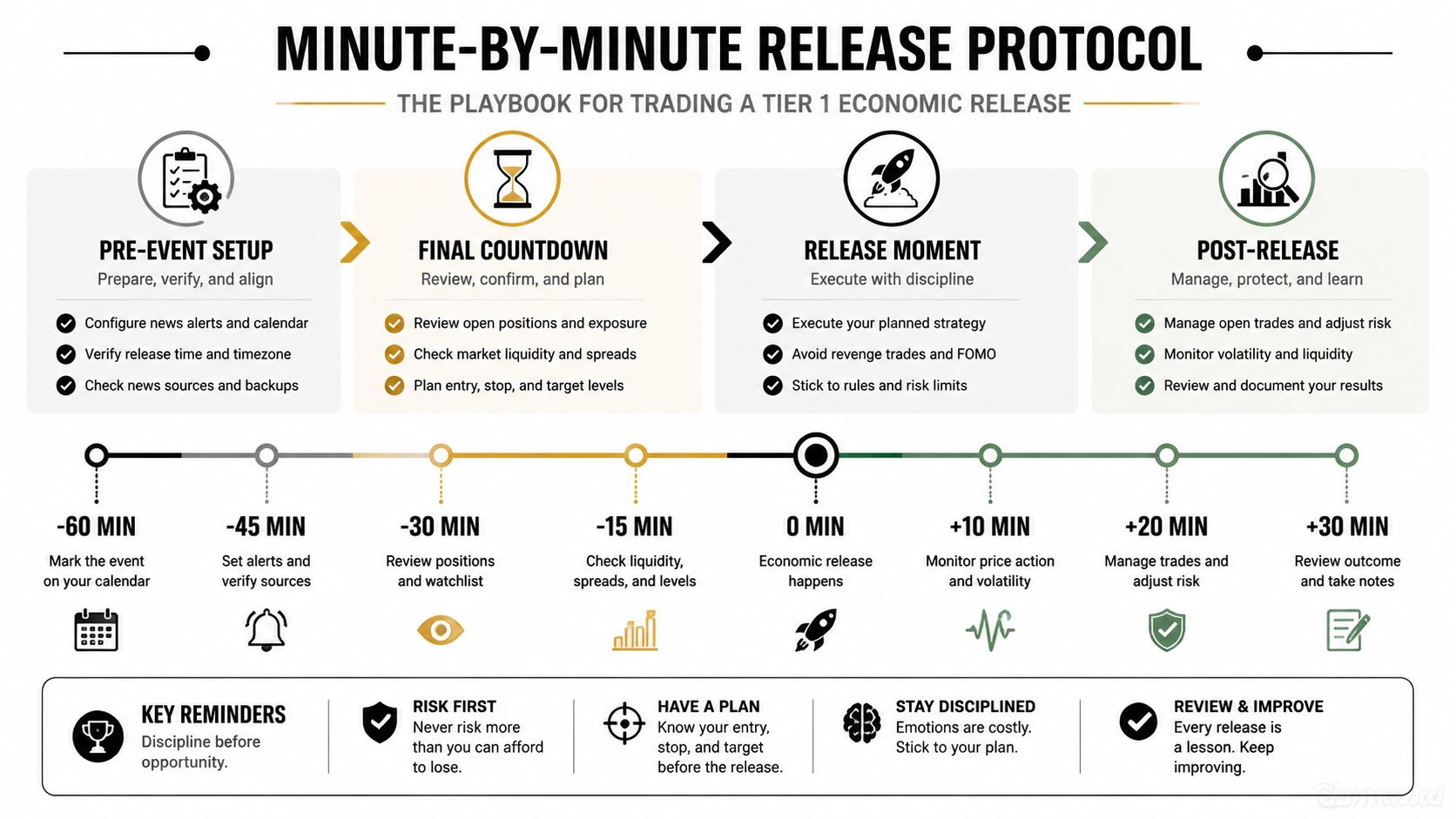
A Minute-by-Minute Release Protocol
A release plan needs timing, not vibes. The easiest way to lose money on news is to show up unprepared, freeze at the print, and then widen your stop while the spread is already moving against you.
The 60-minute window before the print
Start with alerts. High-impact releases should be on your screen 30 to 60 minutes before the event, which gives you time to check the feed, confirm the calendar timestamp, and map the trade thesis to the current chart context. The point is to know whether the release is likely to be a trigger, a fade, or just noise before the market starts moving.
About 30 minutes before the release, flatten or reduce positions that could get caught in the spike. Bookmap's guidance also pushes traders to close affected positions before the print and wait for the first burst of volatility to pass before trying to re-enter, because the first reaction often has poor structure and wide spreads (Bookmap on using economic calendars).
Broker behavior matters here. OCO orders can behave differently during a news spike, especially when liquidity thins out and one side of the bracket fills before the other side updates. On some platforms the stop and target are handled cleanly, on others the order book lags just enough to create a worse fill than the chart suggests.
Practical rule: if the trade only works when you “hope” the release is quiet, it isn't a good news trade.
The print and the first 30 minutes after
At the release second, don't manage the trade emotionally. Your job is to execute the plan you wrote before the event. If the setup is a trigger, the entry, stop, and target should already exist. If the setup is a fade, you need to wait until the initial burst loses energy. If the setup is a filter, you stand down.
Risk needs a hard ceiling. Keep event risk capped at no more than 1% of account equity per event. That keeps one bad release from turning into a session problem, and it forces you to size the position for the worst-case tape, not the best-case headline.
The first 15 to 30 minutes after release are usually the ugliest part of the tape, so don't widen stops in the first 5 minutes just because the market has run a little farther than expected. Use broker-side OCO orders rather than mental stops if your platform supports them, then save a screenshot of the order book and the first reaction so your review has an actual reference point. If you want a tighter testing loop, the same habits apply when you backtest trading strategies, because the goal is to compare your planned execution with what the market really did.
A compact checklist helps:
- Alert set: 30 to 60 minutes before.
- Exposure reviewed: about 30 minutes before.
- Order ready: entry, stop, target pre-defined.
- Execution chosen: flatten, wait, enter, or stand down.
- Review saved: screenshot and notes after the move settles.
If the release is tied to a funded account, the review process needs the same discipline. The Hire-a.dev risk mitigation mindset fits here, because one rushed decision during a headline spike can do more damage than a string of ordinary trades.
Backtesting the Calendar Before You Risk Real Money
Most traders don't backtest news properly. They remember one big winner, forget three sloppy losses, and then call the setup “good enough.” That's not testing, that's selective memory.
A simple six-month filter
Pull the last 6 months of prints for one event, then mark the actual versus forecast surprise for each release. Measure the average true range move in the first 30 minutes after the event, and keep only the releases that historically moved price by more than 0.5 ATR. That threshold gives you a practical shortlist instead of a long calendar full of noise (Tradevea guide on filtering low-quality setups).
That same approach is what traders usually miss when they try to trade every red folder. A release that looks exciting on the calendar may be dead on your instrument.
What to log every time
A journal entry doesn't need to be fancy. It needs to be consistent.
- Event name: CPI, claims, PPI, GDP, or rates.
- Surprise direction: above, below, or near forecast.
- Mode used: filter, fade, or trigger.
- Entry and stop: exact price, not a memory.
- Outcome: result and whether it followed plan.
- Screenshot: chart plus order book if possible.
A trade log like this keeps you honest because it shows whether the event, not the mood, drove the result. After 20 trades, review the list and cut anything that doesn't justify capital.
If you want a broader framework for building that journal into a repeatable process, the risk mitigation guide from Hire-a.dev is a useful parallel read for thinking about structured controls, even outside trading.
What to remove from the watchlist
Don't keep a release because it feels important. Keep it only if the data has shown repeatable follow-through on your instrument and your session. A smaller shortlist is usually better than a crowded one, because the calendar's job is to improve decision quality, not to create more trades.
Applying This to a Funded Account and Next Steps
Prop accounts change the math. A flat 5% daily loss limit and up to 10% maximum drawdown mean one ugly news trade can wreck your day, even if the setup looked valid before the print. That's why funded traders tend to use news rules, add-ons, or automation when they want exposure around releases, instead of treating every event like a free shot.
Where automation fits
Alerts can be pushed through webhooks into DXtrade, cTrader, or MT5-style platforms so the plan doesn't depend on you staring at the screen at the exact second of the release. EA logic can auto-flatten ahead of red-folder events, and community alerts in Discord help funded traders stay synced when multiple markets are printing at once.
The true advantage isn't speed alone. It's consistency. If your platform can't enforce the plan, the plan usually collapses the moment volatility expands.
Trading around the calendar is still trading, which means risk of loss is real. The goal is to control exposure, not to chase every headline.
FAQ
Is economic calendar trading only for forex?
No. The same release can matter across FX, gold, bonds, and equity indices, but the reaction path is different. That's why the asset map matters as much as the event itself.
Should I trade every high-impact release?
No. High-impact just means the event can move price. It doesn't mean it'll move your instrument cleanly enough to trade.
What's the safest way to start?
Start by using the calendar as a filter. Build a backtest, keep the best-moving releases, and only then decide whether a fade or trigger makes sense.
How far in advance should I prepare?
A good baseline is 30 to 60 minutes before the release for alerts and position checks, then 15 to 30 minutes after the print before you consider re-entry, if your plan even allows it.
If you want to trade news with clear rules instead of guessing around the release, MyFundedCapital offers funded trading programs, instant funding, and account scaling paths that fit traders who need structure around risk and volatility. Review the account types, compare the news-trading options, and see which setup matches the way you trade economic calendar events.
