Most advice about proprietary trading jobs is outdated. It still assumes the only route is a Wall Street desk, a math-heavy interview loop, and a move to New York or Chicago.
That’s only half true now. If you trade FX, indices, crypto, or CFDs independently, there’s a second path that looks nothing like the old one. You need to understand both, because the skills, hiring filters, pay model, and daily pressure are different.
What is a Proprietary Trading Job in 2026
A proprietary trading job used to mean one thing. You worked for a firm that deployed its own capital, and you earned a salary plus a share of what you made.
That still exists. But the term now covers two separate worlds.
The first is the traditional prop firm. Think of firms that recruit from top universities, test for quantitative ability, and expect strong programming or market structure knowledge. These jobs are selective, formal, and often tied to specific financial hubs.
The second is the funded trader model. In that setup, a trader proves skill through an evaluation or challenge and then gets access to simulated capital under strict rules. This route has opened the door to traders who don’t have institutional experience, licenses, or a conventional finance resume.
The old definition is too narrow
A lot of traders still search “proprietary trading jobs” and end up on job boards that mostly show quant, execution, and research roles. That creates the wrong impression. One verified market snapshot notes that job boards list only 334 “Proprietary Trading Firm” roles, while the funded model offers access to $5K to $500K in simulated capital without institutional credentials, and this path is still missing from 90% of career pages despite estimated growth in 2025 (Indeed market snapshot).
That gap matters. A discretionary FX trader with a strong personal process may be a poor fit for a traditional quant seat, but a very good fit for a funded program.
If you’re still thinking “prop trading is only for Ivy League quants,” you’re working from an old map.
Practical rule: Don’t ask only, “How do I get a prop job?” Ask, “Which prop model matches how I already trade?”
What the two paths really mean
Here’s the clean way to consider it:
- Traditional prop jobs suit people who want a structured employer, formal training, team infrastructure, and a long-term institutional career.
- Funded prop programs suit independent traders who already have a method and want capital access without going through a classic hiring process.
- Hybrid profiles exist. A trader might start in the funded world, build a verified record, then use that experience to pursue desk roles later.
- Wrong fit is expensive. A manual chart trader usually struggles in quant interviews. A trader who needs coaching, daily oversight, and team process may struggle in a self-directed funded environment.
A useful primer on the funded model is this overview of how proprietary trading firms work. Read it with one question in mind: are you looking for employment, or are you looking for a capital allocation structure?
What firms actually care about
Both models care about one thing first. Can you manage risk while producing repeatable results?
They don’t care equally about the same signals, though.
Traditional firms often screen for:
- Quant foundation Probability, statistics, coding, or market microstructure
- Professional readiness Interviews, communication, teamwork, and sometimes licensing
- Trainability Can you operate inside a desk process?
Funded programs usually screen for:
- Rule compliance Can you stay inside drawdown and trading parameters?
- Execution discipline Can you repeat the same setup without freelancing?
- Self-management Can you trade without a manager sitting behind you?
That’s the frame for proprietary trading jobs now. There isn’t one ladder. There are two, and they reward different strengths.
The Four Key Roles Inside a Prop Trading Firm
People often imagine “prop trader” as a single job title. In practice, prop firms split responsibility. Even when one person wears several hats, the work still falls into a few core functions.
Discretionary trader
This is the role most independent traders understand first. A discretionary trader reads price action, context, news flow, liquidity, and market behavior, then makes decisions manually.
In a traditional firm, this trader may focus on one market or one style and operate inside desk limits. A senior trader or risk lead may review the book. The trader doesn’t usually control the entire operating stack.
In a funded program, the discretionary trader often does much more:
- defines the setup
- chooses execution timing
- controls risk on each position
- reviews performance after the session
- adjusts only when data supports a change
That’s why many retail traders underestimate the job. They think they’re applying for “capital.” In reality, they’re stepping into a compact business unit where they are strategy, execution, and self-supervision.
Quantitative or algorithmic trader
This role builds systems rather than relying mainly on screen reading. The work can include research, backtesting, signal design, automation, and post-trade analytics.
At a traditional prop firm, the quant trader often works closely with researchers and developers. Code quality, statistical rigor, and data handling matter as much as the idea itself.
In the funded world, the algo trader is usually more independent. They need to know whether their system can survive practical constraints such as spread changes, execution quality, product rules, and platform behavior.
A profitable backtest doesn’t mean much if the strategy can’t function in live-style conditions.
Most weak algo applications fail for the same reason weak manual applications fail. The trader hasn’t translated an idea into a risk-controlled process.
Execution trader
This role gets less attention, but it matters. Execution traders focus on how orders enter and exit the market. They care about timing, fills, slippage, and whether the order method matches the strategy.
In a traditional setting, execution can be highly specialized. One person may execute what another person designs. That division is common when firms care strongly about process consistency.
For self-directed traders in funded environments, execution isn’t a separate department. It’s part of your edge. If you panic into entries, widen your stop after entry, or chase candles, you’re failing at execution even if your market idea was correct.
Good execution usually looks boring:
- entries taken where the plan allows them
- stops placed before emotion takes over
- exits handled by rule, not hope
- no impulsive size increase after a loss
Risk manager
Every serious prop operation has a risk function, whether formal or personal.
At a traditional firm, a dedicated risk manager or desk lead may watch aggregate exposure, product concentration, intraday loss, and behavior under stress. The trader isn’t the final authority on all risk decisions.
In a funded program, the trader absorbs much of that responsibility directly. You’re expected to stay inside the account’s rules without external rescue.
Here’s the practical version:
| Role | Traditional prop firm | Funded trader program |
|---|---|---|
| Discretionary trader | Focuses on trading decisions inside desk structure | Often handles strategy, execution, and review alone |
| Quant or algo trader | Works with research and development teams | Builds and runs systems independently |
| Execution trader | May be a dedicated function | Usually part of the trader’s own process |
| Risk manager | Separate oversight role exists | Trader enforces rules personally |
Which role fits you
If you’re trying to break into proprietary trading jobs, identify your natural role before you chase opportunities.
- You may fit discretionary trading if you read charts well, stay calm under pressure, and can accurately journal decisions.
- You may fit quant or algo work if you enjoy testing, coding, and validating ideas more than making rapid manual decisions.
- You may fit execution work if you notice micro-timing, order quality, and trade management details others ignore.
- You may fit risk oversight if you think in limits, scenarios, and exposure before you think in upside.
A lot of traders fail because they pursue the role that sounds prestigious, not the one that matches how they think.
Skills Tech and Qualifications You Actually Need
Individuals often ask the wrong question here. They ask, “Do I need a finance degree?” The more useful question is, “What skills keep me inside the rules long enough to prove I deserve capital?”
That’s a different conversation.
A verified industry snapshot notes that only 5% to 10% of traders pass evaluation challenges, and that risking less than 2% per trade can improve pass rates by 40% (QuantVPS prop firm statistics). That tells you what matters. Not charisma. Not social media screenshots. Process.

Technical skills that matter in practice
You don’t need every skill below. You do need enough of them to match your path.
- Platform fluency If you trade manually, you should know your platform cold. That includes order entry, stop placement, risk sizing, and session management on tools such as cTrader or DXtrade.
- Data literacy You need to review performance by setup, session, instrument, and mistake type. Traders who can’t audit themselves usually repeat the same error under a new excuse.
- Market understanding Know what you trade and why it moves. A trader who mixes forex, indices, and crypto without understanding their behavior usually ends up with random exposure.
- Programming ability If you build systems, Python is the practical starting point for research and automation. If you need outside help for strategy tooling or analytics, working with experienced python developers can speed up build quality and testing discipline.
Qualifications that help, but aren’t the whole story
Traditional firms often care about credentials. They may want evidence of quantitative training, coding competence, or licenses, depending on the seat.
Funded programs care much less about formal qualifications. They care whether you can operate inside defined limits, produce consistent execution, and avoid self-inflicted account damage.
That’s why a trader with no finance degree can still be competitive if they have:
- a clean trading journal
- a narrow and repeatable setup
- controlled risk per trade
- consistent review habits
- no habit of revenge trading after losses
A platform comparison like this guide to the best FX trading platform is useful because platform friction matters more than beginners think. Slow order handling, poor chart workflow, or awkward risk tools can turn a decent process into sloppy execution.
Psychological skills are not optional
At this point, most candidates leak edge.
You need to regulate behavior when the market does something you didn’t expect. That means:
Patience before entry
Waiting for your setup instead of manufacturing trades from boredom.Discipline during the trade
Not moving a stop because you “still believe” in the idea.Honesty after the trade
Recording whether the loss came from variance or from breaking your own rule.
If you can’t trade one setup the same way for a long stretch of time, you’re not ready for a prop environment. You’re still improvising.
A practical checklist
Use this before you apply anywhere:
- Can you explain your edge clearly? If your setup needs a ten-minute monologue, it probably isn’t defined well enough.
- Do you know your invalidation point before entry? If not, your risk is emotional, not planned.
- Can you review trades by category? “I was off today” isn’t analysis.
- Can you stop trading after a bad sequence? Many failures come from the second mistake, not the first.
- Can you follow rules on ordinary days? Stress doesn’t create bad habits. It exposes them.
That’s what firms are trying to measure. Skills aren’t just what you know. They’re what you can repeat under pressure.
Traditional vs Funded Prop Firms A Detailed Comparison
This is the decision point. Both paths sit under the umbrella of proprietary trading jobs, but the actual experience is very different.
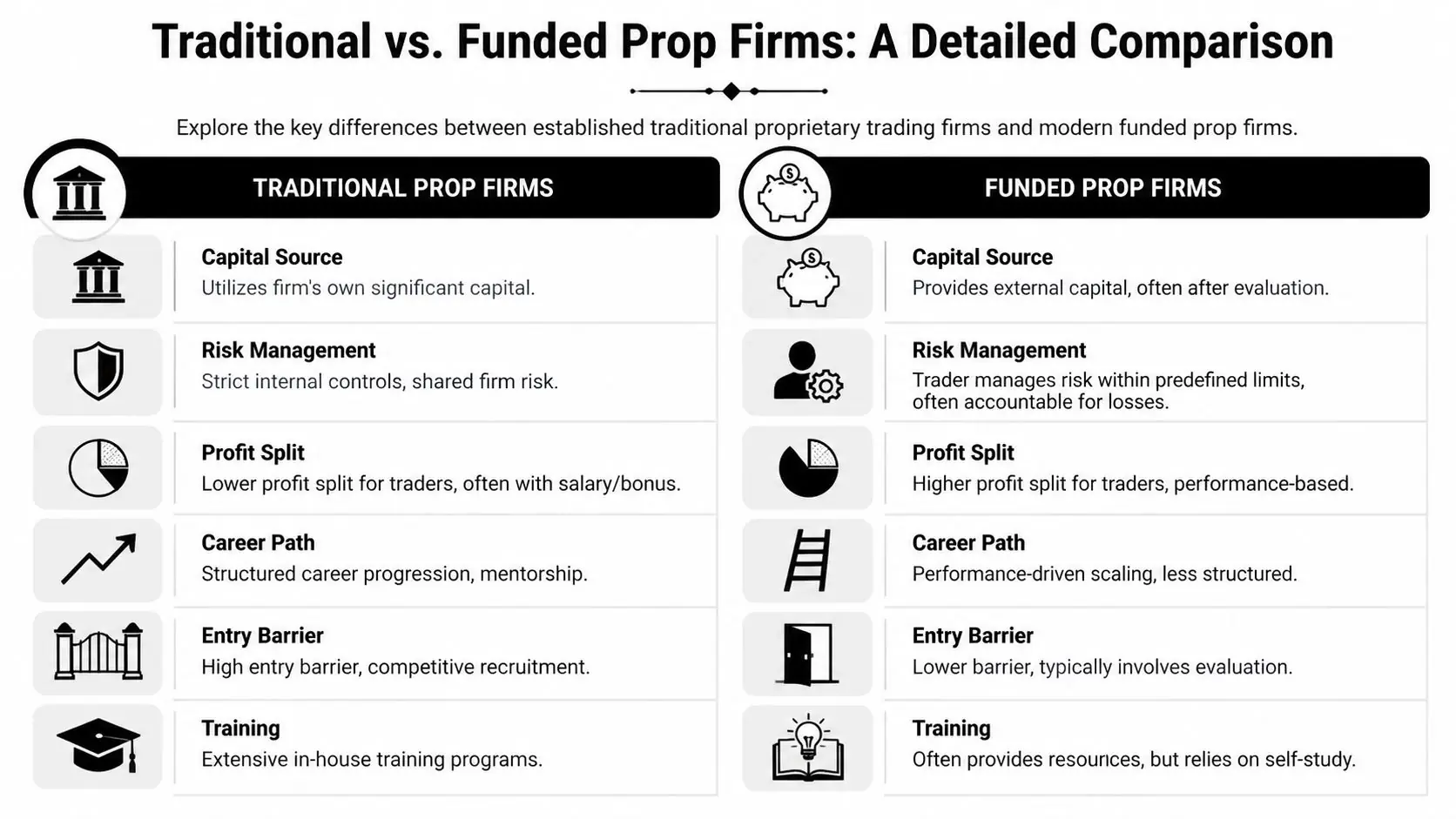
Side by side reality
| Criterion | Traditional Prop Firm (e.g., Jane Street) | Funded Trader Program (e.g., MyFundedCapital) |
|---|---|---|
| Hiring path | Formal recruiting, interviews, testing, often university-driven | Evaluation or challenge-based access |
| Capital model | Firm deploys its own trading capital | Trader receives access to simulated capital under rules |
| Work structure | Team-based, desk-based, often on-site | Self-directed, usually remote |
| Risk oversight | Centralized desk or firm-level risk controls | Individual trader must respect predefined limits |
| Compensation style | Salary plus bonus | Profit split based on performance |
| Training style | Structured mentoring and internal development | More self-study, platform practice, and personal review |
| Career path | Promotion through desk performance and internal trust | Capital scaling through consistency and rule adherence |
| Best fit | Quant, execution, research, or team-oriented traders | Independent discretionary, algo, or copy traders |
Entry barriers are completely different
Traditional firms filter heavily at the front door. They want evidence before they let you near meaningful risk. That can mean internships, technical interviews, coding tests, or prior desk experience.
Funded firms invert that process. Instead of judging your resume first, they judge your trading behavior first.
That’s why these two models attract different candidates:
- a statistics-heavy graduate with strong coding may prefer the traditional route
- a profitable self-taught FX trader may prefer evaluation-based access
- an experienced trader who dislikes corporate structure may choose funded programs even if they could pursue desk work
The risk model changes your daily experience
Traditional desks usually manage risk at several levels. A trader may have limits, but the firm also has supervisors, risk personnel, and operational controls around them.
Funded models push more responsibility onto the individual. If there’s a daily loss cap or a maximum drawdown rule, you can’t rely on anyone to save you from yourself. That makes self-control a job requirement, not a personality bonus.
Some traders need external structure to perform well. Others trade better when they own every decision and every consequence. Know which one you are.
Compensation changes incentives
Traditional firms usually provide stability first, upside second. You may start with a salary and earn more as your book justifies it.
Funded programs remove most of that salary logic. If you don’t perform, you don’t earn. If you do perform, your share of profits can be attractive. That appeals to traders who want a direct link between output and income, but it also means income can be uneven.
A funded account page like funded trading accounts is useful to review because the account structure tells you what kind of trader the firm is designed for. The details matter. Drawdown method, payout cadence, instrument coverage, and whether algorithmic or copy trading is permitted all affect whether the model fits your strategy.
Which path works better for which trader
Use this decision lens.
Traditional prop firms usually fit better if you:
- want a long-term institutional finance career
- enjoy team environments and formal feedback
- have quant, coding, or research strengths
- value salary stability and career progression
Funded programs usually fit better if you:
- already trade independently
- want remote access and flexibility
- prefer performance-based upside over a fixed salary
- can follow strict risk rules without supervision
What doesn’t work
A few bad matches show up again and again:
- Corporate-minded traders in self-directed models They wait for guidance that never comes.
- Undisciplined discretionary traders in funded programs They treat account rules like suggestions.
- Independent chart traders chasing quant jobs They apply for roles that reward very different abilities.
- Traders obsessed with payout size but careless with process They focus on the reward mechanism instead of the behavior required to reach it.
The right model won’t fix weak habits. It only makes your current strengths and weaknesses more visible.
Compensation The Real Numbers Behind Prop Trading
At this point, hype usually takes over. Ignore the social posts. Look at the structure.
Compensation in proprietary trading jobs depends first on which prop world you’re in. Traditional firms and funded programs can both pay very well, but they don’t pay in the same way, and they don’t reward the same kind of consistency.
A verified compensation breakdown notes that elite traditional firms like Jane Street can pay new graduates $425K to $600K in total compensation, while successful funded traders average $8K to $25K monthly on profit splits from 80% to 100%, and entry-level salaries at smaller prop firms average around $112K (Mergers & Inquisitions proprietary trading compensation).
Traditional compensation
Traditional prop firms usually pay through a mix of base salary and bonus.
That structure does two things:
- gives a trader some income stability while they develop
- ties most serious upside to actual trading contribution
At the elite end, compensation can be extraordinary. But that doesn’t mean those jobs are easy to land, or easy to keep. The firm expects output, discipline, and growth. High pay is paired with very high standards.
For a junior trader, the advantage is obvious. You get infrastructure, learning, and salary support. The trade-off is that you went through a much narrower gate to get there.
Funded trader compensation
The funded model works differently. You usually don’t get a salary. You earn a profit split if you perform inside the account rules.
That model appeals to independent traders because:
- the upside can scale with skill
- there’s no need for a formal employer to “hire” you first
- the income is directly connected to your trading output
But there’s a harder truth. Only successful traders get paid. If your process breaks down, your income disappears with it.
A realistic way to read the numbers
Don’t compare these two paths as if they were the same job.
Use this lens instead:
| Pay question | Traditional prop firm | Funded trader program |
|---|---|---|
| Fixed salary | Usually yes | Usually no |
| Bonus or split | Bonus tied to performance | Profit split tied to performance |
| Income stability | Higher | Lower |
| Upside for strong independent traders | Strong, but structured | Strong, often more direct |
| Need to pass formal hiring | Yes | Not in the same way |
What traders get wrong about prop pay
The biggest mistake is assuming headline pay equals expected pay.
A trader sees top-end compensation and starts mentally spending money they haven’t earned. That mindset creates pressure, and pressure ruins execution.
A better approach is to treat compensation as a byproduct of three things:
- rule adherence
- repeatable edge
- staying in the game long enough for the edge to compound
Don’t choose a prop path based on the largest number you’ve heard. Choose it based on the pay structure you can actually survive.
Income quality matters more than income fantasy
A salary plus bonus model may fit a trader who wants a career inside an institution. A split-based model may fit a trader who wants autonomy and accepts variable income.
Neither one is “better” in the abstract.
The right question is simpler. Do you want:
- structured income with structured expectations, or
- variable income with direct performance linkage?
That answer will usually tell you more than any compensation headline.
Trading always involves risk of loss. This discussion is educational only and isn’t financial advice.
Your Blueprint to Landing a Proprietary Trading Job
Most applicants make this harder than it needs to be. They chase prestige first and fit second. That’s backward.
The fastest route into proprietary trading jobs is to choose the lane that matches your current strengths, then build proof that survives scrutiny.
Path one for traditional prop roles
If you want a desk job, your application needs to show more than market interest. It needs to show that you can think clearly, communicate under pressure, and work inside a controlled environment.
Start with your resume. Keep it tight. Highlight coding, statistics, market research, competition results, or anything that proves decision quality. If you need help cleaning up the presentation, an AI resume builder can help structure the document around measurable skills instead of generic statements.
Then focus on interview preparation:
- Quant reasoning Expect probability, mental math, logic, and market-thinking questions.
- Technical fluency If you claim Python or C++, be ready to discuss what you have built.
- Behavior under pressure Firms want to know how you handle being wrong, not just how you talk when you’re right.
A weak traditional candidate usually has one of two problems. Either they have the academic background but no practical market thinking, or they have enthusiasm for trading but no evidence they can operate in a professional process.
Path two for funded trader programs
For this route, your interview is your trading record.
You don’t need to sound impressive. You need to behave predictably.
Build your preparation around a simple sequence:
Choose one market cluster
Don’t trade everything. Pick the instruments you understand.Define one or two setups
If your rules are broad enough to justify any trade, they aren’t rules.Create a verifiable record
Use demo or simulated conditions and log entries, exits, size, mistake type, and screenshots.Study the account rules like a contract
Daily loss limits, max drawdown, prohibited behavior, payout conditions, and holding restrictions all affect strategy choice.Trade the evaluation as if preserving capital is the target
Many traders fail because they trade the challenge like a race instead of a risk test.
A firm such as MyFundedCapital offers challenge-based and instant-funding style access to simulated capital across forex, crypto, and commodities on DXtrade and cTrader, with rule parameters that matter for manual, algorithmic (by agreement with support), and copy traders. That’s useful if you already know your strategy type and need to match it to a firm structure rather than forcing your process into the wrong environment.
A practical preparation checklist
Before you apply or start a challenge, be able to answer these questions clearly:
- What is your setup? One sentence, not a story.
- What invalidates the trade? If you can’t say this quickly, your stop is emotional.
- What conditions make you skip a trade? Good traders know when not to participate.
- What is your mistake pattern? Overtrading, early exits, adding to losers, chasing breakouts, and moving stops all need names.
- What does a normal trading day look like? If every day feels improvised, the process isn’t ready.
What works and what doesn’t
What works:
- keeping your strategy narrow
- tracking your own mistakes aggressively
- matching your path to your actual strengths
- preparing for rules before you prepare for upside
What doesn’t:
- applying broadly without understanding role differences
- changing strategy in the middle of an evaluation
- treating a funded challenge like a lottery ticket
- assuming confidence can replace evidence
The mindset that gets traders hired or funded
The traders who make progress usually stop trying to look talented. They start trying to look reliable.
That shift matters.
Traditional firms want to trust you with a seat. Funded programs want to trust you with risk limits. In both cases, the candidate who wins is usually the one who can show calm, repeatable behavior rather than dramatic upside.
Frequently Asked Questions About Prop Trading Jobs
Do I need a finance degree or certification
No. It depends on the path.
Traditional proprietary trading jobs may favor candidates with strong academic backgrounds, quantitative training, or licenses for certain roles. Funded trader programs usually care much more about trading behavior than formal credentials.
If you can manage risk, follow rules, and show a repeatable process, you can be competitive without a finance degree. But if you want a classic institutional seat, strong technical credentials still help.
Can I do prop trading part-time alongside my job
Yes, but only if your strategy fits the time you have.
Part-time traders often struggle when they copy an intraday style that requires full-session attention. If you have a job, use a strategy that matches your schedule. Don’t force a fast execution style into limited screen time.
The actual risk isn’t part-time trading itself. It’s using a full-time strategy with part-time attention.
Are funded trading programs legitimate
Some are, some aren’t. You need to do due diligence.
Good signs include:
- Clear rules Daily loss, maximum drawdown, and payout conditions are easy to understand.
- Transparent account structure You know whether you’re trading in a demo environment with real market quotes.
- Consistent payout process The firm explains how and when payouts work.
- Support and community access Traders can ask questions and get operational help.
Bad signs are vague rules, shifting terms, unclear restrictions, and poor communication when traders ask direct questions.
Which path is better for a beginner
Usually, neither path rewards a true beginner who hasn’t built process yet.
A new trader should first learn to track trades, define setups, size risk properly, and review mistakes. After that, the funded route can be a practical next step for self-directed traders. The traditional route makes more sense if you’re building toward a formal institutional career and already have the academic or technical base to compete.
Trading involves risk of loss. This article is for educational purposes only and isn’t financial advice.
If you want a practical route into the funded side of proprietary trading jobs, explore MyFundedCapital and compare whether Instant Funding, a 1-Step Challenge, or a 2-Step Challenge matches your trading style, risk tolerance, and need for capital access.