Choosing the best FX trading platform isn't about finding a single "best" option; it's about finding the right tool for your specific strategy and goals. This guide breaks down the practical differences between leading platforms to help you select the one that best supports your trading approach. We will cover key features, performance, and how each platform aligns with different trading styles, so you can make an informed decision.
Choosing the Right FX Platform for Your Funded Trading Career

Your platform choice is one of the most critical decisions you'll make as a trader. It’s your command center, directly impacting everything from execution speed and analysis to your ability to manage risk according to your prop firm's rules. A clunky or unsuitable platform can be the difference between hitting a profit target and breaching a drawdown limit. Remember, trading involves a substantial risk of loss and is not suitable for all investors.
This guide will break down the real-world differences between leading platforms like cTrader, DXtrade, and the industry-standard MT4/MT5. We’ll analyze them based on the criteria that truly matter to beginner and intermediate traders. To see the specific options available, you can explore the trading platforms offered at MyFundedCapital.
Quick Guide to the Best FX Trading Platforms
Here's a quick overview of which platform might be best for you, based on your trading style and needs.
| Platform | Best For | Key Strengths |
|---|---|---|
| cTrader | Discretionary day traders and cBot developers. | Advanced charting, depth of market (DOM), clean interface, robust backtesting for C#. |
| DXtrade | Traders seeking a modern, web-based experience with integrated tools. | Customizable widgets, built-in trading journal, user-friendly design. |
| MetaTrader 4/5 | Traders using Expert Advisors (EAs) and relying on a large community. | Vast ecosystem of EAs and indicators, widespread broker support, familiar interface. |
Think of this table as a starting point. Your perfect match depends on your unique strategy and workflow, which we'll dive into with a much deeper comparison.
Getting to Know the Top Trading Platforms
Picking the right trading platform isn't just about features. Every platform was designed to solve a specific problem for a specific type of trader, and understanding that "why" is the key to finding the one that aligns with your approach.
From industry veterans like MetaTrader to sleek newcomers like cTrader and DXtrade, each has a core identity. Let's break down who they were built for so you can align your strategy with the right tech from day one.
MetaTrader 4 and 5: The Industry Standard
There's no getting around it—MetaTrader 4 (MT4) is the giant of retail forex. Despite its age, its original design goal of simplicity and accessibility made it an instant hit. More importantly, it was built to support a massive open ecosystem for automated trading through Expert Advisors (EAs).
This focus on a simple interface and a gigantic library of EAs is why MT4 remains so popular. It commands a staggering 85% market share among forex traders globally, according to a recent forex trading statistics report. With over 90% of retail brokers offering it, MT4 is often the default, a reliable workhorse for many trading styles.
For traders who rely on algorithms, MT4 is more than just a platform—it’s an entire industry. The marketplace for pre-built EAs and custom indicators is so vast that it's the main reason many traders refuse to switch.
MetaTrader 5 (MT5) was MetaQuotes' answer to the modern, multi-asset world. While MT4 was a forex-only tool, MT5 was engineered from the ground up to handle stocks, futures, and other instruments. It also introduced a more powerful programming language (MQL5), additional timeframes, and a native economic calendar.
So why hasn't everyone jumped ship? The transition has been slow, mostly because EAs built for MT4 don't work on MT5. They require a complete rewrite, a massive undertaking for developers and traders who have invested years into their MT4-based systems. For a more detailed breakdown, check out our complete MT4 vs. MT5 comparison.
cTrader and DXtrade: The Modern Challengers
While MetaTrader sits on its legacy, a new generation of platforms like cTrader and DXtrade have emerged. They were built for today's discretionary trader, prioritizing a clean user experience, advanced charting, and transparency.
They approach the market from a completely different angle:
cTrader: Developed by Spotware, cTrader was created to give retail traders an institutional-grade experience. Its entire focus is on fast execution, sophisticated order types, and full Depth of Market (DOM) pricing. It’s built for the trader who wants powerful analytics and a pristine interface straight out of the box.
DXtrade: This platform is all about flexibility. DXtrade’s core idea revolves around a modern, widget-based layout that lets you build a trading desk perfectly tailored to your workflow. It also comes with built-in tools like a trading journal and performance analytics—features you'd normally have to find and pay for elsewhere.
A Detailed Platform Comparison for Prop Firm Traders
When you're a funded trader, picking the best FX trading platform isn't about finding the one with the slickest marketing. Your ability to pass a challenge and stay funded depends on practical, nitty-gritty features that directly affect your P&L and your adherence to the firm's rules.
This breakdown compares DXtrade, cTrader, Match-Trader, and the industry-standard MetaTrader 4/5 through the lens of a prop trader. We're focused on what actually counts: execution quality, analytical tools, and how well the platform fits into the prop firm ecosystem. Think of your platform as a business partner—the wrong one can cost you dearly.
FX Trading Platform Feature Comparison for Funded Traders
Before we dive deep, here’s a high-level look at how these platforms stack up on the features that matter most to funded traders. This table gives you a quick reference for the key differentiators.
| Feature | DXtrade | cTrader | MetaTrader 4/5 | Match-Trader |
|---|---|---|---|---|
| Best For | All-in-one performance tracking & disciplined trading. | Discretionary traders, scalpers, and charting purists. | Algorithmic traders and those reliant on a massive indicator/EA ecosystem. | Traders seeking a simple, modern, and mobile-friendly experience. |
| Execution Environment | Modern, web-based, fast execution. Performance depends on firm's setup. | ECN-native design with Level II Depth of Market. Known for low latency. | Highly variable; depends entirely on the broker's server and liquidity bridge. | Clean, fast, full-featured web and mobile platform. |
| Charting & Analysis | Strong, with a game-changing built-in trading journal and widget layout. | Best-in-class native charting with 54 timeframes and advanced order types. | Functional but dated. Power comes from the vast MQL5 third-party marketplace. | User-friendly and clean, covering all essential analysis needs effectively. |
| Prop Firm Integration | Excellent. Often has built-in drawdown displays and performance stats. | Strong. Integrated risk stats are common, providing real-time rule feedback. | Often requires third-party tools or separate dashboards for rule tracking. | Good. Modern architecture allows for easy integration of prop firm metrics. |
| Automated Trading | API access for custom solutions, but no large, pre-existing ecosystem. | Open API (cTrader Automate) using C#. Growing but smaller than MT5's community. | The undisputed leader with the massive MQL4/MQL5 community and marketplace. | API is available, but the ecosystem for bots is still in its early stages. |
This table highlights the core strengths of each platform. Now, let's explore the practical implications of these differences in your day-to-day trading.
Execution Speed and Slippage
For any prop trader, but especially for scalpers, execution is critical. A small amount of slippage on a funded account's position size can be the difference between hitting your profit target and breaching your daily drawdown limit.
- cTrader This platform was designed for a true ECN environment, which means it offers Level II pricing (Depth of Market). You can see the liquidity available at various price levels, which can help in anticipating and minimizing slippage. It's widely considered a top choice for manual order execution speed.
- MetaTrader 4/5 The performance of MT4/5 is highly dependent on the prop firm's server infrastructure. While it can be fast, it wasn't originally architected for the same level of low-latency, transparent execution as cTrader. Slippage during major news events can be a real issue.
- DXtrade & Match-Trader As newer platforms, these were engineered for speed. They provide fast, reliable execution through modern web-based interfaces. Their performance often rivals cTrader, but it depends on the firm's specific liquidity providers and server setup.
Charting Capabilities and Analytical Tools
A solid trading plan is built on deep market analysis. Your platform must provide the tools to dissect price action and your own trading performance without requiring you to juggle multiple other apps.
cTrader is a standout for discretionary traders who spend a lot of time analyzing charts. It offers:
- A massive 54 timeframes, including tick and second-based charts (like a 20-second chart), which is useful for scalpers looking for precise entries.
- Advanced Order Types that give you more control over your execution.
- Detachable chart windows and a clean interface, making it great for multi-monitor setups.
DXtrade takes a different but equally practical approach with its integrated tools aimed at building trader discipline.
- The Built-in Trading Journal is a standout feature. It automatically logs trades and gives you space for notes and screenshots, making trade review—a cornerstone habit of every successful trader—incredibly simple.
- Its Customizable Widget-based Layout lets you build a command center tailored to your workflow, with charts, news, and performance analytics on one screen.
MetaTrader 4/5 provides solid, functional charting, but it can feel dated compared to modern competitors. While you get all the standard tools, it lacks their advanced timeframes and slick user experience. Its real power is the massive MQL5 community, where you can find an endless supply of custom indicators and EAs.
Match-Trader provides a clean, intuitive charting package that is more than sufficient for most traders. It offers a very straightforward experience, avoiding the steeper learning curve of some of cTrader’s more complex features.
For a prop firm trader, a platform's built-in analytical tools are not just a convenience—they are a risk management necessity. Using DXtrade's journal to track your psychological state during trades can directly help you avoid emotional decisions that could breach a 5% daily drawdown rule.
Prop Firm Workflow Compatibility
The right platform has to work seamlessly with your prop firm’s rules. If your account data is hard to access or lacks key risk metrics, it adds unnecessary friction to your trading process.
Here’s how they fit into the day-to-day life of a prop trader:
- Risk Management: DXtrade and cTrader are often set up with integrated dashboards that clearly show your real-time daily and maximum drawdown levels. This instant feedback is crucial for staying in the game. With MT4/5, this is usually handled by third-party tools or a separate web-based dashboard, which can sometimes lag.
- Allowed Strategies: The firm always sets the rules, but the platform can make following them easier. For example, firms like MyFundedCapital may allow weekend holding. While possible on any platform, firms with more flexible rulesets often lean toward modern platforms like DXtrade and cTrader.
- Payout Reporting: All platforms provide a trade history, but DXtrade and cTrader tend to present it in a cleaner, more professional format that's easy to export. This small detail simplifies verifying your profits for a payout request.
How Algorithmic Trading Performs on EAs vs cBots
For many traders, the best FX trading platform is one that runs on its own. Algorithmic trading demands a platform that can execute automated strategies without interruption. This brings us to the classic comparison: MetaTrader's Expert Advisors (EAs) versus cTrader's cBots.
The choice here is a technical one. EAs are built with MetaQuotes Language (MQL4/MQL5), a proprietary language similar to C++. On the other hand, cBots are coded in C#, a more modern and versatile language from Microsoft that many developers already know.
The Bottom Line: If you're not a coder, the massive community and ready-made marketplace for MetaTrader EAs give it a significant advantage. But if you are a developer or plan on hiring one, the C# environment in cTrader is undeniably more powerful and flexible for building sophisticated, custom strategies from the ground up.
Backtesting and Optimization Engines
An automated strategy is only as good as the data it was tested on. This is where you can see the platforms diverge.
MetaTrader 5: MT5's multi-threaded, multi-currency backtester is a major upgrade from MT4. You can test a strategy across several pairs at once, which provides a more realistic view of its performance at a portfolio level. However, the quality of its historical data and tick simulation can sometimes be less precise than cTrader, potentially leading to skewed results.
cTrader: The backtesting engine in cTrader Automate is known for its accuracy. It uses true tick-by-tick data, which gives a more faithful simulation of market conditions. For high-frequency strategies where every tick counts, this precision gives developers more confidence that their backtest results will translate to live trading.
Consistent uptime is crucial for any trader running automated strategies 24/7. This is where a Virtual Private Server (VPS) becomes an absolute necessity. For anyone running EAs or cBots, knowing how to set up your virtual server is a foundational step to ensure your algorithms run without interruption.
Real-World Performance Scenarios
So how does this all look in practice? Let's break it down.
Scenario 1: High-Frequency Scalping
A scalping bot aiming to profit from tiny, rapid price changes needs speed above all else. cTrader often has an edge here due to its native ECN-style environment and hyper-accurate backtesting. The C# language also gives developers more granular control over order execution logic.
Scenario 2: Complex, Multi-Instrument Strategy
Imagine an algorithm that trades based on correlations between EUR/USD, Gold, and the S&P 500. MT5's multi-currency backtester is designed for this, but cTrader's superior C# framework and open API can make building and managing such logic cleaner. It allows for easier integration of external data feeds and libraries compared to MQL5.
Beyond EAs and cBots
While MT5 and cTrader get most of the attention, other platforms are also built for serious developers. DXtrade has a powerful open API that lets you build custom front-ends and integrate third-party services. Likewise, Match-Trader offers backend access for those wanting to develop proprietary trading systems.
To dig deeper into developing your own automated systems, check out our complete guide on strategies for algo trading.
Finding the Right Platform for Your Trading Style
Chasing the "best fx trading platform" is less important than finding the platform that clicks with your specific trading style, personality, and goals. A platform that feels intuitive to a scalper might seem clunky and restrictive to a swing trader.
Think of your trading strategy as the blueprint and your platform as the workshop. Let's break down which platforms are built for different types of traders.
This decision tree gives you a quick visual on how your approach points you toward a specific platform.
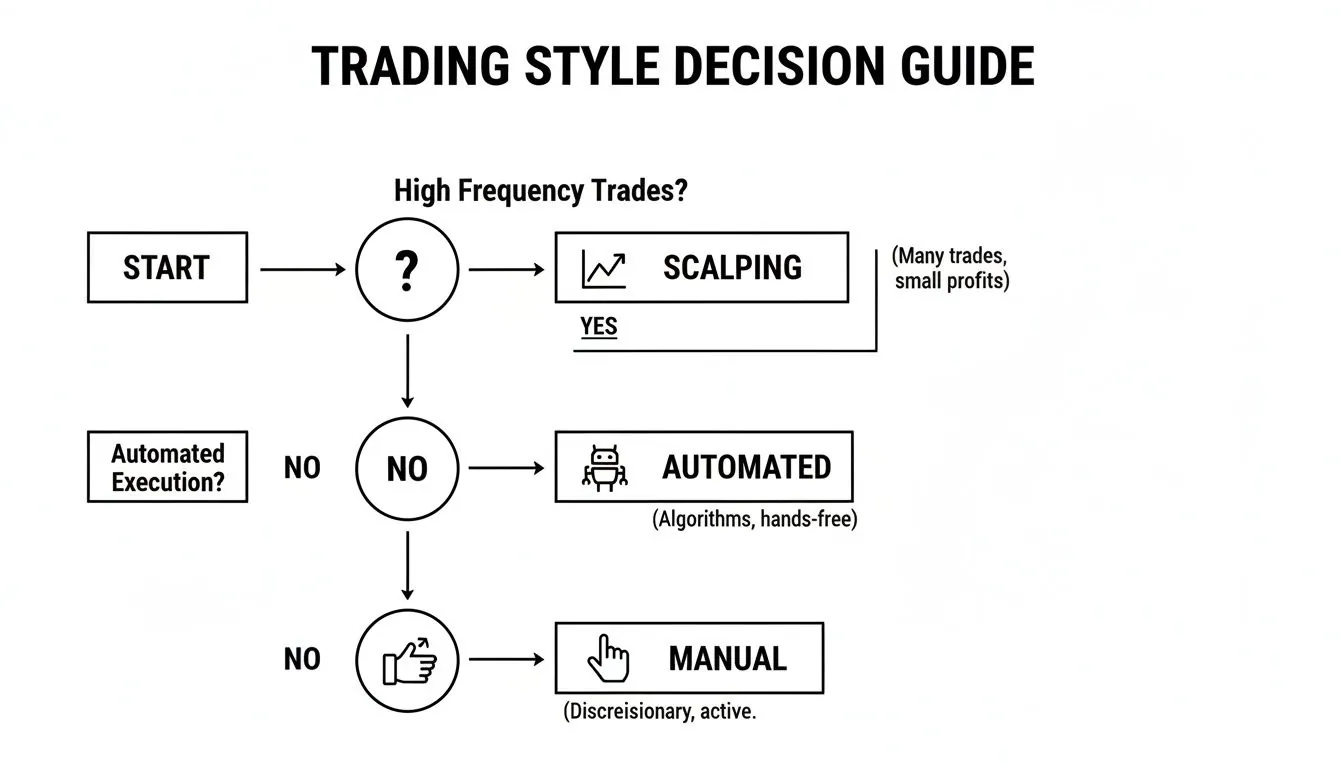
As you can see, your core methodology—whether you're scalping, automating, or trading manually—is the biggest factor in finding your ideal platform.
For the Beginner Focused on Manual Trading
If you're just starting with prop firm trading and still honing your strategy, simplicity is your greatest asset. You need a platform that lets you focus on analysis and execution, not on learning a complicated user manual.
Top Recommendation: MetaTrader 4 (MT4)
There’s a reason MT4 has been an industry workhorse for over a decade: it’s incredibly straightforward. The interface is clean and simple, allowing you to get up and running quickly. You can focus your energy on learning price action and risk management instead of getting lost in confusing features.
For instance, a new trader taking on a 1-Step Challenge can easily use MT4's built-in charting tools to draw support and resistance, place market orders, and set their stop-loss. Plus, the massive online community means that any question you have has likely been answered in countless forums and videos.
For the Discretionary Day Trader and Scalper
When your strategy hinges on razor-sharp entries, advanced charting, and split-second execution, you need a platform built for performance. You live and breathe in the charts, and every moment matters.
Top Recommendation: cTrader
cTrader was built for traders like you. It comes packed with institutional-grade features like Level II Pricing (Depth of Market), a suite of advanced order types, and charting capabilities that are in a different league. Its clean, modern design is also a huge plus, especially for multi-monitor setups.
A scalper trading the London open, for example, needs to see liquidity and enter with precision. cTrader lets them drop down to a 20-second chart for granular analysis and place a limit order at an exact pip level. At the same time, they can watch the depth of market to gauge order flow—something you can’t do on a standard MT4 setup.
For a day trader, the difference between cTrader and MT4 is like the difference between a finely tuned race car and a reliable family sedan. Both will get you there, but only one is built for high performance under pressure.
For the Algorithmic and EA-Driven Trader
If your edge is built on code and automated strategies, your platform isn't a cockpit—it's an engine room. Your main concerns are a solid development environment, accurate backtesting, and a strong community for support.
Top Recommendation: MetaTrader 4/5
Despite its age, MT4 (and its successor, MT5) still reigns supreme in the world of retail algorithmic trading. The reason is simple: its unparalleled ecosystem. The MQL marketplace is home to thousands of pre-built Expert Advisors (EAs) and indicators.
Imagine a prop trader wanting to run a grid trading EA on their funded account. They can browse dozens of EAs on the MQL5 marketplace, run them through the Strategy Tester for backtesting, and deploy them on a VPS. While cTrader's C# environment is more powerful from a pure coding perspective, the sheer volume of ready-made tools for MetaTrader makes it the default choice for most EA traders.
For the Multi-Asset Swing Trader
When you hold positions for days or even weeks across assets like forex, indices, and commodities, you need flexibility. A wide range of instruments is key, as is a prop firm that allows for longer-term strategies like holding trades over the weekend.
Top Recommendation: DXtrade
DXtrade is a modern, web-based platform that’s gaining traction for its clean interface and integrated trading tools. Prop firms that offer DXtrade, like MyFundedCapital, often have more accommodating rules, such as allowing news trading and holding trades over the weekend.
Here’s a practical scenario: a swing trader spots a promising setup on Gold (XAU/USD) on a Thursday but anticipates the move will take a few days to play out. With DXtrade and a firm that permits weekend holding, they can enter the position and manage it without pressure, a massive strategic advantage that would be impossible under stricter rules.
How Your Platform Affects Your Payouts and Rule Compliance
When you're a funded trader, your trading platform isn't just a tool—it's your business partner. How it works with your prop firm’s rules and payout system is just as critical as its charting or execution speed. The wrong setup can cause you to accidentally break a rule you weren’t even tracking properly.
Your primary job is to protect your capital and stay within the firm's drawdown limits. Platforms like cTrader and DXtrade are built for this reality. They often display your 5% daily loss and 10% maximum drawdown limits right on the dashboard. Seeing those numbers in real-time is a powerful psychological check that keeps you from letting a bad trade blow up your account. On the other hand, with MT4, you usually have to add a third-party indicator or use a separate dashboard to see these vital stats.
Getting Paid: Does Your Platform Make It Easy or Hard?
When you hit your profit target and it's time to request a payout, you want a smooth process. You need a clean, undeniable record of every trade. A confusing or messy trade history can cause delays while the firm’s support team verifies your activity.
This is another area where modern platforms have a distinct edge.
- DXtrade and cTrader These platforms generate clean, professional account statements that are incredibly easy to read and share, which helps streamline the firm's verification process.
- MetaTrader 4/5 MT5 is an improvement, but MT4 reports can look dated. While the data is there, the layout isn't as intuitive, which can sometimes slow things down.
Getting paid promptly is a top priority. When a firm offers a fast payout time, they're relying on an efficient system. A platform that provides clear, easy-to-read reports is a huge part of making that speed possible.
Why This Matters More Than Ever
The push for better platform integration is happening for a reason. The global forex brokers market is projected to hit $5.8 trillion in 2026 and grow at a 9.8% CAGR, with some analysts even seeing it reach $8.42 trillion by 2030. This growth means more traders are entering the market, demanding better tools and transparency. You can read the full research on the forex brokers market for more on that trend.
Firms are responding to this demand. MyFundedCapital, for example, offers both Instant Funding and Challenge accounts on forward-thinking platforms like DXtrade and cTrader, recognizing that traders need modern tools to succeed.
Ultimately, your platform should make your life easier. It needs to help you follow the rules, get paid without drama, and let you focus on what actually matters—finding and executing good trades.
This content is for educational purposes only and not financial advice. Trading involves a substantial risk of loss and is not suitable for all investors.
FAQ: Common Questions About Trading Platforms
Can I use my MT4 EAs on other platforms?
No. Expert Advisors (EAs) are built using MetaQuotes Language (MQL4/MQL5), which only works within the MetaTrader ecosystem. Moving an automated strategy to a different platform like cTrader or DXtrade requires a complete rebuild in a different programming language (like C# for cTrader) or via an API.
What is cTrader's biggest advantage for day traders?
For day traders, cTrader's main advantage is its institutional-grade execution environment combined with a clean interface. Key features include:
- Level II Pricing (Depth of Market) Provides a transparent view of the order book, helping traders anticipate slippage and refine entries.
- Advanced Charting Offers 54 timeframes, including tick and second-based charts, allowing for granular analysis of price action.
- Sophisticated Order Types Gives traders more control over execution, which is essential for maintaining discipline in fast-moving markets.
Why do so many prop firms only offer MT4 or MT5?
This is largely due to operational history and a massive existing user base. Many traders learned on MT4/MT5, so offering it reduces the learning curve and support requests. From a business perspective, the vast ecosystem of third-party administrative and risk management tools built for MetaTrader makes it easier for firms to manage thousands of accounts. However, forward-thinking firms are increasingly offering platforms like cTrader and DXtrade to attract traders who demand modern tools.
Does my platform choice affect weekend holding?
The platform itself does not restrict weekend holding; it is active whenever the market is open. This rule is set entirely by your prop firm and is non-negotiable. However, you will often find that firms offering more flexible rules—such as add-ons for holding positions over the weekend or trading during news—are the same ones that have invested in modern platforms like DXtrade and cTrader. Always check your prop firm's specific rules before holding a trade into the weekend.
Ready to put your trading skills to the test on a platform that fits your strategy? MyFundedCapital offers funding programs that let you choose the platform that works best for you.
Explore our funding programs and start your challenge today!
Related: setting up your desk? Read our guide to the best monitors for trading.