

 AR
AR
 NL
NL
 FR
FR
 DE
DE
 ES
ES
 IT
IT
 PL
PL
 SV
SV
 PT
PT


Getting into trading can feel like a catch-22: you need capital to make money, but you need to make money to build capital. Proprietary trading firms solve this problem by funding skilled traders, allowing you to prove your abilities without risking your own savings. This guide provides a practical, no-hype look at how to navigate the world of prop trading and choose the right firm for your journey.
What Is a Prop Firm and Is It Right for You?
A proprietary trading firm, or prop firm, provides capital to traders who can demonstrate a profitable strategy. You pay a small fee to take an evaluation, often called a "challenge." If you pass by hitting a profit target while respecting risk limits, the firm funds you and pays you a large share of the profits you generate.
This model is built on merit. Instead of risking your life savings, you risk only the initial evaluation fee. It's a structured, lower-risk path for disciplined traders to access significant capital. Trading involves substantial risk of loss and is not suitable for every investor. This content is for educational purposes only and is not financial advice.
How Prop Trading Differs From a Broker
It's crucial to understand that a prop firm is not a broker. You are not depositing your personal funds into a live trading account. Instead, you trade on a simulated account to prove your strategy. Once funded, you continue trading on a simulated account, and the firm pays you a share of the profits based on your performance.
Prop firms typically use non-discretionary accounts, meaning you, the trader, have full control over every trade. The firm sets the risk management rules, but all buying and selling decisions are yours.
Is This Path Right for You?
Prop trading offers a unique opportunity, but it demands real skill and unwavering discipline. It is not a shortcut to wealth. Ask yourself these honest questions to see if it's a good fit:
- Do I have a proven trading strategy? You need a system with a statistical edge that you can execute consistently, even under pressure. For example, does your strategy show a 60% win rate with a 1.5:1 risk/reward ratio over at least 50 backtested trades?
- Am I disciplined enough to follow rules? Success in prop trading is defined by risk management. Can you walk away after hitting a daily loss limit, even if you feel a big trade is "just around the corner"?
- Can I handle the pressure of evaluation? Trading with profit targets and deadlines adds a psychological layer. You must be prepared to manage the stress without deviating from your plan.
If you can confidently answer "yes," exploring prop trading firms for beginners is a logical next step.
How Prop Firm Funding Models Actually Work
Once you decide a prop firm is for you, the next step is to understand their funding models. This choice dictates the upfront cost, the rules you trade by, and how quickly you can start earning. For most new traders, the decision comes down to three main options: the 2-Step Challenge, the 1-Step Challenge, and Instant Funding.
The 2-Step Challenge: The Standard Proving Ground
The 2-Step Challenge is the industry standard and an excellent starting point for new traders. It tests both profitability and consistency in two distinct stages.
- Phase 1: The Profitability Test. The goal is to hit a profit target, typically 8% to 10% of the starting balance, without breaking any drawdown rules. For a $100,000 account, this means generating $8,000 to $10,000 in profit.
- Phase 2: The Consistency Test. After clearing Phase 1, you move to a confirmation stage with a lower profit target, usually around 5%. This phase verifies that your initial success was skill, not luck, and that you can manage risk over time.
This flowchart can help you visualize whether prop trading aligns with your current skills and goals.
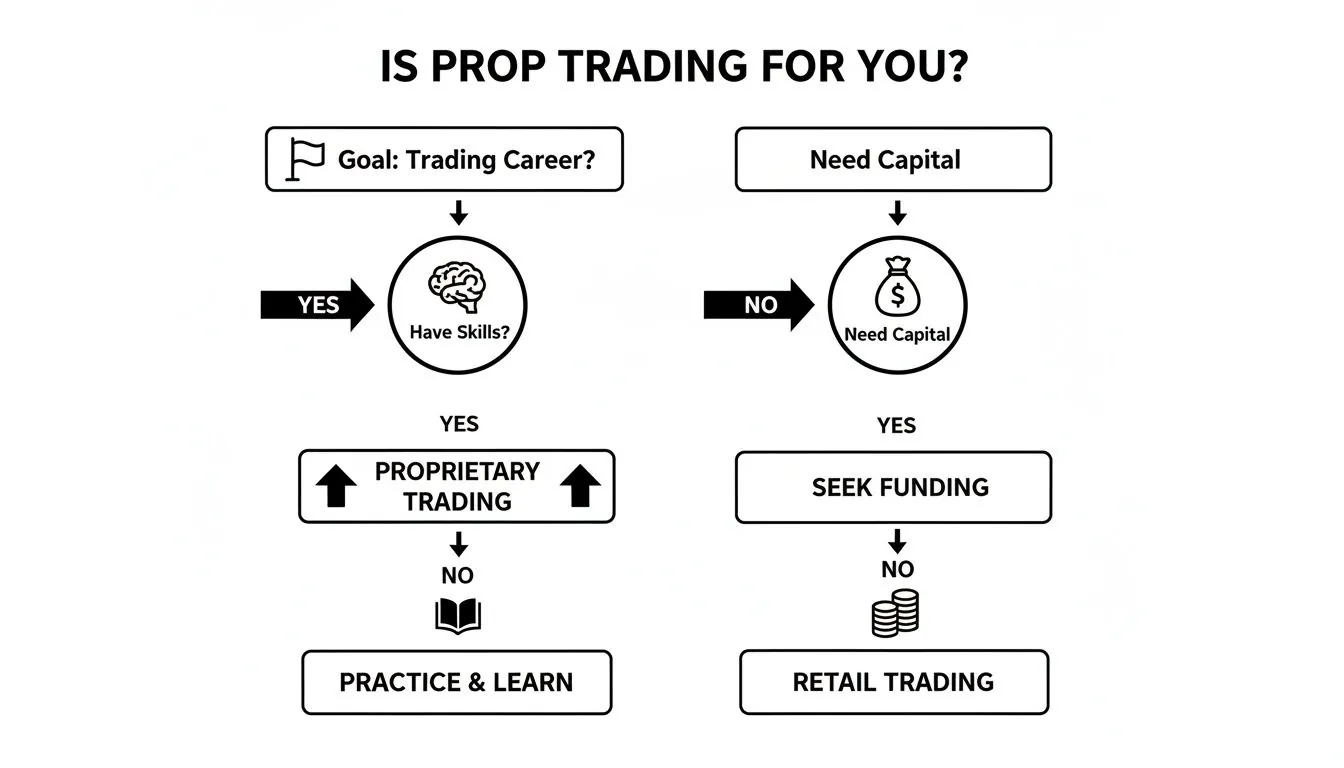
If you have a solid plan but lack capital, a prop firm can be the bridge to achieving your trading ambitions.
1-Step Challenges and Instant Funding: The Fast Track
For traders confident in their strategy, some firms offer a faster path to a funded account.
A 1-Step Challenge condenses the evaluation into a single phase. You still have a profit target (often around 10%) and risk rules, but you get funded as soon as you pass. This is ideal for experienced traders who want to prove their skills once and move on.
Instant Funding lets you bypass the evaluation entirely. You pay a higher upfront fee for immediate access to a funded account. This model is built for consistently profitable traders who know they can manage risk effectively from day one. You can learn more in our detailed guide on prop firm instant funding.
Comparing Prop Firm Funding Models for Beginners
Choosing the right model depends on your confidence, trading style, and risk tolerance. This table breaks down the three main options.
| Funding Model | Best For | Typical Cost | Key Challenge | Pros | Cons |
|---|---|---|---|---|---|
| 2-Step Challenge | Beginners or cautious traders who want a structured, less stressful path to funding. | Lowest | Passing two consecutive phases and maintaining discipline over time. | Lower cost, builds confidence, less pressure per phase. | Slower path to funding, requires passing two evaluations. |
| 1-Step Challenge | Traders who are confident in their strategy and want a faster evaluation process. | Medium | Hitting a significant profit target (e.g., 10%) in a single phase. | Quicker than 2-Step, straightforward goal, lower cost than instant. | Higher pressure than 2-Step, no "confirmation" phase. |
| Instant Funding | Confident, consistently profitable traders who want to start earning immediately. | Highest | Managing risk from day one on a funded account. | No evaluation, immediate access to capital, earn from day one. | Higher upfront fee, often stricter drawdown rules, high pressure. |
Ultimately, a 2-Step challenge offers a great learning experience with less financial risk, while a 1-Step or Instant Funding account gets you into the action faster if you have a proven track record.
The Critical Rules You Must Understand to Succeed
Passing a prop firm challenge is less about hitting the profit target and more about not breaking the risk rules. Too many traders focus on profit and ignore the limits that are designed to measure professional discipline. Think of the drawdown rules as your account's health bars; if either hits zero, it's game over.
Daily Drawdown: Your Daily Risk Budget
The Daily Drawdown is the maximum amount you can lose in a single trading day, typically set between 4% and 5% of your starting balance. This limit resets at a specific time each day.
Practical Example: On a $100,000 challenge with a 5% daily drawdown, your daily loss limit is $5,000. If your account equity (including open and closed positions) drops by more than $5,000 at any point during the day, you have breached the rule, and the challenge ends immediately.
Actionable Advice: Set your personal daily loss limit at half the firm's limit. If the official drawdown is 5%, stop trading for the day if you lose 2.5%. This creates a crucial buffer and prevents emotional, revenge-trading mistakes.
Maximum Drawdown: Your Total Account Shield
The Maximum Drawdown is the total amount your account can fall from its highest point, usually set between 8% and 12%.
Practical Example: On a $100,000 account with a 10% max drawdown, your account equity must never drop below $90,000. It doesn't matter if it's from a single trade or a series of small losses.
It’s also vital to know if the drawdown is "static" (based on your initial balance) or "trailing," which can be trickier. Our guide on what trailing drawdown is explains the difference.
Beyond Drawdown: Other Rules to Watch
Drawdown limits are the most important, but other rules can easily trip you up.
- Minimum Trading Days: Most firms require you to trade on a minimum number of days (e.g., 5 or 10) to prove your strategy is consistent.
- News Trading Restrictions: To avoid extreme volatility, many firms restrict trading around major economic announcements like NFP or FOMC. Always check the firm's calendar.
- Weekend Position Holding: Holding trades over the weekend can expose the account to "gap risk." Some firms forbid this, which is a critical factor for swing traders.
These rules aren't traps; they're a framework to identify traders who can manage risk professionally.
How to Choose the Right Prop Trading Firm
With so many firms available, selecting the right one requires careful research. Your goal is to find a reliable partner that aligns with your trading style and supports your growth. Look beyond flashy account sizes and dig into the details that matter.
Reputation and Transparency
A firm is only as good as its track record of paying traders.
- Check Trustpilot Reviews: Read comments to find consistent themes. Are traders happy with payouts and support, or are there complaints about vague rules and payment issues?
- Read the Fine Print: Legitimate firms have clear, easy-to-understand terms and conditions. If the rules are confusing, that's a red flag. A firm’s history of paying traders on time is the single most important factor.
Platforms and Tradable Assets
The trading platform is your primary tool. While MT4/MT5 are common, newer platforms like cTrader and DXtrade often offer a cleaner interface and more advanced order types. Also, confirm the firm offers the assets you want to trade. Over 40 major prop firms focus heavily on Forex, CFDs, and Crypto.
Rules and Beginner-Friendly Features
The best prop trading firms for beginners offer realistic rules that give you a fair chance to succeed.
- Reasonable Drawdown Limits: A 5% daily and 10% maximum drawdown is a fair industry standard.
- Realistic Profit Targets: An 8-10% target for Phase 1 is challenging but achievable.
- No Hidden Rules: Transparent policies on news trading and holding positions are signs of a good firm. For more details, see our guide on the 7 best prop trading firms for beginners.
Payouts, Support, and Scaling
Think about the end game: getting paid and growing your account.
- Payout Schedules: How often can you withdraw profits? Bi-weekly is standard, but some firms offer weekly or on-demand payouts.
- Customer Support: Look for 24/7 support via live chat or a community platform like Discord.
- Scaling Plans: These plans allow you to increase your account size by hitting consistent profit targets, showing the firm is invested in your long-term success.
Your Action Plan to Pass a Prop Firm Challenge

Passing a challenge isn't about a single brilliant trade; it's about executing a solid plan with discipline. This process begins long before you pay the evaluation fee. A well-prepared trader already knows they can win—the challenge is just the final exam.
Step 1: Pre-Challenge Homework (The Non-Negotiable Part)
Before paying for a challenge, you must prove to yourself that your strategy works within the firm's rules. Use backtesting and forward-testing to gather data and confirm your strategy can generate profit without hitting the drawdown limits.
- Define Your Strategy: Write down the exact entry, exit, and stop-loss rules for your system. For example: "Enter long on a 1H chart when the 20 EMA crosses above the 50 EMA, with RSI above 50. Set stop-loss 20 pips below entry and take-profit at a 2:1 reward/risk ratio."
- Backtest Against the Rules: Go through historical data and "trade" your system. Meticulously track your floating drawdown to ensure you never would have breached the daily or maximum loss limits.
- Forward-Test on a Demo: Trade your strategy on a demo account for at least 30 days. This tests your ability to execute the plan under live market conditions. If your strategy can’t stay within a 5% daily and 10% max drawdown on a demo, it will not pass a real challenge.
Step 2: Navigating the Challenge
Once you have a data-backed strategy, the challenge becomes a test of execution and mental fortitude. Your primary job is to manage risk.
Here’s your daily trading checklist:
- Calculate Max Risk Per Trade: Never risk more than 0.5% to 1% of your starting balance on a single trade. On a $100,000 account, this is a max loss of $500 to $1,000 per trade.
- Set a Personal Daily Stop-Loss: If the firm’s daily limit is 5%, set your personal limit at 2.5%. The moment you hit it, shut down your platform and walk away. No exceptions.
- Wait for A+ Setups Only: You have plenty of time. Do not force trades on mediocre setups. Patience is a profitable virtue.
The psychological pressure is what breaks most traders. You must learn to detach emotionally and treat trading like a business. Frustrated after a loss? Walk away. The market will be there tomorrow. The prop trading industry has grown over 1,200% in the last decade, yet pass rates often struggle to break 10%, proving that psychological discipline is the true differentiator. You can learn more about the growth and realities of prop trading.
Life After the Challenge: Payouts and Scaling
Passing the challenge is a major accomplishment, but it’s just the beginning. Your focus now shifts from passing a test to building a sustainable trading career.
Getting Paid
Once funded, you are typically eligible for your first payout after 14 to 30 days. After that, most firms operate on a bi-weekly payment schedule. Some flexible prop trading firms for beginners, however, offer faster access to profits through weekly withdrawals.
Understanding Scaling Plans
Scaling is how you grow your income long-term. A scaling plan is the firm's way of rewarding consistent traders by increasing their account size.
A common scaling benchmark is to achieve a 10% profit target over a 3-month period with no rule violations. If you succeed, the firm might double your capital from $50,000 to $100,000. Repeating this process allows you to compound your earning potential and reach account sizes of $1 million or more.
Top prop firms pay out significant sums. FTMO generated $323.2 million in revenue in 2024, and one firm recently paid over $177 million to its traders in a single year. These figures highlight what is possible for traders who master the process. You can explore the potential of top prop firms on TradeInformer.com.
Success as a funded trader requires the same discipline that got you through the challenge. Treat your trading as a business, manage risk relentlessly, and execute your strategy with patience.
FAQ: Common Questions About Prop Trading
Are prop firms a legitimate way to make a living?
Yes, for skilled and disciplined traders. It is a performance-based career, not a get-rich-quick scheme. Your income depends entirely on your ability to generate profits while managing risk. Be wary of any firm that promises guaranteed returns.
What happens if I fail a prop firm challenge?
The only financial loss is the one-time evaluation fee you paid. You are not responsible for any trading losses incurred in the simulated account. Many firms offer a discount for a retry, allowing you to learn from your mistakes and try again.
How can I tell if a prop firm is a scam?
Trustworthy firms have a history of paying traders, transparent rules, and a strong reputation on review sites like Trustpilot. Red flags include unrealistic promises of easy money, vague or confusing rules, and no verifiable public presence or payout history.
Which prop firm funding model is best for a beginner?
The 2-Step Challenge is generally the best starting point for beginners. It has the lowest upfront cost, breaks the evaluation into manageable stages, and provides a structured environment to build confidence and test your strategy under real evaluation conditions.
Ready to prove your trading skills in a supportive, transparent environment? MyFundedCapital offers clear rules, flexible programs, and fast payouts to help you turn your strategy into a career. Explore our funding programs and start your journey today.
