The NQ tick value is $5 per contract. NQ moves in 0.25-point increments, so one full index point equals $20 per contract. The smaller MNQ contract is $0.50 per tick and $2 per point. Use these values to calculate profit and loss, position size, and stop-loss risk before entering a trade.
What is the NQ Tick Value?

This guide focuses on the practical application of the NQ tick value—the numbers you'll use every single day in the market. We'll skip abstract financial theory and get straight to what you need to manage your trades, a critical skill whether you're trading your own capital or aiming to pass a prop firm challenge. All trading involves substantial risk of loss and is not suitable for every investor. This content is for educational purposes only and is not financial advice.
The Numbers You Need to Know
First, let's put the core stats in one place. The Nasdaq-100 futures market, managed by the CME Group, offers different contract sizes. The two most common are the E-mini (NQ) and the Micro E-mini (MNQ).
Here’s a quick reference table with the key details.
NQ & MNQ Tick Value Quick Reference
| Contract | Symbol | Tick Size (Price Increment) | Tick Value (USD) |
|---|---|---|---|
| E-mini Nasdaq-100 | NQ | 0.25 Index Points | $5.00 |
| Micro E-mini Nasdaq-100 | MNQ | 0.25 Index Points | $0.50 |
The key takeaway is the relationship between the two. The Micro MNQ contract is precisely 1/10th the size of the standard E-mini NQ. This smaller exposure makes it an excellent starting point for new futures traders or anyone looking to manage risk with more precision.
Once you have a firm grasp of these values, you can start to trade with real intention. Specifically, you'll be able to:
- Calculate your potential profit and loss on a trade before you enter.
- Set a stop-loss based on a specific dollar amount you're willing to risk.
- Choose the right contract (NQ or MNQ) for your account and risk tolerance.
Understanding the NQ tick value is fundamental, because every trade you make hinges on these simple, yet powerful, numbers.
What is a Tick in Futures Trading?
Before calculating the NQ tick value, you have to understand what a "tick" is. Think of it as the smallest possible price jump a futures contract can make, up or down. The price doesn't move smoothly; it jumps from one specific price to the next in these minimum increments set by the exchange.
Tick Size vs. Tick Value
This is where many new traders get tripped up, but the difference is essential for managing your risk.
- Tick Size This is the price increment itself. For both the E-mini NQ and the Micro MNQ, the official tick size is 0.25 index points. When the NQ price moves from 18,000.00 to 18,000.25, that's a one-tick move.
- Tick Value This is the dollar amount your account gains or loses when the price moves by one tick. This cash value is different depending on which contract you're trading.
So, the tick size tells you how far the price moved, while the tick value tells you how much money that move is worth. This is the key to translating chart movements into real dollars, letting you calculate potential profit and loss before you enter a trade. For a deeper look at this concept, our guide on trading the tick is a great resource.
How to Calculate Profit & Loss Using the NQ Tick Value

Let's get into the practical math. Understanding the dollar value of a tick directly translates to your profit, your loss, and how you manage risk on every trade. The good news is the math is simple.
The P/L formula is basic multiplication:
Total P/L = (Number of Ticks Moved) x (Tick Value) x (Number of Contracts)
This calculation is the key to knowing your real-time financial exposure. Let's walk through concrete examples.
Calculating for the E-mini NQ ($5.00/tick)
The E-mini Nasdaq-100 (NQ) is popular due to its liquidity and significant dollar-per-tick value. With a tick size of 0.25 index points being worth $5.00, even minor price fluctuations can lead to substantial P/L swings.
Example 1: A Small Winning Trade
You go long one NQ contract, and the market moves in your favor by 8 ticks.
Calculation: 8 ticks x $5.00/tick = $40 profitExample 2: A Losing Trade with a Stop-Loss
You short one NQ contract, but the trade goes against you by 20 ticks (5 full points) and hits your stop-loss.
Calculation: 20 ticks x $5.00/tick = $100 loss
This direct relationship between ticks and dollars is what makes risk management tangible. For a prop trader, a 10-tick stop-loss puts $50 at risk for every NQ contract held. That number has to fit within your daily drawdown limits. You can find extensive historical data for NQ on sites like FirstRate Data.
Calculating for the Micro MNQ ($0.50/tick)
For traders with smaller accounts or those wanting to scale into positions with more precision, the Micro E-mini (MNQ) is a game-changer. It’s exactly 1/10th the size of the NQ, so its tick value is a more manageable $0.50.
Let's run through the same scenarios with the MNQ:
Example 1: A Small Winning Trade
You buy one MNQ contract, and the price moves up by 8 ticks.
Calculation: 8 ticks x $0.50/tick = $4 profitExample 2: A Losing Trade with a Stop-Loss
You short one MNQ contract, and it moves against you by 20 ticks (5 points).
Calculation: 20 ticks x $0.50/tick = $10 loss
The same price movement results in a profit or loss ten times smaller. This flexibility is critical for smart risk management, especially when trading under the strict rules of a funded account.
Applying the NQ Tick Value for Risk Management
Knowing what an NQ tick is worth is only half the battle. Using that knowledge to protect your trading account is what separates traders who last from those who don't. Trading without a calculated risk plan is a recipe for disaster.
Setting Your Stop-Loss in Dollars, Not Just Points
The first step is deciding the maximum amount of money you are willing to lose on a single trade. This should be a specific, predetermined dollar amount. Once you have that figure, use the NQ tick value to calculate exactly where to place your stop-loss.
The formula is simple:
Stop-Loss in Ticks = Maximum Dollar Risk / Tick Value
Let's use a real-world example. You're trading one E-mini (NQ) contract and your maximum risk for this trade is $100.
- Calculation: $100 (your max risk) / $5.00 (the NQ tick value) = 20 Ticks
Your stop-loss should be placed 20 ticks (or 5 full points) away from your entry price. If you were trading one Micro (MNQ) contract with that same $100 risk, your stop would be much further away, giving the trade more room to breathe: $100 / $0.50 = 200 ticks.
Your Pre-Trade Risk Checklist
Professional traders run through a mental checklist before entering a position. This habit turns trading from a gamble into a series of calculated decisions and is a cornerstone of discipline, a topic we cover in our guide to forex trading risk management.
Here’s a simple checklist to use before every trade:
- Define Your Max Dollar Risk What is the absolute maximum you'll lose (e.g., $100)? Ensure this fits within any prop firm rules, like a daily drawdown limit.
- Choose Your Contract Are you trading NQ or MNQ? The Micro (MNQ) is ideal for smaller accounts or when you need to fine-tune your risk.
- Calculate Stop-Loss in Ticks Based on your dollar risk and contract, how many ticks away does your stop need to be?
- Check Your Position Size How many contracts are you trading? If one NQ with a 20-tick stop is a $100 risk, then two contracts would be a $200 risk. A Position Size Calculator can help with this.
This framework forces you to prioritize capital preservation. By anchoring every decision to the NQ tick value, you prevent one bad trade from wiping out your gains.
Sizing Your Positions Correctly for NQ and MNQ
Your knowledge of risk management becomes real when you choose your position size. This is the critical step where you decide whether the standard E-mini (NQ) or the smaller Micro (MNQ) is the right tool for the job based on your personal risk tolerance.
For example, say your trade idea requires a 10-point stop-loss, and you're only willing to risk $50.
If you trade one standard NQ contract, that 10-point stop puts $200 at risk (10 points x $20/point), which is four times your limit. The correct choice is to use a single MNQ contract, which keeps your risk at exactly $50 (10 points x $5/point).
Matching Contract Size to Your Risk
The beauty of having both NQ and MNQ is flexibility. You can trade the exact same Nasdaq-100 index but with 1/10th the financial exposure. This is a vital skill for succeeding in a prop firm environment with strict daily drawdown rules.
This decision tree helps visualize how to match your contract choice to your risk.
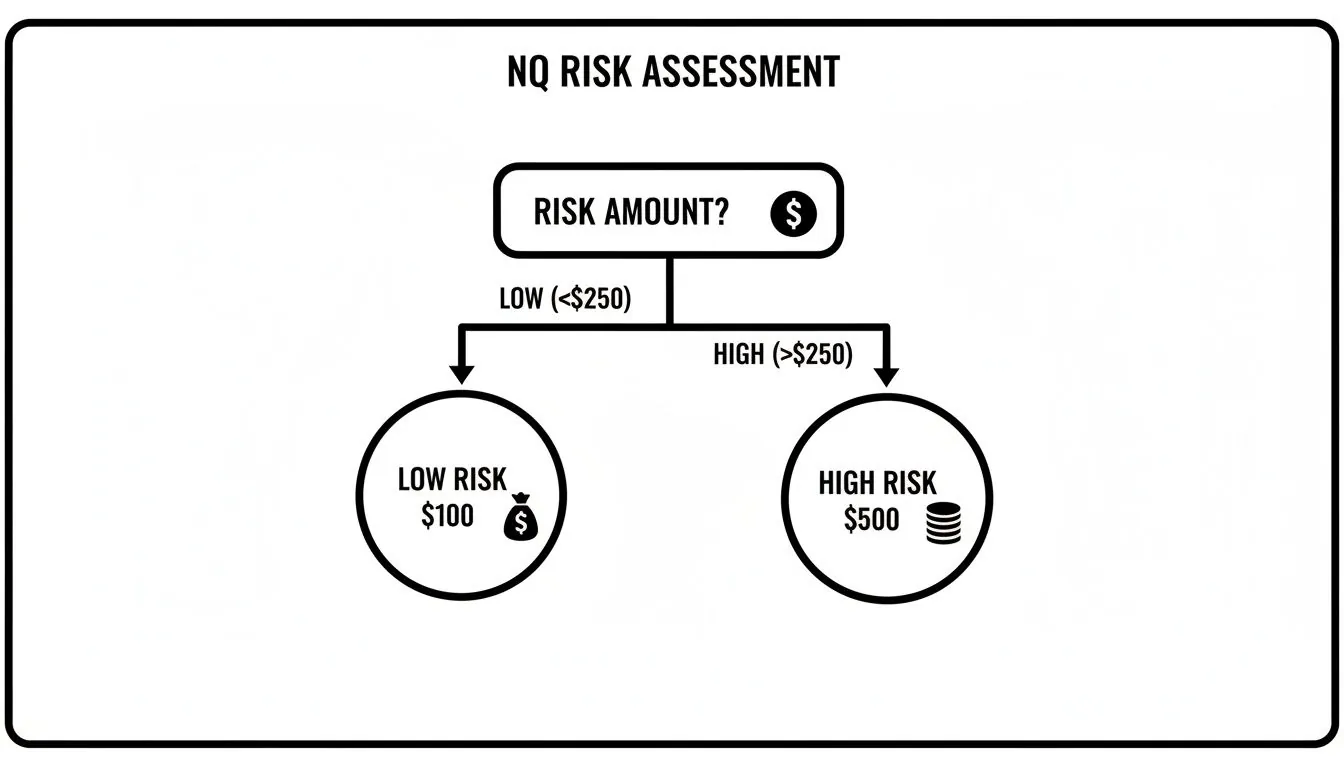
Smaller risk limits naturally point you toward the MNQ. Larger risk tolerances might allow for the bigger NQ contract, but the decision always starts with your predetermined risk. You can play around with different scenarios using a simple lot size calculator.
Why Volume and Liquidity Matter for NQ
The NQ tick value is powerful, but what makes the market truly tradable is its incredible volume, which creates deep liquidity. This means you can get in and out of large positions without the price jumping away from you, a phenomenon known as slippage.
- Tighter Spreads High volume keeps the gap between buy and sell prices narrow, reducing your entry costs.
- Minimal Slippage When you place an order, there's a high probability it will be filled at the price you expect. This is crucial when your stop-loss is only a few ticks away.
- Clean Execution Orders are filled almost instantly. When you need to cut a losing trade immediately to protect your capital, this reliability is non-negotiable.
The CME's E-mini Nasdaq-100 contract regularly trades an average daily volume of over $200 billion. This massive participation, driven by the accessible $5 tick value, creates a statistically rich environment. You can dig into the data on specialized futures information platforms.
FAQ: NQ Tick Value
What's the difference between NQ tick value and point value?
A tick is the smallest price move, while a point is a larger unit.
- Tick Value The NQ's smallest price move is 0.25 points, which is worth $5.00.
- Point Value A full 1.00 point move consists of 4 ticks (4 x 0.25). Therefore, the NQ's point value is $20.00 ($5 per tick x 4 ticks).
How do I choose between NQ and MNQ?
Your choice depends on your account size and risk tolerance.
- NQ (E-mini) With its $5.00 tick value, it's suited for well-capitalized traders comfortable with larger P/L swings.
- MNQ (Micro) The $0.50 tick value makes it perfect for traders with smaller accounts, those testing new strategies, or anyone wanting finer control over risk.
Why is NQ so popular with prop firm traders?
Traders comparing a futures-specific evaluation can use our Topstep funded account review to map NQ position sizing against the current Maximum Loss Limit and payout rules.
NQ is a staple in prop trading for two main reasons. First, its high liquidity and volatility create consistent trading opportunities. Second, the fixed $5 tick value makes risk management straightforward, which is critical when adhering to strict daily drawdown rules.
Does the NQ tick value ever change?
The current tick size and multiplier are standardized by CME for each contract, but exchanges can amend contract specifications. Check the current NQ specifications and MNQ specifications before trading or updating a risk model.
MyFundedCapital offers simulated funded accounts for forex, crypto, and commodities. Available symbols, contract types, and sizing depend on the selected platform and program, so verify them in your trading platform before applying CME NQ calculations. Compare MFC funding programs.