The question, is trading in forex profitable, often arises when the underlying concern is, “Can I do this without blowing up?” That’s the right question. The honest answer is yes, forex can be profitable, but the data shows most retail traders never reach that stage.
If you want the truth, start here: over 80% of retail forex traders lose money, and only about 15% to 30% achieve profitability, according to industry disclosures summarized by Goat Funded Trader’s review of forex profitability data. That statistic should change how you think about the market. Forex is not a shortcut to income. It’s a performance business that punishes sloppy risk, emotional decisions, and undercapitalization.
Answering the Big Question on Forex Profitability
So, is trading in forex profitable?
Yes, but only for traders who operate like risk managers first and traders second. The market offers opportunity, liquidity, and flexibility. What it does not offer is forgiveness for poor execution.
Most beginners approach forex backward. They start with income goals, screenshots, and aggressive position sizing. Professionals start with survival. That difference explains why so many people burn out before they ever build a repeatable edge.
The profitable minority usually doesn’t win because they predict every move. They win because they build a process that can survive losing trades, bad weeks, and changing market conditions. That means controlled position sizing, patience, and a system with positive expectancy over time.
If you’re still unsure whether forex itself is legitimate or just surrounded by bad actors, read this breakdown on forex trading and scam concerns. It helps separate the market from the marketing.
Bottom line: Forex is profitable for a small group of disciplined traders. For everyone else, it becomes an expensive lesson in leverage, psychology, and false expectations.
That may sound harsh. It’s also useful. Once you accept that profitability is rare, you stop chasing excitement and start building competence.
The Unfiltered Truth About Why Most Traders Lose
Losses in forex usually come from repeatable mistakes, not bad luck. The pattern is consistent across broker disclosures and regulator reporting: a large share of retail accounts lose because traders combine weak risk control with unstable decision-making.
Amplified trading power magnifies ordinary mistakes
Forex gives traders access to amplified trading power. That feature attracts undercapitalized traders because it creates the illusion that a small account can produce professional-level income.
Dukascopy’s analysis of forex profitability illustrates the problem clearly. With a 1:500 ratio, a 20-pip adverse move on EUR/USD at 2% account risk erodes $20 from a $1,000 balance. One trade may look manageable. A string of trades sized too aggressively for routine market movement can damage the account before any real edge has time to play out.
That is why many retail traders fail even with decent market ideas. The account structure is too fragile to absorb normal variance.
Psychology breaks traders faster than bad analysis
A meaningful share of losing traders can spot valid setups. Their real problem starts after entry, when stress alters behavior.
Common patterns include:
- FOMO entries Chasing price after the planned entry is gone
- Revenge trading Increasing position size after a loss to recover quickly
- Plan drift Moving stops, delaying exits, or inventing new rules mid-trade
- Overtrading Taking more trades to feel productive rather than selective
These are not random habits. They are predictable responses to pressure, especially when the trader is using too much size relative to account equity. Traders who want to last need a defined process for risk management in forex trading, because technical skill without behavioral control rarely survives live conditions.
A trader can survive a mediocre strategy longer than they can survive undisciplined execution.
Trading costs quietly erase thin edges
Many beginners evaluate performance by asking whether the market moved in their direction. That misses the core question. Did the trade still make sense after spreads, slippage, and holding costs?
A strategy with a narrow edge often looks profitable in screenshots and backtests, then fails in execution. Small frictions matter. If your average win is only slightly larger than your average loss, transaction costs can wipe out the advantage completely.
This is one reason profitability is less about finding more signals and more about protecting a measurable edge. Traders who ignore cost structure often mistake activity for progress.
Operational risk matters too
Many traders initially focus only on market risk. Broker terms, margin disputes, execution quality, and account protections matter just as much once real money is involved. If you ever need context on how these cases can escalate, this guide on NFA arbitration and margin debit defense is a useful reference.
The hard truth is simple. Many retail traders fail because they are undercapitalized, oversized, emotionally reactive, and operating without a repeatable process. That also explains why proprietary trading firms have become a practical alternative for serious traders. They impose rules, expand buying power, and reduce the pressure to force income from a small personal account.
The Core Pillars of a Profitable Trading System
A trading system becomes profitable for the same reason any decision process becomes profitable. It produces a positive expected outcome over a large sample, then survives the inevitable periods when results run below average. That sounds simple. In practice, it is where retail traders break down, because a workable system needs more than an entry signal.
The traders who last usually build around four pillars: expectancy, risk control, psychology, and discipline. Remove one, and the rest stop working.
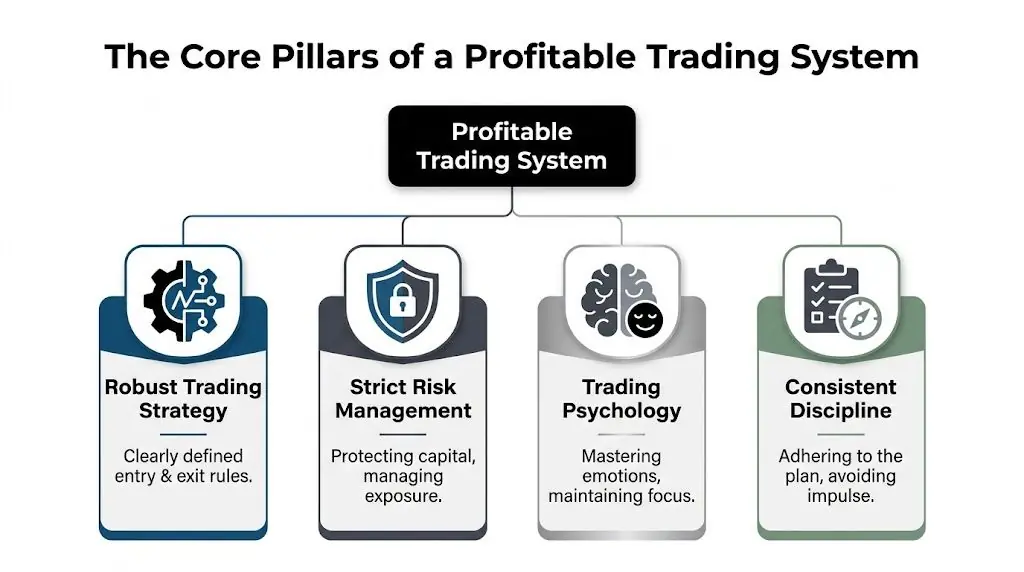
A real edge is expectancy, not a flashy win rate
Win rate gets too much attention because it is easy to market. Expectancy is what pays.
A system can lose on many trades and still make money if average winners are meaningfully larger than average losers and execution stays consistent. The opposite is also true. A trader can win often, feel accurate, and still bleed capital if losses are larger when they do happen.
As noted earlier, profitable traders tend to have one thing in common. They protect downside first, then let the math of repeated execution work in their favor. That is a very different mindset from chasing a high percentage of winning trades.
Risk management is the operating system
Risk management decides whether your edge ever gets enough repetitions to matter. A good idea traded at the wrong size usually fails before its edge has time to show up.
A practical framework looks like this:
- Small risk per trade Keep exposure low enough that one bad decision does not distort your week or your judgment.
- Defined invalidation Place the stop where the trade thesis is proven wrong, not where the loss merely feels uncomfortable.
- Position sizing after the stop Set the trade size only after you know where the setup fails.
- Drawdown response Reduce exposure during weak periods instead of trying to win losses back quickly.
For a practical framework you can apply in real conditions, study this guide to risk management in forex trading.
One honest test works well. If the size of a normal loss changes your mood, your risk is still too high.
Psychology is system design, not motivation
Psychology problems rarely begin with emotion alone. They usually begin with vague rules.
A trader who has no written setup will improvise. A trader who improvises cannot review performance cleanly. Without review, there is no way to separate a bad trade from a valid trade that lost.
That is why professional behavior looks repetitive. It usually includes a written setup definition, a pre-trade checklist, a post-trade journal, and a cooldown rule after a streak of losses. Those habits reduce decision fatigue and make errors visible before they become expensive patterns.
This matters even more for undercapitalized traders. When every trade feels tied to rent, status, or self-worth, psychology deteriorates fast. One reason prop firms appeal to serious traders is structural. Rules, loss limits, and access to more capital can reduce the pressure that pushes retail traders into revenge trading and oversized decisions.
Discipline turns an edge into actual returns
Discipline is execution quality over time. It is following a valid process when the last three trades lost and when the last three trades won.
That principle extends beyond forex and sits inside the broader fundamental principles of finance, where capital preservation, risk-adjusted returns, and process quality matter more than dramatic short-term outcomes.
The non-obvious point is this. A profitable system does not need to feel exciting. It needs to be repeatable, measurable, and boring enough that you can follow it for hundreds of trades. That is how traders move from random outcomes to something that can scale.
Realistic Profit Benchmarks for Different Traders
Social media has done serious damage to expectations in forex. It made people think professionalism looks like huge monthly gains. In real trading, professionalism usually looks boring.
According to Quadcode’s analysis of forex profitability, experienced forex traders achieve realistic returns of 5% to 25% annually or 3% to 10% monthly, with top performers reaching 10% to 25% yearly through disciplined strategies. The same source notes that institutional traders consistently deliver 8% to 15% annual returns, while disciplined traders often target 0.2% to 1% daily, and beginners may see 1% to 3% monthly during the learning phase.
Realistic Forex Profit Benchmarks by Trader Profile 2026
| Trader Profile | Experience Level | Realistic Monthly Return | Realistic Annual Return |
|---|---|---|---|
| Beginner trader | First year | 1% to 3% | Qualitatively modest while learning |
| Developing retail trader | Building consistency | 3% to 10% | 5% to 25% |
| Top-performing retail trader | Experienced | Qualitatively within disciplined monthly ranges | 10% to 25% |
| Institutional trader | Professional | Qualitatively steady and controlled | 8% to 15% |
What the numbers really tell you
The first lesson is that consistency beats intensity. Monthly performance that looks modest on paper can become powerful when it’s repeatable and protected from deep drawdowns.
The second lesson is more important. If a trader claims returns far beyond these ranges as normal, your first question shouldn’t be “how?” It should be “what risk did they take to get there?”
- Beginners should care more about rule-following than percentage returns.
- Intermediate traders should focus on stable execution and lower drawdown.
- Advanced traders usually improve not by trading more, but by filtering harder.
The market doesn’t pay extra for effort. It pays for disciplined execution of a real edge.
That’s why the smartest benchmark isn’t “How much did I make this month?” It’s “Did I trade well enough that I’d trust this process with more capital?”
Actionable Steps to Improve Your Trading Odds
You don’t improve in forex by consuming more content. You improve by tightening your process until bad habits have fewer places to hide.
Build one strategy and test it properly
Most struggling traders switch methods too fast. They lose three trades, declare the system broken, then start over. That resets the learning curve every time.
Pick one market condition and one setup type. Define:
- Entry trigger What exact event gets you in
- Stop placement Where the trade is wrong
- Target logic How you take profit
- No-trade conditions When you stay out
Then backtest it. Not casually. Log screenshots, outcomes, notes, and whether the setup followed your rules. The point isn’t to find perfection. The point is to find whether the idea has enough edge to deserve live attention.
Use a pre-trade checklist
A checklist reduces emotional trading because it forces you to slow down before risk goes on.
A practical pre-trade checklist might include:
- Market context Is the pair trending, ranging, or reacting to a key level?
- Setup quality Is this one of your A-grade patterns?
- Risk amount Does the position fit your plan?
- Invalidation point Do you know exactly where the idea fails?
- Emotional state Are you calm, rushed, or trying to recover?
If you can’t answer those questions clearly, skip the trade.
Forward-test in a realistic environment
Backtesting tells you whether a concept had merit in past data. Forward-testing tells you whether you can execute it in real time.
That second part matters more than most traders admit. A strategy can look excellent on historical charts and still fail because you hesitate, chase, or break rules under live conditions.
Treat your demo period like a professional evaluation:
- Trade only your documented setup
- Keep the same risk model every session
- Review every loss for execution errors
- Track whether you followed the plan, not just the result
Journal behavior, not just profit
A lot of journals are just spreadsheets of wins and losses. That misses the deeper problem. You need to know why you made or lost money.
Write down things like:
- What you saw before entry
- What you felt during the trade
- Whether you changed the plan
- Whether the trade fit your rules
- What you’d repeat or avoid next time
This creates accountability. It also shows whether your problem is strategy quality or self-control.
Good journals expose patterns you won’t notice in memory alone.
Build external structure
Trading alone makes it easier to rationalize weak habits. Structure helps. That can come from a trading buddy, a review routine, or a serious community where execution gets discussed more than hype.
The traders who improve fastest usually make their process visible in some way. Not for applause. For feedback and accountability.
The Prop Firm Advantage How to Scale Profitability
A lot of traders don’t fail because they lack skill. They fail because they’re trying to produce meaningful income from too little capital while carrying too much emotional pressure.
That combination ruins decision-making. When every trade feels like rent money, patience disappears.
Undercapitalization distorts behavior
A trader with a small personal account often feels forced into one of two bad choices:
- Take tiny gains that don’t change income at all
- Take oversized risk to make the account “worth it”
That’s why skilled traders often hit a ceiling trading only their own funds. Even solid execution doesn’t translate into meaningful cash flow unless capital is large enough.
The prop model changes the equation.
The math becomes practical with funded capital
According to Daily Price Action’s discussion of forex income potential, a 3% monthly return on a $100K funded account yields $3K profit, and at a 90/10 split that leaves $2,700 net income for the trader. The same source notes that scaling to larger funded capital creates a more realistic path to $10K+ monthly income for consistently profitable traders.
That single example explains why the question isn’t just “Can you trade profitably?” It’s also “Can you trade profitably on enough capital for the result to matter?”
If a trader can produce steady returns with discipline, funded capital solves two major problems:
- Amplified income potential without risking large personal savings
- A structure that rewards process, not reckless aggression
Why the prop environment can improve discipline
A good prop evaluation does more than offer buying power. It imposes boundaries. That matters because many retail traders perform better when hard limits force them to respect risk.
Clear loss parameters can reduce the worst retail habits:
- No endless averaging down
- No emotional doubling after losses
- No pretending a bad trade is now a swing trade
- No confusing survival with progress
For many traders, that external framework is the missing piece. They don’t need another strategy. They need a structure that punishes impulsive behavior fast enough to stop it from becoming normal.
Who should consider the prop route
A funded route makes the most sense if you can already do the following:
- Follow a written strategy
- Keep risk controlled across a series of trades
- Accept that consistency matters more than excitement
- Treat evaluation as a skills test, not a lottery ticket
If that sounds like your approach, compare what funded capital can change through funded forex trading accounts.
The edge of a prop firm isn’t magic capital. It’s the amplification of an already disciplined process. Without the process, more capital just creates bigger mistakes. With the process, scaling becomes realistic.
Frequently Asked Questions About Forex Profitability
Can beginners make money in forex
Yes, but beginners usually shouldn’t expect fast or stable income. Early progress often comes from learning to protect capital, follow a plan, and avoid large mistakes. Profit can come later. Survival comes first.
Is trading in forex profitable without leverage
It can be, but returns on small personal accounts may feel too slow to matter. That’s one reason many traders adopt aggressive strategies. They’re trying to force income from limited capital. The smarter path is usually to build consistency first, then scale responsibly.
How long does it take to become consistently profitable
There’s no fixed timeline. Some traders improve quickly because they focus on one setup, one risk model, and one review process. Others stay stuck for years because they keep changing strategies, overtrading, and skipping journaling. Consistency usually arrives when behavior stabilizes, not when a trader finds a “secret” indicator.
Do profitable traders win most of their trades
Not necessarily. Many profitable traders don’t rely on a huge win rate. They rely on controlling losses, letting strong trades pay, and keeping expectancy positive over a large sample. That’s why a trader can be right less often than expected and still grow an account.
Your Path Toward Consistent Trading in 2026
So, is trading in forex profitable? Yes. But only when you treat it like a profession built on process, not prediction.
The useful conclusion isn’t that forex is easy for the talented. It’s that profitability tends to emerge when a trader solves three problems at once: risk control, behavioral discipline, and access to enough capital for skill to matter. Traders often focus on charts and ignore the other two. That’s why they stay stuck.
If you want to move into the profitable minority, stop asking how much you can make next month. Start asking whether your method is repeatable, whether your risk is survivable, and whether your current capital structure supports long-term growth.
Trading involves risk of loss. Nothing here is a promise of income, and this article is educational only, not financial advice.
If you’re ready to apply a structured approach, compare the funding options at MyFundedCapital. Review the challenge models, account types, and risk parameters, then choose the path that fits your trading style and experience.