ES
ES
 DE
DE
 FR
FR
 AR
AR
 IT
IT
 NL
NL
 PL
PL
 SV
SV

Wondering if forex trading is a legitimate market or just a sophisticated scam? The truth is, the market itself is real, but it's surrounded by fraudulent schemes designed to steal your money. This guide will show you how to tell the difference, spot common scams, and find a legitimate path to trading.
The Real Forex Market vs. The Scams
The forex market is the largest, most liquid financial market in the world, where banks, corporations, and governments exchange currencies. It's not a scam. The problem lies with unregulated brokers, fake gurus, and other predators who exploit the market's complexity to lure in hopeful traders.
This guide provides a clear map to navigate the industry safely. We’ll show you the warning signs of a scam and the characteristics of a legitimate trading opportunity so you can operate with confidence.
At its core, legitimate forex trading is about speculating on currency movements using analysis and disciplined strategy. It is a high-risk activity that requires skill, and there are no guarantees of profit. Any platform or person promising guaranteed returns is a major red flag.
The Sheer Scale of the Market
The forex market’s daily trading volume exceeds $7.5 trillion, making it a pillar of the global financial system. Its immense size, however, also makes it a magnet for scammers. These predators create noise with impossible claims, such as "guaranteed 98% daily win rates," to trick newcomers. Always remember that forex trading involves a substantial risk of loss and is not a "get rich quick" scheme.
Before you start, you must also confirm the legal framework in your country. For example, traders often ask, Is Forex Trading Legal in South Africa? Answering this question is a critical first step.
To help you distinguish between a real opportunity and a scam, use this comparison table.
| Characteristic | Legitimate Forex Opportunity | Common Forex Scam |
|---|---|---|
| Regulation | Regulated by top-tier authorities (FCA, ASIC, CySEC). | Unregulated or licensed in weak offshore jurisdictions. |
| Promises | Focuses on risk management, education, and realistic potential. | Guarantees high, consistent profits with little to no risk. |
| Transparency | Clear information on fees, spreads, and execution policies. | Vague or hidden fees; pressure tactics to deposit more funds. |
| Withdrawals | Smooth and timely processing of withdrawal requests. | Delays, excuses, or outright refusal to process withdrawals. |
Understanding these distinctions is your first line of defense. A legitimate operation provides tools and education, while a scam just wants your deposit.
This content is for educational purposes only and does not constitute financial advice. Trading involves significant risk of loss.
Common Forex Scams and How to Spot Them

While the forex market is legitimate, a cottage industry of sophisticated scams surrounds it. These predators are experts at exploiting the hope and inexperience of new traders. The good news is that their methods fall into predictable categories. Once you learn the red flags, the question "is forex trading a scam?" becomes much easier to answer.
Unregulated Brokers and Impossible Bonuses
One of the most common scams involves unregulated brokers. These firms operate from jurisdictions with weak financial oversight, leaving you with no protection.
Their primary bait is the "too good to be true" bonus. They might offer a 100% deposit match, but the fine print contains impossible withdrawal conditions.
- Example: You deposit $1,000 and get a $1,000 bonus. To withdraw any funds, you must trade an unrealistic volume, like 100 standard lots ($10,000,000). This effectively traps your initial deposit.
The Rise of Social Media Gurus and Signal Sellers
Social media is the perfect hunting ground for the modern scammer: the self-proclaimed trading "guru." They flaunt a lavish lifestyle—rented Lamborghinis, private jets—and sell you their "secret" via a signal service.
Here’s how the signal seller scam typically works:
- Cherry-Picked History They only show winning trades, often from demo accounts, to create an illusion of infallibility. Losses are never mentioned.
- Vague Signals Alerts like "Get ready to Buy EUR/USD" are intentionally ambiguous. If the trade fails, they blame your execution, not their poor signal.
- Hidden Affiliate Deals Many gurus earn commissions by forcing you to sign up with a specific, usually unregulated, broker. They profit whether you win or lose.
Actionable Tip: If someone had a system that truly guaranteed a 95% win rate, they wouldn't sell it for $49 a month on Instagram. They would be managing a multi-billion-dollar fund.
High-Yield Investment Programs (HYIPs) and Ponzi Schemes
A particularly nasty scam is the High-Yield Investment Program (HYIP). These are simply Ponzi schemes disguised with forex terminology, promising high, passive returns like "10% profit per week" with no effort on your part.
The playbook is always the same:
- The Hook An unbelievable promise of risk-free returns.
- The Illusion Early investors receive "payouts," which are just funds from new victims. This creates social proof and attracts more money.
- The Exit Once enough funds are collected, the operators disappear, the website goes dark, and all the money is gone. The infamous EminiFX case is a recent example where thousands lost millions. You can find more details about these evolving threats from Chainalysis.
You can learn more about the evolution of these forex scams from DailyForex. Recognizing these core patterns is your best defense.
Your Due Diligence Checklist for Safe Trading
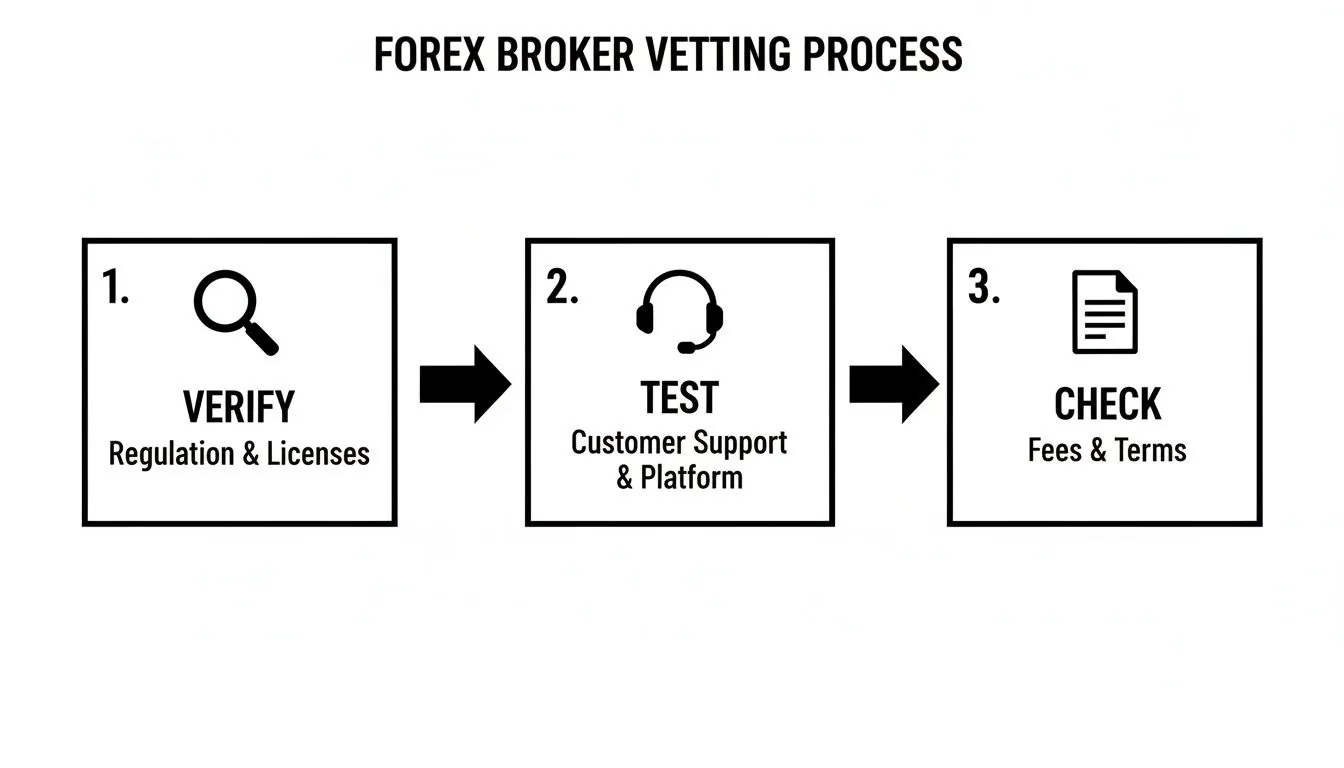
To avoid scams, you must act like a diligent investigator, not a hopeful target. Scammers bet on you skipping your homework. Use this checklist as your standard operating procedure before sending money to any broker or service.
Step 1: Verify the Regulatory License
This is the most critical step. Legitimate brokers are regulated by serious financial authorities.
Here’s a concrete process to verify a broker's license:
- Find the License Number A regulated broker displays their license number and regulator's name in their website footer. If it's hard to find, that's a red flag.
- Go to the Official Regulator's Website Open a new browser tab and search directly for the regulator (e.g., "FCA register," "ASIC professional register"). Do not use links from the broker's site.
- Search the Official Register Use the regulator's search tool to enter the license number or firm name. Verify that the company name and, most importantly, the website URL on the official register match the broker you are vetting. Scammers often create "clone firms" with similar names.
Step 2: Dig Into Reviews and Reputation
Online reviews offer valuable insights if you know how to read them.
- Look for Realistic Feedback A flood of perfect 5-star reviews is suspicious. A healthy mix of positive and negative feedback is more authentic.
- Focus on Negative Reviews Pay close attention to complaints about withdrawals. Are there patterns of delays, excuses, or surprise fees? This is a massive red flag.
- Check Multiple Sources Cross-reference reviews on sites like Trustpilot with discussions on forums like Reddit to get a more balanced view.
Step 3: Confirm How They Protect Your Funds
A legitimate broker must hold client funds in segregated accounts. This means your money is kept separate from the company's operational funds and is protected if the brokerage goes bankrupt.
- Actionable Step: Ask their support team directly: "Are client funds held in segregated accounts?" A trustworthy broker will give a clear "yes" and can point to their regulatory obligations.
Mastering personal risk management is crucial, and our practical guide to risk management in forex trading can help. But it all starts with choosing a secure and legitimate partner.
Finding a Legitimate Path with Prop Trading
For skilled traders, proprietary (prop) trading offers a legitimate path to scale their efforts without risking personal savings. Prop firms provide capital to traders who can prove their ability to manage risk and generate profit consistently.
This model is the opposite of a scam. Instead of luring you with false promises, it requires you to pass a skills-based evaluation. It aligns the firm's interests with yours: they only make money if you, the trader, are profitable.
How Legitimate Prop Firms Work
Legitimate prop firms use a transparent evaluation process, often called a "challenge." You pay a one-time fee for an evaluation account and must meet specific trading objectives while adhering to strict risk rules.
- The Process Pass the evaluation by hitting a profit target without exceeding drawdown limits.
- The Reward If you succeed, you are given a "funded account" to trade the firm's capital. You keep a large share of the profits, typically 80% or more.
The key difference is focus. Scams are obsessed with getting your deposit. Legitimate prop firms are obsessed with your performance. Their business model relies on finding and funding profitable traders.
This skill-based system provides a clear answer to the "is forex a scam?" question by offering a structured, merit-based path. Learn more about what proprietary trading firms are and how they work.
A Transparent, Rule-Based Environment
Most modern prop firms operate using simulated or demo accounts for both the evaluation and funded stages. You trade with virtual funds in an environment that mirrors the live market. This is a risk management strategy for the firm, allowing them to copy your trades with their capital without giving direct market access to thousands of traders. When you earn a profit in the simulation, the firm pays your profit split from its own funds.
A good firm is completely transparent about its rules:
- Profit Targets A specific percentage gain required to pass (e.g., 8-10%).
- Maximum Loss Limits A hard cap on total drawdown, often around 10%.
- Daily Loss Limits A safety net to prevent one bad day from ending your challenge, typically 5%.
- Profit Splits Your share of the profits, starting around 80%.
These rules are not designed to make you fail; they enforce the discipline required for professional trading.
How to Vet a Prop Firm
Just like with brokers, you must vet prop firms carefully. Shady operators exist to collect challenge fees from traders set up to fail.
- Check the Rules Are the profit targets (e.g., 8%) and drawdown limits (e.g., 5% daily/10% max) realistic and in line with industry standards? Overly tight rules are a red flag.
- Verify Payouts Look for authentic payout proof from traders on platforms like Discord and Trustpilot. A healthy community will have real discussions, including both praise and complaints. Our guide on how to find honest prop firm reviews can help you spot fakes.
- Test Support Send their support team a few specific questions. Quick, clear answers are a good sign. Vague, slow responses are not. A professional firm uses standard platforms like DXtrade or cTrader and has a responsive support team because they succeed only when you do.
FAQ: Forex Trading Scams
Is it really possible to get rich from forex trading?
While it is technically possible, it's extremely unlikely and the wrong goal to have. Framing it as a way to "get rich" leads to excessive risk-taking and falling for scams. Successful trading is a demanding profession that requires skill, discipline, and robust risk management. It is not a lottery ticket.
Are all forex signal services a scam?
The vast majority are. Any service guaranteeing profits or boasting a near-perfect win rate is almost certainly a scam. Legitimate analysis services provide trade ideas with clear logic and risk parameters, but they will always emphasize that the final decision and risk are yours alone. Be extremely skeptical of anyone selling signals, especially on social media.
If I get scammed in forex, can I get my money back?
Getting your money back is incredibly difficult and often impossible, especially if the scam operation is unregulated and based offshore. Your best strategy is prevention through diligent research. If you are scammed, immediately contact your bank to dispute the transaction, report the firm to financial regulators, and file a police report. This article on what to do after being scammed offers further steps.
Is prop firm trading just another type of scam?
No, a legitimate prop firm is the opposite of a scam. Its business model is based on finding and funding skilled traders, as the firm only profits when its traders do. The evaluation process and strict risk rules are designed to identify traders with professional discipline. A scam wants your fee and sets you up to fail; a prop firm wants a long-term profitable partner.
Ready to prove your trading skills in a fair and transparent environment? MyFundedCapital provides the structure, capital, and support you need to become a funded trader.
Compare our funding programs and start your challenge today.