Understanding the term "pip" is crucial for any forex trader, as it's the basic unit for measuring price changes, profits, and losses. This guide breaks down exactly what a pip is, how to calculate its value, and why it's a critical concept for managing your trades. You'll learn the practical steps to use pips to define risk, set targets, and build a solid trading plan.
Free resources: Forex & Prop Trading Glossary (drawdown, breach, lot, pip and the rest in plain words).
What is a Pip in Forex?
A pip stands for 'percentage in point' and is the smallest standardized price move a currency pair can make. It's the universal unit of measurement in the forex market.
For most currency pairs, a pip is the fourth decimal place (0.0001). For pairs involving the Japanese Yen (JPY), it is the second decimal place (0.01).
For example, if the EUR/USD price moves from 1.1050 to 1.1051, that is a one-pip increase. While it seems like a tiny change, these small movements are how traders measure performance and calculate profit or loss. Trading involves risk, and every pip movement directly impacts your account balance.
Why Pips are Essential for Every Trader
Understanding pips is not optional; it's fundamental to trading. It's the language used to calculate risk and reward, making it a core part of any trading strategy.
- Quantify Your Risk You can set a stop-loss order based on a specific number of pips you are willing to risk, which provides a clear and objective limit.
- Define Profit Targets A take-profit level set at a specific pip count gives you a concrete goal for exiting a winning trade.
- Measure Performance Pips provide a standard way to analyze your trading strategy's effectiveness over time, independent of your position size.
Mastering this concept is critical, especially for new traders. For a broader overview of forex basics, our guide on how to trade forex for beginners is a useful resource.
Pips vs. Pipettes: Understanding the Difference
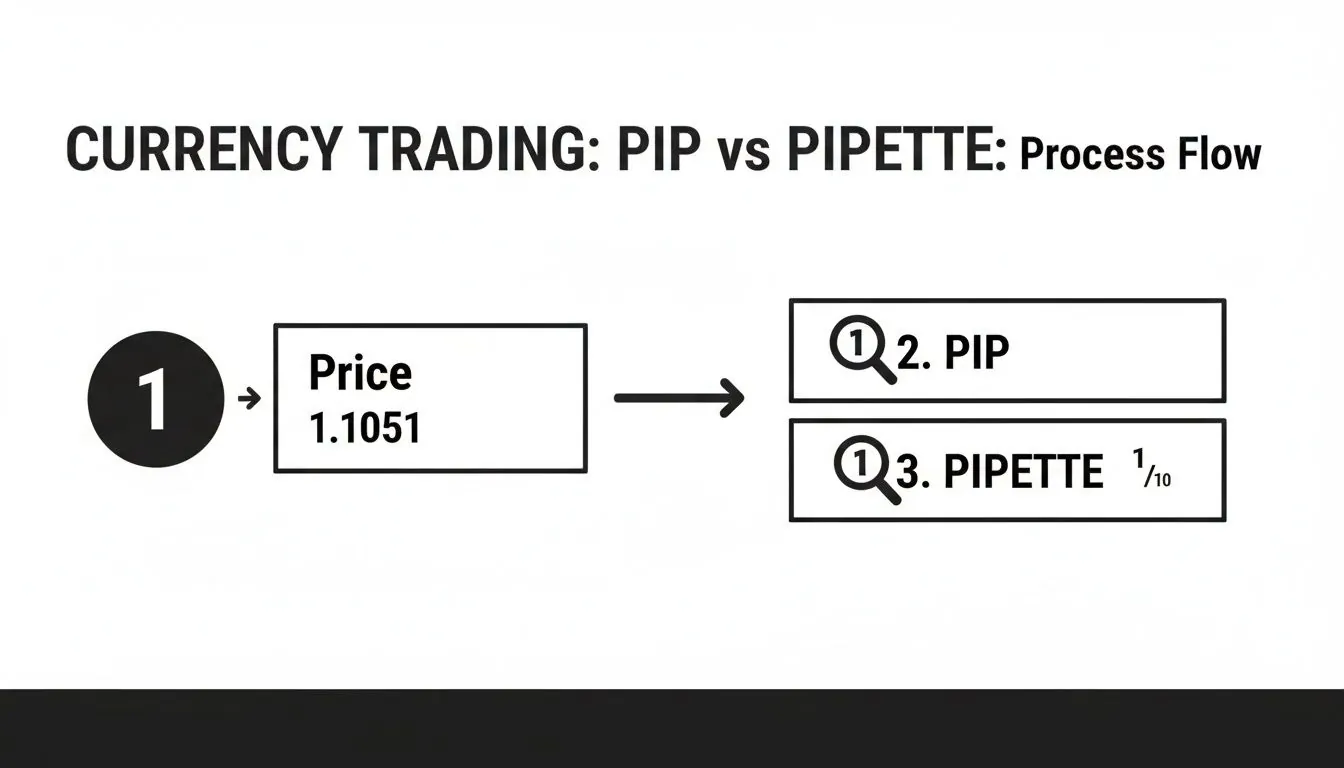
When you look at a trading platform, you might see an extra digit in the price quote. For instance, EUR/USD might be quoted as 1.10512 instead of 1.1051.
That fifth digit is a pipette, also known as a "fractional pip." A pipette is one-tenth of a pip. Brokers introduced them to offer tighter spreads and a more precise view of price movements.
Pip vs. Pipette at a Glance
The easiest way to differentiate them is by their decimal placement.
| Term | For Most Pairs (e.g., EUR/USD) | For JPY Pairs (e.g., USD/JPY) | Represents |
|---|---|---|---|
| Pip | 0.0001 | 121.01 | Standard unit |
| Pipette | 0.00011 | 121.011 | 1/10th of a pip |
A common mistake for beginners is confusing pipettes for pips, which can lead to significant miscalculations of profit and loss. For example, a price move from 1.10510 to 1.10512 is a move of two pipettes, or 0.2 pips—not two pips. Correctly reading your platform is essential for effective risk management.
How to Calculate the Value of a Pip
Knowing what a pip is represents only half the battle. The next crucial step is understanding what a pip is worth in actual currency. The monetary value of a pip is not fixed; it depends on the currency pair you're trading, your position size (lot size), and the current exchange rate. This calculation is essential for proper risk management.
The Formulas for Calculating Pip Value
For some pairs, the math is simple. When the US Dollar is the quote currency (the second currency in the pair), like in EUR/USD or GBP/USD, the pip value is fixed based on your trade size.
- Standard Lot (100,000 units) 1 pip = $10
- Mini Lot (10,000 units) 1 pip = $1
- Micro Lot (1,000 units) 1 pip = $0.10
For other pairs where the USD is the base currency (e.g., USD/JPY) or in cross-pairs without the USD (e.g., GBP/AUD), you need a formula:
Pip Value = (Lot Size x Pip Size) / Exchange Rate
For instance, if you trade 1 standard lot (100,000 units) of USD/JPY when the exchange rate is 150.00, the calculation is: (100,000 x 0.01) / 150.00 = $6.67 per pip.
Calculating this manually for every trade is inefficient and prone to error. Most traders use tools to ensure accuracy. Our free Lot Size Calculator can help you determine the correct values instantly.
Connecting Pips to Your Profit and Loss
Understanding how pip movements translate into profit or loss is where theory becomes practice. The financial impact of a pip's move is determined by your lot size, which acts as a multiplier for your trades.
A 20-pip move can have vastly different outcomes depending on your position size:
- On a Micro Lot (1,000 units of EUR/USD) 20 pips ≈ $2
- On a Mini Lot (10,000 units of EUR/USD) 20 pips ≈ $20
- On a Standard Lot (100,000 units of EUR/USD) 20 pips ≈ $200
The market moved the same distance in each case, but the position size dictated the financial result. This demonstrates the core of risk management: deciding how much capital to expose to any given price move. Remember that trading involves risk, and larger position sizes amplify both potential gains and losses.
Pips are the fundamental unit in the $7.5 trillion-per-day forex market. While EUR/USD might have a 92-pip average daily range, a more volatile pair like GBP/JPY can move over 150 pips, offering different risk profiles. You can learn more about the economic impact of pips in forex for a broader perspective.
A pip is just a number until you assign it a monetary value with your lot size. The relationship between pips, pip value, and lot size is the foundation of a sustainable trading strategy. For a more detailed breakdown, review our guide on calculating profit and loss in forex.
How Pips Are Critical for Prop Trading Challenges
For traders aiming to get funded through a proprietary trading firm, understanding pips is not just educational—it's essential for survival. Prop firm rules, such as daily loss limits and maximum drawdown, are directly tied to the pip movements in your account. Managing your trades in terms of pips is the only way to stay within these strict limits.
Pips and Prop Firm Rules in Action
Let's use a practical example. Imagine you are trading a $100,000 challenge account with a 5% daily loss limit ($5,000) and a 10% maximum drawdown ($10,000).
You open a trade on EUR/USD with a 1.0 standard lot, where each pip is worth $10. If the trade moves against you by 50 pips, you are now at a -$500 unrealized loss. This single trade has consumed 10% of your daily loss limit. A few such trades could quickly lead to a rule violation and failure of the challenge.
Success in a prop firm challenge requires you to be a risk manager first and a trader second. Your ability to translate the firm's rules into a concrete pip-based risk for each trade is the most critical skill for getting funded. This content is educational only and not financial advice.
Building Trades Around Pip-Based Rules
A professional approach involves starting with risk parameters and building your trade around them. Before entering a trade, ask: "How many pips can I risk on this trade while staying well within my drawdown limits?"
- Define Your Pip Risk First On a $100,000 account, you might decide to risk no more than $500 (0.5% of the account) per trade. If you're trading EUR/USD with a standard lot ($10/pip), this forces your stop-loss to be no wider than 50 pips.
- Set Pip-Based Profit Targets With a 50-pip stop-loss, you can set clear profit targets. Aiming for a 2:1 reward-to-risk ratio means your take-profit should be at least 100 pips from your entry. This ensures your winning trades are meaningful enough to progress toward the profit target.
Thinking in pips helps you build a professional risk management framework that respects prop firm rules, protects your account, and systematically works toward your funding goal.
FAQ: Common Questions About Pips
Here are answers to some frequently asked questions about pips in forex trading.
1. Does a pip always have the same value?
No. The monetary value of a pip is dynamic and changes based on three factors: the currency pair being traded, the current exchange rate, and your position size (lot size). For example, a one-pip move on EUR/USD has a different dollar value than a one-pip move on USD/JPY. Always calculate the pip value before entering a trade.
2. How many pips should I target per day?
There is no single answer to this. A scalper might aim for 5–10 pips multiple times a day, while a swing trader might hold a position for several days to capture a 100+ pip move. Your target should align with your trading strategy, risk tolerance, and the market's current volatility. Focus on consistent execution and maintaining a positive risk-to-reward ratio rather than a fixed daily pip count.
3. Are pips used for trading gold or indices?
The concept is similar, but the terminology is different. When trading commodities like Gold (XAU/USD) or indices like the S&P 500, traders usually refer to price movements in terms of points and ticks. A point often refers to a $1 price change, but the principle of calculating profit and loss based on small price increments remains the same.
Ready to apply your knowledge of pips in a real trading environment? MyFundedCapital offers a platform to test your skills and prove your strategy.
Explore our funded account programs and take the first step toward becoming a funded trader.