The number of trading days in a month typically ranges from 19 to 23, with an average of 21. For a trader, especially in a prop firm, understanding this number isn't trivia. It's a core part of risk management.
A lot of newer traders still plan around calendar months as if every day gives them a chance to execute. It doesn't. Your real month is the number of sessions your market is open, and that changes how you set profit expectations, manage drawdown, and decide when to push and when to stay flat.
The Core Number Why 21 Trading Days Is the Benchmark
You start the month thinking you have plenty of time. Then two red days hit early, one session disappears to a holiday, and the pressure changes fast. In prop trading, that shift is not psychological fluff. It affects how aggressively you press, how much room you have under drawdown rules, and whether your payout plan still makes sense by week three.
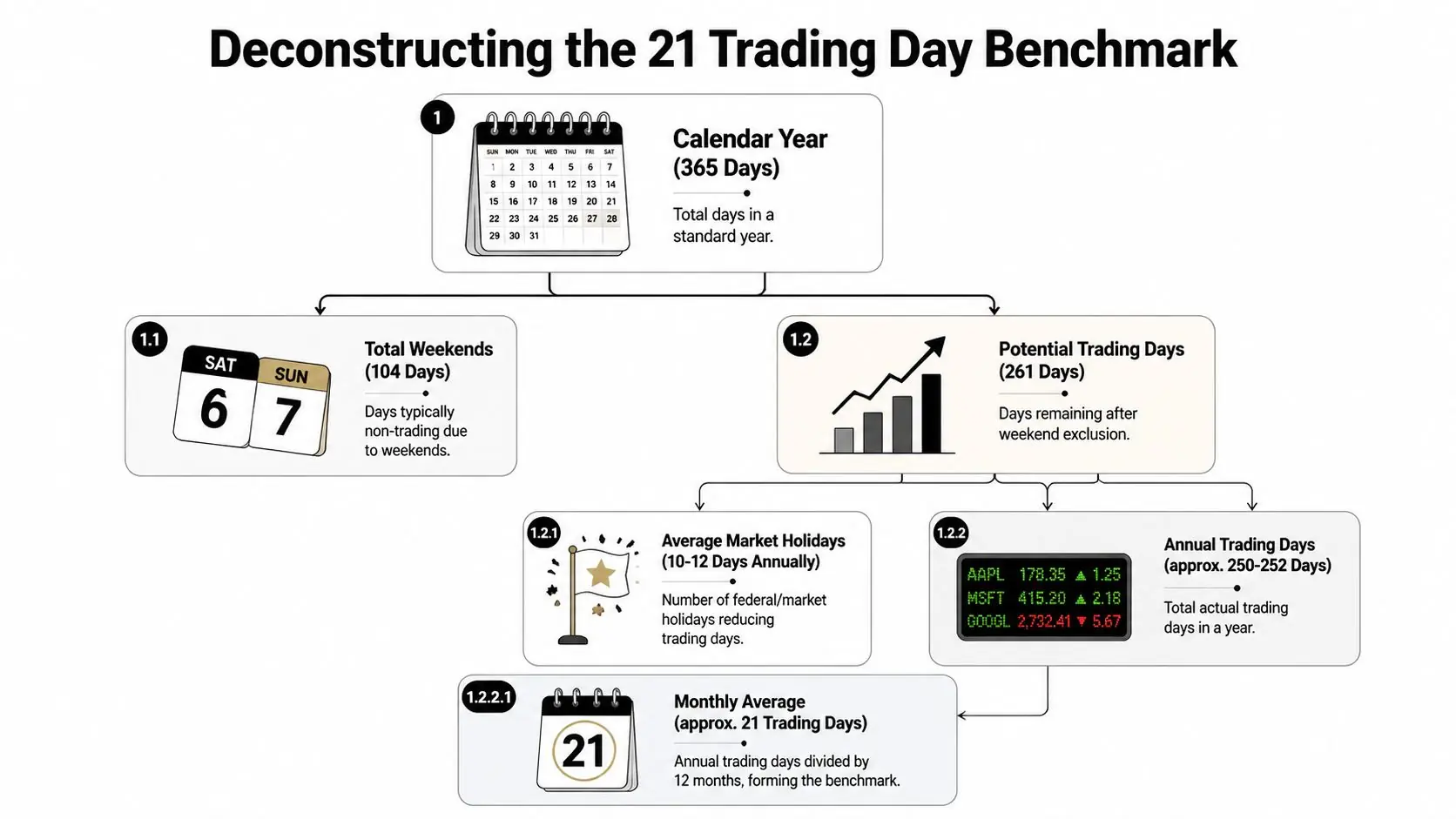
The benchmark of 21 trading days comes from the annual market structure. U.S. markets generally open Monday through Friday, then close for weekends and scheduled exchange holidays. Using that framework, the Wikipedia trading day reference lists 251 trading days per year as a common benchmark, which works out to roughly 20 to 22 trading days per month. That is why 21 becomes the number traders plan around.
Start with annual session count, not the calendar month
New funded traders often budget time off a 30- or 31-day calendar. That creates bad assumptions. The market only offers a limited number of sessions, and your account is judged on what happens during those open windows.
A simple way to frame it:
- Calendar days include weekends and closed holidays.
- Trading days are the sessions where you can execute, manage risk, and make progress.
- Monthly planning works better when it starts from the expected session count, not the date range.
That distinction is important because prop firm performance is path-dependent. If your month has about 21 sessions, every mistake consumes a larger share of your opportunity set than many traders realize.
Why 21 matters more in a prop account
In a personal account, a short month is inconvenient. In a funded account, it can change your whole plan.
At MyFundedCapital, traders are not managing only for returns. They are also managing for rule compliance, consistency, and payout timing. If you have around 21 sessions, that number shapes how you break down a profit target, how many full-risk attempts you can justify, and how quickly a bad start can put you in defensive mode.
A practical example helps. A trader trying to hit a target over 21 sessions has more room to stay selective than a trader facing a 19-session month with the same rules. Fewer sessions usually mean one of two trade-offs. Either risk per trade goes up, which increases the chance of hitting drawdown limits, or patience has to go up, which means accepting that some months will not support aggressive pacing.
That is the part many newer traders miss.
Use 21 as a baseline, then adjust
The number is a benchmark, not a promise. Some months run lighter. Some give you a little more room. The edge comes from treating 21 as your default planning unit and adjusting once you know the actual session count.
In practice, that changes how professionals structure the month:
- Daily risk gets framed against available sessions, not against a vague monthly goal.
- Recovery plans stay realistic, because there may be fewer chances to earn back an early drawdown than the calendar suggests.
- Profit pacing improves, especially for funded traders trying to balance target progress with rule preservation.
- Payout expectations stay grounded, since a compressed month can slow progress even when execution is solid.
The benchmark matters because it sets the baseline for expectation management. If the coming month has fewer than 21 sessions, the margin for error is smaller. If it has more, you have more room to wait for clean setups instead of forcing action just to stay on pace.
2026 trading days by month (NYSE and Nasdaq)
US stock exchanges are open on 251 days in 2026. Months range from 19 to 22 trading days; the holidays below are full-day closures.
| Month | Weekdays | Exchange holidays | Trading days |
|---|---|---|---|
| January | 22 | New Year’s Day (Jan 1), Martin Luther King Jr. Day (Jan 19) | 20 |
| February | 20 | Presidents’ Day (Feb 16) | 19 |
| March | 22 | None | 22 |
| April | 22 | Good Friday (Apr 3) | 21 |
| May | 21 | Memorial Day (May 25) | 20 |
| June | 22 | Juneteenth (Jun 19) | 21 |
| July | 23 | Independence Day, observed (Jul 3) | 22 |
| August | 21 | None | 21 |
| September | 22 | Labor Day (Sep 7) | 21 |
| October | 22 | None | 22 |
| November | 21 | Thanksgiving (Nov 26) | 20 |
| December | 23 | Christmas Day (Dec 25) | 22 |
| Total | 261 | 10 | 251 |
Early closes (such as the day after Thanksgiving) still count as trading days. Futures and forex follow their own calendars, so check the venue’s holiday schedule before you plan around a specific date.
How to Calculate Trading Days for Any Month in 2026
A funded trader who starts the month without an exact session count is trading with the wrong denominator.
Monthly targets, daily loss tolerance, and payout timing all sit on top of one simple input: how many real opportunities the market gives you. At MyFundedCapital, that count affects how aggressively you press, how quickly you recover from a slow start, and whether your pacing is realistic or forced.
The calculation itself is straightforward. What matters is doing it before the month begins, then building the month around it.
Use this three-step method
Start with the total number of calendar days in the month
Every month gives you a fixed starting number.Remove Saturdays and Sundays
For equities and other standard weekday market schedules, those are not tradable sessions.Remove exchange holidays for the market you trade
One closure can tighten the month more than newer traders expect.
Sample calculation for April 2026
| Metric | Calculation | Result |
|---|---|---|
| Total calendar days | April has 30 days | 30 |
| Weekend days | 8 weekend days removed | 22 |
| Market holidays | 1 holiday removed | 21 |
| Final trading days | 30 minus 8 minus 1 | 21 trading days |
April 2026 is a clean example. Thirty calendar days. Eight weekend days removed. One market holiday removed. That leaves 21 trading days.
That number is not trivia. It is your operating window.
If your account has a fixed profit target, 21 sessions tells you how much pace you need without guessing. If your first week goes poorly, it also tells you how many sessions remain to recover without forcing lower-quality trades.
How to turn the count into a usable plan
A lot of traders stop after they get the final number. That is where bad pacing starts.
Use the monthly count to structure decisions that matter:
- Mark your high-opportunity sessions Flag major data releases, earnings clusters, or sessions you already know fit your setup.
- Mark lower-quality periods Holiday weeks, shortened sessions, and thin reopenings often need a different playbook.
- Set pace by session count Build your target path around trading days, not calendar weeks.
- Review in blocks A five-session review cycle usually gives a cleaner read on execution than random day-by-day reactions.
For forex traders, session timing matters just as much as raw session count. If part of your month starts with the Sunday open, map that against your plan using MFC's guide to when forex opens on Sunday.
If you realize halfway through the month that you only had a limited number of quality sessions to work with, the problem was not the calendar. The problem was planning.
A simple monthly checklist
Run this before every new month:
- Check the right market calendar Use the exchange or market schedule that matches what you trade.
- Count the weekends Month structure changes more than traders assume.
- Mark every full holiday closure Missing sessions change pacing and risk decisions.
- Adjust your target path A shorter month gives you less room to recover from mistakes or dead days.
- Match the count to your prop rules Profit targets and drawdown limits do not relax just because the month is compressed.
Hitting a fixed target makes this calculation even more critical. A shorter month means you need more profit per available session, or you need to accept a slower path and protect the account.
That is the trade-off. Traders who know the session count can stay selective and still stay on pace. Traders who ignore it usually feel pressure by the second week, then start taking trades that do not belong in the plan.
Market Holidays and Their Impact on Your Trading Month
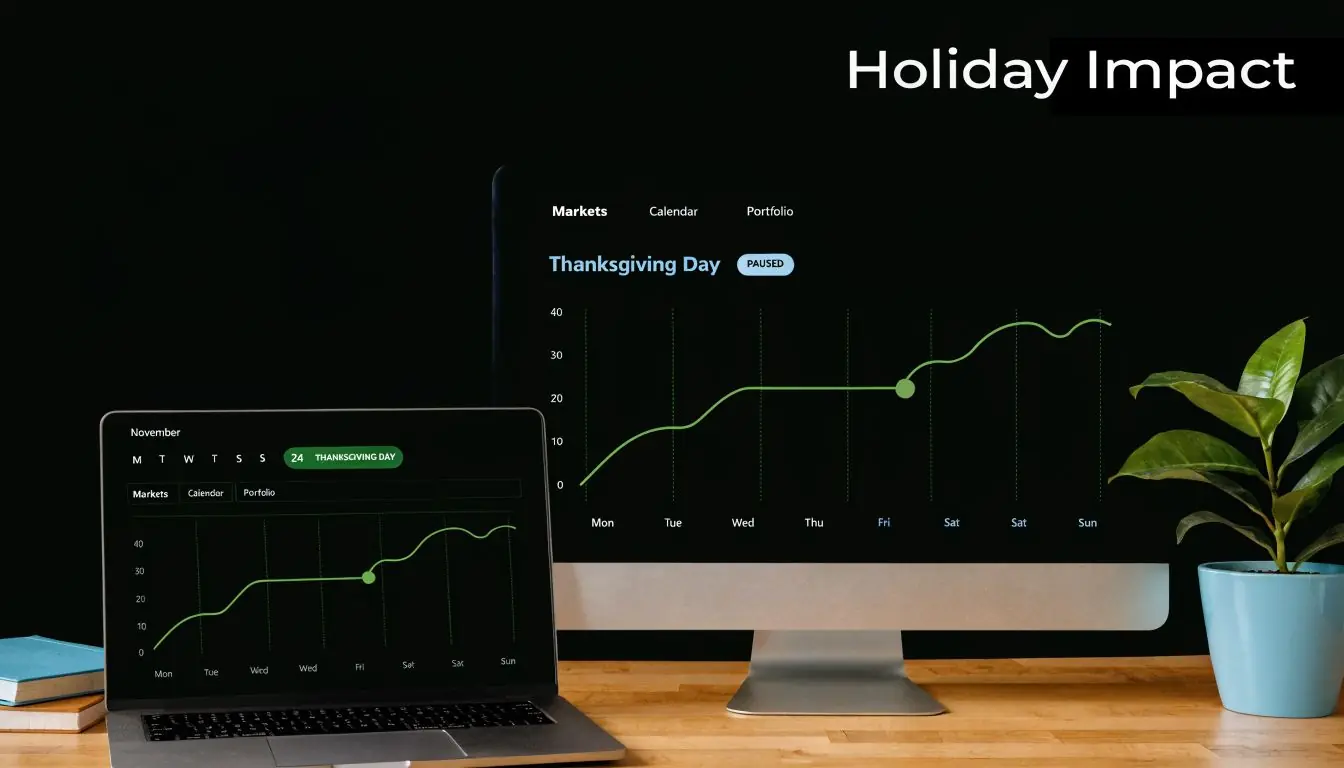
Holidays don't just remove sessions. They change the character of the sessions around them.
That's where many traders get caught. They know the market is closed on the holiday itself, but they don't adapt to the thinner conditions before it, or to the odd behavior that can show up when the market reopens.
Short months create pressure
In major global financial markets, monthly trading day counts usually fall between 19 and 23, and holiday-heavy months like December often land around 19 to 20, while months like March or August can reach 22 to 23, according to Funded Futures Network's market calendar overview.
That difference matters because a shorter month changes trader behavior. When there are fewer sessions, traders tend to force pace. They chase moves they would normally ignore. They widen standards for entry because they feel they're running out of time.
What holidays change besides the count
Holiday periods often bring a different trading environment:
- Liquidity can thin out Fewer active participants can make price movement less reliable.
- Execution can worsen A setup that looks clean on the chart may fill poorly.
- Patience gets tested Traders often feel pressure to "make the month happen" before the holiday break.
- Post-holiday opens can behave differently The market may need time to rebuild normal participation.
This matters across instruments, but it matters even more if you're trading sessions that overlap with global flows. If you trade FX around the weekly reopen, it's worth knowing what time forex opens on Sunday because holiday timing and weekend gaps can change how useful that opening window really is.
Holiday weeks are usually a bad time to demand perfect market behavior from imperfect market conditions.
What works and what doesn't
What works
- Reduce expectations in compressed weeks If the market gives less, trade less.
- Focus on your best setup only Holiday noise punishes average ideas.
- Accept that some weeks are defensive Capital preservation can be the right goal.
What doesn't
- Trying to make up for fewer sessions by trading more size
- Treating low-participation sessions like normal sessions
- Forcing a monthly result before a holiday closure
Traders often think the danger is the holiday itself. Usually it isn't. The danger is the decision-making that happens when a trader knows the month is getting shorter and starts trading from urgency instead of process.
Trading Days Across Equities Forex and Crypto Markets
Not every market gives you the same type of trading month. If you trade more than one asset class, the phrase how many trading days in a month doesn't mean exactly the same thing in each one.
The session count still matters, but the way opportunity appears is different in equities, forex, and crypto. If you don't adjust for that, you'll compare performance across markets in a misleading way.
Equities are the cleanest to count
U.S. equities are the most straightforward. The market has defined open days, defined hours, and known holiday closures. That makes the monthly session count easy to track and useful for planning.
For stock traders, the count is strict. If the exchange is closed, there is no regular session. That clarity is helpful for pacing, but it also means a short month is a short month.
Forex gives more continuity, but not infinite opportunity
Forex is commonly treated as a Monday to Friday market on a global schedule. In practice, the monthly benchmark still sits around the same weekday structure traders use for planning, even though some regions allow limited Sunday access.
That doesn't mean every hour is equally tradable. A forex trader may technically have access, but the quality of the session still depends on participation, overlap, and news flow. Session access and session quality are not the same thing.
Crypto is always open, but that doesn't settle the question
Crypto trades 24/7, so at first glance it looks like the trading-day count doesn't matter. In practice, it still does if you're managing risk around structured routines, payout cycles, or strategy windows.
The Coincodex discussion of trading day trends notes an emerging shift in 2025 to 2026, where crypto ETF approvals started aligning some crypto volume more closely with traditional equity market hours. That doesn't make crypto an equity market. It does mean some traders aren't getting the same edge from weekend action that they once assumed.
If you trade BTC and want a live market reference during planning, CoinStats for Bitcoin investors is a practical tool for checking price context and market behavior across the week.
The practical comparison
| Market | Typical operating rhythm | What matters most |
|---|---|---|
| Equities | Fixed weekday sessions | Exact exchange calendar |
| Forex | Weekday global flow with limited Sunday access in some regions | Session quality and overlap |
| Crypto | Continuous market access | Liquidity pattern and timing discipline |
If you're trading multiple asset classes from one platform, you also need to know what instruments are available to you. A market list like funded trader markets helps you separate the idea of "market access" from "good trading conditions."
A market being open doesn't mean your strategy should be active.
That's the distinction. Equities teach discipline through closures. Forex teaches discipline through sessions. Crypto teaches discipline through the absence of forced stops. Each one can punish a trader who mistakes availability for opportunity.
How Trading Days Affect Your Prop Firm Strategy at MFC
At this stage, the calendar ceases to be academic.
In a prop environment, you aren't just trying to find good trades. You're operating inside hard risk limits. The number of available sessions changes how much pressure each session carries, how quickly mistakes compound, and how aggressively you should pursue a target.
The biggest mistake is using calendar days
A common error is budgeting risk as if every month has 30 usable days. It doesn't.
For prop trading risk management under a 5% daily loss limit, treating the month as 30 calendar days instead of a real trading-month average can inflate the perceived drawdown buffer by over 30%, according to this TradingView discussion on trading-day-based risk planning. The same source notes that experienced traders often benchmark around 20.67 days per month for position sizing.
That matters because false time abundance creates bad behavior. Traders take a hit, assume they have plenty of sessions left, and start pressing before conditions justify it.
Short months raise the cost of every mistake
A shorter month gives you fewer attempts. That's obvious on paper, but many traders don't feel it until they're in drawdown.
Here is how that usually plays out:
- One bad day weighs more heavily You have fewer sessions to recover.
- Patience gets harder to maintain Traders start hunting setups instead of waiting for them.
- The daily loss cap becomes more psychologically restrictive Not because the rule changed, but because each session feels more important.
- Profit targets feel closer and farther at the same time Closer because the deadline feels real, farther because there are fewer clean opportunities.
What disciplined traders do differently
Strong prop traders adapt their process to the session count instead of trying to overpower it.
They usually do some version of this:
Set a monthly pace using tradable sessions
They don't divide goals by calendar days.Reduce unnecessary exposure in compressed periods
They know a short month doesn't reward frequency.Protect mental capital after a red day
In a tighter month, revenge trading is even more destructive.Review progress by session blocks
They measure performance after a set number of active market days, not random dates.
If you want an outside view of how active trading communities discuss performance and consistency, Paultradingeducation channel data is useful for observing engagement patterns around trading education content without relying on hype.
Execution rule: When the month is shorter, your standards should get tighter, not looser.
Profit targets and payout planning
A fixed target feels very different in a short month than in a fuller one. The problem isn't only arithmetic. It's behavioral pressure.
When traders know they have fewer sessions, they often:
- add lower-quality setups,
- hold trades longer than planned,
- increase size after a slow start,
- or trade out of schedule to "catch up."
That's usually what breaks accounts, not the calendar itself.
A better approach is to treat the month as a capacity problem. Ask:
- How many sessions are likely to be high quality?
- Which days are likely to be poor conditions?
- How much risk can I deploy without needing a recovery spiral?
- What result would count as a solid month if conditions stay mixed?
If you're comparing evaluation routes and want to see how different structures may fit your style, reviewing a prop firm's challenge models is more useful than obsessing over headline targets alone.
The main point is simple. In prop trading, session count shapes decision quality. Traders who respect that usually stay alive long enough to let their edge work. Traders who ignore it often end up fighting the clock, the rules, and their own emotions at the same time.
Trading involves risk of loss. A precise calendar won't make you profitable, but a sloppy one can absolutely make a decent trader perform badly.
Frequently Asked Questions About Trading Days
Does a shorter trading month mean I should trade more aggressively?
Usually no. A shorter month means each session matters more, which is exactly why aggression often backfires. In compressed months, tighter selectivity is usually better than higher frequency.
Is the average the same for forex as for stocks?
The planning benchmark is similar because traders still work around weekday market structure. But forex behaves differently because access can extend around the weekly open in some regions, and session quality matters as much as session count.
Do early closes count the same as full trading days?
They count as open market days, but they shouldn't always be treated like full-opportunity sessions in your plan. If liquidity is thinner or participation is unusual, many traders reduce expectations or avoid forcing trades.
Should crypto traders even care how many trading days are in a month?
Yes, if they're trading with structured risk limits, performance reviews, or prop-style routines. Crypto may be open all the time, but a trader still needs a framework for pacing, review, and exposure control.
If you're ready to apply this kind of session-based risk planning in a funded environment, explore MyFundedCapital to compare challenge models, account types, and trading conditions. Trading involves risk of loss, and this article is for educational purposes only, not financial advice.