ES
ES
 DE
DE
 FR
FR
 AR
AR
 IT
IT
 NL
NL
 PL
PL
 SV
SV

You're up on the day, then one more trade turns against you and the platform flags a breach before you can recover. That's how traders lose funded accounts despite having a workable strategy. This guide explains the math behind the daily loss limit, how floating P&L, equity calculations, and rollover timing create hidden risks, and how to build a personal stop that protects both capital and decision-making.
Free tool: see how much room is left before your daily and maximum loss limits with our drawdown calculator.
Why the Daily Loss Limit Catches Traders Off Guard
A trader starts the morning well, banks $400, and sees one final setup before the session ends. A sudden price spike pushes the open position deep into loss. The account's equity crosses the firm's threshold for a moment, and the account is terminated, even though the trader expected to close the position before the damage became permanent.
That failure usually doesn't come from a lack of market knowledge. It comes from treating the daily loss limit as a simple end-of-day calculation. Many professional traders use limits around 3% to 5% of account value, while some risk guides recommend a tighter 1% to 2% ceiling to reduce the risk of ruin, as outlined in this risk-management guide on daily loss limits. In prop trading, the rule is often enforced in real time, not after the closing bell.
The traps traders miss
The dangerous details are usually buried in the calculation method:
- Floating losses may count An open trade can reduce equity before you close it.
- Balance and equity differ Your balance reflects realized results, while equity includes current open P&L.
- The reset follows server time Your local session may not match the firm's trading day.
- Costs can matter Commissions, swaps, and slippage may contribute to the loss calculation.
- A temporary dip can be enough Recovery later in the session may not undo a breach.
A firm's rules page, such as the MyFundedCapital challenge rules, should be read as an operating manual, not as legal fine print. This guide treats the daily loss limit as a survival constraint. You'll learn how it differs from maximum drawdown, how the breach math works, and how to stop yourself before the firm's hard limit stops you.
What a Daily Loss Limit Actually Means
A daily loss limit is a session-level control that caps how much capital can be lost before trading stops for the day. The firm normally compares your current equity with the equity or balance established at the daily reset, then checks whether the permitted loss has been exceeded at any point.
The exact rule varies by firm. Some use a percentage of the initial account balance, while others calculate the threshold from the previous day's balance or equity. Some measure closed P&L only, but prop-style systems commonly include floating P&L and trading costs. You need the firm's definition before placing a trade.
The basic calculation
Take a $100,000 account with a 5% daily loss limit. The calculation is:
$100,000 × 5% = $5,000
The trader must not allow the account's measured equity to fall more than $5,000 below the applicable starting reference for that trading day. If equity reaches the breach point, the account may be suspended or terminated according to the firm's policy.
“Starting equity” means more than the closed balance. If you hold an open position at the reset, the account may begin the new session with the balance plus that position's unrealized P&L. That opening figure becomes important because a losing overnight position can reduce the room available for fresh risk.
The reset may occur at a defined server time, such as 00:00 UTC, or at a firm-specific time such as 5 PM EST. Don't assume that midnight on your wall clock starts a new risk day. The platform's server clock controls the calculation.
For a $50,000 account with a 4% limit, the math is:
$50,000 × 4% = $2,000
The limit applies to the worst measured point during the day, not merely to the result visible at the close. If the account reaches $5,001 below its reference on the $100,000 example, it can breach even if the position later recovers and the account finishes the session in profit.
Daily loss limit by account size
| Account Size | Daily Loss % | Max Daily Loss ($) |
|---|---|---|
| $50,000 | 4% | $2,000 |
| $100,000 | 5% | $5,000 |
The figures in the table are arithmetic examples based on the percentages shown. They aren't universal prop-firm terms. Always confirm whether the firm uses balance, equity, a static reference, or a trailing reference.
Practical rule: Calculate the dollar limit before trading, then leave room for spread changes, commissions, swaps, and adverse movement. The official cap should never be your intended risk budget.
Hidden Mechanics That Trigger Unexpected Breaches
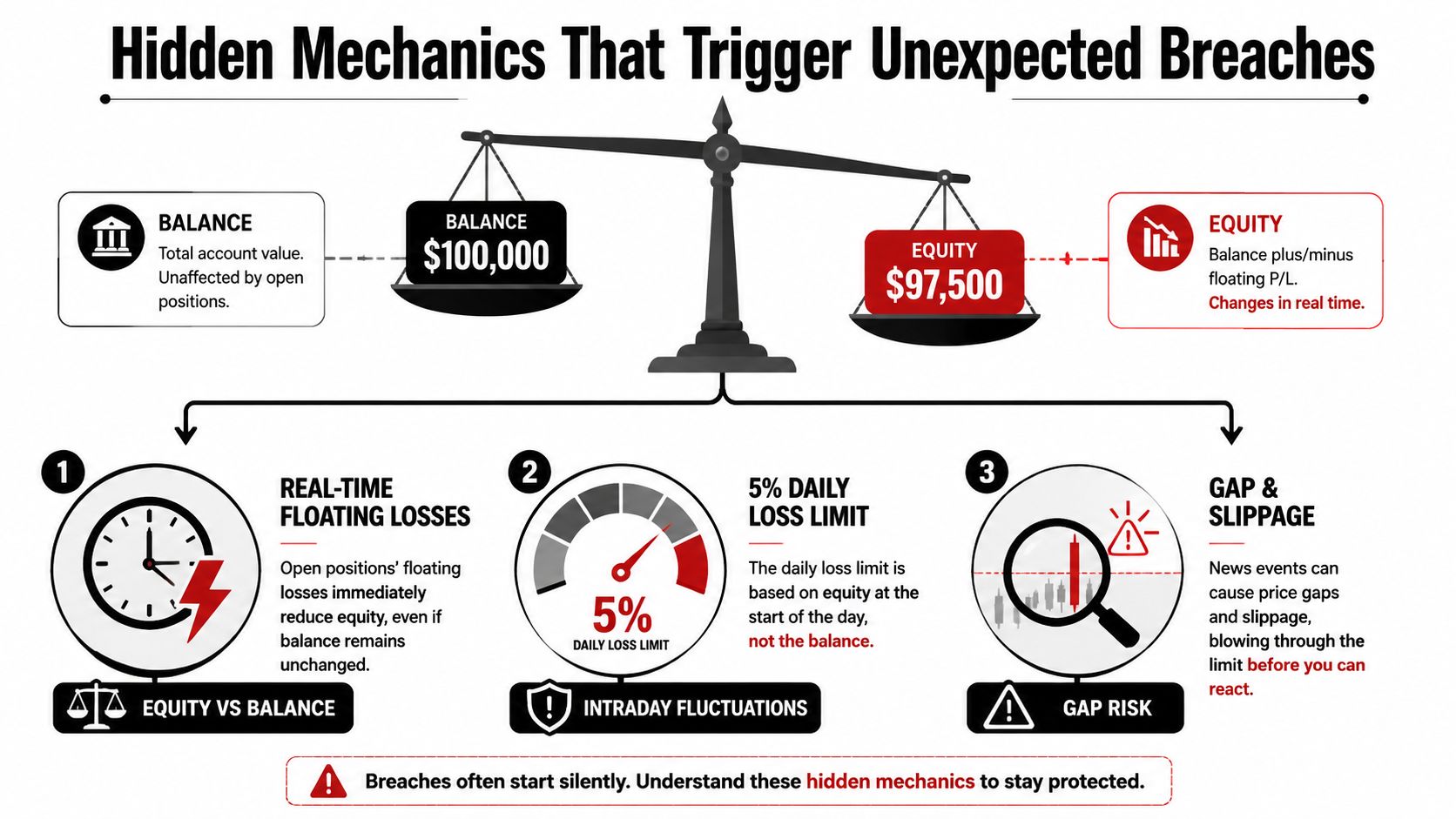
Most surprise breaches come from three mechanics working together. The trader watches the balance, the firm watches equity, and the platform applies the rule according to a server clock that may not match the trader's routine.
Equity versus balance
Balance changes when trades close. Equity changes continuously as open positions move. If a $100,000 account has a $5,000 daily limit and an open position shows a $3,000 floating loss, the trader may already have consumed most of the session's allowance even though the balance has not changed.
That distinction becomes dangerous during volatile periods. A position can cross the threshold briefly, trigger the risk system, and then reverse. Closing the trade later doesn't necessarily erase the earlier breach. The system may record the worst equity point rather than the final result.
The same calculation can also include realized losses, commissions, swaps, and slippage. A trader who plans only from the stop-loss distance may underestimate the actual account impact.
The rollover trap
Suppose the daily reference is $100,000 and the limit is $5,000. A position is still open at reset with a $2,000 floating loss. If the firm uses equity at reset, the new session may effectively begin around $98,000 rather than $100,000.
The headline limit remains $5,000, but the trader's room before reaching the broader floor is already reduced by the open loss. Relative to the original account reference, only $3,000 of new adverse movement may remain before the combined effect reaches $5,000.
This is why overnight positions need separate treatment. A trade that looked manageable before rollover can become a large part of the next session's risk budget as soon as the server resets.
Timing mismatches
A trade opened at 4:55 PM EST may belong to a different risk day from the one shown on the trader's local clock if the firm resets at another server time. That matters when the position is already losing as the reset occurs. The loss may become part of the new day's starting condition, or the platform may assign the trade's P&L according to its own session logic.
Read the firm's reset definition and convert it to your local time. Then record the time in your trading plan. A desk that ignores rollover timing is effectively trading with an unknown risk limit.
Before each session, check:
- Reference value Is the limit based on balance, equity, or initial capital?
- Open exposure Are floating gains and losses included?
- Reset time Which timezone controls the change of day?
- Costs Do commissions, swaps, and execution slippage count?
- Breach action Does the system stop entries, liquidate positions, suspend access, or terminate the account?
Daily Loss Limit vs Maximum Drawdown
The daily loss limit and maximum drawdown answer different questions. The first asks how much damage can occur during one trading day. The second asks how far the account can decline across the evaluation or funded period.
Modern prop-style frameworks commonly pair a 5% daily limit with a 10% overall loss cap, as described in this trading rules explanation of daily and maximum drawdown limits. On a $100,000 account, that structure can mean a $5,000 daily ceiling and a total downside floor at $90,000.
A trader can therefore violate the daily rule while remaining well above the overall floor. Five consecutive 1% losses or three consecutive 2% losses can mathematically reach a 5% daily cap, before slippage and costs are included. The account's cumulative drawdown may still look acceptable, but the session rule can end the account first.
The reverse also happens. A trader can stay below the daily threshold each day while gradually eroding the account until the maximum drawdown is reached. Small losses don't become safe merely because they're spread across separate sessions.
Side-by-side comparison
| Rule | Daily Loss Limit | Maximum Drawdown |
|---|---|---|
| Time horizon | Resets at the firm's defined daily rollover | Applies across the account's evaluation or funded period |
| Reference point | Often balance or equity at the daily reset | Often initial balance or a defined drawdown floor |
| What it controls | Intraday loss concentration | Cumulative account deterioration |
| Typical action | Suspension or breach when the session cap is exceeded | Account failure or termination when the overall floor is crossed |
| Main trader error | Ignoring floating P&L and reset timing | Assuming several small losing days are harmless |
These rules must be monitored independently. A useful way to study external performance dashboards, including the top PnL traders on Solana, is to distinguish a strong cumulative result from the path taken to achieve it. A large overall gain doesn't reveal whether a trader respected intraday risk controls.
For a fuller explanation of the second rule, review what maximum drawdown means. The practical conclusion is simple: passing one risk test doesn't offset violating the other.
How to Set a Personal Limit That Keeps You Safe
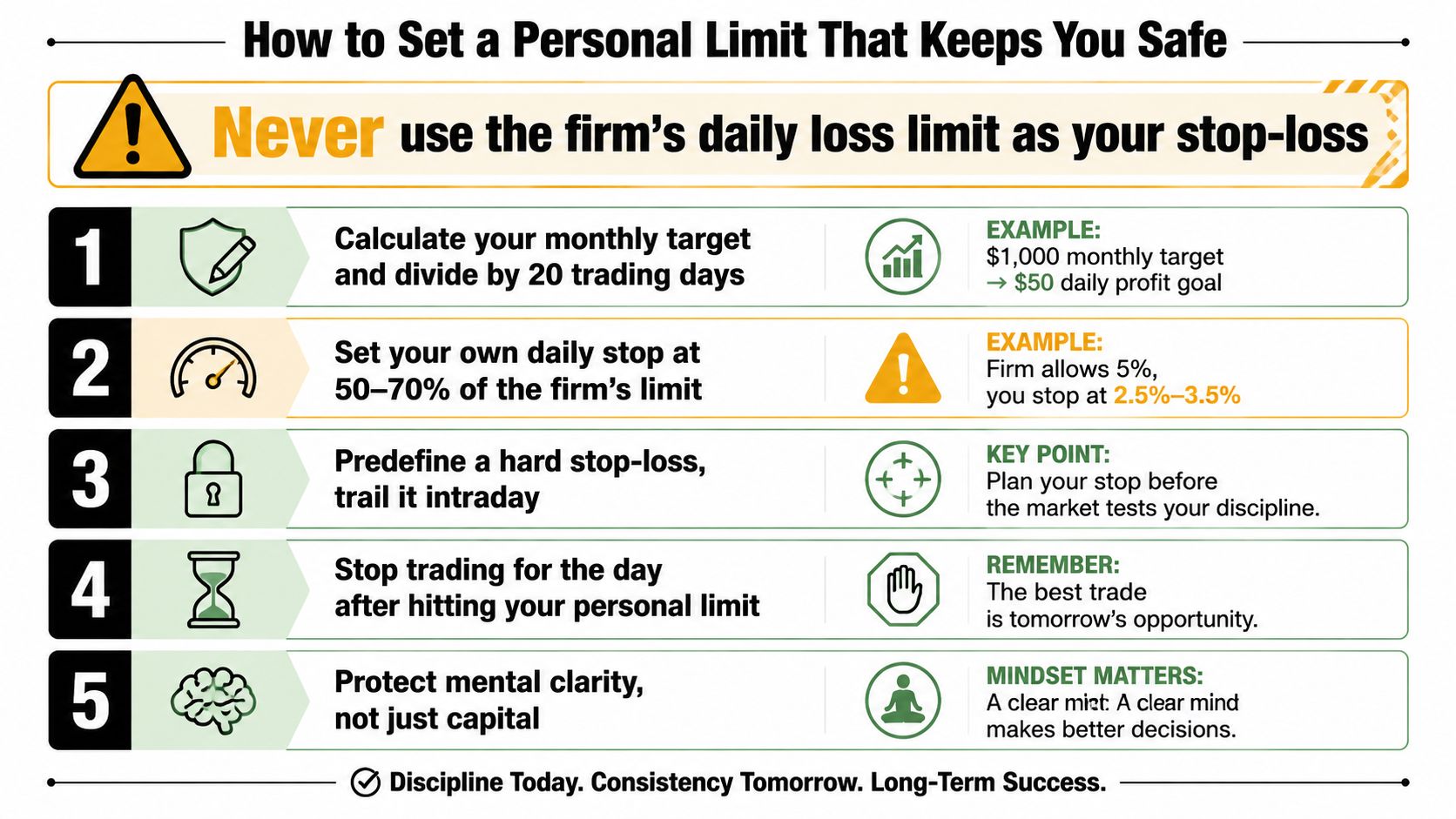
Using the firm's hard limit as your personal stop is a rookie mistake. The official threshold is the last line of defense, and reaching it usually means your position sizing, emotional control, or both have already deteriorated.
A practical personal cap sits below the firm's limit. Risk guides commonly suggest personal limits around 50% to 60% of the firm's hard limit, while other guidance uses roughly 2% to 3% of equity or sets the cap at two to three times single-trade risk, as explained by TradeZella's day-trading risk framework. The right choice depends on your strategy, trade frequency, volatility, and actual loss distribution.
Build the number from trade risk
On a $100,000 account, suppose the firm's daily cap is 5%, or $5,000. A personal stop at $2,500, or 2.5%, creates a buffer. If single-trade risk is 1%, that personal cap gives room for two full losses and part of a third before trading ends. It doesn't make the risk small, but it prevents the firm's hard stop from becoming your decision point.
A separate guide recommends setting the daily cap at roughly two to three times the amount risked on one trade. With $50 risk per trade, that produces a daily cap of approximately $150, and three full-loss trades become the predetermined stopping point. This approach directly links the session rule to execution rather than to an arbitrary account percentage.
A working checklist
- Confirm the firm's hard cap. Write down the dollar value, reset time, reference balance, and treatment of floating P&L.
- Choose a buffer. A personal cap at 40% to 60% of the firm's maximum is a conservative framework; some traders use 50% to 70%, depending on their system and tolerance.
- Tie it to position size. Calculate the loss from one normal stop, then decide how many full losses your session can absorb.
- Define the second trigger. After consecutive losses, reduce size or stop. Don't increase size to recover.
- Account for edge. Review your own win rate, average loss, average winner, and risk-reward profile. If your results depend on frequent attempts, a very tight cap may prevent proper execution. If your strategy has occasional large losses, the cap must be tighter.
- Record the rule before entry. Once the personal limit is reached, close the platform and stop for the day.
A structured analyst workflow with PlotStudio AI can help organize trade logs and inspect loss patterns, but no dashboard can replace a hard behavioral rule. For broader position-sizing principles, see these forex risk-management strategies.
The personal limit exists to preserve judgment. Capital protection is only half the job. You're also preventing a normal losing sequence from becoming revenge trading.
Two Trading Days That Show the Difference
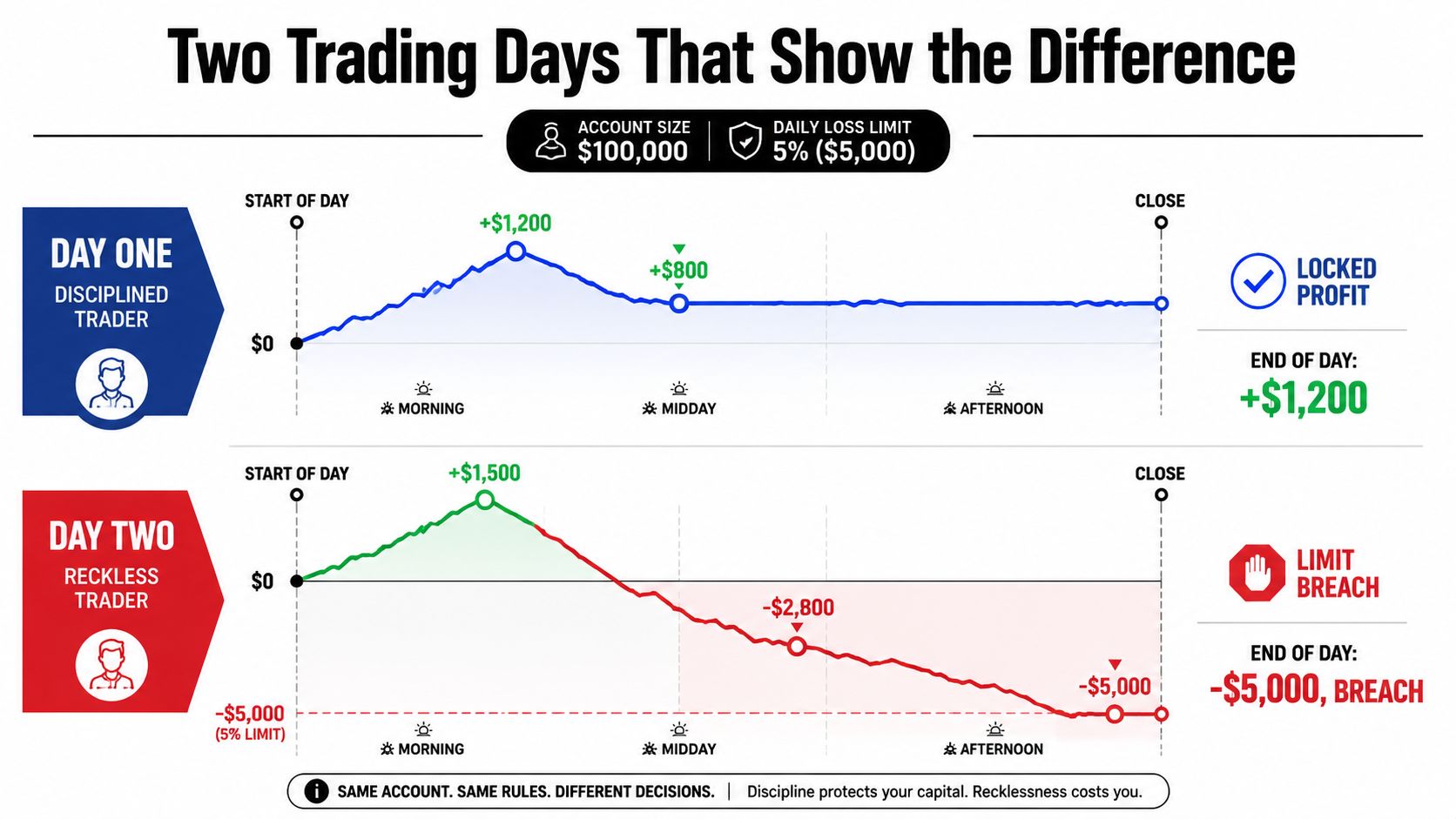
The cleanest way to understand discipline is to watch two traders face the same opening losses. Both trade a $100,000 account with a 5% daily loss limit, equal to $5,000, and both begin with a personal stop at $2,500.
On Day One, the first setup loses $1,200. The trader pauses, reviews the execution, and takes a second qualified setup. That trade loses $900, bringing the session to $2,100 down.
The trader is still below the firm's hard cap, but only the personal rule matters now. The remaining $400 before the personal stop isn't enough to justify forcing another trade. The trader shuts down the platform, records the two losses, and preserves the account for the next session.
That result feels unsatisfying because the trader didn't recover. It is still a controlled outcome. The account remains active, and the trader avoids turning a normal losing day into a rule breach.
Day Two and the recovery trap
Day Two starts with the same $1,200 loss, followed by the same $900 loss. This time, the trader increases position size to recover quickly. The third trade loses $1,500, taking the total to $3,600 down.
The trader has already violated the personal stop and is now operating with reduced clarity. A fourth revenge trade floats to -$2,800 before the stop-loss executes. The session's losses pass $5,400, exceeding the $5,000 firm cap and breaching the account.
The key error wasn't the first loss. It was the decision to use larger risk after the second loss. The fourth position also demonstrates why floating P&L matters. The account can breach while the trade is open, before the final realized result appears in the balance.
The correct response after the second loss was to stop, or at minimum to reduce exposure according to a rule written before the session. A trader who needs to recover immediately is no longer evaluating setups. They're negotiating with the market.
Frequently Asked Questions About Daily Loss Limits
Does the daily loss limit reset at midnight?
It resets at the firm's defined server rollover, not necessarily at midnight in your local timezone. Some firms use 00:00 UTC, while others use a time such as 5 PM EST. Check the platform and rules page, then convert the time before planning overnight exposure.
Weekends and rollover periods can create special conditions. The firm may pause the calculation while markets are closed, or it may apply the next session's reference when trading resumes. Don't assume that a calendar weekend automatically clears an open loss.
If I close and reopen a losing trade, does the counter reset?
Usually, closing and reopening doesn't erase cumulative intraday exposure. The system may track realized losses, floating losses, and the worst equity point during the session. A new position starts a new trade, not a new risk day.
What happens to an overnight position?
An overnight position can carry unrealized P&L into the next reset. If the position is losing, the new session may begin with less available room because the opening equity is already impaired. Confirm whether the firm uses balance or equity at rollover.
Does reaching 90% of the limit trigger a breach?
The verified rule is the hard cap itself. Some firms may provide dashboard warnings or internal alerts before the threshold, but you shouldn't rely on a warning. Treat 90% of the limit as an emergency signal to stop opening new positions and reassess exposure.
News restrictions and daily loss rules can operate at the same time. A permitted news trade can still breach the loss limit through volatility, spread expansion, slippage, or a gap. A restriction on news trading doesn't create extra loss capacity.
Start Trading with Transparent Risk Rules
Risk rules are only useful when you can understand and monitor them. Before choosing a prop program, confirm the daily loss percentage, the dollar calculation, the reset time, the treatment of floating P&L, and the relationship between the daily limit and maximum drawdown.
MyFundedCapital offers simulated-capital evaluation and funding options with documented risk parameters, including a 5% daily loss limit and maximum drawdown of up to 10%, according to the publisher's stated program details. Traders can review account sizes, evaluation phases, platform availability, and optional conditions such as news trading or weekend holding before deciding whether the structure fits their method.
Trading involves risk of loss, and no rule can turn an unprofitable strategy into a profitable one. Review the program terms, compare the calculation methods, and practice your personal stop before you begin an evaluation.
MyFundedCapital offers funding programs and challenge options designed around clearly defined daily loss and maximum drawdown rules. Visit MyFundedCapital to compare account types, review reset and equity conditions, and start an evaluation with a clear understanding of the risk parameters.