ES
ES
 DE
DE
 FR
FR
 AR
AR
 IT
IT
 NL
NL
 PL
PL
 SV
SV

A trade closes in profit, your balance looks healthy, and then a market spike pushes an open position deep into loss. The account breaches its drawdown rule before you can close the trade. This is the kind of mistake that catches newer funded traders, not necessarily because their strategy is broken, but because they misunderstood how the firm measures risk.
This guide explains the three main drawdown rules, the formulas behind them, balance versus equity measurement, static versus trailing floors, worked dollar calculations, and a practical system for avoiding breaches. Trading involves risk of loss. This article is educational content only and isn't financial advice.
Why Drawdown Rules End More Trading Careers Than Bad Strategies
A trader starts a challenge with a clear setup and a reasonable plan. After several trades, the closed P&L is positive. Then a news release moves the market sharply against an open position. The floating loss pushes current equity below the daily threshold, even though the trade hasn't been closed and the balance still looks safe.
If the firm measures live equity, the account can be locked immediately. The trader may feel cheated because the position later recovers, but the rule isn't judging the eventual outcome. It's controlling the worst point reached while the account was exposed.
That distinction is why funded traders need to study the measurement method, not just the percentage printed on the sales page. A daily loss limit based on balance behaves differently from one based on equity. A static maximum drawdown behaves differently from a trailing floor. A hard breach behaves differently from a warning or session lock.
The four questions to answer first
Before trading an evaluation, find the exact answers to these questions:
- What is measured? Is the firm checking balance, equity, or the higher of the two?
- When is it measured? Does the system monitor every tick, the end of the day, or a server rollover?
- What reference point moves? Is the maximum drawdown fixed from the starting balance, or does it follow a new equity high?
- What happens at the limit? Does the account pause, close open positions, or terminate immediately?
The practical risk is straightforward. A daily limit controls one trading day, while maximum drawdown controls the account's broader path. Either one can end an evaluation if the rulebook treats the breach as hard.
You'll learn how to calculate each floor before entering a trade, how floating P&L changes the result, and how to keep a personal buffer below the firm's official limit. That process won't make a losing trade harmless, but it can stop a manageable loss from becoming an avoidable account failure.
Understanding Drawdown as a Concept
An account can finish at $48,000 after very different trading paths. It might have declined steadily from its starting balance, or it might have climbed to $50,000 before falling to $48,000. Drawdown measures the second path by comparing the trough with the earlier peak.
Core definition: Maximum drawdown is the largest peak-to-trough decline in an account or portfolio before a new equity high is made. A common formula is (Trough − Peak) / Peak. The maximum drawdown reference at Pfolio explains maximum drawdown as a path-dependent measure of cumulative loss.
Suppose the account reaches a peak of $50,000 and later falls to $48,000. The calculation is:
($48,000 − $50,000) / $50,000 = −4%
The negative result shows the decline from the peak. The calculation does not use the trader's average entry price, average daily result, or number of losing trades. It uses the highest recorded account value and the lowest value that follows it before a new high is established.
Why the path matters
Two traders can end at the same balance while carrying different levels of risk and different drawdown histories. One may have moved from a lower balance directly to the final result. The other may have reached a much higher peak, then surrendered a large part of that gain. A maximum drawdown rule records the second account's deeper decline because the account was exposed to that larger fall.
The measurement also depends on what the firm counts as account value. A balance-based rule may ignore open-trade losses until positions close. An equity-based rule includes floating P&L, so the account can approach its floor while a trade is still open. A higher-of-balance-and-equity rule produces a different result again. This guide to equity in trading explains how equity reflects the account's current value, including open-position results.
Risk managers use drawdown rules alongside volatility and daily P&L because a single daily result does not show the account's full path. Northern Trust found that the U.S. stock market spent about 94% of its life in a drawdown relative to its prior peak. Northern Trust's history of drawdowns shows that periods below a previous high are normal, rather than unusual exceptions.
A drawdown rule limits the size of an adverse run before recovery demands become harder.
Recovery gets harder as losses deepen
The recovery math is asymmetric:
- A 15% drawdown requires a 17.6% gain to return to the starting point.
- A 50% drawdown requires a 100% gain to recover.
These figures, along with the formal maximum-drawdown explanation, appear in the Pfolio reference linked above. A larger loss therefore needs a disproportionately larger gain. For a funded trader, that matters because trying to recover quickly can encourage the same oversized risk that caused the breach.
Morgan Stanley's research found that drawdowns of 95% to 100% took 6.7 years on average to recover, while drawdowns from 0% to 50% took 1 year on average. The study also reported a median drawdown of 85% and a median peak-to-trough period of 2.5 years in its large stock sample. Morgan Stanley's drawdown study provides historical context for the recovery problem.
For a funded trader, calculate the distance from current value to the firm's floor before opening a position. Treat that floor as a boundary, not as a level to test after the trade turns against you.
How the Daily Loss Limit Works
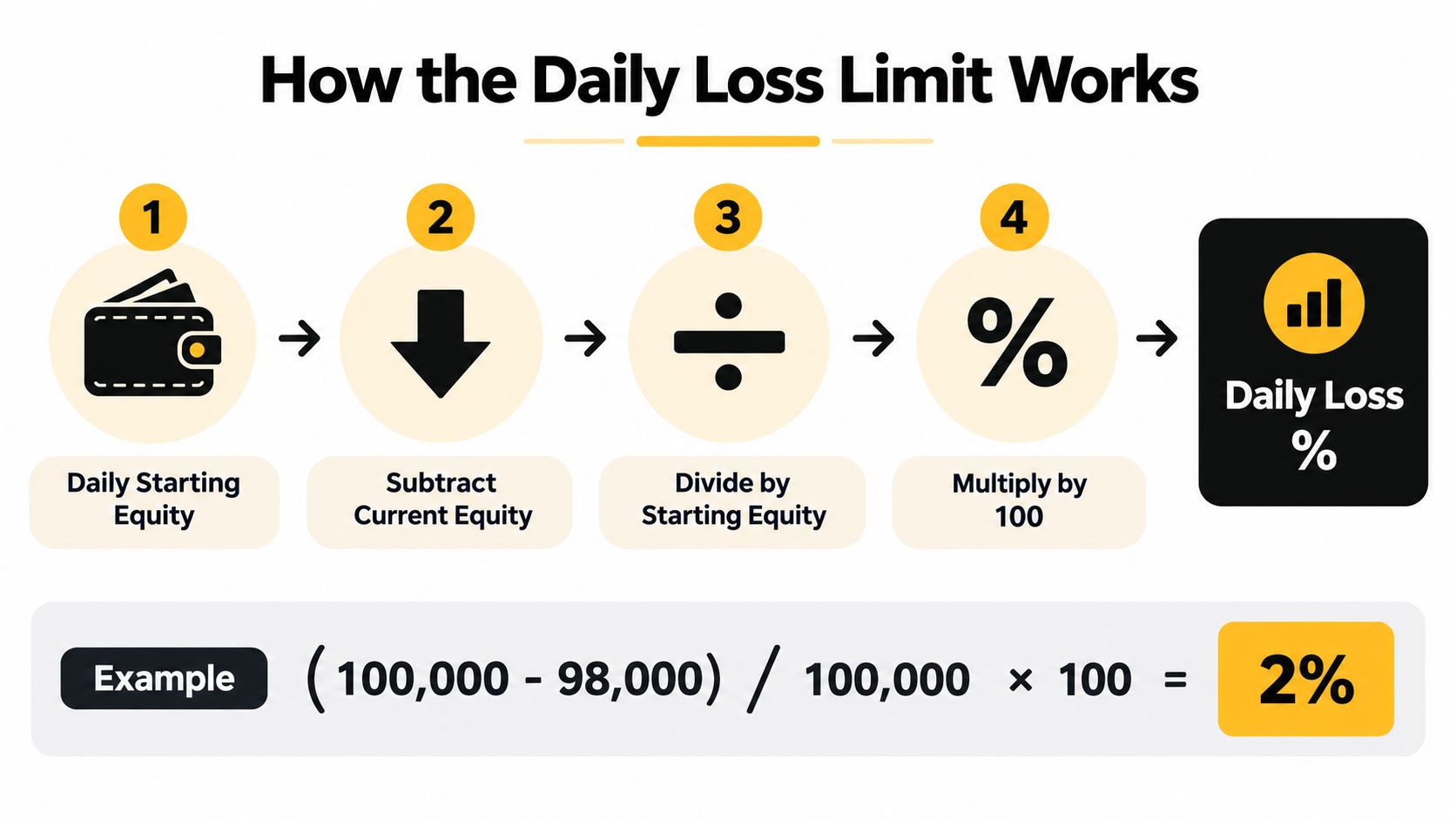
At the start of a trading day, a funded account has a loss budget that can disappear before a position is closed. The daily loss limit is that intraday boundary. A common calculation is:
(Daily Starting Equity − Current Equity) / Daily Starting Equity × 100
The important word is equity. It includes both closed results and open-trade P&L, so a floating loss can breach the rule while the trade is still running. Other firms measure balance, which excludes open P&L, or use the higher of balance and equity. The label alone does not tell you the calculation. The firm's account terms do.
A $50,000 calculation
Suppose the account begins the day at $50,000 and has a 5% daily limit. First convert the percentage into a dollar allowance:
$50,000 × 5% = $2,500
The breach point is therefore:
$50,000 − $2,500 = $47,500
Now the trader has closed losses of $1,400, while an open position shows a floating loss of $1,200. Current equity becomes:
$50,000 − $1,400 − $1,200 = $47,400
The daily loss calculation is:
($50,000 − $47,400) / $50,000 × 100 = 5.2%
The account has breached the rule. The closed loss by itself is only 2.8%, but the open loss pushes equity below the allowed floor. For Traders' daily drawdown explanation discusses this balance-versus-equity distinction and notes that many prop-style systems use a 4% to 5% daily ceiling.
Practical rule: If the firm measures equity, treat every floating loss as though it has already been realized.
Reset timing and enforcement
A daily limit commonly resets every 24 hours at server rollover, not whenever you personally start a session. For Traders' maximum drawdown guide distinguishes this daily control from cumulative maximum drawdown. Changing instruments or taking a break does not normally reset the clock.
The platform may close positions or lock the account as soon as the limit is reached. A trade that later recovers cannot usually undo a breach. Before trading, confirm whether the firm applies a hard breach, a session pause, or another enforcement method. A daily loss limit guide can also help clarify how this control differs from other account limits.
Connect trade risk to the daily budget
A trader risking 1% to 2% per trade can use a 4% to 5% daily budget after a small run of losses. Correlated positions can reach that boundary faster because several trades may lose at the same time. Calculate the combined exposure, including spread widening, slippage, and floating P&L across every open position.
The daily rule evaluates the account as a whole, not the quality of one setup. Set a personal stop below the firm's limit so normal market movement does not carry the account straight to the breach line.
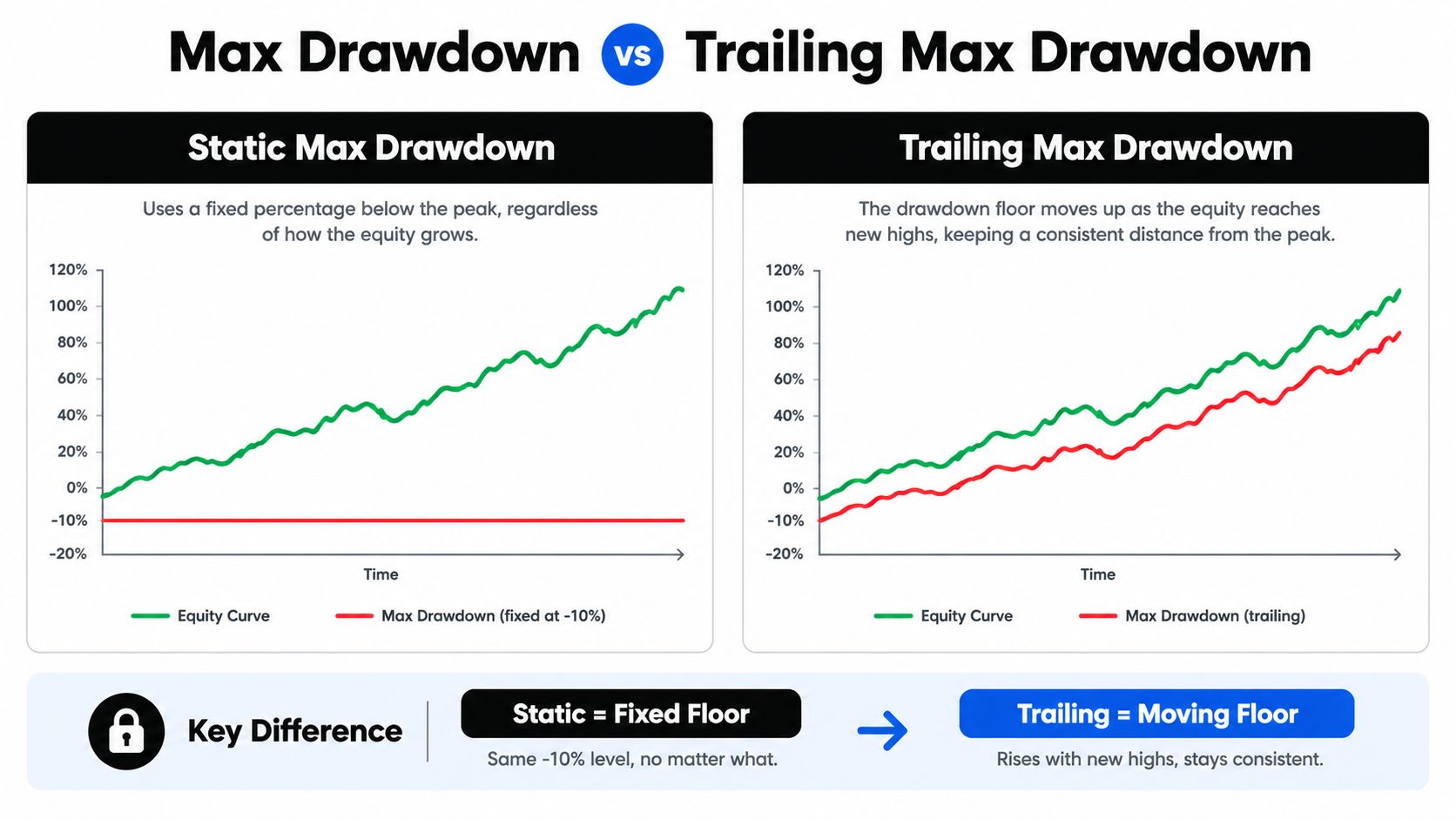
Max Drawdown vs Trailing Max Drawdown
Maximum drawdown and trailing maximum drawdown both define an account-level floor, but they use different reference points. A static maximum drawdown stays anchored to the starting balance. A trailing maximum drawdown follows the account's highest qualifying equity or balance point upward.
Assume a $50,000 account with a 10% maximum drawdown. The initial drawdown allowance is:
$50,000 × 10% = $5,000
The initial floor is therefore:
$50,000 − $5,000 = $45,000
Under a static structure, that floor remains $45,000 even if the account grows. Under a trailing structure, the floor can rise after a new high.
| Rule Type | How It's Measured | Example at Start | Example After +$2,000 Profit | Behavior |
|---|---|---|---|---|
| Static maximum drawdown | Fixed from the starting balance | $45,000 floor | Still $45,000 floor | The floor doesn't move as profits accumulate |
| Trailing maximum drawdown | Follows the qualifying equity or balance high | $45,000 floor | Floor moves upward according to the firm's trailing calculation | The available cushion can shrink after a profitable run |
The table shows the key point without assuming that every firm trails in exactly the same way. Some systems trail live equity, some trail closed balance, and others update at a daily checkpoint. The account terms must state which high-water mark counts.
Static structure
With a static floor, a profitable period creates more room above the minimum. If the account rises to $52,000 and later falls to $49,000, the account remains above the original $45,000 floor. The trader has given back profit, but the drawdown reference hasn't chased the new high.
This structure can suit traders whose results naturally include pullbacks after strong runs. It doesn't make the strategy safer, and the daily loss limit still applies if the account has one. It just makes the account-level reference predictable.
Trailing structure
A trailing floor ratchets upward as the account reaches new highs. If the firm trails the account from a high-water mark, a move from $50,000 to $52,000 can raise the floor from its initial position. A later retracement is then measured against the higher reference, not the starting balance.
Trailing rules can punish early gains more than static rules. Two accounts with the same headline percentage can have different survival odds because the trader's timing, volatility, and holding period determine how quickly the trailing floor tightens.
A profitable trade can improve your balance while reducing the distance between current equity and a trailing floor. Always track both numbers.
For a deeper explanation of the moving reference point, read this guide to trailing drawdown.
Worked Drawdown Calculations You Can Copy
Use one account to see how the rules interact. Start with $50,000, a 5% daily loss limit, and a 10% maximum drawdown. The daily budget is:
$50,000 × 5% = $2,500
The initial maximum drawdown budget is:
$50,000 × 10% = $5,000
The initial account-level floor is:
$50,000 − $5,000 = $45,000
Day one
The trader loses $1,200. Equity closes at:
$50,000 − $1,200 = $48,800
The daily budget remaining is:
$2,500 − $1,200 = $1,300
The account-level drawdown used is $1,200, leaving:
$5,000 − $1,200 = $3,800
The daily loss limit resets at the next server rollover, but the $1,200 account loss remains part of cumulative drawdown.
Day two
The trader opens positions and current equity falls by $1,800 from the day's starting equity. The calculation is:
$1,800 / $48,800 × 100 = approximately 3.7%
That remains below the 5% daily threshold, assuming the firm's daily reference is $48,800. The position later recovers and closes with a smaller loss. The temporary equity decline still mattered because an equity-based system could have breached the limit if the floating loss had reached the daily floor.
This is why you shouldn't judge the rule from closed P&L alone. A recovery doesn't erase the fact that the account may have touched a prohibited equity level.
A trailing floor after a profitable run
The trader then earns $2,000, taking equity from $48,800 to:
$48,800 + $2,000 = $50,800
Under a static 10% maximum drawdown, the floor remains $45,000. Under a trailing structure, the firm's rule may raise the floor from the new qualifying high of $50,800. The exact floor depends on whether the firm trails equity, balance, or another reference and when it updates the watermark.
Now suppose the account gives back $1,500. Current equity becomes:
$50,800 − $1,500 = $49,300
That is still above the static $45,000 floor. A trailing account may also survive, but its remaining cushion is based on the higher reference point, not on the original $50,000 start.
The daily loss limit and maximum drawdown are separate kill lines. The daily limit resets every 24 hours at server rollover, while maximum drawdown is cumulative over the life of the account or challenge. Breaching either one can end the account regardless of the other, as explained in this maximum drawdown rules reference.
A Practical System to Avoid Breaching Drawdown Rules
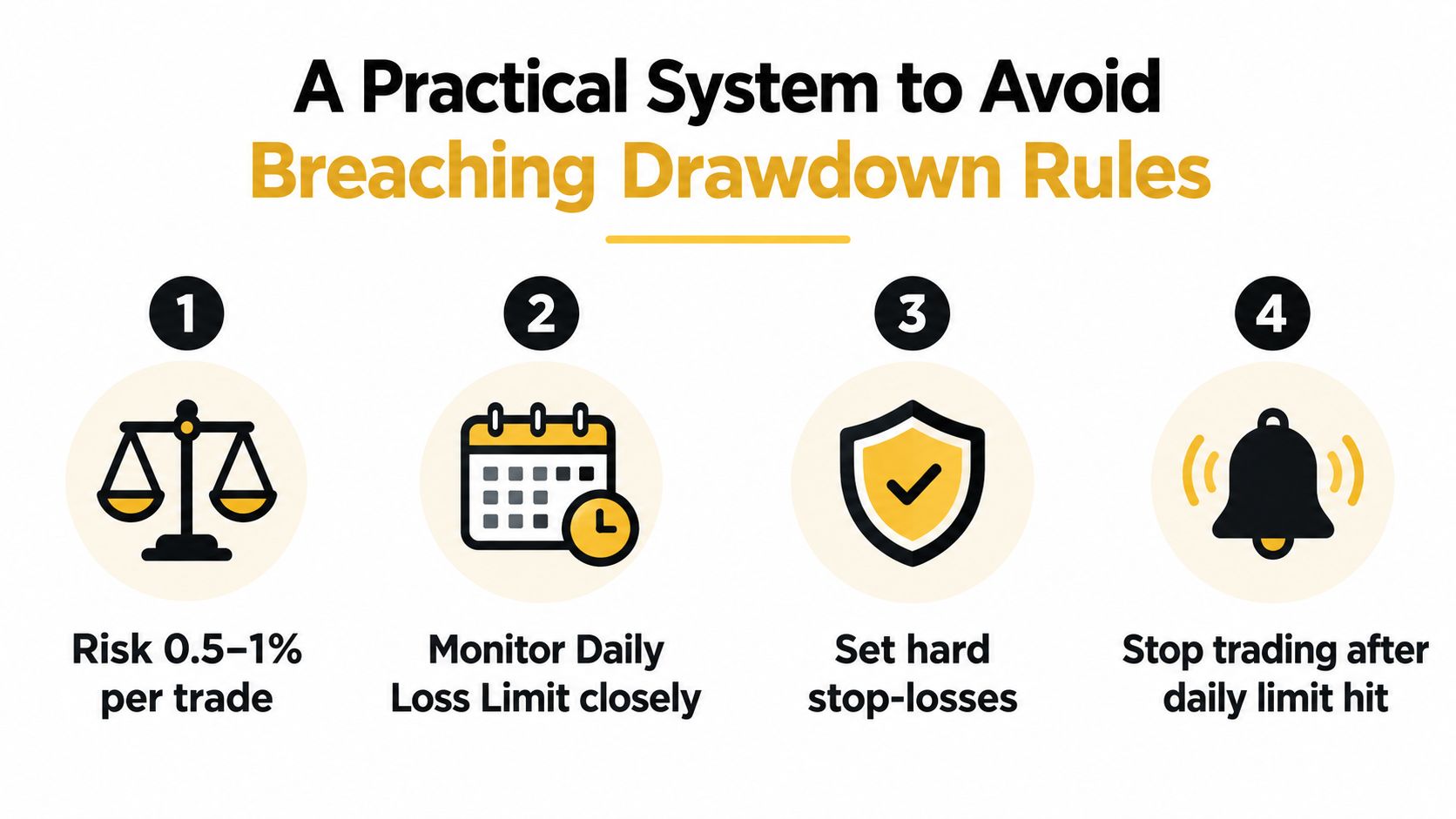
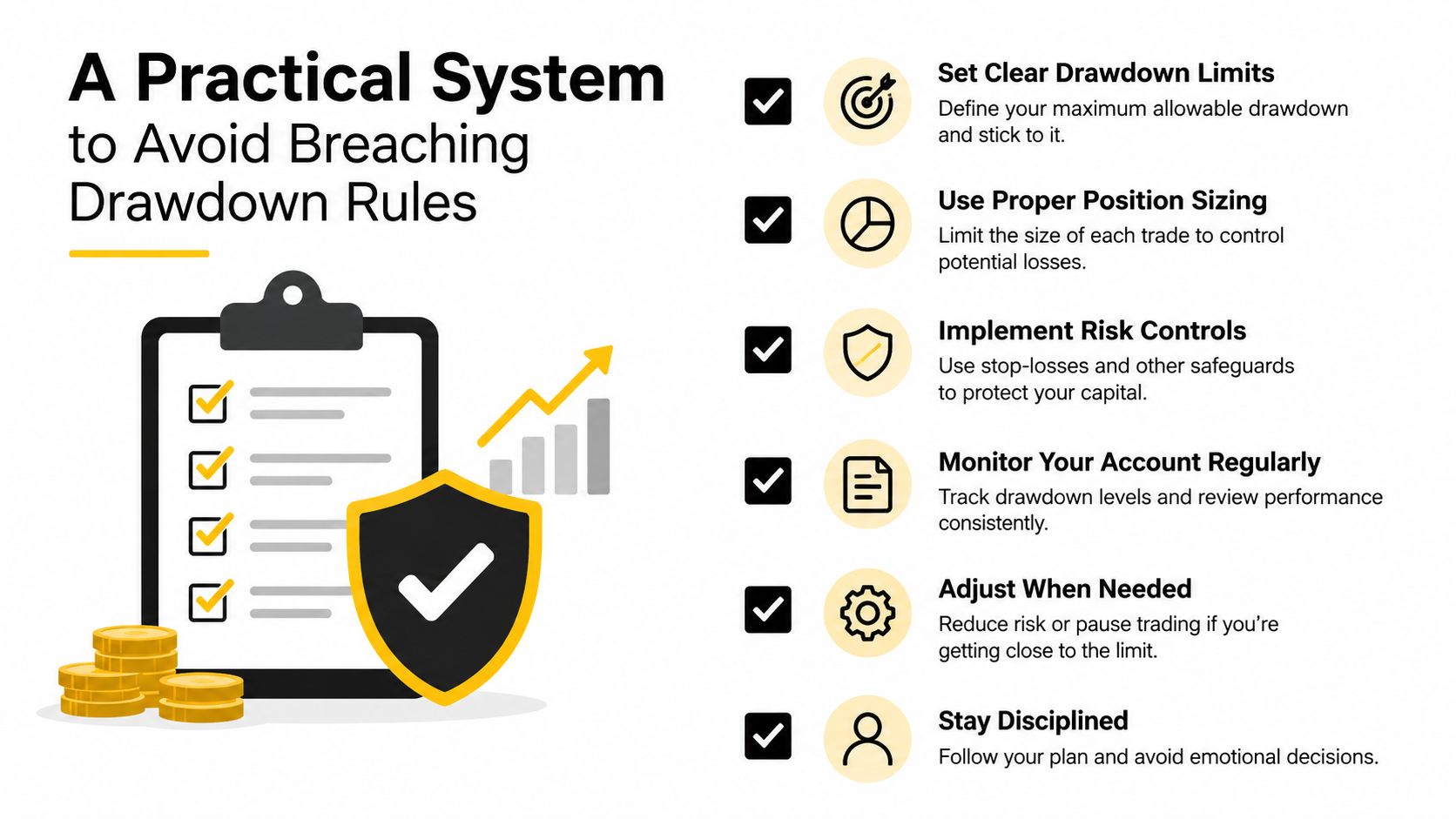
Treat the firm's limit as a ceiling you should rarely approach. Your personal stop should sit below it, leaving room for spread changes, slippage, correlated positions, and execution delays.
Size from the daily budget
Under a 5% daily limit, risking 0.5% to 1% per trade leaves more room for a losing sequence than risking 2% on every entry. The risk-management guidance from Traders Second Brain describes this relationship and frames drawdown caps as controls for limiting adverse runs.
Calculate the dollar risk before placing the order:
Account equity × personal risk percentage = planned loss at the stop
Then include all open positions in the same calculation. Three trades on related instruments may behave like one larger position when the market moves together.
Use a personal daily stop
Don't wait for the firm's hard limit. Set a lower internal threshold, record it in your platform or journal, and stop opening new trades when you reach it. A personal stop creates space between a poor session and an account breach.
If you hit that stop, review execution, market conditions, and position correlation. Don't increase size to recover the loss. Reducing size after losses preserves decision quality and keeps the next trade from turning a bad session into a rule violation.
Check the floor before every order
Use this short pre-trade checklist:
- Current equity: Include every open position's floating P&L.
- Daily starting equity: Confirm the value used after the firm's rollover.
- Daily distance: Subtract current equity from the daily breach level.
- Account floor: Identify the static or trailing maximum drawdown threshold.
- Event risk: Check whether scheduled news can create a fast equity spike.
- Correlation: Review whether another position already carries the same market exposure.
- Holding variance: Ask whether the trade's normal adverse movement fits the remaining buffer.
A trader with a narrow distance to the floor shouldn't use the same size as a trader at a fresh high. The setup may be identical, but the account's available risk isn't.
Keep a live risk sheet
Record the starting equity, current equity, daily floor, maximum drawdown floor, open risk, and distance to each limit. Update it before entering, adding to, or holding a position through a volatile period.
Drawdown caps are account-preservation tools, not performance enhancers. They can limit the size of mistakes, but they can't create an edge, improve execution, or make an unprofitable strategy profitable.
Drawdown Rules FAQ and Next Steps
Do weekend gaps count toward daily or maximum drawdown?
They can, depending on the firm's measurement window and whether open positions remain active. A gap can change equity immediately, so a system that checks live equity may register the movement even if the trader hasn't closed the position. Read the weekend-holding terms alongside the drawdown terms, because the rule may apply during the period when the market reopens rather than when the trader placed the original order.
Can a news spike trigger a breach even if the trade recovers?
Yes, if the firm measures live equity. A brief move against an open position can push current equity below the daily or trailing floor before the market reverses. A later profitable close doesn't undo a breach that the system has already recorded.
What happens to open positions after a breach?
A hard breach can close or lock the account immediately, with open positions included in the calculation. Don't assume you can close the trade manually after seeing the warning. Some firms use a session pause or another enforcement model, so confirm the exact consequence before opening an account.
Do profit withdrawals change the drawdown floor?
They can, depending on the firm's terms and whether the floor is linked to starting balance, current balance, equity highs, or a post-withdrawal reference. Ask the firm how the floor behaves after a payout before treating withdrawn funds as separate from account risk.
MyFundedCapital offers Instant Funding, 1-Step Challenges, and 2-Step Challenges, with account sizes from $5K to $100K, a flat 5% daily loss limit, and up to 10% maximum drawdown, according to the publisher information supplied for this article. Traders should compare the specific account rules, measurement basis, optional news and weekend features, and their own holding style before choosing a program.
Trading involves risk of loss, and no funding program removes that risk. Use the published terms as the final authority, calculate both floors in dollars, and keep your personal limits below the firm's hard thresholds.
MyFundedCapital provides Instant Funding and 1-Step and 2-Step Challenges from $5K to $100K, with drawdown limits designed for traders who want clearly defined risk parameters. Visit MyFundedCapital to compare account types and choose a challenge that matches how you size positions, hold trades, and manage daily risk.