

You opened a funding page, saw 80/20, 90/10, and 100 percent, and your eye went to the biggest number. That number is not free money. The label hides the profit base, the gates, and when any cash moves.
A profit sharing bonus is a pre-agreed share of eligible trading profit. It is not a salary, a signup gift, or a guaranteed wage. If eligible profit is zero, every split pays zero. Traders get stuck because they treat the firm's cut as a fee they already paid at signup. The firm's cut comes out of profit that clears the rules, and only then.
The split is the cut of a pizza that only exists after the order is paid and refunds are removed. Cancel the order and there is no pie. Take a refund off the ticket and the pie shrinks before anyone is served. Your percentage is a slice of what remains.
Three pay types that are not the same
Prop-firm profit split. This is cash on a schedule from closed trading profit after the firm accepts the result. You request it. A banner does not create it.
Company cash bonus. This follows the employer's profit, not your tickets. The company can pay it in a year your book is flat, and skip it in a year your book is green.
Retirement profit-sharing contribution. This sits in a plan. It can stay invested, move in value, and stay unavailable until a qualifying distribution. It is not money you spend on payout day.
Trading involves risk of loss. Evaluations and funded accounts are skill tests, not income promises. This is education, not financial advice.
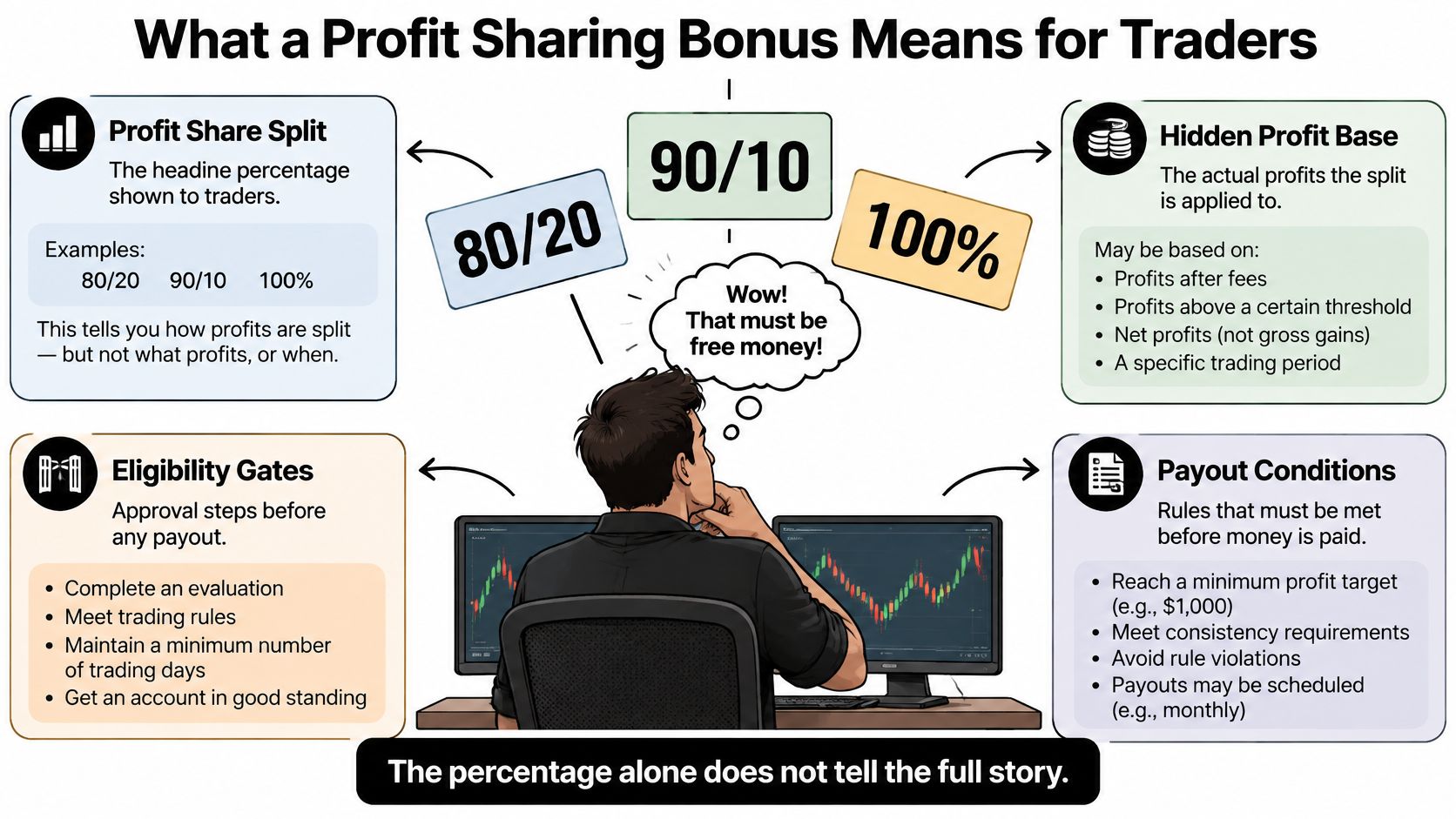
The percentage alone does not tell the full story. On one pool of eligible profit, those three splits still write three different checks.
Profit Split Payouts at 80, 90 and 100 Percent
Read the trader's dollars first. The split label is not the payout. Firm keeps is only the leftover after your share.
| Eligible net profit | Split | Firm keeps |
|---|---|---|
| $2,000 | 80/20 | $400 |
| $2,000 | 90/10 | $200 |
| $2,000 | 100 percent | $0 |
| $5,000 | 80/20 | $1,000 |
| $5,000 | 90/10 | $500 |
| $5,000 | 100 percent | $0 |
| $10,000 | 80/20 | $2,000 |
| $10,000 | 90/10 | $1,000 |
| $10,000 | 100 percent | $0 |
On $2,000 at 80/20 you receive $1,600. On $5,000 at 80/20 you receive $4,000. On $10,000 at 80/20 you receive $8,000. The last column is the part that does not come to you.
The formula: bonus equals eligible net profit times the approved trader share, and only after the account passes the payout checks.
Eligible net profit is closed, realized profit minus published deductions such as refunds, platform costs, chargebacks, or risk losses. Open floating profit and loss is never part of it.
The $10,000 row in dollars
At 80 percent the trader receives $8,000 and the firm keeps $2,000. At 90 percent the trader receives $9,000 and the firm keeps $1,000. At 100 percent the trader receives $10,000 and the firm keeps nothing of that profit.
Moving from 80 to 90 adds $100 per $1,000 of eligible profit. Moving from 80 to 100 adds $200 per $1,000. The smaller rows use the same ratio. A $2,000 pool at 90/10 leaves the firm $200. A $5,000 pool at 90/10 leaves the firm $500.
A trader with the same gross return who breaks the flat 5 percent daily loss limit or the 10 percent maximum drawdown is not in that pool. The clean account and the breached account do not share a bonus, even when a screenshot of closed profit looks similar.
An NBER working paper that used a survey of 500 U.S. public companies and corporate panel data found that adopting profit sharing was associated with an average 4 to 5 percent increase in productivity, without a definitive causal mechanism. The measured effect was larger in smaller companies and in cash-based plans. A published formula, applied to realized net profit, is what gives a trader a line of sight. A headline percentage does not.
Payouts can be requested roughly every 7 to 14 days or on demand, by bank or crypto, with average processing of 1:46h. The calendar does not change the split math. Every row above assumes the profit is already eligible. A disqualified account at 100 percent still pays nothing.
Eligibility Rules and Payout Gates Before You Get Paid
Tick this list before you request a payout. One miss keeps you out of the pool.
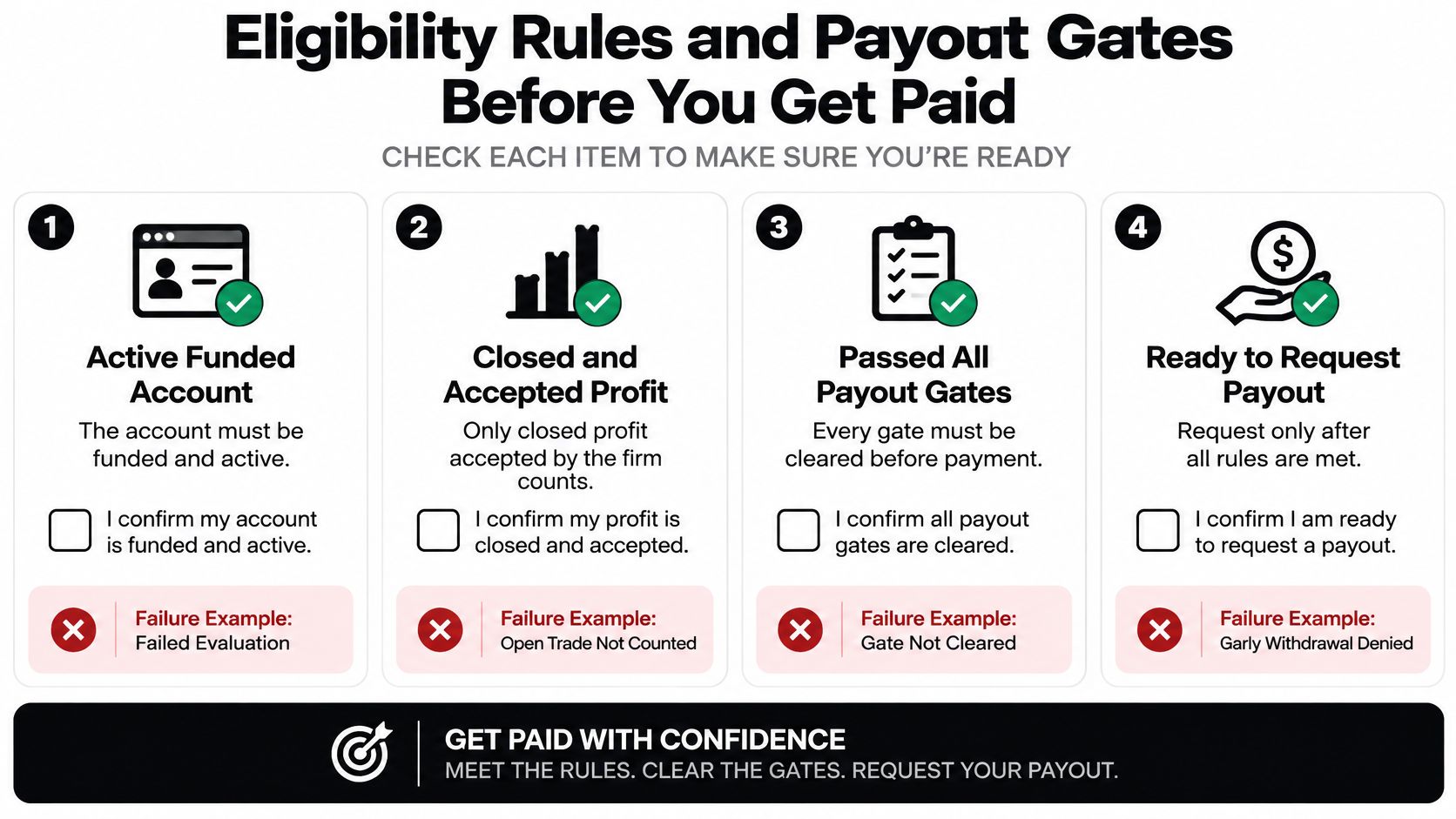
- Active funded account. The account has to be funded and still active. Failure example: you are sitting on a failed evaluation, so there is no payout account to pay.
- Closed, accepted profit. Only profit that is closed and accepted at the payout enters the pool. Failure example: a floating winner that is still open at the cutoff adds nothing.
- Daily loss and drawdown intact. No breach of the flat 5 percent daily loss limit or the maximum drawdown of up to 10 percent. A green day cannot cure a limit breach. Failure example: the week finishes up, but Tuesday hit the daily cap, so that day fails compliance.
- Add-ons you bought. News trading, weekend holding, or a faster payout counts only where you purchased that add-on. Failure example: you hold through the weekend without the weekend add-on, and the rule break blocks the request.
- Identity and method checks. Identity, payout method, and validation have to be finished. Failure example: the profit is eligible, but the bank details or crypto wallet never cleared review, so the request sits unpaid.
What each gate does
| Gate | Rule | Consequence |
|---|---|---|
| Daily loss | Flat 5 percent daily loss limit | Day fails compliance even if other days are green |
| Drawdown | Maximum drawdown up to 10 percent | Breach blocks the payout and can end the account |
| Open profit | Only closed, accepted profit counts | Floating gains add zero to the bonus |
| Add-ons | News, weekend or faster payout rules | Use without the add-on is a rule break |
| Deductions | Refunds, platform costs, chargebacks, risk losses | Subtracted before the share is applied |
| Later losses | Losses after a payout | Completed payment stands, but the next payout can pause |
Prorating, style, and who is left out
If only 10 of 30 days qualify and eligible profit from those days is $1,500, only that $1,500 enters the pool, not the whole balance. The other 20 days do not donate their result, good or bad, into a bonus you did not earn under the rules.
Refunds, platform costs, chargebacks, and risk losses come off before the share is applied. Quoting gross profit and loss overstates the check. A $2,000 gross close with $300 of stated deductions is a $1,700 base, and the split multiplies $1,700.
Manual, algorithmic, and copy trading count the same only when the program says so across forex, indices, crypto, and commodities. Confirm EA and copy treatment in the written step challenge rules before you assume a copied book is paid like a manual book.
Account sizes commonly run from $5,000 to $100,000, with scaling paths toward $500,000. A larger balance does not relax a gate. The same daily-loss and drawdown tests apply on the bigger number.
Currency, local tax, and contractor status are your check, not the firm's slogan.
A 2025 review citing US General Social Survey measures found that roughly 33% to 37% of adult workers reported receiving cash profit shares, compared with 23% to 29% reporting cash gain shares. Those averages don't say who is excluded, how free-riding is handled, or whether contractors and people measured on a different result get paid. A high headline share that excludes news days, weekends, or copied trades can pay less than a lower share with wider eligibility.
Eligibility is binary at payout time. You are in the pool, or you are not.
Bonus Calculations on Real Account Sizes
Same formula, three account sizes. The upgrade is real money, and it is smaller than a social post implies when the pool is small.
| Account and eligible net profit | 80/20 | 90/10 | 100 percent |
|---|---|---|---|
| $10,000 account, $800 eligible | $640 | $720 | $800 |
| $50,000 account, $4,000 eligible | $3,200 | $3,600 | $4,000 |
| $100,000 account, $5,500 eligible | $4,400 | $4,950 | $5,500 |
Example A. A $10,000 account closes $800 of eligible profit in the window. At 80 percent the trader receives $640. At 90 percent, $720. At 100 percent, $800. The 10-point upgrade is $80.
Example B. A $50,000 account has $4,000 of eligible net profit. At 80 percent that is $3,200. At 90 percent, $3,600. At 100 percent, $4,000. The jump from 80 to 100 on that window is $800.
Example C. A $100,000 account shows $6,000 gross closed profit and $500 of stated deductions. Eligible net is $5,500. At 80 percent the check is $4,400. At 90 percent, $4,950. At 100 percent, $5,500. Gross profit never gets multiplied.
A mixed month is not recalculated
Say that same $100,000 account already paid a bonus on $5,500 of earlier eligible profit. That payment is not reopened. A later $2,000 closed loss does not create a negative bonus and does not claw the paid check back into a new invoice. It reduces what can become eligible next time, and it can threaten the drawdown gate that decides whether another payout exists at all.
A path toward $500,000 can multiply the same percentage. Only profit that stays inside the risk rules enters the pool. A bigger balance with a breach is still a zero bonus.
Plug your own closed profit into eligible net times share. Ignore unrealized profit and loss until it is closed and accepted. The profit calculator formula is the worksheet for that arithmetic, not a forecast. If you're an Australian professional sorting tax on a cash bonus, bonus tax guidance for Australian professionals from Wealth Collective covers the tax side separately from the trading split. These illustrations are educational. Markets can reverse, and sample profits are not expected results. Trading can lose money.
How to Qualify for a Higher Profit Share
A base split may start at 80%, with 90% or 95% available as an upgrade. The higher percentage only matters if you qualify and have eligible profit to share. No upgrade guarantees future profits.
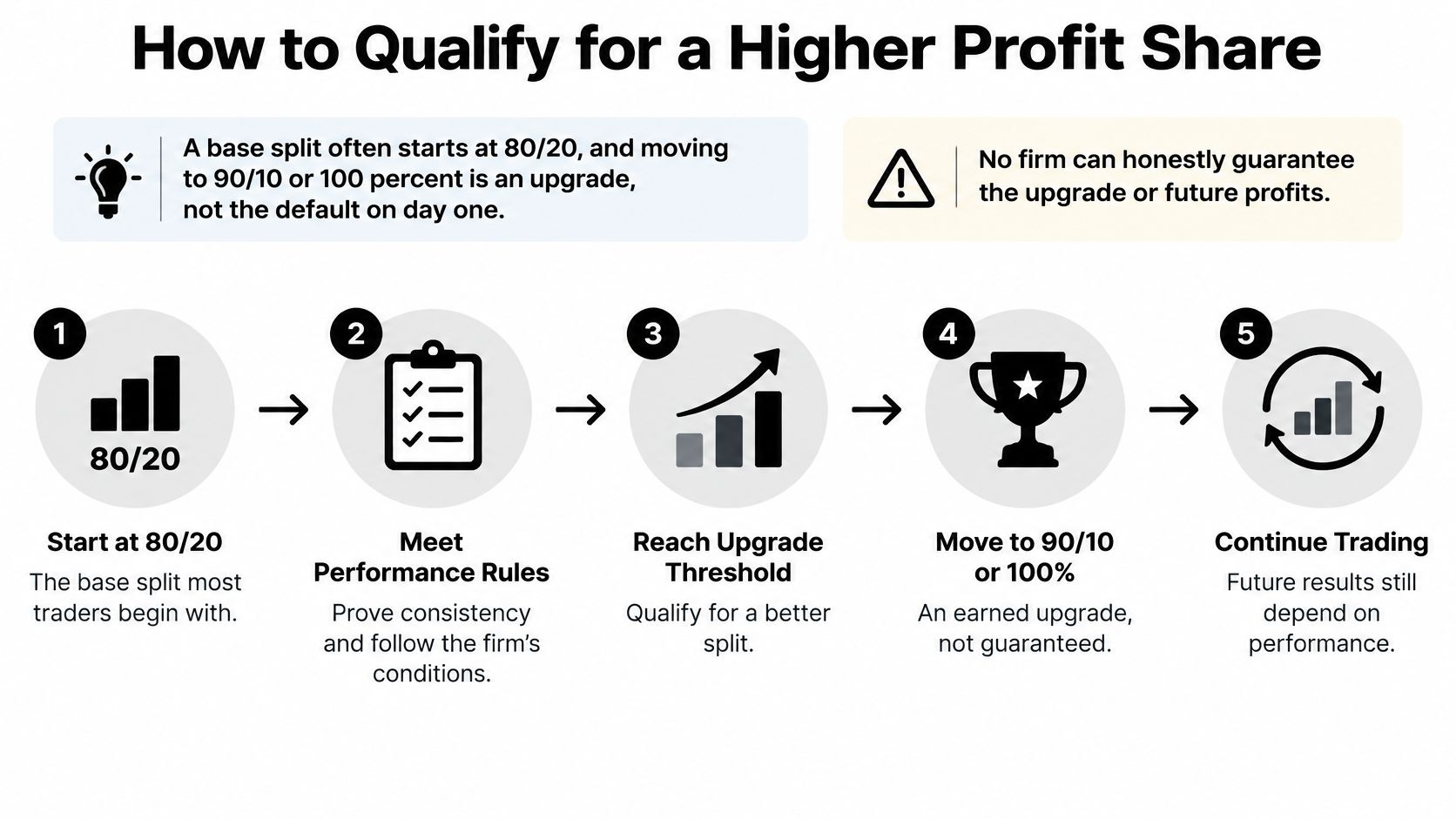
A difference-in-differences study of mandatory profit sharing in France, published in ILR Review, found that the policy increased labor's share of firm value by 1.8 percentage points and reduced the firm profit share by 1.4 points, with no statistically significant effect on investment or productivity. That finding concerns labor policy, not trader payout programs. For a trading program, a tiered split can be a practical way to connect a higher share to a clear, measured milestone.
The sequence
- Read the live program sheet. Record the starting share, whether Instant Funding, a 1-step challenge, or a 2-step challenge applies, and which add-ons are available. Upgrade terms can differ by program.
- Stay within the published risk limits. Treat the 5 percent daily loss limit and maximum drawdown as firm gates. A breach can leave you with no eligible payout, even if the headline split is 100 percent.
- Build a record of closed, profitable periods. A single strong day does not show sustained results. Keep your trading activity clear enough for a reviewer to assess compliance.
- Request a payout on eligible profit. Check whether the program offers a 7-to-14-day cycle or on-demand requests. Open trades are not closed results.
- Confirm the upgrade milestone. Ask whether a higher share depends on verified profitable periods, continued compliance, account scaling, or another stated condition. Get the terms in writing before changing your trading size.
- Check when the new percentage applies. Confirm that the upgraded share applies to future eligible profit, rather than changing a payout already made.
- Review costs as the account grows. A path from a $5,000 account toward $100,000 or more does not automatically change the split. Check the costs of scaling an account and compare the live program terms before assuming a larger account is free or starts at the highest share.
Frequently Asked Questions About Profit Sharing Bonuses
Is 100 percent always better than 90 or 80
Only when eligible profit, rules, and add-ons are otherwise the same. A lower share that allows news and weekend holding, or a payout cycle you can use, can beat a higher share you can't access. Compare the base after deductions, not the banner. If copied or algorithmic trades are excluded on the 100 percent offer and included on the 80 percent offer, run the math on the trades you really place.
Do you owe money back if the next month loses
A paid, crystallized bonus is not a wage you must return because a later trade loses. Later losses can still block the next payout or breach drawdown and stop the account. Read the clawback and inactivity lines on the program you join before you treat a paid check as untouchable in every clause. Some programs pause the next request rather than invoicing you, and that pause is still a real cost if you needed the cash.
Are challenge fees, simulated capital, and profit splits the same
No. The fee buys an evaluation or instant access to simulated capital. The profit sharing bonus is a share of later eligible profit, and it can be zero. Passing a 1-step or 2-step challenge does not promise income. You can pay the fee, pass the test, then lose the funded account on a risk-limit breach before any bonus exists. Trading involves risk of loss, and nothing here is financial advice.
MyFundedCapital funds skilled traders with simulated capital and pays a profit sharing bonus from eligible net profit, with splits that start at 80% and can move to 90% or 95% with the split add-on. Compare account types from $5,000 to $100,000, Instant Funding against a 1-step or 2-step challenge, the daily loss limit and drawdown cap, and payout timing on MyFundedCapital before you pay a fee. Start a challenge or open the funding comparison only once those terms match your style, whether manual, algo, or copy, and remember that trading can lose money and this page is educational, not financial advice.
