Your backtest is green, the equity curve looks convincing, and you're wondering whether to connect the script to a funded account. Algorithmic trading with Python gets harder at that point: you need to establish whether the strategy still works after realistic fills, changing market conditions, and account restrictions.
What You Are Really Building in Python
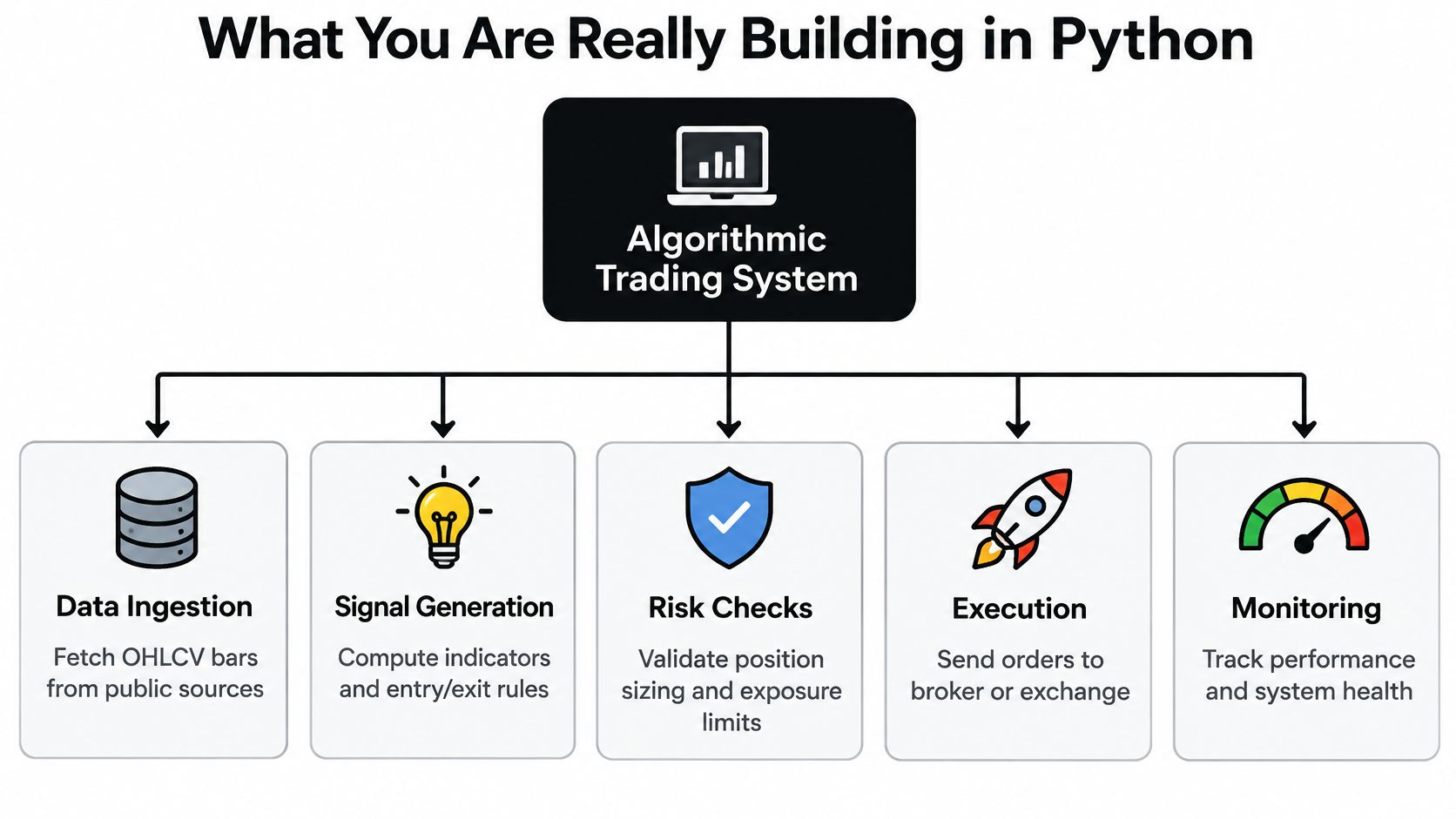
A trading algorithm isn't just an indicator attached to a buy button. It's a pipeline of data, signals, risk checks, execution, and monitoring, with explicit rules for what happens when any component fails.
The useful artifact isn't a notebook that prints a return. It's a reproducible research package, an order-validation layer, and an execution ledger that let you decide whether a strategy deserves deployment. Passing a funded-account challenge remains an outcome to test, not something a tutorial can promise.
The architecture should keep research decisions separate from order submission.
Start with a small, inspectable stack
Use Python 3.11 or later as a project baseline, create a clean virtual environment, and record dependency versions. Treat the version choice as an engineering preference, not a trading edge.
My recommended division of labor is straightforward:
- Research Use Jupyter to inspect data, chart assumptions, and investigate individual trades.
- Production code Move reusable functions into modules edited in VS Code. Keep configuration outside strategy logic.
- Numerical work Use pandas for time-indexed data, NumPy for calculations, and matplotlib for diagnostic charts.
- Indicators Start with pandas calculations. Add TA-Lib or pandas-ta only when they make a specific calculation easier to inspect.
- Simulation Start with Backtrader for explicit order handling. Consider vectorbt when you need broader parameter exploration.
- Connectivity Use ccxt for an appropriate crypto venue or a venue-specific client for broker data and orders.
These library categories are described in Interactive Brokers' overview of Python algorithmic trading. The selection above is an implementation recommendation, not a claim that one package produces better returns.
A normal development computer is a sensible starting point for this workflow. Prioritize reliable storage, recoverable project files, and a stable connection over expensive hardware.
Keep the first system deliberately boring
Choose one instrument, one bar frequency, and one strategy hypothesis. Avoid a heavy machine-learning framework until you can explain your timestamps, labels, costs, and validation procedure without referring to model accuracy.
Free data is useful for learning and early rejection of weak ideas. Before paying for a feed, identify the specific deficiency you need to solve, such as missing quotes, unsuitable timestamps, or inadequate historical coverage.
Practical rule: If you can't reconstruct why an order was sent, the system isn't ready for unattended trading.
Educational backtesting and production trading have different responsibilities. A research script can stop with an exception; a live system must account for outstanding orders and existing exposure when it stops. Trading involves risk of loss, and this content is educational only, not financial advice.
Market Data Pipelines You Can Trust
Start with the data contract, not the download command. Define what a timestamp means, which timezone it uses, whether a bar is complete, and what each price represents.
For an hourly EURUSD experiment, request the intended historical period through yfinance or your broker's client, then check what arrived. Don't assume a request for two years means the provider returned complete hourly coverage.
Normalize before calculating indicators
Keep provider-specific retrieval inside an adapter. The following compact pattern assumes client.history is your adapter, rather than pretending every provider exposes the same API:
raw = client.history(
    symbol="EURUSD",
    start=config.start,
    end=config.end,
    interval="hourly",
)
bars = raw.rename(columns=str.lower)
bars.index = pd.to_datetime(bars.index, utc=True)
bars = bars.sort_index()
if bars.index.has_duplicates:
    raise ValueError("Duplicate timestamps")

hourly = bars.resample("h").agg({
    "open": "first",
    "high": "max",
    "low": "min",
    "close": "last",
})
hourly["missing"] = hourly["close"].isna()
hourly.to_parquet(config.output_path)
For naive timestamps, first establish the provider's documented timezone. Assigning UTC to a local timestamp doesn't convert it correctly.
Don't forward-fill missing OHLC bars into apparently tradable observations. Preserve the missing-data flag, distinguish scheduled closures from feed outages, and prevent entries when required inputs are absent.
Store immutable raw downloads separately from cleaned Parquet files or SQLite tables. Include instrument, provider, retrieval time, and transformation version so another run can reproduce the same inputs.
Faberwork LLC's Python-driven logistics optimization insights provide a useful cross-domain reading companion. The engineering discipline worth adopting here is to define inputs and transformations before optimizing decisions.
Implement hypotheses, not indicator collections
Use configurable parameters rather than presenting an arbitrary moving-average pair as universally effective. For a long-only momentum hypothesis, enter after a completed-bar upward crossover, exit after the reverse crossover, and attach a protective stop based on the actual entry fill.
close = hourly["close"]
fast = close.rolling(config.fast_window).mean()
slow = close.rolling(config.slow_window).mean()

momentum_entry = (fast > slow) & (fast.shift() <= slow.shift())
momentum_exit = (fast < slow) & (fast.shift() >= slow.shift())

mean = close.rolling(config.reversion_window).mean()
deviation = close.rolling(config.reversion_window).std()
zscore = (close - mean) / deviation.replace(0, np.nan)

reversion_entry = zscore < -config.entry_z
reversion_exit = zscore >= config.exit_z
Execute these decisions only after their source bar has closed. Log the timestamp, strategy version, indicator values, requested action, and reason even when the decision is to stay flat.
For mean reversion, enter when the negative z-score exceeds the configured threshold and exit near the rolling mean or at the protective stop. Size from a risk budget divided by volatility-adjusted stop distance, then apply contract-value conversion and exposure caps.
Neither hypothesis has validated parameters yet. Momentum can repeatedly enter reversals in a range; mean reversion can keep buying into a persistent decline. Freeze the rules before comparing results.
Use retail historical feeds to develop this research pipeline. Use the intended venue's quotes and execution records to assess deployment suitability, because data quality and execution assumptions belong in realistic testing, as emphasized in FINRA's algorithmic-trading guidance.
Backtesting Frameworks Compared Honestly
Choose the simulator by the questions you need to answer. My default recommendation is Backtrader when a beginner needs readable order-state logic, and vectorbt when an already-defined strategy needs efficient parameter exploration.
Backtesting framework comparison at a glance
| Framework | Best For | Speed | Realism of Execution | Learning Curve |
|---|---|---|---|---|
| Backtrader | Inspecting event-driven strategy behavior | Favor inspectability over sweep size | Explicit order lifecycle, still dependent on assumptions | Learn orders and callbacks |
| Zipline-reloaded | Structured event-driven research | Evaluate with your workload | Requires careful data and market configuration | Expect setup work |
| vectorbt | Array-based research and parameter sweeps | My preference for broad exploration | Avoid confusing simplified fills with venue behavior | Array logic needs care |
These are practical selection judgments, not measured speed rankings. No framework can infer the liquidity your historical dataset doesn't contain.
Connect signals to order state
A minimal Backtrader wiring pattern can consume the momentum columns produced earlier through a custom data feed. Configure capital, commission, and slippage explicitly rather than using unexplained defaults.
class Momentum(bt.Strategy):
    def __init__(self):
        self.pending = None

    def next(self):
        if self.pending:
            return
        if not self.position and self.data.entry[0]:
            self.pending = self.buy(size=config.units)
        elif self.position and self.data.exit_signal[0]:
            self.pending = self.close()

    def notify_order(self, order):
        if order.status in (
            order.Completed, order.Canceled,
            order.Margin, order.Rejected,
        ):
            self.pending = None

engine = bt.Cerebro()
engine.adddata(SignalFeed(dataname=prepared_bars))
engine.addstrategy(Momentum)
engine.broker.setcash(config.account_cash)
engine.broker.setcommission(commission=config.commission_rate)
engine.broker.set_slippage_perc(config.slippage_fraction)
engine.run()
This is signal-to-order scaffolding, not a complete deployment script. Add fill-confirmed protective orders, partial-fill reconciliation, and instrument-specific accounting before treating its output as executable evidence.
For a companion review, use The Coin Course's guide to avoid overfitting in backtesting. Keep parameter exploration separate from the final decision about whether the strategy is sufficient to trade.
Validation Beyond a Pretty Equity Curve
A profitable backtest is a candidate for rejection testing, not proof of a deployable edge. A strategy can make money over the full sample yet breach an account restriction when losses cluster.
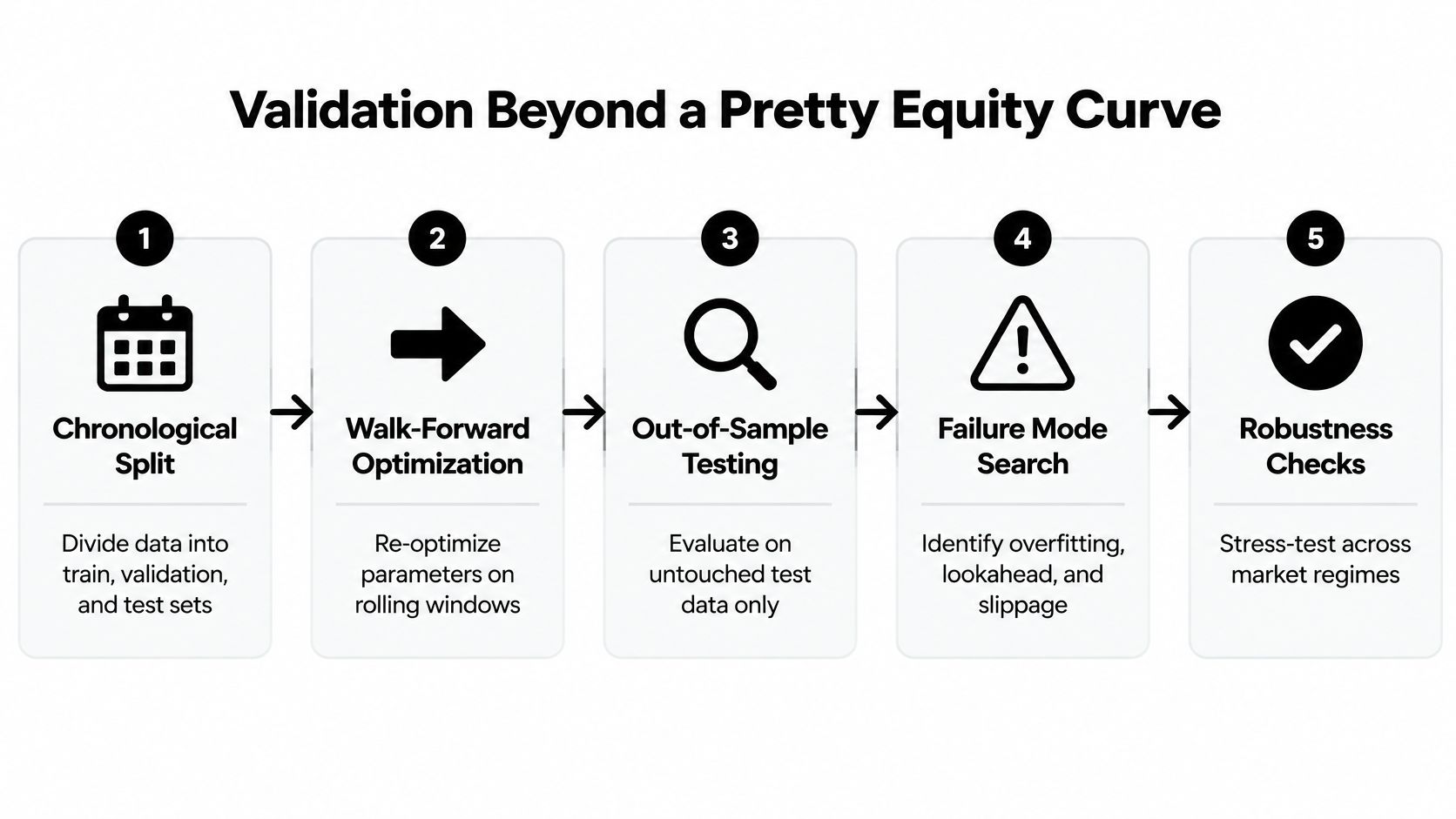
Use chronological training, validation, and untouched test periods, followed by walk-forward evaluation. This risk-first approach addresses the overfitting, regime dependence, and execution concerns discussed in CNBC-TV18's coverage of retail algorithmic-trading risks.
Search for failure modes
- Look-ahead Change future observations and confirm earlier signals remain unchanged. Confirm every decision uses only information available at its timestamp.
- Instrument selection Record why each instrument entered the universe. Don't select today's attractive instruments using knowledge unavailable historically.
- Parameter sensitivity Move neighboring settings together and separately. Reject a rationale that depends on one isolated optimum.
- Regime dependence Evaluate volatility spikes, spread widening, news windows, session boundaries, and gaps as distinct conditions.
- Rule survivability Recalculate account equity and remaining risk allowance through every simulated path, not just at trade closure.
Walk-forward testing means choosing parameters using past data, evaluating them on the next unseen window, and repeating without retroactively editing earlier decisions. The final untouched test should remain untouched until the research process is frozen.
Report what could disqualify the strategy
Report drawdown duration, worst day, loss clustering, turnover, cost sensitivity, and the proportion of simulated paths that breach the account's limits. Specify how paths were constructed, especially whether the method preserves clustered losses.
A shorter drawdown isn't automatically safer if the strategy concentrates its losses inside the account's daily measurement window.
Use this practical guide to backtesting trading strategies as an additional checklist. The deployment decision should depend on failure behavior, not merely a higher ending balance.
Execution Audit and Slippage Benchmarking
The execution audit answers the question the equity chart cannot: Did the venue execute the strategy you thought you were testing?
Record the intended action before submission, then append acknowledgments and fills without overwriting the original decision. Keep order-level and fill-level records separate so partial execution doesn't disappear inside an average.
Build a ledger that explains implementation shortfall
Your ledger needs enough detail to distinguish price movement from software failure:
- Decision context Instrument, side, strategy version, signal time, decision price, bid, ask, spread, session, and market condition.
- Submission details Client order identifier, requested price, quantity, order type, submission time, and reference quote age.
- Venue response Acknowledgment time, rejection status, rejection reason, and broker order identifier.
- Execution details Each fill price, fill quantity, fill time, fees, and resulting position.
- Derived measures Latency, signed slippage, unfilled quantity, and realized execution cost.
Define adverse slippage consistently. For a buy, a fill above the reference is adverse; for a sell, a fill below it is adverse.
fills["direction"] = fills["side"].map({"buy": 1, "sell": -1})
fills["adverse_move"] = (
    fills["direction"]
    * (fills["fill_price"] - fills["decision_price"])
)
fills["slippage_pips"] = fills["adverse_move"] / fills["pip_size"]
fills["latency_ms"] = (
    fills["fill_time"] - fills["submit_time"]
).dt.total_seconds().mul(1000)

summary = fills.groupby(
    ["instrument", "session", "market_condition"]
).agg(
    median_slippage=("slippage_pips", "median"),
    worst_slippage=("slippage_pips", "max"),
    median_latency=("latency_ms", "median"),
)
This is a per-fill diagnostic. Add quantity-weighted order summaries before comparing orders of different sizes, and summarize rejections from the order ledger rather than the fills table.
Compare ordinary liquidity with news windows, market open or close, and weekend gaps. Execution costs and adverse conditions are central to the deployment gap described in HutterTrade's discussion of algorithmic-trading profitability.
For the terminology behind these measurements, consult this explanation of slippage in trading. A strategy with attractive gross returns can still be unsuitable when the audited costs consume its expected edge.
Put a gate before every submission
SEC Rule 15c3-5 requires applicable broker-dealers with market access to maintain financial and regulatory controls. Its requirements are useful design references, not a claim that every individual Python trader has identical legal obligations.
Build a validation function around a normalized order and independently calculated account state:
def validate(order, state, limits, log):
    checks = {
        "missing_or_stale_data": state.required_data_invalid,
        "instrument_not_permitted": order.symbol not in limits.symbols,
        "duplicate_order": order.client_id in state.submitted_ids,
        "position_cap": state.projected_position > limits.position_cap,
        "order_notional": order.notional > limits.order_notional,
        "price_deviation": order.deviation > limits.price_deviation,
        "exposure_cap": state.projected_exposure > limits.exposure_cap,
        "risk_budget": state.projected_loss > state.remaining_budget,
        "kill_switch": state.trading_halted,
    }
    for rule, failed in checks.items():
        if failed:
            log.error("order_rejected", extra={
                "rule": rule, "client_id": order.client_id
            })
            return False
    return True
Calculate projected exposure using existing positions and working orders, with correct contract multipliers and account-currency conversion. Normalize quantity before validation, reserve capacity atomically, and persist identifiers so a restart doesn't defeat duplicate detection.
Operational boundary: A kill switch can block new orders. It cannot guarantee an exit price.
The SEC's market-access FAQ explicitly includes automatically generated orders. These safeguards reduce operational exposure, but valid orders can still lose money through adverse movement, gaps, and slippage.
Broker, Prop Firm, and Platform Integration
A strategy can pass its backtest and still fail at the venue boundary. Choose the broker or platform before finalizing the adapter, then test each integration independently. OANDA, Interactive Brokers, ccxt-supported crypto exchanges, DXtrade, and cTrader each have different client libraries, account permissions, and automation interfaces.
Treat acknowledgments and positions as separate facts
Use request-response calls for explicit commands where supported, and streaming connections for updates where available. If a request times out, reconcile with the venue before retrying. A missing acknowledgment does not confirm that an order failed.
Order types carry different execution risks:
- Market Prioritize execution, with no fixed execution price.
- Limit Set a price constraint, while accepting that the order may remain unfilled.
- Stop Set a trigger, not a guaranteed loss ceiling.
- Trailing stop Confirm whether the trailing logic runs at the venue or locally, and test its behavior during a disconnection.
A chart display is not a reconciliation system. Compare working orders, fills, and positions with your execution ledger, and investigate any mismatch before sending more orders.
Deploy through explicit gates
A week of paper trading is an initial test, not deployment approval. Test reconnects, rejected orders, restart recovery, and protective-order behavior before considering the smallest permitted allocation.
MyFundedCapital is one option for simulated funded-account trading. Its published program terms specify a flat 5% daily loss limit, up to 10% maximum drawdown, and account sizes from $5K to $100K. Treat those limits as configuration inputs, not targets to consume.
Check how the firm calculates equity, when limits reset, which drawdown method applies, and whether news or weekend exposure is allowed. Set your internal halt threshold below the contractual boundary to leave room for slippage and execution delays.
Your 30-Day Plan, FAQs, and Funding Path
Treat this schedule as a learning plan, not a deadline for placing orders. If an acceptance test fails, repeat that stage instead of advancing because the calendar says you should.
- Week one Build the data adapter, document timestamps, preserve raw files, and investigate missing observations.
- Week two Implement the momentum and mean-reversion hypotheses separately, with decision logs and explicit exits.
- Week three Run cost-aware simulations, chronological validation, and account-rule checks. Reject fragile variants.
- Week four Paper trade, reconcile every order, and compare observed execution with simulation assumptions.
Is Python fast enough for high-frequency trading?
Don't choose HFT as a beginner's project. Use Python for a workflow whose timing requirements you can measure and test, and profile the complete data-to-order path before deciding whether performance is a constraint.
How much capital should I start with?
There's no universal starting amount. Use simulation first, then consider only an allocation or evaluation fee you can afford to lose without affecting essential expenses.
What return is realistic?
No defensible return target follows from a language or library choice. Estimate net expectancy from your own validated strategy, include execution uncertainty, and accept that a strategy may have no deployable edge.
Do prop firms allow automated trading?
Check the selected firm's current agreement and platform permissions. Confirm restrictions on order frequency, copying, prohibited execution behavior, news exposure, and third-party bridges before connecting anything.
Use this guide to getting a funded trading account to assess the funding path against your audit results. Trading involves risk of loss, and this material is educational only, not financial advice.
MyFundedCapital offers simulated funded-account programs through 1-Step and 2-Step Challenges and Instant Funding. Visit MyFundedCapital to compare account types and current rules, then match those conditions against your Python strategy's execution audit and drawdown tests before choosing a program.