Focus on two or three major pairs and learn their sessions instead of watching every chart.
Lots = risk in dollars ÷ (stop in pips × pip value per lot). Leverage is a ceiling, not a target.
New FX positions are blocked around high-impact news unless you bought the News Trading add-on.
What you can trade
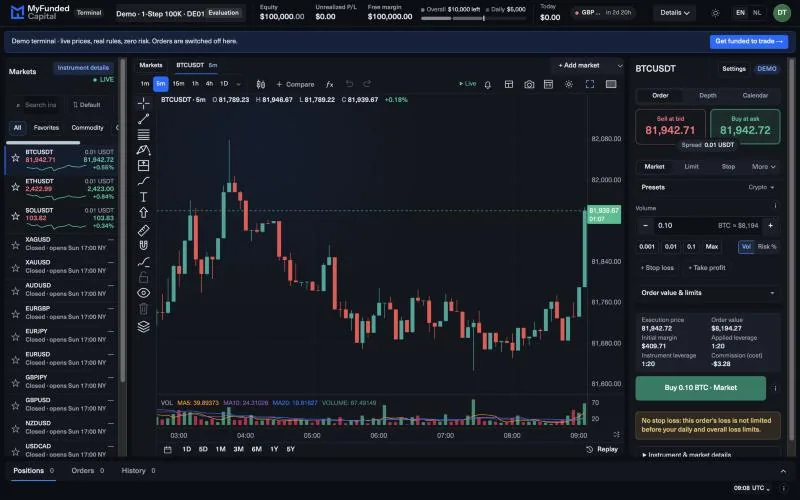
On the 1-Step, 2-Step and Instant Funded you trade in the MyFundedCapital Terminal. The forex list covers ten pairs: EURUSD, GBPUSD, AUDUSD, NZDUSD, USDJPY, USDCHF, USDCAD, EURJPY, GBPJPY and EURGBP. Open an instrument’s details in the Terminal to see its contract size, commission, swap and trading hours before you trade it.
Your account is in US dollars. On pairs quoted in another currency, such as the yen pairs or EURGBP, the Terminal converts profit, loss, margin and your limits to US dollars at the live rate. Start with two or three pairs and learn how they behave; depth beats breadth.
Sessions and what moves prices
Forex trades around the clock on weekdays, but liquidity comes in waves:
- Asian session. Usually quieter; the yen and Australian dollar pairs are most active.
- London session. The deepest liquidity of the day; the euro and pound pairs often set the day’s direction here.
- New York session. US data releases land early in the session, and the London–New York overlap is typically the busiest stretch.
The big drivers are interest-rate expectations, inflation and jobs data, and central bank decisions. That is why the economic calendar belongs in your daily routine.
Many funded traders pick one session and trade only that. It keeps the routine short, matches your energy to the market’s, and makes your journal easier to read because every trade happened in similar conditions.
Sizing a forex trade
Size comes from risk, not from leverage. The formula is: lots = risk in dollars ÷ (stop in pips × pip value per lot). On EURUSD one standard lot is worth about $10 per pip.
Worked example: a $10,000 account risking 0.5% risks $50. With a 25-pip stop, 25 × $10 = $250 per lot, so the position is $50 ÷ $250 = 0.20 lots. Round down, never up. On yen pairs and other non-dollar quotes the pip value differs, so let the ticket do the conversion. If the stop hits, you lose $50, a small part of the $500 daily limit on a 1-Step account.
The order ticket in the Terminal shows the loss at your stop and what is left of each limit before you send the order, and “Fit to limits” sizes the ticket for you.
Leverage and the news window
Forex leverage is 1:50 on the 1-Step, 1:100 on the 2-Step and 1:30 on Instant Funded. Leverage only sets how much margin a position needs; your loss limits do not change with it. A trader using full leverage can breach in one move.
On 1-Step, 2-Step and Instant Funded accounts bought from 7 October 2026, opening new FX positions is blocked from 2 minutes before to 2 minutes after high-impact news. Closing a position is always allowed, and the News Trading add-on removes the restriction. Holding over the weekend needs the Weekend Holding add-on.
Scalping, high-frequency trading and hedging are prohibited, so build setups that are meant to last longer than a few seconds of noise.
Quiz
Check yourself
0 / 3
Lesson complete
Nice work. … of 6 lessons in Market guides done.
MyFundedCapital School
Market guides checklist
Rules as of 17 Oct 2026. Tick each line before your next session.
| Rule | 1-Step Challenge | 2-Step Challenge | Instant Funded | MFC Stocks | Prediction Markets |
|---|---|---|---|---|---|
| Profit target | 10% | 8% + 5% | — | 7% | 10% |
| Daily loss limit | 5% | 5% | 3% | 2% daily pause | 3% |
| Maximum loss | 10% · trailing | 10% · static | 6% · trailing | 5% · trailing | 6% · trailing |
| Consistency | 35% | 35% | 35% | 35% | 35% |
| First payout | after 7 days | after 14 days | after 14 days | after 14 days | after 7 days |
| Then every | 7 days | 14 days | 7 days | 14 days | 7 days |
| Profit split | 80% → 95% | 80% → 95% | 70% → 80% | 70% → 80% | 75% → 90% |
1. How do you trade forex on a funded account?
- Focus on two or three major pairs and learn their sessions instead of watching every chart.
- Lots = risk in dollars ÷ (stop in pips × pip value per lot). Leverage is a ceiling, not a target.
- New FX positions are blocked around high-impact news unless you bought the News Trading add-on.
2. How do you trade gold (XAUUSD) on a funded account?
- Gold reacts to the US dollar, real interest rates and risk-off moves.
- Read the contract size in the Terminal’s instrument details before you size a trade.
- Metals follow the same news window as forex on the 1-Step, 2-Step and Instant Funded.
3. How do stock indices like US30 and NAS100 move?
- US30 tracks 30 large US companies; NAS100 tracks the largest Nasdaq companies and leans to tech.
- Most index movement clusters around the US cash open and major US data.
- MyFundedCapital doesn’t offer index trading yet; MFC Stocks covers 1,500+ US stocks.
4. How do you trade crypto on a funded account?
- Bitcoin, Ether and Solana trade in the Terminal on the 1-Step, 2-Step and Instant Funded.
- Coins = risk in dollars ÷ stop distance in dollars. Wide stops mean small positions.
- Crypto never closes, but your daily limit still resets at 17:00 New York time.
5. How do you trade US stocks around earnings on a funded account?
- Earnings land outside the regular session, so the reaction shows up as a gap at the open.
- Shares = risk in dollars ÷ stop in dollars per share. Wide post-earnings stops mean fewer shares.
- One big earnings day can push your best-day share toward the evaluation cap.
6. How do you trade economic calendar events like NFP, CPI and FOMC?
- NFP, CPI and FOMC move forex, gold and indices more than almost any other scheduled event.
- Without the add-on, new FX and metals entries pause 2 minutes either side of big news.
- Spreads widen and stops can slip at the release; plan size for the worse fill.
myfundedcapital.com/learn/
Questions
Which forex pair is best for beginners?
EURUSD is a common start: it is the most traded pair, and its pip value in US dollars is simple, which makes sizing easy to check.
Do I need a stop-loss on every trade?
A stop-loss is not required by the rules, but sizing from risk only works if you know where you exit. Without a stop, you cannot calculate a safe size.
Related lessons
Tools and rules
Rules shown here come from the help center and the live rulebook; your program terms apply.