ES
ES
 DE
DE
 FR
FR
 AR
AR
 IT
IT
 NL
NL
 PL
PL
 SV
SV


The popular advice is to find the profit-sharing plan with the highest contribution potential. That's incomplete. The best profit sharing plans aren't interchangeable: a first-time small-business sponsor may value published flat fees and turnkey administration, while a complex employer may need custom formulas, pooled structures, or independent advisor and TPA support. This roundup compares seven providers by plan flexibility, pricing visibility, payroll integration, fiduciary support, administrative burden, scalability, and employer fit. Terms, costs, and availability depend on the provider and employer agreement, so verify current details before choosing.
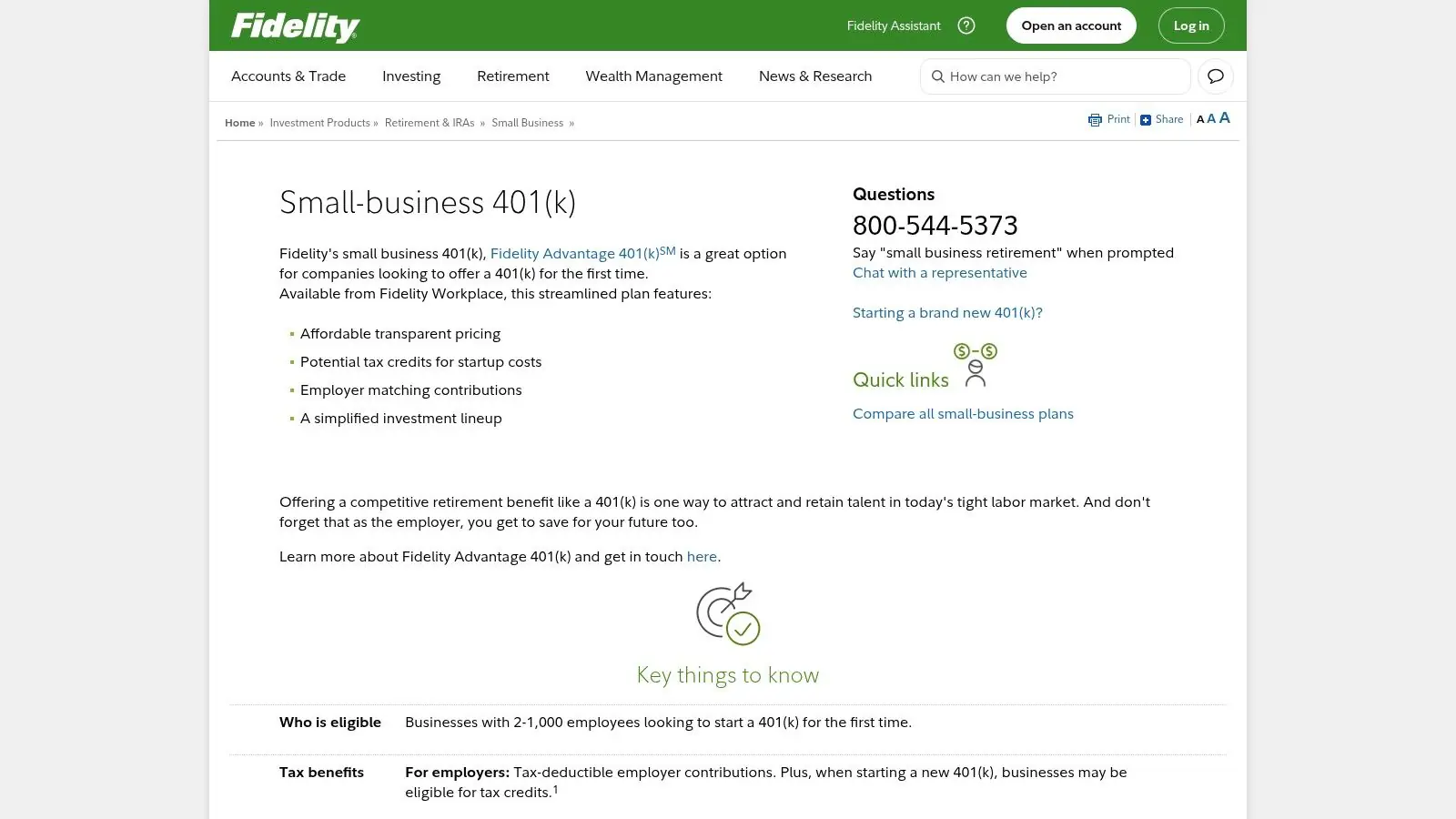
1. Fidelity Advantage 401(k) from Fidelity Workplace
Fidelity Advantage 401(k) is built for employers starting a first retirement plan and wanting a relatively guided implementation. Its safe-harbor-centered design can reduce the nondiscrimination testing burden, while Fidelity handles core recordkeeping and participant services. That combination suits an owner who wants to avoid assembling several vendors before the plan is operating.
The product's strongest practical advantage is published, itemized pricing for the starter offering. Many larger retirement providers quote fees after reviewing the workforce, investment menu, and service requirements. Fidelity's public pricing approach makes it easier for a small sponsor to compare the initial cost structure before entering a sales process. Review the participant investment service fee separately, because it adds to fund expense ratios.
Fidelity can also serve as the plan administrator under a 3(16) fiduciary arrangement and as an investment 3(38) fiduciary, depending on the selected service structure. That support may reduce the amount of routine administration and investment-selection work retained by the employer, although the sponsor still needs to understand exactly which responsibilities the agreement transfers.
Where the design can narrow
Advantage 401(k) is not the right starting point for every profit-sharing formula. Employers that need more customized allocations, certain loan features, or a traditional combination design may need to move to Fidelity's broader Workplace 401(k) offering.
That upgrade path matters. A provider can be a good fit today but a poor fit if the employer expects complex allocations soon. Fidelity's participant lineup includes target-date funds and core investment options, with the scale and recordkeeping tools expected from a major workplace provider.
Practical rule: Ask Fidelity to model the transition from Advantage 401(k) to a traditional Workplace plan before signing. The cost and administrative effect of a future migration belong in today's decision.
Best fit: A first-time sponsor that prioritizes transparent starter pricing, guided administration, established participant tools, and a possible path toward more customized profit sharing.
See Fidelity Advantage 401(k) and small-business retirement options
2. Charles Schwab Retirement Plan Services
Charles Schwab is a better match for sponsors that want a broad plan-design menu rather than a narrowly packaged starter product. Its retirement services support traditional profit-sharing plans, 401(k) arrangements, money purchase plans, and ESOPs, giving employers more room to coordinate retirement benefits with ownership or retention goals.
The platform also fits employers that want a strong brokerage environment. Managed accounts, advice options, and self-directed brokerage features can give participants more control, but that flexibility creates a communication obligation. A sponsor should define which investments are available, who provides advice, how fees are disclosed, and whether participants can make suitable decisions without assuming that more choice automatically means better outcomes.
Schwab is also compatible with independent TPAs and advisors. That's important for employers whose allocation formula, eligibility rules, or testing requirements need design work outside the recordkeeper. An independent TPA may provide a more customized structure, while Schwab supplies the recordkeeping and brokerage infrastructure.
The price of flexibility
Schwab's main drawback is limited public pricing visibility. Fees are typically custom-quoted, so a serious comparison requires a written proposal that separates recordkeeping, administration, investment expenses, advisor compensation, TPA work, participant services, and transaction charges.
Solo or individual 401(k) arrangements can also have strict operational cutoffs and administrative rules under the plan document. That isn't necessarily a Schwab-specific weakness, but it makes the document more important than the product name. A sponsor should ask for the deadlines that apply to contributions, amendments, distributions, and reporting before assuming the plan will operate like a simple brokerage account.
Best fit: An employer that values standalone profit-sharing flexibility, self-directed brokerage access, and the ability to pair Schwab with an independent advisor or TPA.
Review Charles Schwab Retirement Plan Services
3. Empower Ready Select, Pooled Solutions, and Traditional 401(k)
Empower offers several routes instead of forcing every employer into one operating model. Ready Select targets smaller or first-time sponsors, while pooled arrangements such as PEP and MEP structures can move parts of administration and fiduciary responsibility into a broader framework. Traditional 401(k) implementations remain available for employers that need more direct control over plan design.
That range helps solve a specific sponsor problem: administrative capacity. A small employer may want employer contributions without managing every testing, reporting, investment, and participant-service task internally. A pooled structure can simplify the operating model, but the sponsor must examine the governing agreement to see which duties remain with the employer and which are handled by the pooled plan provider.
Empower's platform is also advisor- and TPA-friendly. That makes it suitable for employers with a defined contribution strategy that goes beyond a basic pro rata allocation. Employers should bring the intended formula to the proposal stage rather than assuming the recordkeeper's standard package will support every desired design.
Pooled administration requires closer reading
Empower's pricing is proposal-based rather than broadly posted online. Participant fees and feature availability can vary by employer contract, so two organizations using an Empower-branded solution may receive different service packages.
That variability doesn't make the platform unsuitable. It changes the comparison method. Request a fee schedule and responsibility matrix that identify the plan sponsor's duties, pooled fiduciary services, TPA services, audit support, participant communications, investment expenses, and any charges triggered by amendments or special allocations.
Profit-sharing also needs a disciplined allocation process. A written formula should connect the employer's contribution decision to the plan document, payroll data, eligibility rules, and participant statements. For trading businesses or other performance-driven employers, a clear profit split method can help distinguish an incentive arrangement from a retirement-plan allocation, which follows its own legal and administrative rules.
Best fit: A small or growing employer that wants to reduce administrative workload through pooled solutions, or a larger sponsor that needs scalable recordkeeping and advisor-supported customization.
Explore Empower small-business retirement plans
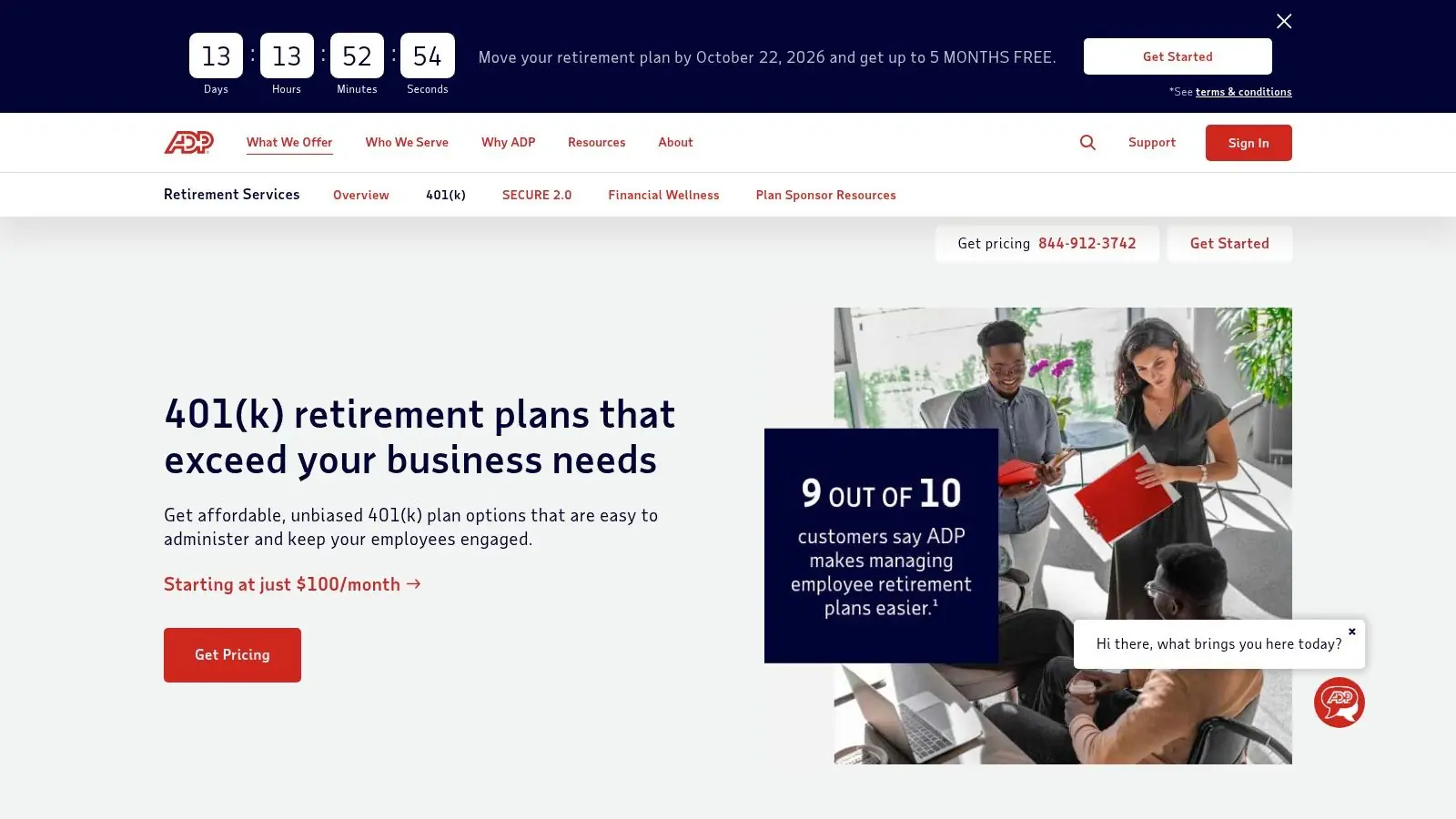
4. ADP Retirement Services
ADP's strongest differentiator is the connection between retirement administration and payroll. Its SmartSync integration is designed to reduce manual data movement, which can matter when eligibility, compensation, deferrals, employer contributions, and employee status change throughout the year.
That makes ADP especially logical for an employer already using ADP payroll or HR tools. The sponsor may avoid maintaining a separate payroll-to-recordkeeper workflow, although integration still needs testing. Ask who owns correction work when payroll data and plan records disagree, how contribution changes are approved, and how year-end profit-sharing allocations are transmitted.
ADP supports a broad service menu, including 401(k) plans, PEPs, 403(b) plans, SIMPLE and SEP arrangements, nonqualified plans, and standalone profit-sharing plans. It can also support combinations such as safe harbor contributions, a match, and discretionary profit sharing. This breadth is useful for mid-market employers with more than one workforce or benefit objective.
Strong integration, less public pricing
ADP's pricing is custom-quoted, so the headline product category tells an employer little about the final cost. The proposal should distinguish payroll integration from retirement recordkeeping, TPA and testing services, investment expenses, participant education, fiduciary services, and implementation work.
Complexity can also affect the service experience. User feedback about implementation and support is mixed in more complicated situations, which means the employer should identify the implementation team, escalation process, testing calendar, and data-validation procedure before execution.
A practical evaluation should use an actual payroll file or representative data set. The question isn't whether ADP integrates with payroll. It's whether the integration handles the employer's compensation definitions, eligibility groups, profit-sharing formula, and correction process without creating a new manual burden.
Best fit: An employer already using ADP payroll or HR systems, especially a mid-market sponsor that needs bundled retirement designs and strong payroll synchronization.
Review ADP Retirement Services
5. Human Interest
Human Interest focuses on small and midsize employers that want a straightforward operating model. Its Essentials, Complete, and Concierge tiers use flat monthly employer fees, with published, itemized pricing that makes the initial comparison easier than a fully custom proposal.
The provider also states that it charges no transaction fees for plan amendments, profit-sharing allocations, loans, and distributions. For a sponsor that adjusts employer contributions annually, that detail matters. A low recurring fee can lose its appeal if every change to the plan creates a separate charge, so transaction treatment belongs in the total-cost calculation.
Human Interest offers broad payroll connectivity, including more than 600 payroll integrations, according to its pricing materials. That figure is a quantitative product claim and should be verified against the employer's specific payroll system before purchase. The provider also offers optional 3(16) fiduciary services, while the top tier includes Department of Labor audit defense.
Transparent fees, curated investments
The investment lineup is curated by Human Interest by default. Employers that want fully open architecture should ask what investment restrictions apply, whether an advisor can add or replace funds, and how participant-level advisory and recordkeeping costs are charged.
The trade-off is clear. Human Interest may reduce the work involved in setting up and operating a small plan, but a sponsor with unusual investment requirements may find the default architecture limiting. Anecdotal reports of service hiccups from third-party sources also justify a careful review of service-level expectations rather than relying only on the fee page.
Ask for the full annual cost: Include recurring employer fees, participant charges, investment expenses, fiduciary add-ons, payroll integration, audit support, and any service not included in the selected tier.
For an employer that wants to connect business performance to a contribution decision, a profit calculator formula can be useful for internal modeling. It shouldn't replace the retirement plan's formal allocation formula or compliance review.
Best fit: A small team that values visible pricing, flat administration, broad payroll connectivity, and predictable handling of annual profit-sharing allocations.
Check Human Interest pricing and plan tiers
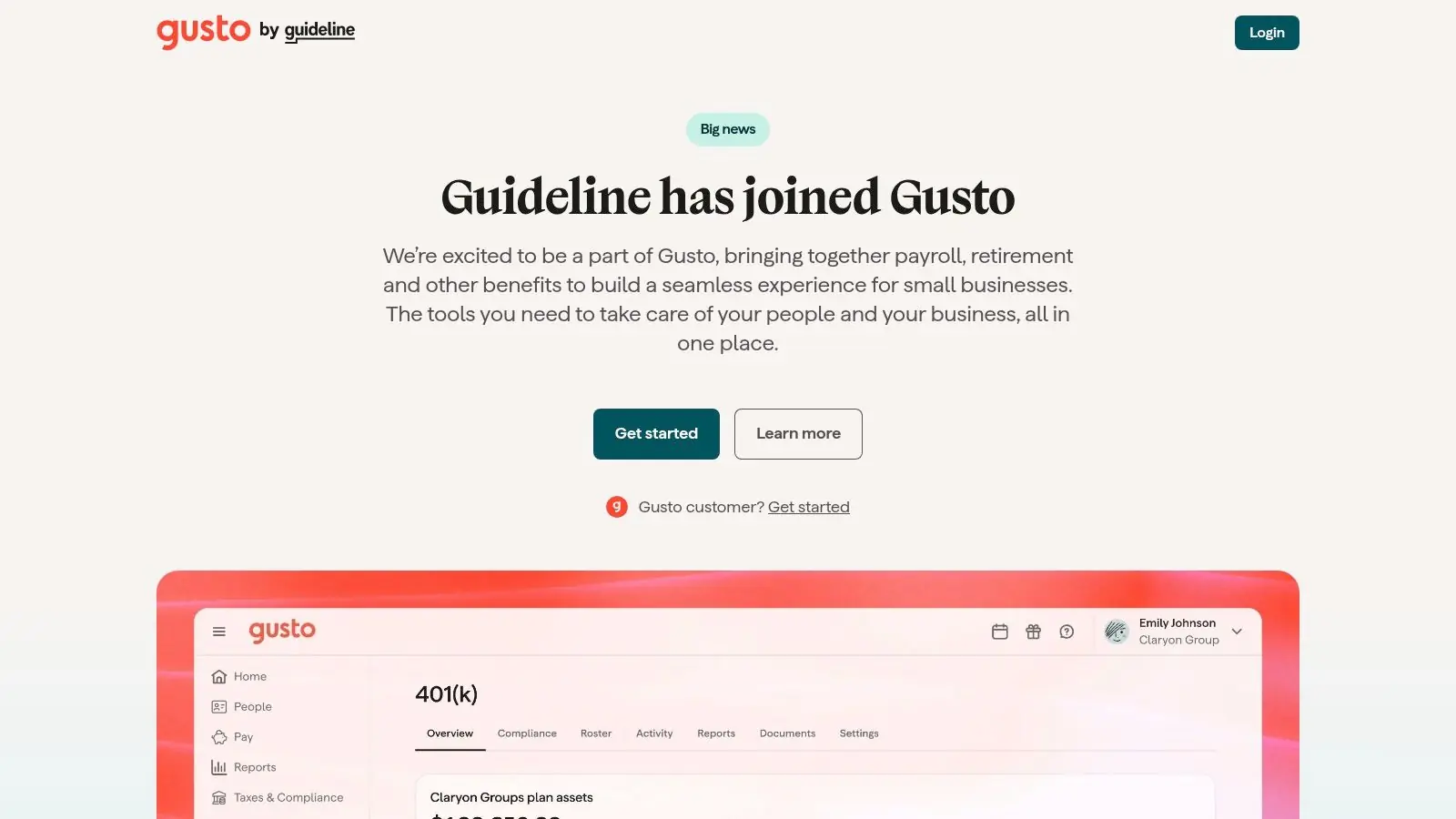
6. Guideline 401(k) Now Operated Within Gusto Retirement
Guideline stands out because its public materials describe several profit-sharing allocation methods rather than treating employer contributions as a single standard feature. Core and Premium tiers support profit sharing, while documented options include pro rata, integrated, and new comparability formulas.
That distinction is material for employers with different age groups, tenure patterns, or compensation bands. A pro rata formula is generally easier for employees to understand. Integrated or new comparability designs may require more testing, explanation, and TPA involvement. The right choice depends on the workforce and sponsor objectives, not just on which formula appears most favorable to owners.
Guideline also publishes employer pricing tiers and participant advisory fee disclosures. That creates a clearer starting point for a budget than a proposal-only model. Payroll integrations with many providers support a more automated workflow, and 3(38) investment fiduciary services are available.
Don't choose the starter tier by accident
The starter plan, described as an IRS “starter” type, doesn't allow employer contributions. That means an employer seeking profit sharing needs Core or Premium, not the entry-level option. The sponsor should confirm the selected tier in the written proposal and check whether the desired allocation method is included or requires an additional service.
Guideline's strength is therefore not just price visibility. It's the combination of published fees and documented formula flexibility. Its limitation appears when the sponsor needs enterprise-level customization. More unusual arrangements may require a higher tier or a direct conversation about implementation and administration.
Start with the employee outcome: Model the allocation under the actual payroll and workforce structure before asking which Guideline tier is cheapest.
Best fit: An SMB employer that wants predictable administrative fees and more clearly documented profit-sharing formulas than a basic packaged plan usually provides.
Visit Guideline, now operated within Gusto Retirement
7. Principal Financial Group
Principal is designed for sponsors that need a broad defined contribution platform rather than a narrow small-business package. Its retirement capabilities include 401(k), 403(b), profit-sharing, and other arrangements, with support for for-profit, tax-exempt, and government sponsor types.
The platform is advisor- and TPA-friendly, including investment-only and trustee service options. That gives an employer more control over the service team and implementation model. It can also support complex combinations and materials aimed at key-employee retention and executive solutions, although the employer needs qualified advisors to evaluate how those features work together.
Principal's breadth is useful when a sponsor expects the plan to evolve. A company might begin with a straightforward defined contribution arrangement and later need different eligibility groups, additional plan features, or more specialized retention objectives. A provider with a wide service menu can reduce the need to rebuild the vendor relationship, but broader capability can also mean a more involved implementation.
Enterprise flexibility needs a detailed proposal
Principal's pricing is custom-quoted, with limited public fee disclosure. The employer should request a line-by-line breakdown covering recordkeeping, trustee services, investment expenses, advisor compensation, TPA work, participant education, compliance testing, implementation, and special plan changes.
Participant experience and investment lineups also vary according to the employer's design choices. That's why a product-level ranking would be misleading. Ask to see the proposed fund lineup, participant interface, service calendar, and responsibility matrix before treating Principal as a complete solution.
For sponsor teams comparing variable compensation concepts, profit-sharing examples may help clarify the difference between a business incentive and a qualified retirement-plan contribution. The plan document, not a general example, controls the actual retirement allocation.
Best fit: A larger or more complex sponsor that needs a broad defined contribution suite, advisor and TPA coordination, and room for specialized workforce or retention designs.
Explore Principal retirement plans for employers
Top 7 Profit-Sharing Plans Compared
| Provider | Implementation Complexity 🔄 | Resource Requirements ⚡ | Expected Outcomes 📊⭐ | Ideal Use Cases 💡 | Key Advantages ⭐ |
|---|---|---|---|---|---|
| Fidelity Advantage 401(k) (Fidelity Workplace) | 🔄 Low–Medium, safe-harbor centric; easy upgrade path to full Workplace | ⚡ Moderate, standard recordkeeping; published employer/participant fees; 3(16)/3(38) reduces sponsor workload | 📊 Streamlined compliance and lower sponsor liability; strong participant tools; ⭐⭐⭐⭐ | 💡 First-time plans seeking transparent pricing and fiduciary relief | ⭐ Published itemized pricing; fiduciary coverage; scale and participant tools |
| Charles Schwab Retirement Plan Services | 🔄 Medium–High, supports complex profit-sharing and ESOPs; TPA pairings common | ⚡ High, custom setup and quoting; robust brokerage administration needed | 📊 Highly flexible plan designs and brokerage options; participant self-direction; ⭐⭐⭐ | 💡 Employers needing standalone profit-sharing, ESOPs, or self-directed brokerage | ⭐ Flexible plan/menu; strong brokerage infrastructure; advisor/TPA friendly |
| Empower (Ready Select, Pooled Solutions, Traditional 401(k)) | 🔄 Low–Medium, Ready Select simple; PEP/MEP reduce sponsor tasks but add pooled governance | ⚡ Moderate, pooled options shift duties; proposal-based pricing and advisor setup | 📊 Reduced admin via pooled plans; scalable tooling for sponsors/participants; ⭐⭐⭐ | 💡 Small firms wanting to offload administration or join pooled solutions | ⭐ Pooled plan options; large-scale tooling; advisor/TPA compatibility |
| ADP Retirement Services | 🔄 Medium, supports complex combos; tight payroll/HR integration required | ⚡ Moderate–High, best with ADP payroll (SmartSync); custom-quoted pricing | 📊 Fewer payroll errors and smoother data flows; comprehensive education tools; ⭐⭐⭐ | 💡 Employers using ADP payroll that want tight payroll-retirement sync | ⭐ Deep payroll integration; broad plan types; participant education/wellness |
| Human Interest | 🔄 Low, turnkey SMB focus with flat monthly tiers and zero transaction fees | ⚡ Low, 600+ payroll integrations; published, flat-fee pricing and simple onboarding | 📊 Predictable costs, easy annual contribution changes; curated investment lineup; ⭐⭐⭐ | 💡 SMBs seeking transparent flat fees and low-administration profit-sharing | ⭐ Transparent pricing; zero transaction fees; turnkey admin and payroll integrations |
| Guideline 401(k) (Gusto Retirement) | 🔄 Low–Medium, published tiers; profit-sharing available on Core/Premium | ⚡ Low, flat-tier pricing and payroll integrations; features vary by tier | 📊 Predictable fees with documented profit-sharing allocation options; ⭐⭐⭐ | 💡 SMBs wanting clear pricing plus multiple profit-sharing formulas | ⭐ Clear public pricing; documented allocation methods; simple admin |
| Principal Financial Group (Principal) | 🔄 Medium–High, enterprise-grade implementations; advisor/TPA integrations | ⚡ High, custom quoting and broader sponsor support; resources for complex designs | 📊 Flexible complex designs, retention/executive solutions; strong sponsor support; ⭐⭐⭐⭐ | 💡 Mid-to-large employers needing customized, enterprise DC solutions | ⭐ Comprehensive DC suite; advisor/TPA-friendly; executive/key-employee solutions |
Choose the Formula Before the Provider
The provider matters, but the formula usually determines whether the plan works for the employer and employees. U.S. profit-sharing plans are generally defined-contribution arrangements in which employer contributions are discretionary. The IRS says an employer can decide each year how much to contribute, including nothing, while the allocation formula must be defined in the plan document. That flexibility can protect cash flow, but it can also weaken employee trust if the sponsor doesn't explain how contributions are determined.
The plan's legal ceiling matters too. For 2026, total annual additions to a participant's defined-contribution account are generally limited to the lesser of 100% of compensation or $72,000, according to the IRS contribution-limit guidance. Eligible catch-up contributions can raise the limit to $80,000, or to $83,250 for participants aged 60 through 63 under the applicable rules. The employer deduction is generally limited to 25% of compensation paid to eligible participating employees, as described by the Department of Labor. These are separate limits, so owners shouldn't evaluate the deduction ceiling and participant allocation ceiling as if they were the same rule.
Use this selection checklist:
- Choose the structure: Decide whether the employer needs a standalone profit-sharing plan or a 401(k) with employee deferrals and employer profit sharing.
- Define the allocation: Compare pro rata, integrated, and new comparability approaches against the actual age, tenure, and compensation profile.
- Model combined contributions: Include employee deferrals, employer contributions, profit sharing, and forfeitures when checking annual additions.
- Compare fee visibility: Treat Human Interest, Fidelity, and Guideline as stronger starting points for published pricing. Treat Schwab, ADP, and Principal as proposal-driven options requiring detailed fee schedules.
- Confirm payroll compatibility: ADP is the natural candidate for employers already using its payroll ecosystem. Other providers should be tested against the sponsor's specific payroll platform.
- Review fiduciary duties: Confirm whether 3(16), 3(38), pooled-plan, trustee, advisor, or TPA services are included, optional, or excluded.
- Check investment choice: Review the participant lineup, self-directed brokerage availability, advisory costs, and any limitations on open architecture.
- Test the employee experience: Ask how the provider explains discretionary contributions, vesting, allocation results, fees, and portability.
The strongest fit depends on the sponsor profile. Human Interest or Fidelity suit employers seeking transparent, turnkey administration. Guideline is compelling when documented formula flexibility matters. ADP fits payroll-centered organizations. Empower is a practical candidate for pooled administration. Schwab is better for brokerage and standalone-plan flexibility. Principal is positioned for broad, complex sponsor needs.
Profit sharing isn't a trading payout, and retirement-plan contributions shouldn't be confused with a promise of investment gains. Trading involves risk of loss, and this article is educational, not financial advice. Employers should review plan terms with qualified retirement counsel, a TPA, and tax professionals before implementation.
MyFundedCapital offers funded trading programs with Instant Funding or 1-Step and 2-Step Challenges, supporting manual, algorithmic, and copy trading across forex, indices, crypto, and commodities. Compare account types, review the stated risk parameters and profit-split terms, and visit MyFundedCapital if you want to evaluate a prop-firm route alongside your broader compensation research. Trading involves risk of loss, and this information is educational rather than financial advice.