You've found a funded trading offer with a low entry fee, and the checkout page makes it look like an easy decision. Then you notice the reset charge, the payout conditions, the daily loss rule, and the possibility that one failed attempt means paying again. This guide shows you how to judge a cheap funded account by its total cost and realistic path to a first payout, not by the sticker price alone.
Introduction to Cheap Funded Accounts
A low-cost challenge can be sensible for a trader who already has a tested process and wants limited upfront exposure. It can also become an expensive loop if the trader buys an evaluation before understanding the drawdown, billing, reset, and withdrawal rules.
A useful starting point is understanding what a funded account actually is. In prop trading, the advertised account size isn't the same as cash deposited into your personal brokerage account. Your access depends on the firm's simulated environment, risk parameters, and eligibility rules.
Consider a common scenario. A newer trader sees an inexpensive evaluation, chooses the largest account that looks affordable, and treats the fee as the full cost. A few aggressive trades hit the daily loss limit. The account ends, the trader buys a reset or another challenge, and the original “cheap” purchase becomes only the first payment in a much more expensive process.
The better question is not, “Which firm has the lowest fee?” Ask instead:
- What will I pay if I fail once?
- Which rules can end the account even when my strategy is profitable overall?
- What must happen before I can request a payout?
- How much risk can my trading style tolerate?
This article is educational content, not financial advice. Trading involves a risk of loss, and no challenge provider can guarantee profits or payouts. The goal is simple, practical comparison. You'll learn how to assess evaluation models, calculate total cost to a first payout, inspect risk rules, and decide whether a low-fee account fits your actual trading behavior.
Cheap can be smart when it reduces controlled access costs. It becomes expensive when the fee hides repeated attempts, restrictive conditions, or a payout process you can't realistically complete.
What Cheap Really Means in Prop Trading Today
The modern retail proprietary trading market has been estimated at about US$850 million in annual revenue in 2026, with year-over-year growth of roughly 45%, according to Track360's 2026 prop trading statistics. The same source estimates around 2.1 million active funded traders and approximately 12 million challenge purchases per year, at an average fee near US$250.
Those figures explain why low-entry products exist. Firms can attract a large number of traders with an affordable first attempt, while many traders purchase more than one challenge over time. At roughly US$250 per purchase, 12 million annual purchases imply billions of dollars in gross challenge spend, although that figure represents purchase volume, not guaranteed firm profit or trader payouts.
The important distinction is between affordable access and affordable success. A low fee may make it easier to test a strategy under defined rules. It doesn't automatically make the route to funded status or a payout inexpensive.
Key insight: The sticker price measures one attempt. The meaningful figure is your probability-adjusted cost to reach a payout.
Industry reporting summarized by Track360 indicates that only about 5% to 10% of traders pass a prop-firm challenge, while roughly 1% to 2% of all clients ultimately reach a payout. A separate compilation citing data from more than 300,000 accounts stated that about 7% of traders who pass an evaluation reach a single payout, with approximately 80% to 95% of challenges ending in failure. These figures come from Track360's 2026 industry report, and they should be treated as industry reporting rather than a promise about every firm.
That changes how you compare offers. If you expect to need more than one attempt, the fee alone is an incomplete budget. You also need to price resets, replacements, recurring charges, platform costs, data fees, and the opportunity cost of spending weeks trading under rules that don't suit your strategy.
Before comparing firms, traders who use amplified products should also strengthen their understanding of BFUSD margin strategies. The principle is broader than one instrument. Margin magnifies both exposure and mistakes, so a cheap account still requires conservative risk planning.
For a wider market comparison, review cheap prop firm options by their rules and payout mechanics, not just their headline prices.
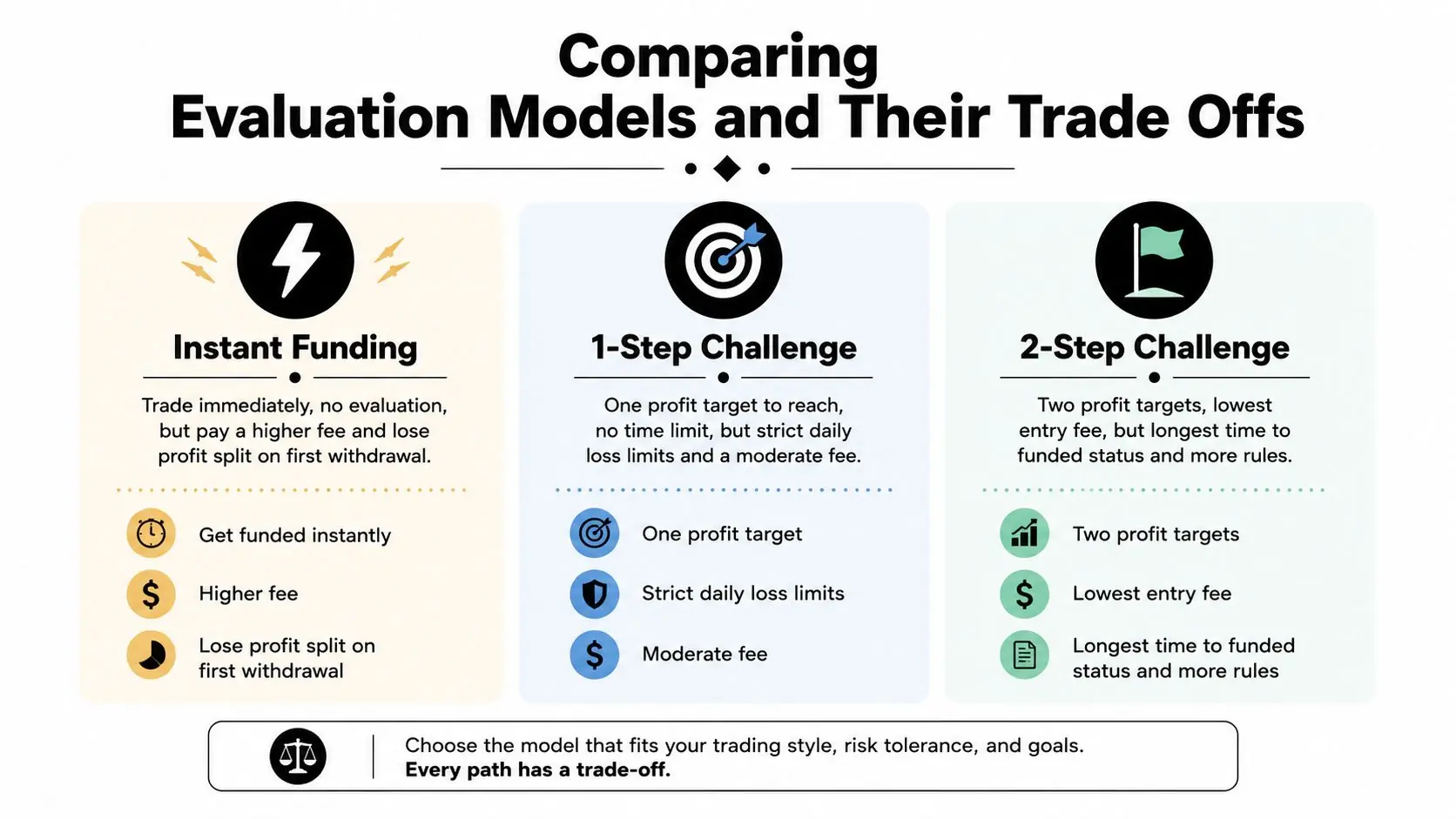
Comparing Evaluation Models and Their Trade Offs
The cheapest funded account usually belongs to a challenge model, but the lowest entry fee isn't automatically the best match. Each structure creates a different workload. Your holding period, trade frequency, tolerance for time pressure, and ability to follow loss limits matter more than the logo on the checkout page.
Instant Funding
Instant Funding removes the evaluation stage. You can trade immediately, but the fee is often higher and the first withdrawal may use a less favorable profit arrangement, depending on the provider's terms.
This model suits a trader who already has a stable process and values immediate access more than the lowest starting cost. It can also suit a scalper who doesn't want to spend time completing a target before trading under funded-account conditions.
The risk is psychological. Immediate access can encourage a trader to treat the account as permission to trade larger. It isn't. The drawdown remains the key boundary, and a fast entry doesn't create a larger margin for error.
1-Step Challenge
A 1-Step Challenge uses one profit target before funded status. It offers a middle path, but the trader still needs to respect daily loss limits, maximum drawdown, and any consistency requirements.
This structure can work for a focused day trader who has a clear target range and doesn't need multiple stages to demonstrate discipline. The absence of a second target may reduce administrative friction, but it doesn't make the evaluation forgiving. A trader who accelerates toward the target by increasing position size can still fail quickly.
2-Step Challenge
A 2-Step Challenge uses two profit targets and often has the lowest entry fee. The trade-off is a longer route to funded status, more opportunities to violate a rule, and greater exposure to changing market conditions during the evaluation.
This format is better suited to patient traders who can repeat the same process over time. It isn't ideal for someone who needs immediate access or tends to overtrade when progress feels slow. Read more about how two-stepping works before choosing this route.
Match the structure to your behavior
| Trader profile | More suitable structure | Main trade-off |
|---|---|---|
| Proven trader who values immediate access | Instant Funding | Higher entry cost and potentially different first-withdrawal economics |
| Focused day trader with a repeatable process | 1-Step Challenge | One target, but strict risk rules still apply |
| Patient trader seeking lower entry cost | 2-Step Challenge | Longer evaluation and more opportunities for rule mistakes |
The key differentiator is not speed. It's whether the model gives your strategy enough room to operate without forcing you to change behavior.
Choose the model that matches your normal trading rhythm. Don't choose a 2-Step Challenge just because it costs less, and don't choose Instant Funding just because it feels faster.
Also inspect whether news trading, weekend holding, expert advisors, copy trading, and specific platforms are allowed. A model that looks cheap becomes unusable if it blocks the way you trade.
How to Evaluate Total Cost Beyond the Sticker Price
Calculate the total cost of ownership before buying. Write the number down. Don't rely on a sales page's largest account size or lowest advertised entry fee.
Start with the full payment path
List every charge that can occur from purchase to first approved payout:
- Initial evaluation or account fee.
- Recurring billing, if the account renews before you pass.
- Activation charges after completing an evaluation.
- Reset or replacement fees after a breach.
- Platform and market-data charges.
- Optional add-ons, such as news access or weekend holding.
- Any payout processing or conversion costs.
Recent comparison coverage emphasizes this broader calculation because the cheapest advertised account may become the most expensive route after a failed attempt or paid add-on. Tradeify's affordable futures prop comparison is useful as a reminder to examine recurring billing, resets, activation, platform access, payout timing, drawdown rules, and consistency conditions together.
Use this checklist before comparing account sizes:
| Cost Factor | What to Check | Cheap Trap Signal |
|---|---|---|
| Entry fee | Is it one-time or recurring? | The page highlights only the first payment |
| Activation | Is another payment required after passing? | Activation terms are hard to find |
| Resets | What triggers a reset and what does it cost? | A reset appears cheaper than a new account but still repeats the same risk |
| Replacement account | Can a failed account be replaced? | Replacement pricing encourages repeated attempts |
| Platform and data | Are trading software and data included? | The fee excludes tools you need |
| Add-ons | Are news trading or weekend holding optional? | Your strategy depends on a paid feature |
| Payout timing | When can you request and receive funds? | Profit is visible but withdrawal conditions are vague |
| Drawdown rules | Is the loss floor static or trailing? | The rule changes as your balance rises |
| Consistency | Are single-day profits capped? | One strong day can delay eligibility |
Calculate cost to first payout
Use a conservative personal estimate:
Expected cost to first payout = initial fee + likely extra charges + expected failed-attempt cost
Don't treat this as a statistical guarantee. It's a budgeting tool. If your trading history suggests that you often need multiple attempts, include that behavior rather than assuming the first purchase will succeed.
Then compare the cash-flow timeline. A challenge can be inexpensive at checkout but expensive in time if you must wait through minimum trading days, review periods, or a payout cycle. Profit isn't usable capital until the provider approves and processes the withdrawal.
Read the rules before the promotion
Download or save the rule page before purchasing. Check whether the firm can change active-account rules, how it defines equity, and whether unrealized losses count toward daily limits. A low price doesn't compensate for a rule you discover after opening the account.
Practical rule: If you can't explain the account's failure conditions in plain English before purchase, you aren't ready to trade it.
Risk Rules That Decide If a Cheap Account Survives
A cheap funded account can fail before your strategy has a fair chance. The usual mistake is treating the advertised balance as usable risk capital. Judge the account by its loss limits, reset cost, and probability-adjusted cost to reach a first payout.
Prop-firm risk systems commonly combine a daily loss limit of roughly 2% to 5% with a maximum drawdown around 8% to 12%, according to NinjaTrader's overview of prop-firm risk parameters. The tighter end is common in modern evaluations, so position sizing must leave room for normal losing streaks and rule-based resets.
Separate the two loss controls
A maximum drawdown is the account-wide floor. A 10% maximum drawdown on a $100,000 account means termination at $90,000. A daily loss limit resets according to the provider's stated calculation. A 5% daily loss limit on a $100,000 account equals a $5,000 daily cap, and that cap can terminate the account before the maximum drawdown matters.
Static and trailing drawdowns behave differently. With static drawdown, the loss floor stays fixed from the starting balance. With trailing drawdown, the floor moves higher as equity reaches new highs, reducing available room after profitable trades.
Size for survival
Risk guidance for evaluations often uses 1% to 2% per trade as a broad benchmark, while experienced traders may reduce risk to 0.25% to 0.5% when the drawdown buffer is strict, according to Elite Trader Funding's evaluation rules guide.
For many modern evaluation structures, I prefer keeping individual trade risk near 0.5% to 1.0%, consistent with the risk-control guidance cited earlier. With a 5% daily stop and 10% maximum loss, 2 to 5 full losses can put the account in danger. That arithmetic also shows why a low checkout fee can become expensive after repeated resets.
Set a hard daily stop below the firm's limit. Stop at your own threshold, not when the platform forces you out. Never widen a stop to avoid realizing a loss, and never increase size to recover a losing session. A cheap account survives through controlled exposure, not aggressive attempts to reach the advertised payout quickly.
Where MyFundedCapital Fits for Value Focused Traders
MyFundedCapital offers Instant Funding, a 1-Step Challenge, and a 2-Step Challenge, with account sizes from $5K to $100K and scaling paths up to $500K. Its evaluations and funded accounts operate in demo environments using real market quotes, so traders should judge the program by its stated rules and simulated-account structure rather than treating the nominal balance as cash deposited in a personal account.

The stated risk parameters include a flat 5% daily loss limit and up to 10% maximum drawdown. Profit splits start at 80/20, with upgrades to 90/10 or 95/5 available under the applicable structure. Those figures matter only if your strategy can remain inside the loss rules and satisfy the account's payout conditions.
Match the option to the trader
- Scalpers may prefer Instant Funding when immediate access and platform compatibility matter more than the lowest entry fee. They still need strict session stops because frequent trading can consume daily loss room quickly.
- Manual and algorithmic traders can use DXtrade or cTrader across 350+ instruments, including forex, indices, crypto, and commodities. Confirm that your execution method and copy-trading setup comply with the current terms.
- Crypto and swing traders should examine the optional add-ons for news trading and weekend holding. Those features matter only if your strategy needs them.
- Challenge-focused traders can choose the 1-Step or 2-Step route when they prefer an evaluation before accessing larger account sizes.
Payouts are available every 7 or 14 days depending on the program, or on demand with the payout add-on under the relevant option, through bank or crypto methods, with average processing around 2 hours. Support includes 24/7 multilingual assistance and an active Discord community. Treat those features as operational considerations, not evidence of guaranteed approval or profitability.
The right comparison is between the full MFC rule set and the alternatives you're considering. Check fees, add-ons, drawdown calculations, consistency rules, and payout requirements before starting. Trading involves risk of loss, and a high profit split can't rescue poor position sizing.
Frequently Asked Questions About Cheap Funded Accounts
Does an ultra-cheap funded account have stricter rules?
It can, but price alone doesn't prove that. Compare daily loss limits, maximum drawdown, trailing mechanics, consistency rules, prohibited strategies, payout timing, and reset conditions. A low fee with a restrictive rule set may cost more through failed attempts than a higher-fee account with rules that fit your process.
Does a low price indicate higher payout risk?
It can create concern, but you need evidence from the firm's published payout policy, rule history, complaint process, and solvency disclosures. Formal certification efforts in the prop-firm industry now focus on evaluation criteria, payout policies, risk controls, complaint handling, solvency disclosure, plain-language rules, version histories, and non-retroactive changes for active accounts, as reported by FinanceFeeds on prop-firm certification. Certification isn't a guarantee of payment, but transparent documentation gives you more information before purchase.
Which consistency rules can delay a payout?
Payout eligibility may require five to ten minimum trading days, a single-day profit cap of 30% to 40% of total withdrawal profit, and a payout cycle from weekly to every 14 days, depending on the provider. Some firms also add review periods before approval, according to The5ers' guide to futures prop-firm rules. Read these conditions before you plan around a withdrawal.
Should beginners buy a cheap funded account?
Only after they can demonstrate consistent execution in a risk-free practice environment and explain every account rule. The low fee shouldn't be treated as tuition for uncontrolled trading. Trading involves risk of loss, and this article is educational content, not financial advice.
MyFundedCapital offers Instant Funding plus 1-Step and 2-Step Challenges from $5K to $100K, scaling up to $500K, with stated 5% daily loss and up to 10% maximum drawdown rules. Compare the account types and payout conditions at MyFundedCapital, then start a challenge only if the rules fit your tested strategy and risk budget.