

 AR
AR
 NL
NL
 FR
FR
 DE
DE
 ES
ES
 PT
PT
 IT
IT
 PL
PL
 SV
SV


Only about 5% to 10% of traders pass an initial prop firm evaluation, and roughly 7% of all traders reach a payout stage. Scaling matters only after you've survived that narrow funnel, followed the rules, and produced profits consistently enough for a firm to increase your allocation.
A prop firm scaling plan is the rulebook for that increase. It connects realized profit, trading activity, consistency, and drawdown control to larger buying power or account size. This guide breaks down how the ladder works, why profitable traders still miss scale-ups, and how to test your own process against a real funding framework without treating larger capital as guaranteed income.
What a Prop Firm Scaling Plan Actually Does
The first mistake newer traders make is treating scaling as the beginning of the journey. It's closer to a promotion after several filters have already done their work. Industry benchmarks place the initial evaluation pass rate at roughly 5% to 10%, while another dataset covering more than 300,000 accounts across 10 firms found that 14% passed an evaluation and obtained funding, according to prop firm statistics compiled by QuantVPS. The same industry discussion places the eventual payout share at roughly 7% of all traders.
That funnel explains the purpose of a scaling plan. A firm doesn't give every challenge participant its largest allocation immediately. It starts with a defined account or buying-power limit, then increases that limit only when the trader demonstrates profitable behavior and rule compliance.
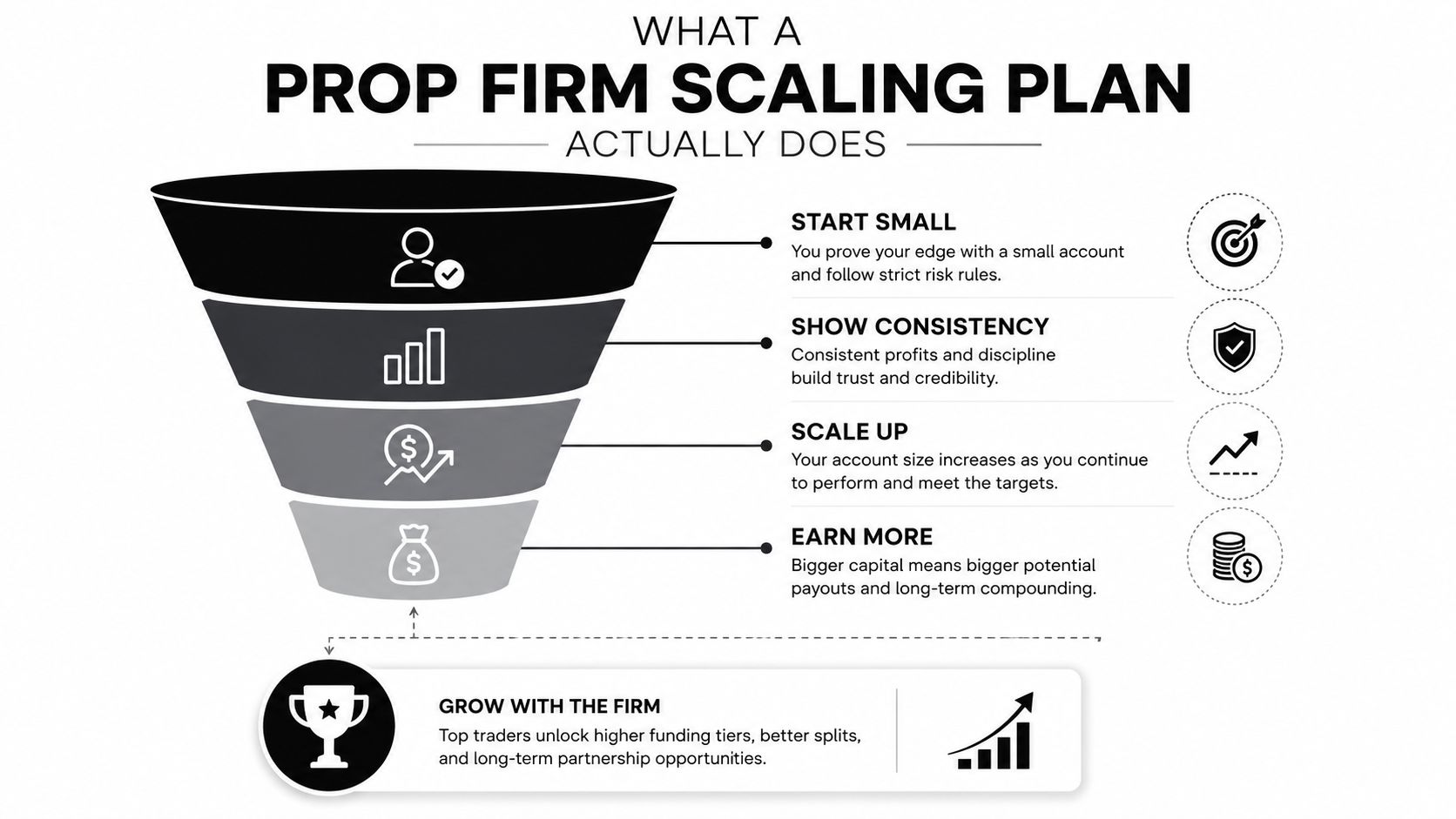
The ladder after funding
A published scaling ladder normally connects several items:
- Starting allocation: The account size or buying-power limit available after funding.
- Profit milestone: The realized gain required before the firm reviews or applies an increase.
- Next tier: The larger allocation, contract ceiling, or position limit accessed after approval.
- Payout structure: The profit split that applies at the current level, if the firm changes it as the account grows.
- Risk boundaries: Daily loss and maximum drawdown rules that remain active at every stage.
The practical benefit is access to more notional capital without buying another evaluation. Depending on the program, the trader may gain permission to trade larger positions, more contracts, or a larger account balance. Some programs may also reduce certain monitoring restrictions after a proven track record, but that isn't universal and must be confirmed in the firm's current rules.
The marketing version might show a path from a small account to a much larger allocation. The operational version is conditional. If the trader misses the minimum-day rule, breaches drawdown, or produces an overly concentrated profit pattern, the next tier can remain locked even after the headline target is reached.
Mentor's rule: Treat every scale-up as permission earned for the next risk tier, not as an entitlement created by one good trade.
A scaling plan can therefore be single-account or multi-account. A single-account model increases the size of one funded account. A multi-account model adds accounts as milestones are achieved. Both require the same discipline: larger access only helps if your risk process survives the larger exposure.
Core Mechanics Behind Scaling Triggers
Profit is usually the most visible trigger, but it's rarely the only gate. Industry guides describe scaling ladders with profit targets commonly between 5% and 10%, with reviews often occurring every 60 to 90 days or quarterly, as outlined in MyFundedCapital's explanation of scaling. The exact rule varies, so you should read the plan as a checklist rather than assuming the percentage alone decides your promotion.
Four gates traders need to satisfy
Profit milestones measure whether your current allocation can produce realized returns. A firm may require a defined profit threshold before moving you to the next tier, but the relevant figure is usually closed, realized profit rather than a temporary floating gain.
Consistency rules test the quality of those returns. A trader who earns nearly all profits in one outsized session may have hit the account target, yet still fail a scaling review because the result doesn't demonstrate repeatable execution. The PropAccount scaling guide identifies consistency and minimum trading activity as frequent reasons traders miss a scale-up.
Minimum trading days prevent a lucky burst from satisfying the entire review. You may reach the profit threshold early, but the firm can still require activity across additional sessions before it accepts the result. Don't keep increasing risk just to create activity. The safer approach is to continue using your normal setup and position limits.
Review cadence determines when the firm checks eligibility. Some programs use a staged trigger that applies soon after all conditions are met. Others review performance on a monthly or quarterly schedule. A longer window gives the firm more information across changing market conditions, while a shorter window creates faster feedback but may place more weight on recent variance.
| Trigger | Typical range | Purpose |
|---|---|---|
| Profit milestone | 5% to 10% | Tests whether the trader can generate realized returns at the current tier |
| Review cadence | 60 to 90 days or quarterly | Measures behavior across more than one market environment |
| Consistency control | Firm-specific | Prevents one unusually large session from dominating total profits |
| Minimum trading activity | Firm-specific | Separates repeatable participation from a short winning burst |
Why the gates work together
Think of scaling as an AND condition. You need the profit result, acceptable distribution of profits, enough trading activity, and no risk breach. Missing one condition can block the entire event.
That's why a trader should track more than balance. Record realized profit, largest winning session, number of trading days, current drawdown, and the exact date or condition for the next review. A dashboard that shows only total equity can make a nearly eligible account look ready when it isn't.
Risk Limits and Why They Gate Every Scale-Up
A firm has a practical reason to focus on realized profit. Floating equity can look strong while positions remain open, but that gain can disappear before the account produces an accepted result. Scaling on unrealized equity would give traders more capacity before they've demonstrated that they can protect a completed gain.
Daily loss and maximum drawdown provide the rails around the profit target. Across funded-trader programs, common benchmarks place the daily loss limit around 3% to 5% and maximum drawdown around 6% to 10%, according to guidance on instant-funding rules from Goat Funded Trader. These are industry benchmarks, not a universal contract. Your firm's rule may be static, trailing, or calculated using a different balance reference.
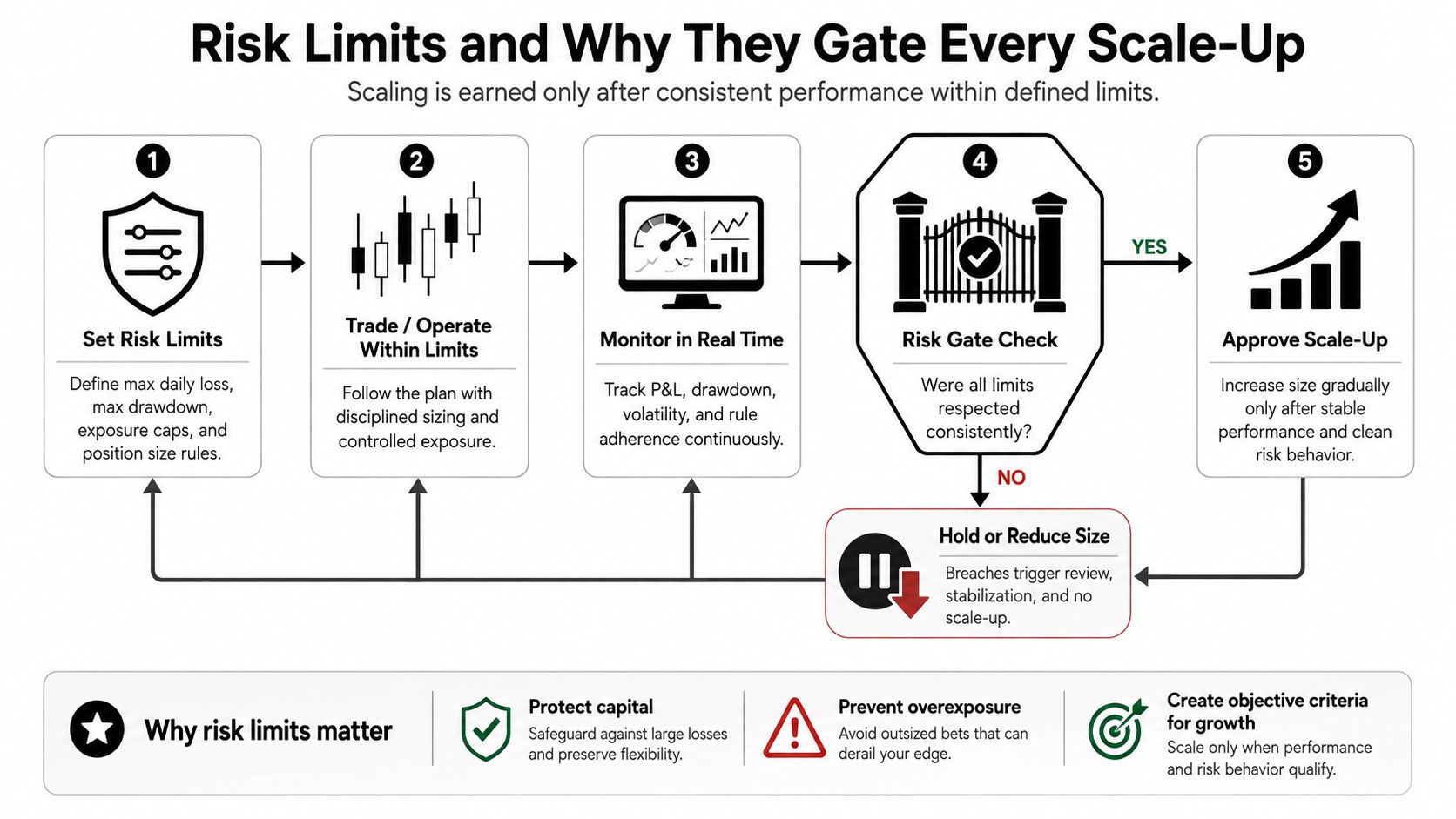
The interaction between profit and drawdown
Suppose your platform shows a large open gain. That equity may appear to put you near the next milestone, but the firm may not count it until you close the trade. If you then hold too long, reverse direction, and breach the daily loss limit, the scale-up disappears along with the realized result.
The same principle applies to a trailing drawdown. If the account's loss threshold follows your highest recorded balance, a profitable period can move the risk floor upward. A later loss then has less room than the original account setup suggested. The MyFundedCapital guide to trailing drawdown is useful for understanding why the relationship between current equity and the moving threshold matters.
Daily loss and maximum drawdown are separate controls. A daily breach can fail an account immediately, while exceeding the account's cumulative drawdown can end the evaluation or funded account, as explained in this resource on what are margin calls from Kons Law.
Scaling is controlled compounding. The firm wants evidence that you can preserve capital at the current tier before it grants more exposure.
A sound plan therefore uses smaller risk than the maximum the rules permit. Independent guidance commonly places per-trade risk around 0.5% to 1% when traders operate under daily and maximum-loss ceilings, as described in the earlier Goat Funded Trader guidance. That range isn't a universal recommendation, but it illustrates the central idea: a scale-up should follow controlled repetition, not a single aggressive push.
Comparing Staged Milestone Models vs Review-Window Models
Two broad structures appear in funded trading. A staged milestone model gives you a visible ladder. You reach a defined profit condition, satisfy the other rules, and move to the next allocation tier. A review-window model evaluates your behavior across a specified period, often combining realized profit with consistency and activity requirements.
The staged model is easier to plan. You know what the next target is, and each completed stage gives immediate psychological feedback. The weakness is that a fixed milestone can encourage traders to chase the number, especially when the account is close to the threshold.
A review-window model slows that impulse. The firm can examine how profits were produced over a broader period instead of treating the account as eligible because it briefly crossed a line. Industry guides describe review periods ranging from 60 to 90 days or quarterly, while some public frameworks use shorter windows. Always verify the exact schedule and calculation method before choosing a program.
| Criterion | Staged milestone model | Review-window model |
|---|---|---|
| Main trigger | Defined profit milestone | Performance assessed across a review period |
| Trader visibility | Clear next target | Broader scorecard |
| Main advantage | Predictable progression | Better view of consistency and variance |
| Main risk | Encourages target chasing | Can feel slower or less immediate |
| Best fit | Traders who want explicit steps | Traders who prefer stability-weighted evaluation |
How to choose between them
Choose a staged structure if you execute well with clear targets and can resist increasing risk near the finish line. The ladder gives you a simple operating question: what conditions remain before the next tier?
Choose a review-window structure if your edge produces moderate, steady returns and you don't want one session to define your record. It can be more demanding operationally because you'll need to monitor activity, profit distribution, and drawdown throughout the window.
Public examples are often discussed using names such as FTMO for staged progression and MyFundedFX for review-oriented frameworks. Those references don't establish a universal rule for every plan. They illustrate why traders must compare the actual terms, including whether the account cap, split, review date, and consistency formula are fixed or conditional.
The better model is the one whose rules match your trading behavior. A fast intraday trader who relies on occasional large sessions may struggle with consistency screening. A lower-variance trader may prefer a review window, even if the capital increase takes longer.
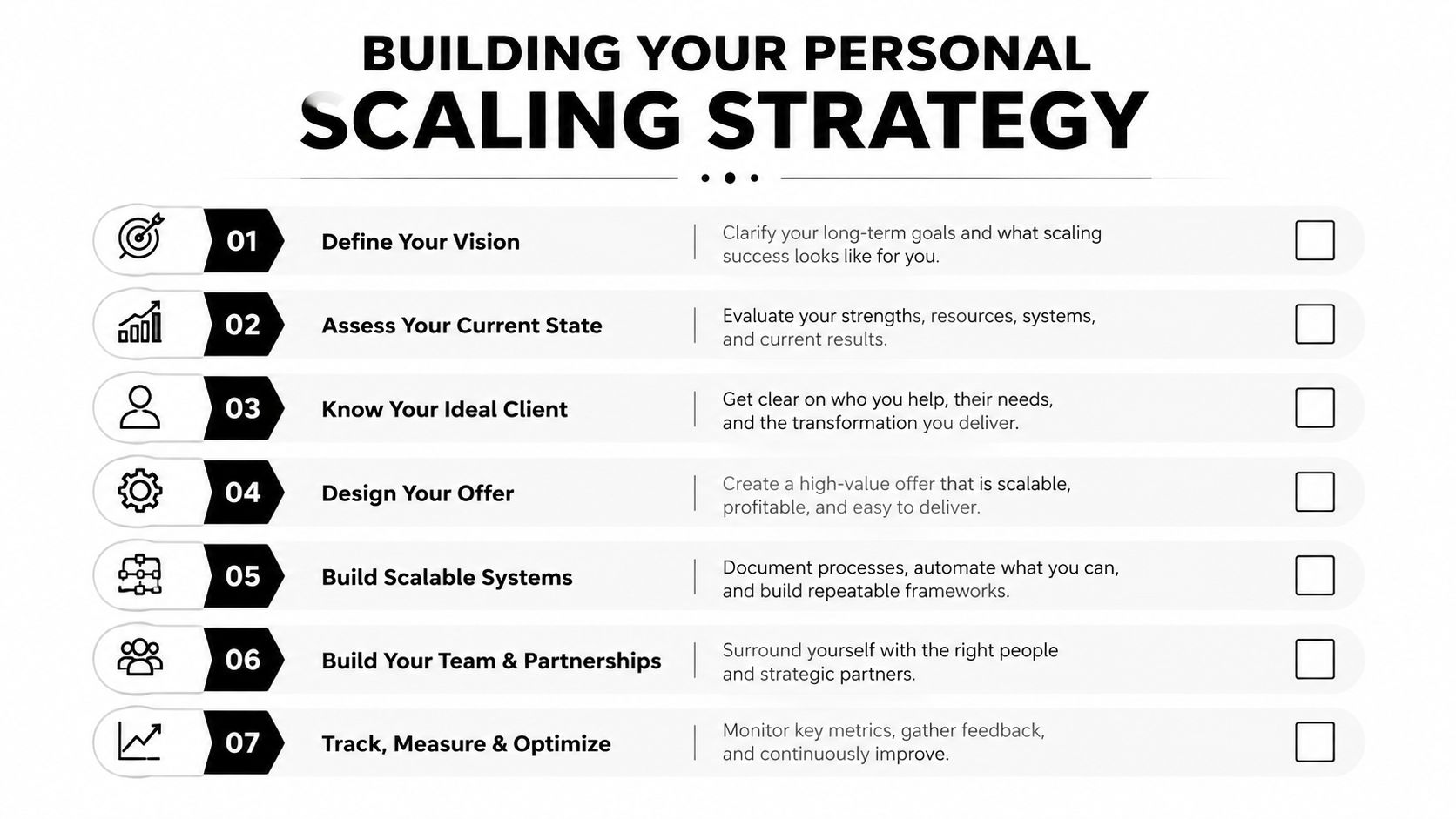
Building Your Personal Scaling Strategy
Your personal plan should begin with the firm's smallest meaningful risk unit, not with the maximum position size displayed in the marketing material. The objective is to remain eligible long enough for your results to become statistically more informative.
Set risk from the account ceiling
If you're trading a $10,000 account and working toward a $25,000 scaling level, a conservative framework might use approximately 0.5% risk per trade, as illustrated in the scaling guidance provided for this type of progression. That example is not a promise or a universal rule. It demonstrates how a trader can create distance between normal losses and the firm's daily loss limit.
Write down these controls before your first session:
- Per-trade loss: Set a fixed maximum based on the account and stop distance.
- Daily stop: Stop trading well before the firm's hard daily limit.
- Maximum open risk: Include correlated positions, not only each trade separately.
- Position reduction: Cut size when the account approaches its drawdown floor.
A trader who risks too much can hit the profit target and still lose eligibility through one reversal. Trading smaller may feel slow, but it protects the review record that scaling depends on.
Keep profit distribution ordinary
Consistency rules often penalize a single session that represents an excessive share of total gains. Public guidance commonly discusses a threshold around 25% to 30% in some programs, while other frameworks use different formulas. Don't assume your firm calculates the ratio the same way.
Use a journal field for largest winning day as a percentage of total realized profit. If one day dominates, reduce risk and allow future sessions to build a broader record. Never force trades to manufacture activity. A minimum-day requirement exists to test behavior over time, not to reward random entries.
Use a review checklist
At the end of each session, record:
- Realized profit or loss.
- Largest winning day as a share of total profit.
- Current trailing or static drawdown position.
- Trading days completed in the current window.
- Remaining distance to the next allocation tier.
- Any rule warning, platform issue, or unusual execution event.
Add a pause rule after a breach. A cooling period lets you identify whether the problem came from position sizing, revenge trading, news exposure, or a misunderstood calculation. Restarting immediately with the same process usually repeats the same failure.
How MFC's Scaling Path Fits the Framework
MyFundedCapital's published structure gives traders several entry routes rather than one universal ladder. Its account sizes range from $5K to $100K, with scaling paths advertised up to $500K. The firm supports manual, algorithmic, and copy trading across 350+ instruments, including forex, indices, crypto, and commodities, through DXtrade and cTrader, with MT5 listed as coming soon.
That product structure fits the broader framework in one important way. The trader begins with a defined allocation and must operate inside explicit risk parameters before larger access becomes relevant. MFC describes a flat 5% daily loss limit and maximum drawdown of up to 10%, while profit splits start at 80/20 and can be upgraded to 90/10 or 100%, depending on the applicable program and conditions.
Where the model matches the ladder
The match is clearest in the relationship between capital and discipline. Larger account access isn't a substitute for controlled execution. A trader must understand how the daily loss calculation works, whether drawdown trails, and how the firm treats open positions, overnight exposure, news, and weekends.
MFC offers Instant Funding as well as 1-Step and 2-Step Challenges, so the path can suit traders who want immediate live-style trading or a structured evaluation. The Second Step Program is relevant for traders comparing a staged challenge route with an instant-access option.
Where review discipline matters
A headline profit result doesn't tell you whether an account qualifies for the next stage. The same hidden gates discussed earlier still matter: consistency of gains, minimum trading-day requirements, and the absence of daily or maximum drawdown breaches. Check the current MFC terms for the exact formula, because account type and optional add-ons can change the conditions that apply.
Optional features include news trading, weekend holding, and faster payouts. Payouts may be available every 7 to 14 days or on demand, with average processing described as around 24 hours, but availability depends on the selected program and its rules. The accounts operate in demo environments with real market quotes, which means the evaluation measures execution and discipline without turning the arrangement into a guarantee of personal profit.
Operationally, MFC's path is best understood as a hybrid. The advertised account tiers and scaling ceiling provide milestone predictability, while risk limits and any consistency review determine whether a trader can keep progressing. Benchmark your own journal against those conditions instead of focusing only on the largest possible allocation.
Scaling Into 2026 and Your Next Steps
The industry direction is toward more behavior monitoring, not unlimited access. Coverage of the 2025 market shift describes firms placing greater emphasis on fraud prevention, trader surveillance, and consistency analysis as challenge-passing services, signal mirroring, and rule circumvention became more common, according to Investing.com's analysis of the prop-trading shakeout. For 2026, that points toward a projection of tighter capital deployment, more hybrid reviews, and stronger scrutiny of trading behavior rather than looser scaling rules.
Use this four-step process before applying:
- Audit your current record: Check consistency, trading days, daily loss exposure, and maximum drawdown.
- Simulate a review period: Run at least one complete trading cycle against the chosen firm's published benchmarks.
- Journal position risk: Record planned and actual risk for every trade, including correlated exposure.
- Apply with a funded-account plan: Define your daily stop, scaling conditions, and pause rule before you start.
Trading involves risk of loss, and simulated funding programs still require careful review of their terms, calculations, and payout conditions. Treat scaling as a test of repeatable process, not a shortcut to guaranteed income.
MyFundedCapital offers Instant Funding plus 1-Step and 2-Step Challenges, account sizes from $5K to $100K, and advertised scaling paths up to $500K with defined daily-loss and drawdown parameters. Visit MyFundedCapital to compare the available funding routes, review the current scaling conditions, and choose a challenge structure that matches your trading process.
