You’ve probably looked at a funded challenge before and thought the same thing most traders do: the rules look simple until you try to trade them without slipping up. The second step program model is built for traders who can produce decent setups, but need to prove they can follow risk rules under pressure.
This guide treats the program the way a desk mentor would. Not as a list of conditions, but as a test of decision-making, position sizing, and patience. Trading involves risk of loss, and this is educational only, not financial advice.
Free resources: Prop Trading Challenge Survival Guide (the math behind the rules and the habits that get traders through).
What Is the MyFundedCapital Second Step Program?
A second step program is a two-phase trading evaluation. You trade a simulated account, hit the required targets, stay inside the loss limits, and then move toward a funded account if you pass both phases.
That structure exists for a reason. A lot of traders can put together a hot week. Far fewer can do it twice, under rules, without letting one bad day wipe out progress. Two-step models screen for exactly that.

The appeal is obvious if you’re undercapitalized. Your personal account might be too small for your edge to matter financially, even if your execution is solid. That’s one reason the broader evolution of funded trading has pulled in so many traders who want access to larger simulated capital without adding more of their own cash.
What the program is really testing
The second step program doesn’t just test whether you can make money. It tests whether you can:
- Follow a plan under constraints
- Limit damage when the market gets messy
- Avoid emotional overtrading after wins or losses
- Repeat performance instead of gambling for a quick pass
That last point matters most. Prop evaluations usually don’t fail because a trader has zero skill. They fail because the trader changes size, forces entries, or loses track of drawdown after a streak.
Practical rule: If you need one oversized trade to pass, you’re probably trading in a way the evaluation is designed to filter out.
Who this suits
This kind of program tends to fit traders who already have:
- a defined setup
- basic journaling habits
- control over position sizing
- patience to wait for clean conditions
It’s a weaker fit for traders who rely on impulse entries, revenge trading, or oversized news bets. The rules expose those habits quickly.
Inside the 2-Step Challenge The Evaluation Phases
You finish your third clean trading day, the account is up, and the temptation shows up right on schedule. Push size now and you might clear the target fast. Push size at the wrong time and you fail an evaluation you were managing well. That is the pressure inside a 2-step program.
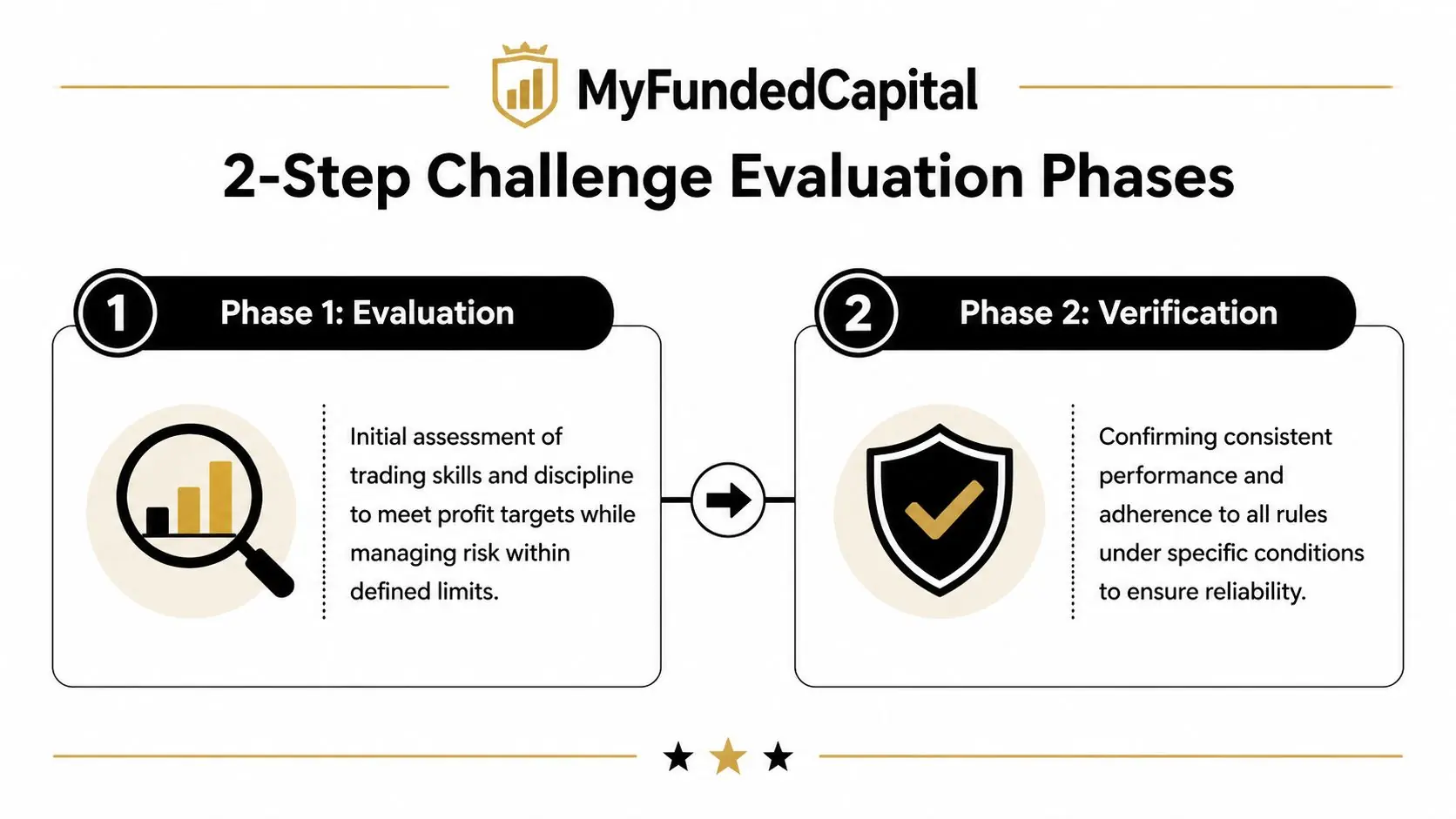
The two phases look simple on paper. In practice, they ask for two different gears.
Phase 1 The Challenge
Phase 1 is the performance phase. The account has to move. On MyFundedCapital’s 2-step model, the usual structure is an 8% profit target, a 5% daily loss limit, and up to 10% maximum drawdown. Operational terms such as minimum trading days can vary by setup, so check the live 2-step challenge rules and account table before buying.
Those numbers have strategy consequences.
An 8% target is high enough that low-frequency, ultra-defensive trading often leaves you stuck in the middle. You need enough opportunity flow to make progress, but every increase in trade frequency also increases the odds of a bad sequence. That trade-off is where many traders lose the account. They do not fail because they cannot read price. They fail because they start treating the target like a deadline.
Three mistakes show up over and over in Phase 1:
- Starting with full-size risk before reading current volatility
- Trying to win back red days immediately
- Taking mediocre setups because the target feels far away
A better approach is controlled offense. Risk small enough to survive a rough patch, but large enough that your A setups still matter. If your normal system needs twenty average trades to reach the target, the issue is not motivation. The issue is fit. Either the setup frequency is too low for the evaluation window, or the per-trade expectancy is not strong enough under challenge constraints.
Phase 2 The Verification
Phase 2 is usually easier mathematically and harder mentally.
The profit target typically drops to 5%, which sounds like a formality. It is not. Traders often get through Phase 1 with sharp focus, then give back their edge in Verification because they feel nearly funded and stop respecting the process that got them there.
This phase is less about proving you can press and more about proving you can stay the same. Same risk. Same setup quality. Same patience.
That sounds simple. It rarely feels simple when the finish line is close.
A solid Phase 2 trader usually makes a few practical adjustments:
- Trades less often
- Passes on B-grade setups
- Protects open profit faster
- Keeps size stable instead of trying to finish in one session
The mistake here is not usually underperformance. It is impatience. A trader up modestly in Verification often starts taking extra trades that were never part of the original playbook. That is how a smaller target becomes an avoidable reset.
Phase 2 should look cleaner than Phase 1, not more aggressive.
What each phase is actually testing
A lot of guides stop at the rule list. That misses the point. The rules shape the kind of trader who passes.
| Phase | What the rules force you to do | Typical failure pattern | Better operating mindset |
|---|---|---|---|
| Phase 1 | Generate returns without losing control | Oversizing to reach the target faster | Selective aggression |
| Phase 2 | Repeat the process without drift | Relaxing standards after early gains | Professional restraint |
That difference matters. In Phase 1, the challenge pushes you to find enough high-quality opportunity. In Phase 2, it pushes you to avoid giving back progress through boredom, confidence, or urgency.
How a professional reads the evaluation
Read each phase as a strategy filter.
An 8% target favors traders with a repeatable setup, enough frequency, and the discipline to press only when the setup justifies it. A 5% daily loss limit punishes anyone who lets one bad session become a spiral. Maximum drawdown up to 10% leaves room for normal variance, but not for sloppy execution repeated over several days.
That is why the two-step format works as a screening tool. It does not just ask whether you can have a good week. It asks whether your method can produce gains, absorb pressure, and stay intact across two separate phases.
Understanding the Trading Rules and Limits
A trader can read the market correctly, catch the direction, and still fail the challenge by mishandling the account rules. That is the part newer traders miss. The setup can be good and the execution can still be disqualifying.
Rules are not paperwork. They define what kind of strategy the account can support. If you ignore that, you end up forcing a trading style into limits it was never built to survive.
Daily loss is usually the first real stress test
Daily loss limits punish emotional trade management faster than almost any other rule. The trap is simple. A trader sees only closed losses, while the firm may be judging the account by equity during the session. Open drawdown matters.
That changes how intraday traders need to operate. If your strategy needs room for pullback, size has to come down. If you trade around news, exposure has to be smaller or flat before the release. If your edge depends on scaling into heat, the daily cap can make that style a poor fit unless the scaling plan is extremely controlled.
I tell traders to stop asking, “How much can I make on this trade?” Start with, “How much intraday pain can this account tolerate if I am wrong or early?”
Maximum drawdown sets the boundaries of your style
A static drawdown gives you a fixed line in the sand. A trailing drawdown keeps tightening the leash as the account grows. Traders who confuse the two often make bad sizing decisions for opposite reasons. Some freeze and undertrade. Others assume they have more room than is available.
The strategic point is straightforward. Drawdown rules decide whether your method should be aggressive, moderate, or defensive.
- Wide-stop swing ideas need smaller size and fewer concurrent positions
- Higher-frequency intraday systems need tight loss control so a rough session does not bleed into the account limit
- Correlated trades have to be treated as one combined risk event, not three separate ideas
- Volatile sessions call for reduced size, even if the setup quality is still there
If you are comparing account options, keep the official 2-step account rules table open while reviewing your plan. The goal is to choose a structure your strategy can survive, not one that only looks attractive on paper.
Operational rules matter more than traders expect
News restrictions, weekend holding policies, and automation rules are not side details. They can invalidate an otherwise solid approach.
A breakout trader who needs NFP volatility has different constraints than a session scalper who is flat by the close. A swing trader who builds positions over several days needs holding flexibility. A trader using EAs or copy execution needs policy clarity before the first order goes live, not after a breach review.
That is the actual trade-off. More freedom usually comes with more variables to control. More restrictions can protect reckless behavior, but they can also make some profitable systems unusable in the challenge environment.
The failures are usually ordinary
Accounts rarely get disqualified because of one exotic mistake. It is usually a sequence of basic errors.
- Stops widened after entry
- Losers added to without a preplanned risk cap
- Multiple related positions treated as if they are uncorrelated
- High-impact news held through without adjusting exposure
- Floating loss ignored because the original thesis still “looks right”
That last one ends a lot of evaluations. Being right later does not help if the account is already gone.
A practical pre-session check
Use a short checklist before every session starts:
- Know your remaining daily and overall loss buffer
- Mark high-impact news and decide in advance whether you will trade it
- Count total open risk, including correlated positions
- Confirm holding, EA, and copy-trading permissions for that account
- Reduce size or stand down if focus is poor
That last step is not mindset talk. It is account preservation. Bad concentration shows up first as late exits, missed stops, revenge entries, and unnecessary size. In a 2-Step program, those mistakes are expensive because the rules are tight enough to expose them quickly.
Proven Strategies for Passing the 2-Step Challenge
A trader who passes the second step program usually doesn’t have a magical setup. More often, they use a normal strategy with tighter process control than everyone around them.
The key is matching your approach to the structure of each phase. Same account. Different job.
Phase 1 needs selective offense
You need progress in Phase 1. Not reckless growth, but enough output to reach the larger target before frustration changes your behavior.
That means your strategy should have three traits:
- Clear invalidation
- Defined reward objective
- Enough frequency to create opportunity without forcing trades
If your system only produces a few clean entries a month, a two-step evaluation may feel slow. That doesn’t make the strategy bad. It just means the fit may be awkward unless the challenge terms allow enough time and your discipline remains intact.
The traders who struggle most here usually make one of two errors:
- They trade too small for too long, then panic and increase size.
- They start too large and spend the rest of the phase trying to recover from avoidable damage.
A middle path works better. Keep risk per trade stable and let expectancy do the work.
Build around fixed risk, not PnL emotion
A practical Phase 1 framework looks like this:
- Use one base risk unit for most trades
- Scale down after a drawdown, not up
- Take only A and B setups
- Stop trading for the day if execution quality slips
Notice what’s missing. There’s no “push harder when close to target.” That’s how traders turn a passing account into a reset.
Trading rule: Your best chance of passing often comes from making the next trade look exactly like the last good one, not from trying to make it bigger.
For traders who want a process template, the guide on how to pass a prop firm challenge is worth reviewing alongside your journal. The useful part isn’t motivation. It’s seeing how challenge rules force trade selection and pacing.
Phase 2 is about not giving the account back
Verification isn’t the time to prove bravery. It’s the time to prove repeatability.
A trader who enters Phase 2 with the same urgency from Phase 1 often creates unnecessary variance. The better approach is to trade less, accept smaller bursts of progress, and focus on protecting account health.
This usually means:
- fewer trades
- less impulse around news
- tighter adherence to your best session windows
- quicker disengagement after a good day
That last one matters. Traders often think discipline means fighting through adversity. In funded evaluations, discipline also means knowing when to stop because the day already did enough.
Strategy fit matters more than style labels
Scalping, intraday trading, and swing-style holding can all work if they fit the rules. The label matters less than the interaction between:
- your average stop size
- your trade frequency
- your emotional tolerance for drawdown
- the account’s loss limits
A scalper with precise execution can pass cleanly. A swing trader with patience can also pass, if the holding rules allow it and the open risk stays controlled. Problems start when traders use a style that clashes with the account mechanics.
Examples:
| Trading style | Works when | Fails when |
|---|---|---|
| Scalping | Execution is consistent and spread/slippage are accounted for | Trader revenge-trades after a few small losses |
| Intraday trend trading | Entries are selective and risk is planned before the session opens | Trader forces setups during dead hours |
| Swing trading | Holding conditions are allowed and size reflects overnight risk | Trader ignores event risk and weekend exposure |
The mindset shift most traders miss
Passing a challenge isn’t the same as maximizing a backtest. It’s a bounded performance task. The account has hard limits, so your strategy has to respect them before it reaches for profit.
That changes how professionals think about trades:
- A good trade is not just one with edge. It’s one whose downside fits the account.
- A winning day is not proof you should size up.
- A losing day is not a reason to “make it back.”
The strongest traders in these programs tend to be boring in the best way. They repeat, track, adjust, and stay unemotional when the market gets noisy.
Is the 2-Step Program Right for You?
Not every capable trader should choose a 2-step evaluation. Some do better with a single-phase model. Others prefer immediate access and accept different trade-offs.
The right choice depends less on confidence and more on how your strategy behaves under constraints.
MyFundedCapital Programs Compared
| Feature | 2-Step Challenge | 1-Step Challenge | Instant Funding |
|---|---|---|---|
| Evaluation hurdle | Two phases | One phase | No evaluation phase in the usual sense |
| Profit targets | Split across two stages, with a larger first target and smaller verification target | Single target structure | Not based on passing an evaluation sequence |
| Drawdown focus | Strong emphasis on surviving both phases cleanly | Strong emphasis on meeting target without a second reset point | Ongoing risk control matters from day one |
| Time to funded status | Longer than one-step or instant models | Shorter than a two-step path if passed quickly | Fastest access path |
| Best fit | Traders with patience and stable process | Traders confident in execution and willing to clear one hurdle | Traders who want immediate access and accept different constraints |
| Psychological pressure | Changes between offense and preservation | Front-loaded | Continuous from the start |
Who tends to fit the 2-step model
The 2-step route suits traders who like structure and don’t mind earning progression in stages.
It’s often a good fit if you:
- already trade one or two setups well
- can stop after reaching a daily objective
- don’t need constant action to stay engaged
- accept that slower progress can be safer progress
It’s a weaker fit if you need flexibility more than structure, or if your strategy depends on conditions the challenge rules may restrict.
Pros and cons that matter in practice
Upsides
- The two-stage design forces discipline.
- Verification can expose bad habits before they become expensive.
- Traders who respect risk often prefer staged progression to all-or-nothing pressure.
Downsides
- Funding takes longer.
- Phase 2 can be mentally awkward because the target is smaller but the account can still fail.
- Traders who thrive on aggressive growth often get impatient.
The 2-step model rewards people who can stay emotionally flat while the account is still unfinished.
Profit split psychology matters
The publisher brief notes that profit splits can start at 80/20. That matters because payout structure shapes behavior over time. A trader psychology study cited by MyFundedCapital reported that traders on an 80/20 profit split took 15% less risk per trade on average than traders on a 50/50 split, suggesting higher splits can encourage steadier behavior.
That doesn’t mean payout terms make someone disciplined. It means incentives can support discipline if the trader already has process control.
A simple decision filter
Choose a 2-step challenge if these statements sound like you:
- I can follow the same process for weeks without improvising
- I’d rather pass methodically than rush
- I’m comfortable trading a verification phase after an initial win
- I care more about longevity than heroic short-term PnL
If not, another model may fit better.
From Challenge Fee to First Payout The Financials
A trader pays the fee on Monday, catches a clean move on Tuesday, and starts calculating payouts before phase one is even under control. That mindset burns accounts.
The money side of the second step program only looks attractive if you map the full path from fee to funded withdrawals. Fees, payout timing, and profit splits are not just account details. They change how you should trade the evaluation.
The fee matters less than your readiness
Treat the challenge fee as the price of testing execution under rules. If your process is still changing every week, that fee is usually money spent on impatience. If your entries, risk sizing, and session selection are already stable, the fee becomes a business expense tied to a defined attempt.
That distinction matters because the wrong trader focuses on nominal account size, while the right trader focuses on expected quality per attempt.
A simple filter helps:
- Weak journal and inconsistent execution the fee is a costly lesson
- Stable process with repeatable setups the fee can make sense
- Frequent strategy changes after losses wait before paying for evaluation
- Clear risk plan with rule awareness the fee has a practical purpose
The objective is preserving attempts. A trader who needs three resets because he keeps forcing trades has turned a manageable fee into an expensive habit.
Payout timing affects strategy choice
As noted earlier in the article, first payouts in a 2-step model typically come after you clear both phases, complete any funded setup steps, and reach the firm’s withdrawal conditions. In practice, this means the trader who chases a fast score often delays getting paid because he fails the evaluation before reaching the funded stage.
That is the strategic point many rule summaries miss. A slower, cleaner approach often gets to cash flow faster than aggressive trading that blows through the drawdown limit.
If you need the current operational details on withdrawals, phase transitions, or account handling, check the official 2-step challenge FAQ before you start. Policy assumptions are expensive.
Profit split only matters if your risk stays consistent
An 80/20 split sounds good on paper. It is good. But traders still sabotage themselves by trading differently when payout day gets close.
I have seen this pattern often. A trader builds steady progress, gets near a withdrawal window, then increases size to make the first payout feel more meaningful. That usually ends with a rule breach or a bad giveback. The account did not fail because the split was poor. It failed because the trader changed behavior at the wrong time.
Funded trading works better when your payout plan follows your risk plan, not the other way around:
- Keep the same per-trade risk near payout dates
- Do not force trades to hit a withdrawal target
- Judge performance over multiple payout cycles, not one good week
Scaling is only useful if your edge survives size
A larger funded account increases opportunity, but it also exposes weaknesses. Some strategies hold up well with more capital. Others break down because execution quality slips, liquidity windows get tighter, or the trader becomes too focused on dollar PnL instead of process.
Ask harder questions before you think about scaling:
- Can I execute the same setup with the same patience when the dollar swings are larger?
- Does my edge depend on market conditions that get harder to trade at higher size?
- Will I keep risk constant, or will bigger numbers pull me into emotional decisions?
A smaller funded account traded with discipline usually earns more over time than a larger account traded with urgency. That is the financial reality behind the second step program.
Common Questions About the Second Step Program
Specific questions usually decide whether a trader starts a challenge or keeps waiting. These are the practical ones that matter.
Can I use an Expert Advisor I built myself
Maybe, but don’t assume “algorithmic trading allowed” means every EA is acceptable in every setup. You need to verify the current policy on automation, execution style, latency-sensitive systems, and trade copying before you trade live on the account conditions.
The fastest way to avoid policy mistakes is to check the official 2-step challenge FAQ before using any automated workflow.
What if I pass one phase and want to pause
Operational handling can vary, so don’t rely on assumptions or stories from other firms. Check whether there are activation windows, support requirements, or timing rules tied to moving into the next phase.
If a pause is allowed, use it properly. Review your journal, not your PnL fantasies.
Are scalping and swing trading allowed
Style labels matter less than rule compliance. A scalp is fine if your execution stays inside the account limits. A swing trade is fine if holding conditions allow it and your overnight risk is sized correctly.
What usually breaks accounts isn’t style. It’s using a style without adjusting risk to match the rules.
How many accounts should I trade at once
Fewer than your ego wants.
If you haven’t shown consistent execution on one evaluation account, adding more usually multiplies mistakes, not opportunity. Multi-account trading only makes sense when your process is already stable, your risk tracking is clean, and you can manage correlated exposure without confusion.
Trade one account well before you try to look like a portfolio manager.
Your Next Step to Getting Funded
The second step program works best for traders who can balance offense with restraint. The first phase asks for controlled performance. The second asks whether that performance can hold up under pressure without sloppy risk decisions.
If your strategy is defined, your sizing is consistent, and you can respect hard limits without improvising, this model can be a sensible path toward larger simulated capital. If you’re still chasing excitement, it probably isn’t time yet. Trading involves risk of loss, and none of this guarantees funding or future profits.
If you want to compare challenge structures and see whether a staged evaluation fits your trading style, review the available funding options from MyFundedCapital and choose the path that matches your strategy, risk tolerance, and pace.