You can have a decent entry and still blow the trade because your exit logic was vague. That's the part most traders learn the hard way, usually after a good position turns into noise, then into regret. Exit strategy planning keeps you from making those decisions under pressure, and in prop-firm trading it can be the difference between passing a challenge and getting clipped by a rule breach.
Why Exit Strategy Planning Separates Consistent Traders From Account Blowers
A trader buys gold at 2,015. The position works fast, price pushes roughly $30 in profit, and the screen starts looking easy. Then a news spike hits, the move reverses, the unrealized gain disappears, and the trader closes flat after burning time, focus, and confidence.
That trade wasn't necessarily bad. The problem was simpler and nastier, there was no exit plan that already answered what to do when the move stopped behaving. Exit strategy planning is not about predicting every tick, it's about deciding in advance what happens when the market changes its mind.

What changes the game for traders under prop rules
Self-funded traders can survive plenty of bad exits if the account is big enough and the lesson lands. Prop-firm traders don't get that luxury. A single rule violation can end the account regardless of how good the setup looked on entry.
Practical rule: if the exit is not decided before the trade opens, the market will decide it for you later.
That's why this topic matters more than most traders admit. A solid entry can still fail if you hold through the wrong event, ignore a drawdown cap, or let a winner turn into a rule-breaking loser. For a broader example of how traders think about exits around event-driven setups, the discussion around intraday calls for Indian traders is useful because it shows how quickly timing can matter when the window is short.
The edge is not magical timing. It's discipline under uncertainty, and the rest of this guide stays there, in the trade-offs that matter when your account is on the line.
Building Your Exit Decision Tree
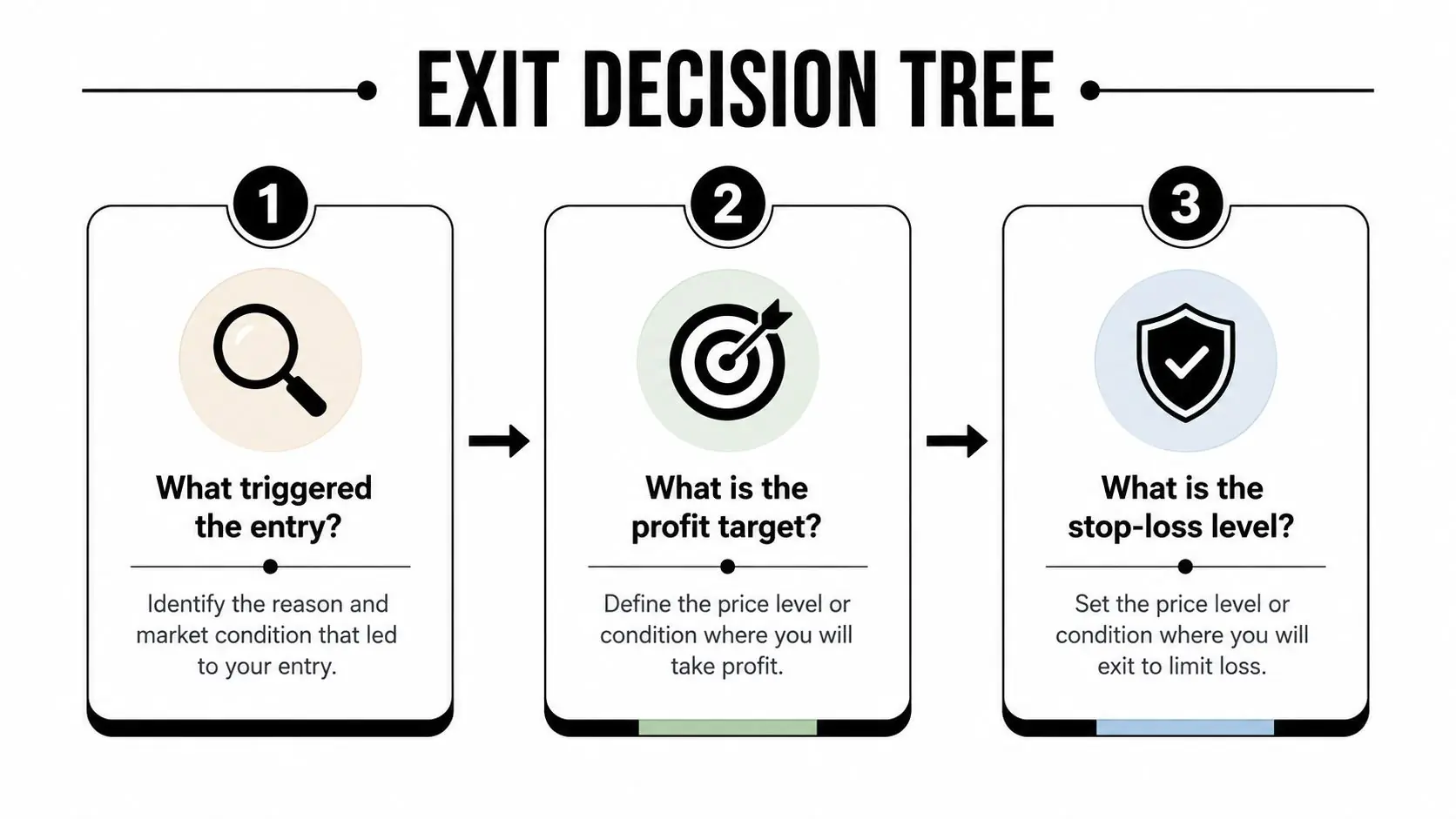
A useful exit framework starts with three questions and refuses to trade without answers. What triggered the entry, what would invalidate the thesis, and what is the planned exit path if price behaves normally, slowly, or violently. If those answers are fuzzy, the trade is already compromised.
Start with the reason you entered
The exit decision tree begins with the entry trigger because every trigger has a different failure point. A breakout trade, a mean-reversion scalp, and a swing on a commodity all fail for different reasons. If you don't name the trigger clearly, you can't know when it's dead.
A 50-pip scalp on GBPUSD during the London open doesn't deserve the same exit treatment as a 300-pip XAUUSD swing over several sessions. One is about speed and location, the other is about room and follow-through. Mixing those two is how traders either cut winners too early or give back too much.
Tie the exit path to time, size, and regime
Position size changes the decision tree. So does the market regime. A tight range with poor follow-through calls for a different exit path than a trend day with clean momentum and shallow pullbacks.
Use a simple structure:
- Entry trigger define the exact setup in one sentence.
- Invalidation level name the price or condition that kills the idea.
- Exit path choose partials, full exit, or a trail before the trade goes live.
- Time limit decide how long the setup gets before you flatten it.
A crypto trader holding through a FOMC-driven spike may take partial profits into the impulse and leave a reduced runner only if the structure stays intact. A forex trader in a tightening European session range may use a time-based exit because the setup is stalling, not because the trade is “bad.” A CFD trader who can't hold over a restricted event needs to flatten before the window closes, not after.
The decision tree is living, not fixed. If you review it after each trade, it gets sharper. If you keep improvising, it becomes a bad habit with prettier wording.
Stop-Loss and Take-Profit Rules That Actually Work in Live Markets
Fixed stops look clean on paper and messy on live charts. Markets don't care about round numbers, and retail traders love putting stops where everyone else can see them. The better move is to place exits around structure and volatility, not superstition.
Use structure first, not ego
A structural stop sits where the trade idea is wrong. A hope stop sits where the trader hopes price won't go. Those are not the same thing, and the market punishes people who confuse them.
For FX majors, a volatility-based stop usually makes more sense than a fixed pip number. If EURUSD is moving with wider-than-normal range, a 1.5x ATR stop gives the trade room without forcing a stop into obvious retail clustering. For a tighter session, the same logic still applies, but the distance should come from the chart, not a random rule.
For crypto, tight stops often get chewed up in volatile sessions. Broader confirmation bands, then staged profit-taking at structure points, usually fit the instrument better. The point is not to “never stop out,” it's to stop out where the setup is wrong, not where your broker can hunt for liquidity.
For indices CFDs, weekend gap risk matters because a stop isn't a shield against reopening away from your level. That's why position size has to account for the fact that a single overnight move can hit your prop-firm limit faster than a weekday drift.
Quick reference for exit sizing
| Instrument | Stop Sizing | Target Ratio | Typical Holding Window |
|---|---|---|---|
| FX majors | Structure or ATR-based, such as 1.5x ATR | Measured move or pre-set partials | Intraday to multi-session |
| Indices CFDs | Wider around session volatility, sized for gap risk | Structure-based or staged exits | Intraday, with caution overnight |
| Crypto | Broader confirmation band, then tighten after acceptance | Partial exits at structure levels | Variable, often wider swings |
A measured target beats an arbitrary percentage because it respects the chart's actual range and momentum. If you want a deeper look at how traders define that balance, the guide on stop-loss and take-profit is relevant to the mechanics, even if your own rules still need to fit the instrument and the day.
Trailing Stops and Time-Based Exits for Different Market Conditions
A trade that is still working should not be managed like a trade that has gone stale. Trending markets need room to breathe. Choppy markets need a deadline. Use the wrong exit tool, and you either cut a winner short or keep paying attention to a trade that already stopped doing its job.
Use trailing stops when price is proving you right
Trailing stops make sense when price keeps moving in your favor and the structure keeps confirming the move. You can trail by a fixed percentage, by ATR, or behind swing highs and lows. The method changes the feel of the trade, but the goal stays the same, protect open profit without killing the move before it has finished.
A gold position in a strong trend can start with a wider ATR trail, then move to a tighter stop behind structure once momentum starts to fade. That keeps the trade alive while the market is still expanding and protects it once the move begins to age. Tighten too early and you will get clipped by a normal pullback, then have to watch the market keep going without you.
For a detailed comparison of trailing stop types, see our guide on trailing stop limit vs trailing stop.
The stop should follow proof, not hope.
Use time-based exits when the trade stops progressing
A time-based exit is blunt, and that is why it works. If the setup has not done what it was supposed to do inside the time window you planned for it, the trade is done. No drama, no second guessing, no hanging on because the idea still feels right.
Range-bound conditions are where this matters most. Price can keep rotating without building real progress, and that drains both capital and focus. If the market has not made meaningful movement by the point your setup should have shown follow-through, flattening early is usually better than waiting for the market to prove you wrong in a larger way. Traders get hurt when a time-based exit turns into a hold, then the hold turns into a bigger loss.
Used together, these two tools solve different problems. Trailing stops protect trends. Time-based exits kill stale trades. If the market starts trending after a dead opening, switch from clock-based management to structure-based trailing. If momentum dries up, switch back to the clock and stop acting like the chart owes you another candle.
Prop-Firm Exit Constraints That Change Everything
Prop-firm rules don't just sit in the background, they rewrite your exit logic. You can have the best read in the world and still fail if one trade, one news spike, or one overnight hold breaks a rule. That's why a trader has to treat constraints as part of the strategy, not as fine print.
Daily loss and drawdown change how much room you can risk
A flat 5% daily loss limit means you can't think trade by trade in isolation. Two or three bad exits in a row can end the day even if each loss looked reasonable on its own. That forces smaller position sizes and stricter pre-planned exits so you don't compound damage inside the limit.
The up to 10% maximum drawdown cap changes how you manage risk as the account moves through the day or the evaluation. If you're closer to the threshold, the same stop distance becomes more dangerous, because a normal loss now consumes a bigger share of what's left. That's why size should shrink as the account gets more fragile.
News and weekend rules shape the way you hold
Many prop firms restrict trading around high-impact news or over weekends unless you've added a special option. If that's the rule set, then the exit plan has to respect the calendar, not argue with it. Scaling out before a known event is often cleaner than trying to survive the headline with full size.
Compliance beats conviction when the firm's rules are the real gatekeeper.
For traders who need to understand how a trailing limit is handled in practice, the explanation at what is trailing drawdown fits this topic directly. The key point is simple, if the firm measures risk by equity path, your exits have to keep the account from drifting into a breach while you're still in the trade.
A prop-firm checklist before you click buy or sell
- Daily loss room know how much loss you can still absorb.
- Drawdown distance check how far the account is from the cap.
- Event calendar mark news windows before the session starts.
- Weekend policy flatten unless the firm explicitly allows holding.
- Size adjustment reduce size before volatility, not after it starts.
The blunt truth is that prop trading rewards traders who manage fragility, not just direction.
Your Daily Exit Strategy Routine, From Preparation to Review
A clean exit plan only matters if you run it the same way every day. The best traders don't “remember” risk management in the heat of the moment, they build a routine that makes sloppy decisions harder to make. That routine has three parts, and each one should be boring on purpose.
Pre-market setup
Before the first trade, check the economic calendar, identify session overlaps, and mark any event that could change volatility. Set your daily loss threshold, calculate position size against the drawdown cap, and write your stop and target on the chart before you place the order. If you can't do that in a minute or two, the trade probably isn't ready.
A practical pre-market list looks like this:
- Calendar check identify news and session overlaps.
- Risk check confirm daily loss room and max drawdown distance.
- Chart levels mark the structural stop and the take-profit zone.
- Scenario plan define what happens if price stalls, spikes, or reverses.
In-trade management
Don't babysit every tick. Review the position on a clock, maybe hourly, unless your timeframe demands faster attention. Move the stop only when a new structure level forms, and scale out at predefined targets instead of reacting to every flicker in PnL.
The cleanest trades are managed with less emotion than most traders expect. If a setup calls for staying flat through a news event, that needs to be written into the plan before entry, not argued with when the candle starts moving. If the event isn't in the plan, you don't improvise around it.
Post-market review
Spend five minutes writing down what the exit did right or wrong. Note whether the plan fit the volatility, whether the rule set forced an early flat, and whether the exit protected capital or just protected ego. That review matters because repeated mistakes become habits fast.
If you want to pressure-test these habits in a realistic funded environment, MyFundedCapital offers Instant Funding and 1-Step or 2-Step Challenges across forex, crypto, and commodities, with clear risk limits and payout options that fit active traders. Visit MyFundedCapital to compare account types and see which funding path matches the way you already trade.