You're probably here because “manage your risk” gets repeated everywhere, yet most traders still learn it the hard way. You hit a daily loss limit, break a rule by one trade, or realize too late that your position size had no real logic behind it.
Professional firms don't treat risk as a mood or a personal strength. They treat it as a system. Once you understand risk management standards, prop firm rules stop looking random and start looking like simplified versions of the same controls large organizations use to stay alive.
Free resources: the free Drawdown Calculator.
Beyond Luck Understanding Professional Risk Management
A trader starts the session fine, takes two losses, sizes up on the third trade, and suddenly the day is over. Many would call that a discipline problem. It is, but it's also a framework problem.
Professionals build systems so one bad stretch doesn't turn into a business-ending event. That's the core point of formal risk management standards. They exist because smart people under pressure still make bad decisions, especially when money and uncertainty are involved.
For a bank, fund, or insurer, that means documented controls, reporting lines, and defined thresholds. For a trader, it means your max loss, position sizing, and stop-trading rules need to exist before the market opens. If you want a broader non-trading view of how firms structure these protections, this overview of Professional Risk Management is a useful companion because it shows the same principle in a business setting.
Risk rules aren't there because firms distrust skill. They're there because skill without limits can still blow up.
That shift matters. If you see risk rules as punishment, you'll keep fighting them. If you see them as survival tools, you'll start using them properly.
What Are Formal Risk Management Standards
At the enterprise level, risk management standards are the rulebooks that tell an organization how to identify threats, judge their importance, decide what level of risk is acceptable, and respond consistently.
Think of them like building codes for a skyscraper. The code doesn't tell tenants where to place a chair. It sets the structural requirements that keep the whole building standing. In the same way, standards like ISO 31000, COSO ERM, and NIST frameworks don't tell a trader where to enter EUR/USD. They define how an organization thinks about uncertainty, responsibility, escalation, and control.
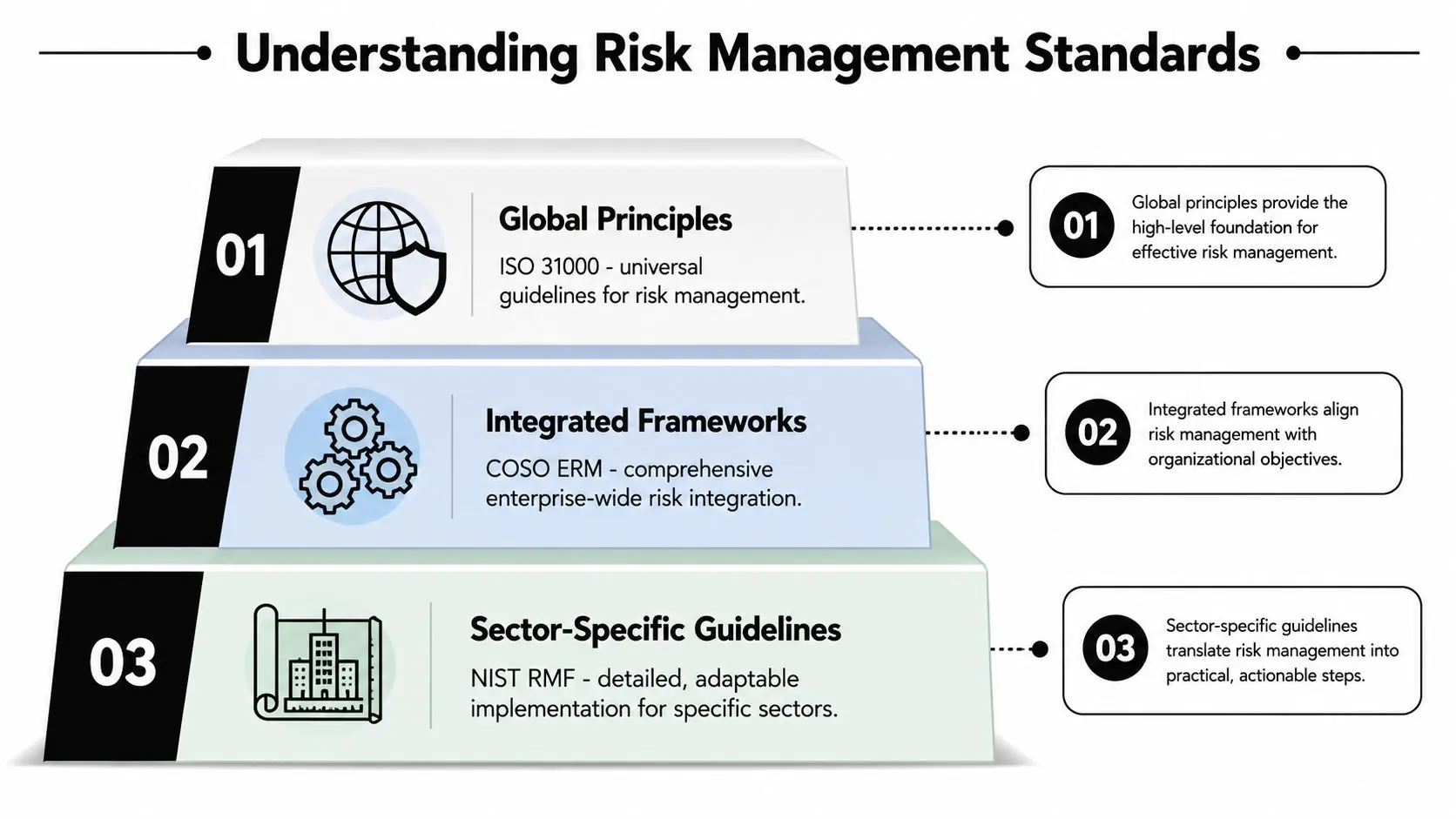
The main job of a standard
A formal standard usually helps an organization do four things:
- Identify risk What can go wrong in operations, markets, technology, compliance, or decision-making?
- Assess risk Which risks matter most, and what's the likely impact?
- Control risk What limits, approvals, safeguards, and monitoring should be in place?
- Review risk Are the rules still working, or has reality changed?
That sounds corporate because it is. But the logic translates cleanly to trading.
- A firm says risk appetite. You can read that as the total amount of pain the business is willing to accept while pursuing returns.
- A firm says risk tolerance. For you, that's the line where a trade, day, or account state becomes unacceptable.
- A firm says controls. You already know those as stop losses, loss caps, size limits, and restricted behaviors.
Why these standards keep spreading
This isn't a niche topic anymore. The global risk management market is projected to reach USD 35.9 Billion by 2032, growing at a 13% CAGR from 2024 to 2032, according to Continuity2's risk management statistics roundup. That projection reflects how widely organizations are adopting structured frameworks such as ISO 31000.
If you want a practical look at how organizations define the actual work behind these frameworks, nexus IT group's hiring guide is helpful because it shows that risk management isn't abstract theory. It gets turned into roles, responsibilities, and routine controls.
What traders usually miss
Retail traders often think standards are only about compliance. They're not. They're really about repeatability.
Practical rule: A risk process matters most when you're tilted, rushed, overconfident, or trying to win losses back.
That's why prop firms look the way they do. They aren't handing you a dense ISO document. They're handing you the operational version of one.
Translating Corporate Jargon into Trader Metrics
Most corporate language sounds distant until you map it to the numbers on your trading dashboard. Once you do that, the whole thing becomes easier to use.
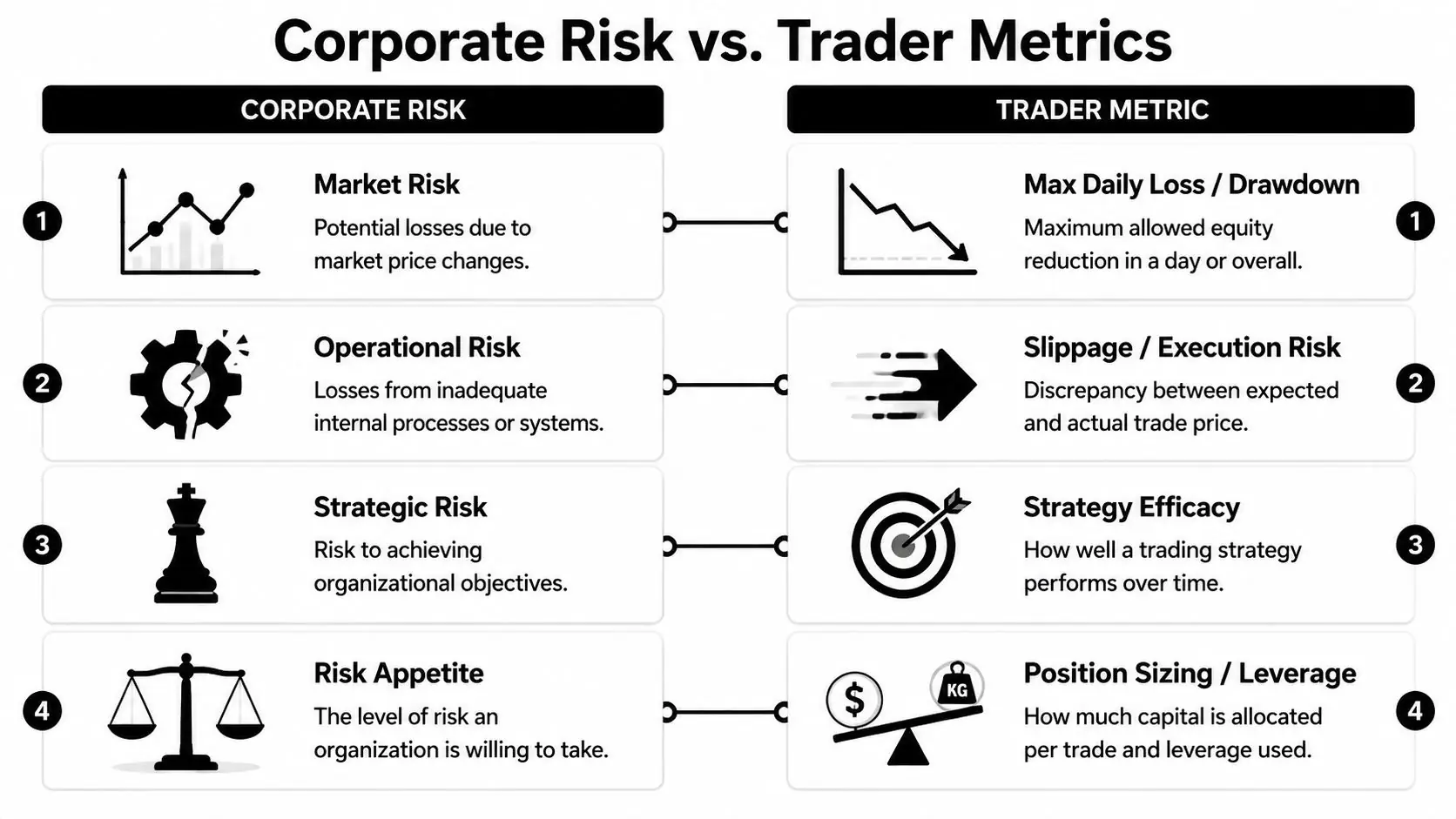
One language, two environments
Here's the clean translation.
| Corporate term | What it means in a firm | What it usually means for a trader |
|---|---|---|
| Risk appetite | Total risk the organization is willing to accept | Your account-level drawdown boundary |
| Risk tolerance | The allowed variation around that boundary | Your daily loss threshold |
| Control framework | The rules used to manage risk consistently | Stop losses, sizing rules, trade limits |
| Stress testing | Testing what happens under bad conditions | Asking what a losing streak or volatile session does to your account |
| Operational risk | Errors in process, systems, or execution | Slippage, platform mistakes, overtrading, order errors |
This is why prop firm rules shouldn't be read as isolated restrictions. They form a complete framework, even if the firm never uses that language.
Why many rulebooks still feel disconnected
There's a real gap between standards language and trader reality. A 2025 analysis of 12 major prop firm rulebooks found that 90% failed to link their 5% daily loss limits to any formal risk scoring methodology, as noted in the ASSP article on its risk assessment and management standard. That's why traders often feel they're being handed hard limits without the reasoning behind them.
So let's supply the reasoning.
- Maximum drawdown is your personal version of enterprise capital preservation.
- Daily loss limits are simplified stress controls. They stop a bad day becoming an account-ending event.
- Position sizing rules act like a trader-sized version of exposure limits.
- Consistency rules try to prevent one oversized day from distorting risk.
If you want a plain-English explanation of one of the most important examples, this guide to maximum drawdown helps because drawdown is the clearest bridge between corporate risk appetite and a trader's hard account boundary.
A prop rulebook is more coherent than it looks
Take a common setup with a daily loss cap, an overall drawdown cap, and rules around consistency, automation, or restricted behavior. That's not random. It's a compressed risk program:
- Daily cap limits short-term damage.
- Overall drawdown defines survival range.
- Execution rules reduce process risk.
- Consistency checks discourage reckless concentration of returns.
Traders often ask, “Why this rule?” The better question is, “What failure mode is this rule trying to stop?”
Once you read prop rules through that lens, they make more sense. They're not a corporate spreadsheet dropped on your head. They're the retail-sized version of it.
Prop Firm Rules as Your Risk Management Framework
Most traders read a prop rulebook the way people read a phone contract. They skim the painful parts, assume they'll deal with it later, and focus on the opportunity. That's backwards.
The rulebook is the framework. Your strategy sits inside it.
Read the rules like a risk officer
When you review a prop account, ask four questions.
What ends my day?
This is your short-term kill switch. It stops emotional escalation, revenge trading, and “I'll make it back” behavior.What ends the account?
This defines your true capital boundary. If you don't know this number cold, you're trading blind.What behavior is the firm trying to shape?
Consistency rules, holding restrictions, and automation policies usually exist to control concentration, event risk, or execution risk.What must I do before placing any trade?
Your personal process should be stricter than the firm's minimums.
Build a personal worksheet
Your worksheet can fit on one page. It should include:
- Per-trade risk limit The amount you're allowed to lose if the stop is hit.
- Daily stop-trading trigger The condition that ends your session before the firm has to do it for you.
- Maximum open exposure How many trades or correlated positions you can hold at once.
- Event rule What you do around major news, thin liquidity, or platform instability.
- Recovery rule What changes after a losing streak.
One practical benchmark is the 1% rule. To calculate maximum risk per trade, multiply your capital by 1% (0.01). On a $10,000 account, that equals a $100 maximum risk limit, as explained in Colibri Trader's guide to risk management.
Why consistency rules matter
A consistency rule is often frustrating because it stops traders from passing an evaluation with one oversized winner and weak process everywhere else. From a risk perspective, that's the point. It filters for repeatable behavior instead of one-day aggression.
If you want to understand how that logic works in prop trading, this explanation of the consistency rule in prop firms is a useful reference. It frames the rule as behavior control, not just an arbitrary hoop.
One example in this space is MyFundedCapital, which structures accounts around clear loss parameters and account rules rather than ambiguous moving targets. Whether you trade there or elsewhere, that's the standard you want to look for: rules you can calculate around before you enter a position.
A good framework doesn't remove pressure. It prevents pressure from changing your rules mid-trade.
Trading involves risk of loss. A prop account doesn't remove that. It just makes the boundaries explicit.
How to Build Your Personal Risk Management Policy
A firm's rules are the outer fence. Your own policy should sit well inside it.
That's where most traders go wrong. They use the prop firm's breach level as their working level. If the account allows more room than your strategy should use, you're giving emotion authority over sizing.
Your policy should answer these questions
Write your answers down. Don't keep them in your head.
- How much can one trade lose?
- How much can one day lose before you stop?
- How many open positions can overlap?
- What markets or conditions are off-limits for your setup?
- What happens after a mistake versus a valid loss?
If you need extra context on practical trader-side controls, this guide to forex risk management strategies is useful because it translates broad principles into daily trading habits.
A simple policy template
Use this as a starting point and tighten it based on your strategy.
Per-trade risk
Start with a fixed cap you won't exceed under any condition. If your stop placement would require more risk than your policy allows, skip the trade or reduce size.
The point is consistency, not maximum opportunity.
Session stop rule
Adopt the 3-Loss Rule, which locks a trader out for the day after three consecutive losing trades, as described in Bulls on Wall Street's day-trading risk guide. This works because losing streaks often degrade decision quality before traders notice it.
Exposure control
Don't judge exposure trade by trade only. Look at correlation.
Three separate positions can still be one directional bet if they all react the same way. A personal policy should cap combined exposure, not just single-ticket risk.
Manual trader versus algo trader
The policy should also reflect how you trade.
| If you trade manually | If you use EAs, bots, or copy tools |
|---|---|
| Focus on impulse control and session discipline | Focus on system boundaries and fail-safes |
| Predefine when you stop after errors or emotional drift | Predefine when the system stops after abnormal behavior |
| Review execution quality and adherence to plan | Review whether the tool acted inside expected parameters |
Apply model thinking without overcomplicating it
If you use automation, treat the strategy like a controlled process.
That means asking:
- What is the bot allowed to do?
- Under what conditions should it stop?
- What counts as abnormal behavior?
- Who is supervising it, you or nobody?
You don't need a corporate model risk committee. You do need clear boundaries, shutdown rules, and regular review. That's the trader version of governance.
If your bot can place trades faster than you can understand them, your controls need to be tighter than your confidence.
Educational only, not financial advice. Trading involves risk of loss, whether decisions come from you or from code.
Checklist for Evaluating a Prop Firm's Risk Rules
Some firms give you a usable framework. Others give you vague rules that only become clear after a violation. You want the first kind.
Use a checklist before you pay for any challenge or funded account. It's easier to compare firms when you judge them as risk environments instead of marketing offers.
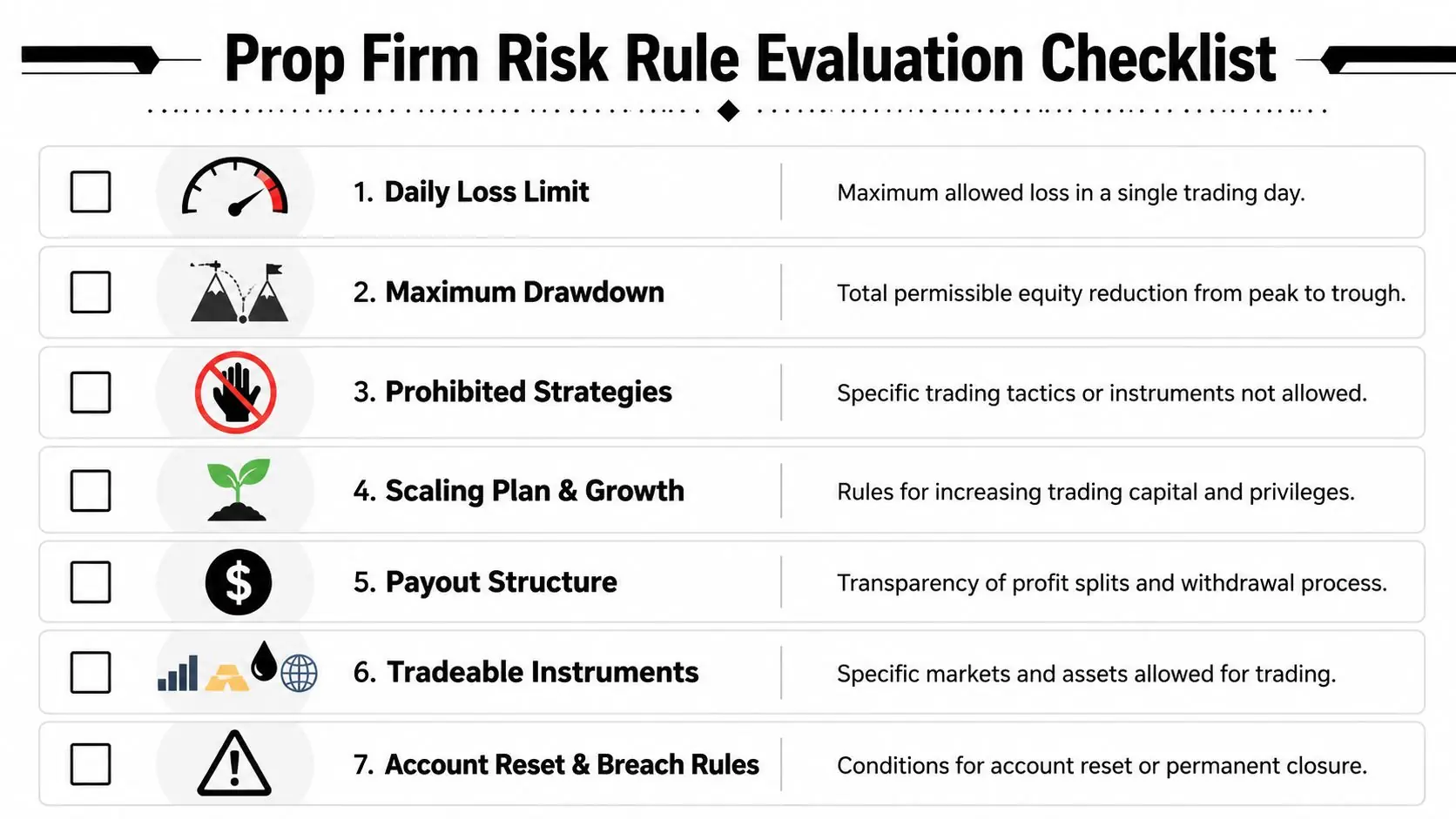
The evaluation checklist
- Drawdown type: Is it static or trailing? Static limits are usually easier to plan around because the boundary doesn't keep climbing with every equity peak.
- Daily loss calculation: Is the limit based on balance or equity? That changes how much room you really have during open trades.
- Rule clarity: Can you understand the breach conditions in one read? If the wording is fuzzy, assume disputes will be harder later.
- Strategy permissions: Are news trading, weekend holding, EAs, or copy trading allowed, restricted, or paywalled?
- Payout conditions: Read the withdrawal rules as carefully as the loss rules. Restrictions sometimes hide there.
- Account breach treatment: What happens after a violation? Reset, closure, review, or something less clear?
- Scaling logic: Does the growth path reward steady execution, or does it pressure bigger swings?
What good rule design looks like
A fair rule set usually has three traits.
It's easy to calculate
You should know, before entry, whether the trade fits. If a rule requires guesswork during market movement, it's weak risk design.
It controls behavior, not just outcomes
Good rules reduce the chance of reckless trading. Bad rules only punish after the fact.
It doesn't rely on hidden interpretation
If support has to “clarify” basic account limits over and over, the framework probably isn't clean.
A fast screening method
Use this quick pass when comparing firms:
| Question | Good sign | Warning sign |
|---|---|---|
| Can I explain the loss rules in one minute? | Clear and fixed thresholds | Exceptions and vague wording |
| Can I model my sizing before trading? | Predictable boundaries | Moving or confusing constraints |
| Do strategy permissions match my style? | Explicit allowed uses | Rules buried in FAQs or terms |
| Are breach consequences obvious? | Simple reset or closure terms | Ambiguous discretionary enforcement |
Rules shape behavior. If the framework is unclear, even a good strategy can fail for administrative reasons instead of trading reasons.
Frequently Asked Questions on Trading Risk
How should risk management change between day trading and swing trading
The structure stays the same, but the timing changes. A day trader usually needs tighter session rules, stricter stop-trading triggers, and more attention to execution quality. A swing trader needs more focus on overnight exposure, gap risk, and whether position size still makes sense when trades stay open longer.
The mistake is copying one style's rules into another. A day-trading framework that works intraday may be too tight for swings. A swing framework may be too loose for fast intraday trading.
What's the real difference between a soft breach and a hard breach in prop firms
A soft breach usually means you violated a rule that may limit account actions, trigger review, or block progression. A hard breach normally means the account is done.
The exact definitions vary by firm, so read the terms carefully. Don't assume the labels matter more than the consequences. What matters is what happens to your account, profits, and eligibility after the event.
Are EAs or copy trading tools a violation of risk rules
Not automatically. The issue is whether the firm permits them and whether your setup stays inside the account's execution and risk boundaries.
Many traders assume automation solves discipline. It doesn't. It just moves the discipline into system design, monitoring, and shutdown logic. If you use tools you didn't fully test or don't understand, you've added operational risk, not removed it.
Do risk management standards matter if I'm just one trader
Yes, because the core problem is the same at every size. You're trying to avoid a loss pattern that ends your ability to keep operating.
Large institutions formalize that with policy documents and committees. You do it with written limits, sizing logic, and a stop-trading process. Same principle, smaller scale.
If you want a prop environment where you can apply these ideas in a structured way, take a look at MyFundedCapital. You can compare funding paths, review account rules, and choose a setup that fits how you trade. Just keep the priority straight. Funding only helps if your risk process is solid first.