

 AR
AR
 NL
NL
 FR
FR
 DE
DE
 ES
ES
 PT
PT
 IT
IT
 PL
PL
 SV
SV

Manual trading usually breaks down the same way. You get tired, miss a clean setup, force a bad one later, then start managing risk based on frustration instead of rules. That’s when traders start looking at automated trading programs.
The right program can remove hesitation and enforce discipline. The wrong one just automates bad decisions faster. In prop trading, that difference matters even more because a bot has to do more than find entries. It has to respect platform behavior, drawdown limits, execution quality, and account rules in real time.
Introduction From Manual Grind to Automated Discipline
If you’re trading a prop evaluation manually, you already know the pressure points. You watch charts for hours, second-guess exits, and sometimes break your own plan after a losing streak. Automation can help, but only if you treat it like a professional system, not a shortcut.
That matters because algorithmic trading is no longer a niche strategy. It generates approximately 60-75% of the overall trading volume in the U.S. equity market according to Quantified Strategies. The takeaway isn’t that you need some mysterious black box. It’s that rule-based execution now dominates market participation, and discretionary traders who want consistency need to think in systems.
Practical rule: A bot doesn’t replace skill. It exposes whether your process is clear enough to code and strict enough to survive.
The traders who do well with automated trading programs usually accept three hard truths early:
- Your edge must be explicit. “I buy when momentum looks strong” is not a rule a machine can execute.
- Risk controls matter more than entries. A decent idea with strict limits lasts longer than a clever idea with loose controls.
- Compliance is part of strategy design. In prop trading, breaking account rules can kill a good system faster than a weak signal can.
Trading involves risk of loss, and automation doesn’t change that. This is educational only, not financial advice.
The Architecture of an Automated Trading Program
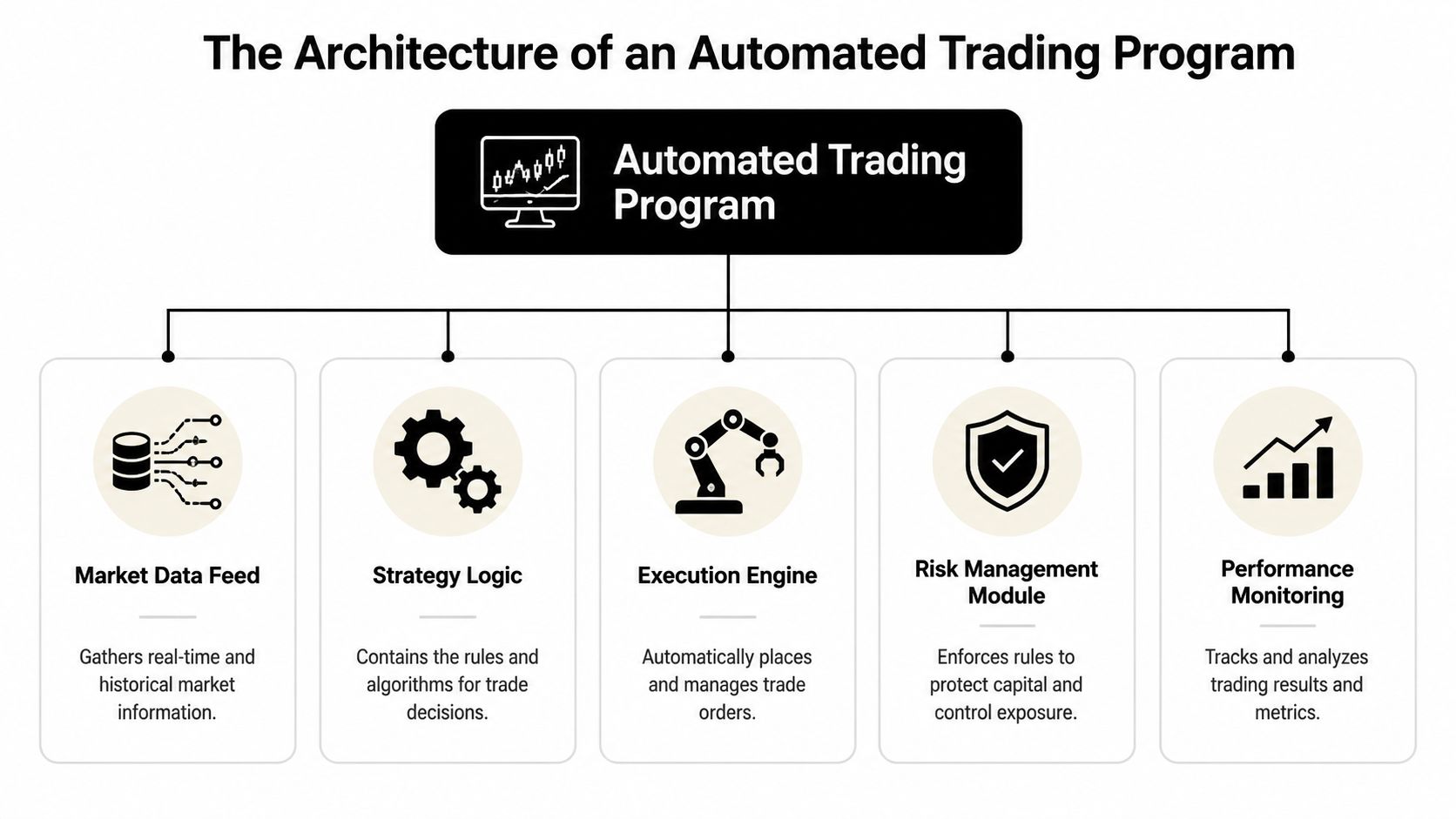
Most beginners think an automated trading program is one script that places trades. In practice, it’s a stack of moving parts. If one layer is weak, the whole thing becomes fragile under live conditions.
A simple way to think about it is a small trading desk run by software. One part reads the market, one part decides, one part controls risk, one part sends orders, and one part monitors what happened.
The four layers that actually matter
Professional systems are often described as a four-layer architecture consisting of the trading algorithm, risk management module, order execution engine, and data processing unit. That structure helps them achieve signal-to-order execution in 1-2 seconds during high-volatility events according to For Traders. For a prop trader, speed matters less as a bragging point and more as a way to stay consistent when price is moving fast.
Here’s how I’d break those layers down in plain language:
Trading algorithm
This is the decision engine. It defines what market condition qualifies as a setup, when to enter, when to exit, and when to do nothing.Risk management module
This is the enforcer. It decides position size, max exposure, stop placement, daily lockouts, and whether the bot should shut down after abnormal behavior.Order execution engine
This handles the mechanics. Market order, limit order, partial fill logic, retries, cancellation rules, and what to do if price moves before the order is accepted.Data processing unit
This feeds the rest of the system. If your price data is stale, delayed, or incomplete, every downstream decision gets worse.
The fifth component traders forget
The mandatory infographic lists five components, and that fifth one deserves extra attention: performance monitoring.
A bot without monitoring is just unattended risk. You need logs, alerts, and a way to review:
- failed orders
- missed signals
- spread anomalies
- latency spikes
- deviations between expected and actual fills
If you’re hosting your system remotely, infrastructure matters too. Traders who want a more resilient setup often look at decentralized virtual servers so their bot isn’t tied to a single home machine or unstable local connection.
Good architecture doesn’t make a bad strategy profitable. It stops a decent strategy from failing for dumb technical reasons.
What weak architecture looks like
You can usually spot weak automated trading programs fast:
| Failure point | What it looks like in practice | Why it hurts |
|---|---|---|
| Strategy and risk mixed together | Entry logic also controls lot size and shutdown rules | Hard to test and easy to break |
| No execution handling | Bot assumes every order fills cleanly | Live trading diverges from backtests |
| No monitoring | Trader notices issues hours later | Small errors become account-level problems |
If you’re serious about passing a prop evaluation, build the system like it will eventually fail somewhere. Then decide in advance how it should fail safely.
Developing Your Trading Strategy Logic
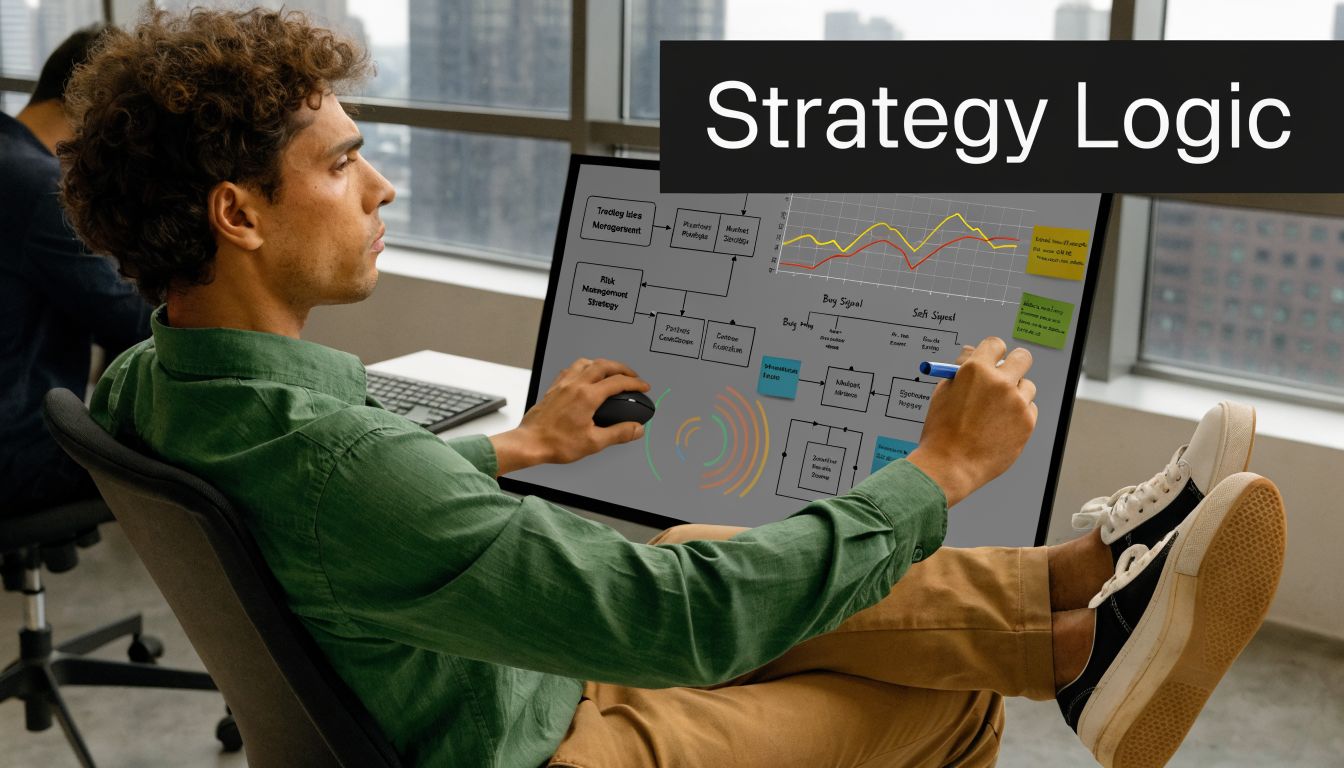
Most automated trading programs don’t fail because the coder used the wrong language. They fail because the strategy logic was vague from the start. If a rule can’t be stated clearly, it can’t be tested accurately.
Start with one market behavior you think repeats. Keep it simple. Trend continuation, mean reversion, breakout from an opening range, or pullback into a moving average are all easier to code than loose pattern recognition.
Turn an idea into machine rules
A usable strategy needs four things:
Market selection
Pick the instruments and sessions first. A setup that behaves well in major forex pairs may act differently in crypto or indices.Entry condition
Define the trigger in exact terms. Not “strong candle.” Define what candle, on what timeframe, after what prior condition.Exit logic
You need profit-taking and loss-taking rules. You also need to define time-based exits if the setup loses validity after a certain period.Position sizing
This should never be improvised. Fixed size, volatility-adjusted size, or another rule is fine, but it must be specified before testing.
Simple beats clever
A lot of newer traders try to build a bot that detects every regime and adapts to every chart shape. That usually creates a system that looks smart in development and collapses in live trading.
A better approach is to make each rule answer one question:
- When am I allowed to trade?
- What exact event gets me in?
- What exact event gets me out?
- How much risk is allowed on this trade?
- What condition stops all new trading?
That’s enough to create a solid first version.
If you need to explain your setup for five minutes before someone understands it, your bot probably won’t execute it cleanly either.
No-code builder or custom code
Platforms differ, but the trade-off is consistent. Visual builders and no-code tools help you prototype quickly. Custom code gives you more control over order handling, filters, logging, and safety logic.
Use no-code when:
- you’re still validating a basic concept
- your rules are straightforward
- you want to learn system behavior before adding complexity
Use custom code when:
- execution details matter
- you need custom risk controls
- you want better debugging and version control
If you want examples of structured approaches, this guide on strategies for algo trading is a useful starting point.
A practical strategy template
Here’s a clean first draft for a ruleset:
| Component | Example of a usable rule |
|---|---|
| Instrument | Major forex pairs only |
| Session | London and New York overlap |
| Entry | Price closes beyond a defined intraday range with confirmation from trend filter |
| Stop | Placed at predefined structural invalidation level |
| Exit | Fixed target, trailing rule, or session close |
| Kill switch | Stop opening trades after abnormal slippage or rule breach |
Notice what’s missing. No intuition, no “strong feeling,” and no manual override unless you’ve explicitly defined it. That’s what makes strategy logic testable.
How to Backtest and Optimize Without Lying to Yourself
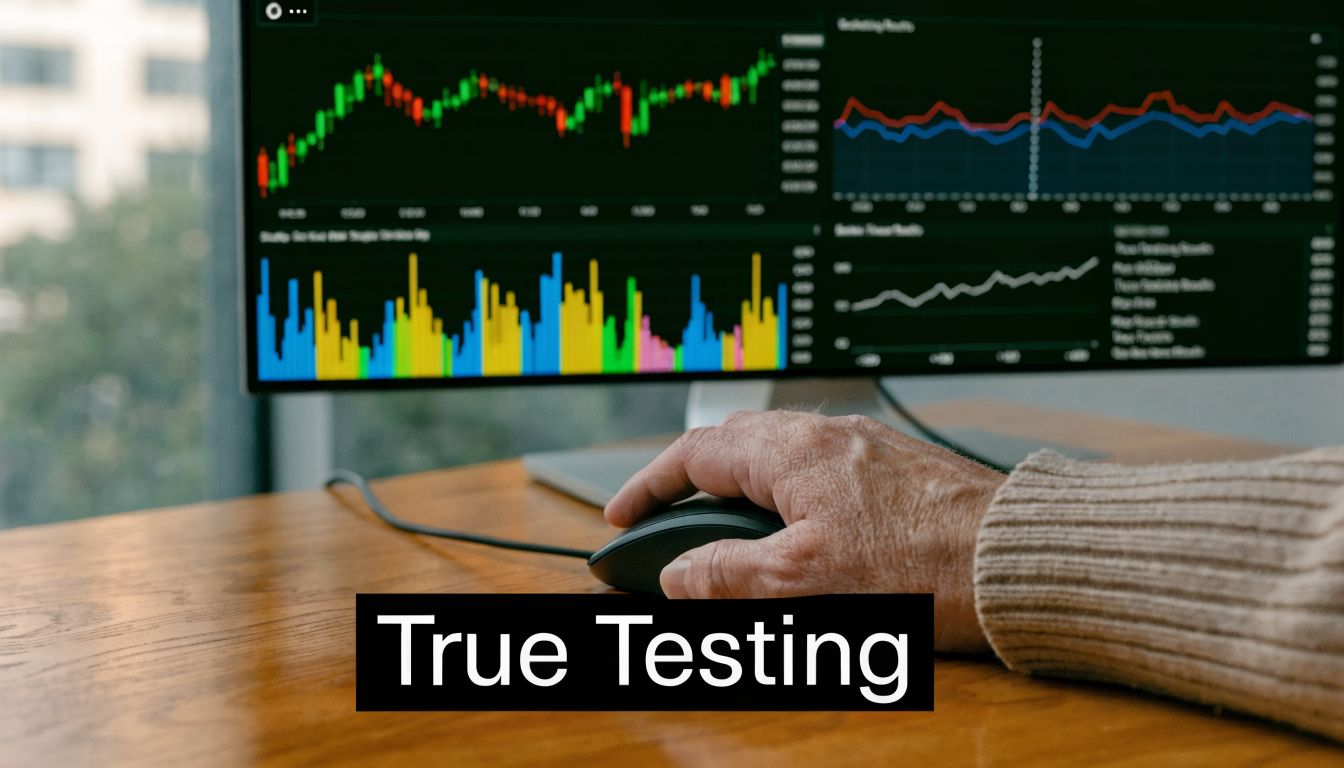
Backtesting is where traders either build confidence or fool themselves. A chart full of smooth equity growth means very little if the test ignored ugly conditions, trading costs, or drawdown behavior.
The first job of a backtest is not to prove your strategy is good. It’s to expose where it breaks.
The three metrics that matter most
When traders review automated trading programs seriously, they usually care less about headline profit and more about risk-adjusted behavior. Colibri Trader highlights three core metrics: Maximum Drawdown, Profit Factor, and the relationship between Win Rate and Risk/Reward.
Two numbers from that framework are worth keeping in front of you:
- A Profit Factor of 2.0 is considered solid
- Anything above 1.5 indicates a potentially sustainable system
That same source also makes a point many beginners miss. A high win rate is meaningless without a positive risk/reward ratio.
Read the report like a risk manager
Don’t ask only, “How much did this make?”
Ask better questions:
How deep was the worst equity decline?
Maximum Drawdown tells you how painful the strategy gets before recovery. If that pain exceeds your account limits or your psychology, the strategy isn’t usable.Are profits meaningfully larger than losses overall?
Profit Factor helps answer whether the edge is real or just noisy.How does the strategy win?
A system with a lower win rate can still be strong if winners are larger than losers. A system with a high win rate can still be fragile if one bad loss erases many small gains.
Optimize with restraint
Optimization is where most curve-fitting starts. Traders test dozens of indicator settings until they find the one that would have worked best on past data. That usually creates a strategy that memorized history instead of learning a pattern.
I’d rather see a bot with fewer parameters and stable behavior across multiple periods than a highly tuned bot with beautiful results in one slice of data.
Use this process:
- Build a baseline version with minimal filters.
- Test it on historical data with realistic spreads and costs.
- Change one parameter at a time and record what improves.
- Run out-of-sample tests on data the bot hasn’t seen before.
- Forward test in a simulated environment before any evaluation account.
For traders who want tools for this stage, reviewing back test software can help you compare how different platforms handle historical testing and replay.
A strategy that survives imperfect conditions is worth more than a strategy that wins only in perfect historical slices.
A quick pass fail framework
| Metric | What to look for | Warning sign |
|---|---|---|
| Maximum Drawdown | Manageable decline relative to your account rules | Deep recovery holes |
| Profit Factor | Preferably above the sustainable threshold | Barely above break-even |
| Win Rate and R:R | Balanced relationship, not vanity stats | High win rate with oversized losses |
One more thing. Don’t optimize to impress yourself. Optimize to survive live execution, risk limits, and bad market days.
Deploying Your Bot within Prop Firm Rules
At 8:29 a.m., the bot is flat. At 8:30, a red-folder news release hits, spreads blow out, and the system fires a market order because the signal still looks valid in code. Two bad fills later, the account is down enough that the next trade puts the daily loss rule at risk. That is how a decent strategy fails a prop evaluation.
Deployment in a prop environment is a risk-control job first and a coding job second. A bot that enters and exits correctly can still fail if it ignores drawdown rules, restricted news windows, platform quirks, or reconnect behavior on DXtrade and cTrader.
Code the rules, not just the setup
Prop firm limits need to sit inside the bot, not in a checklist beside your monitor. If the account has a daily loss cap, trailing drawdown, instrument restrictions, or limits around news trading and weekend holding, the system should enforce them before any order reaches the platform.
Build these controls into the live logic:
- Daily loss guardrails that block new entries before the account gets close to a rule breach
- Drawdown protection based on equity, not just closed P and L
- Session controls that keep the bot out of low-liquidity periods and off-hours
- News filters that pause trading before and after scheduled high-impact releases if the account rules require it
- Symbol permissions so the bot can only trade approved instruments
- Weekend logic that closes, reduces, or blocks positions based on the account’s holding rules
That last point gets missed all the time. Traders see that a strategy can run on DXtrade or cTrader and assume it is ready for a prop challenge. Platform support only means the bot can send orders. It says nothing about whether the bot can stay inside the account rules under live conditions.
If you are comparing automation options for funded accounts, review what a forex expert advisor for prop firm trading can and cannot enforce before you trust it with an evaluation.
Execution decides whether the edge survives
Good signals get ruined by poor fills. In prop trading, that matters because rule breaches often come from execution drift, not from a strategy suddenly losing its edge.
Track the parts of live trading that backtests usually hide:
- Requested price versus filled price
- Spread at signal time versus spread at execution
- Order rejects and partial fills
- Latency during volatile periods
- What the bot does after a disconnect, restart, or stale quote
A system can look disciplined in a backtest and still behave badly when the market speeds up. If your entries depend on tight stops or precise breakout prices, small slippage changes can turn a controlled-risk model into one that clips the daily drawdown limit faster than expected.
News and weekend exposure need separate operating rules
Generic automation guides treat all market hours as roughly the same. Prop rules do not. News restrictions, add-ons, and weekend policies change how the bot should behave, and those conditions need their own logic.
| Condition | What changes in live trading | What the bot should do |
|---|---|---|
| High-impact news | Spreads widen, fills worsen, stop execution gets less predictable | Pause entries, widen buffers, or require stricter confirmation |
| Weekend exposure | Gap risk makes stop placement less reliable | Reduce size, close before cutoff, or block holds entirely |
| Thin sessions | Liquidity drops and price jumps more between ticks | Limit trading windows and avoid aggressive market orders |
Treat those as separate operating modes. Test them separately. A bot that performs well during liquid London and New York hours may have no business trading around CPI, NFP, or late-session rollover.
Use a staged rollout
Deploy in steps. Do not jump from a clean test report to full-size automated trading on an evaluation account.
- Run the bot on live data in a simulation or demo environment
- Check trade logs line by line, including blocked trades
- Verify that daily loss and drawdown lockouts trigger at the right thresholds
- Force disconnect scenarios and confirm safe restart behavior
- Start with fewer features, fewer filters, and fewer symbols
- Promote only the version you can explain, monitor, and shut down fast
One more hard rule. Responsibility stays with the trader. If your automation breaks a funded-account rule because it traded through a news restriction, ignored a drawdown limit, or reopened after a platform interruption, the firm will still count that as your violation.
Pre-Launch Checklist and Common Pitfalls
Before you switch a bot on for an evaluation or funded environment, do a final pass like a pilot reviewing a pre-flight sheet. Most account failures come from issues that were visible before launch.
Automated Trading Program Pre-Launch Checklist
| Check Item | Verification Status (Pass/Fail) | Notes |
|---|---|---|
| Strategy rules are written in plain language and match the code | ||
| Entry, exit, and position sizing logic are all testable | ||
| Backtests include realistic spread, commission, and slippage assumptions | ||
| Maximum drawdown behavior is acceptable for the account rules | ||
| Profit Factor is reviewed alongside drawdown and trade distribution | ||
| Bot shuts down after reaching internal risk limits | ||
| News trading and weekend holding behavior are explicitly defined | ||
| Platform compatibility is verified on the exact trading setup you’ll use | ||
| Logs, alerts, and error handling are active | ||
| Recovery plan exists for disconnects, rejected orders, and bad fills |
Mistakes that keep showing up
The most common pitfall is building a profitable backtest that ignores live friction. That usually means no slippage model, idealized fills, and no allowance for spread expansion.
Another one is weak code hygiene. If you’re using AI-assisted development or modifying scripts you didn’t fully write yourself, it’s worth getting an AI code security audit before deployment. That’s not just about security. It’s also about finding brittle logic, unsafe dependencies, and avoidable failure points.
A few more problems show up constantly:
Too many filters
Traders keep adding conditions until the strategy stops resembling live market behavior and starts resembling a fitted history lesson.No live monitoring
They assume automation means no supervision. In reality, automated trading programs still need review, alerting, and maintenance.Manual interference at the worst time
The bot is allowed to run until a drawdown starts, then the trader overrides the system emotionally and creates a result that can’t be evaluated.
Good automation reduces impulsive decisions. It doesn’t eliminate responsibility.
Frequently Asked Questions about Automated Trading
Do I need to know how to code to use automated trading programs
No, but you do need to think clearly in rules. Some traders start with visual builders or platform tools that lower the coding barrier. Even then, you still need to define entries, exits, risk limits, and shutdown conditions precisely. If you can’t explain the logic cleanly, coding won’t save the strategy.
Can I run multiple bots on one prop account
You can, but portfolio-level risk becomes the primary issue. Two bots that look separate can still stack exposure in the same direction across correlated instruments or similar setups. Before running multiple automated trading programs, define a master risk layer that limits total open exposure, daily loss, and overlapping trade logic.
What happens if a bot breaks a drawdown rule
In a prop setting, that can mean failing the evaluation or losing access to the account under the firm’s rules. The safer approach is to build internal circuit breakers that stop new trades before the hard account threshold is reached. Don’t rely on manual intervention once the bot is already in trouble.
Are automated trading programs better than manual trading
They’re better for traders who already have a repeatable process and want cleaner execution. They’re worse for traders who hope software will invent an edge for them. Automation is a discipline tool. It doesn’t fix weak ideas, poor testing, or sloppy risk management.
If you’re ready to trade with stricter structure, review the funding options at MyFundedCapital, compare the account types that fit your style, and choose a path that matches how you trade, whether that’s a challenge model or instant funding.
