

 AR
AR
 NL
NL
 FR
FR
 DE
DE
 ES
ES
 PT
PT
 IT
IT
 PL
PL
 SV
SV

Most advice about a day trading discord says the same thing: join a room, follow good traders, and learn fast. That sounds clean. However, in practice, it's rarely that simple.
A Discord group can help you pick up language, see how traders think in real time, and avoid trading alone. It can also push you into bad entries, weak risk habits, and expensive subscriptions if you treat it like a shortcut. Trading involves risk of loss. This article is educational only and not financial advice.
Your Guide to Day Trading Discord Communities
A lot of newer traders join a day trading discord because they want speed. They want live calls, watchlists, and someone confident in their ear when the market starts moving. That urge makes sense, but it also creates a blind spot.
Most traders don't need more noise. They need a process.
Discord works best as a supplementary tool, not as your core education. That's the part many people miss. A chat room can show you what traders are watching. It usually can't build your risk model, your review routine, your execution standards, or your discipline under pressure.
Some communities are useful. Some are messy but harmless. Some are built around subscriptions first and trader development second. If you don't know the difference, you'll pay to borrow someone else's conviction without understanding the trade.
Practical rule: If a server helps you think more clearly, it has value. If it makes you trade faster than your plan allows, it has become a liability.
Use this guide like a filter. You need to know what these servers are, what they do well, where they fail, which red flags matter, and how to use a trading community without letting it trade your account for you.
What Exactly Is a Day Trading Discord Server
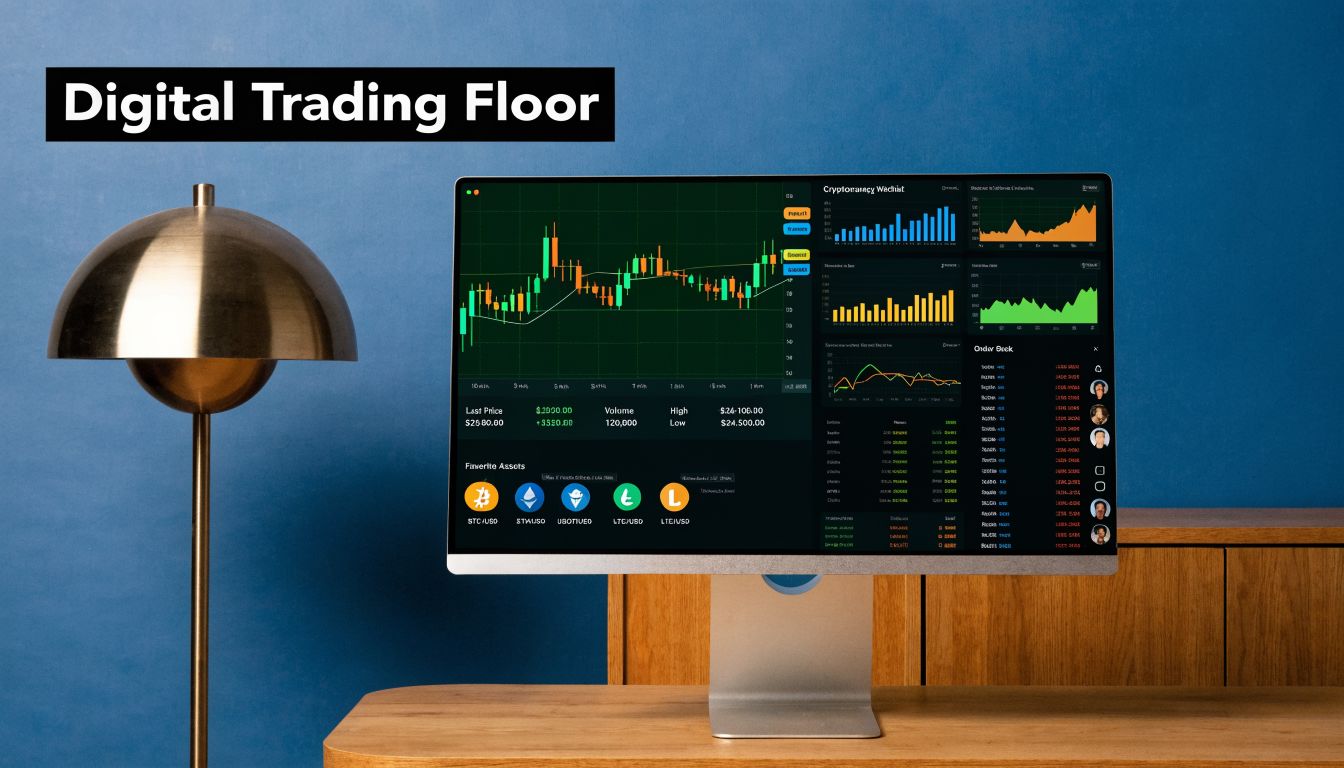
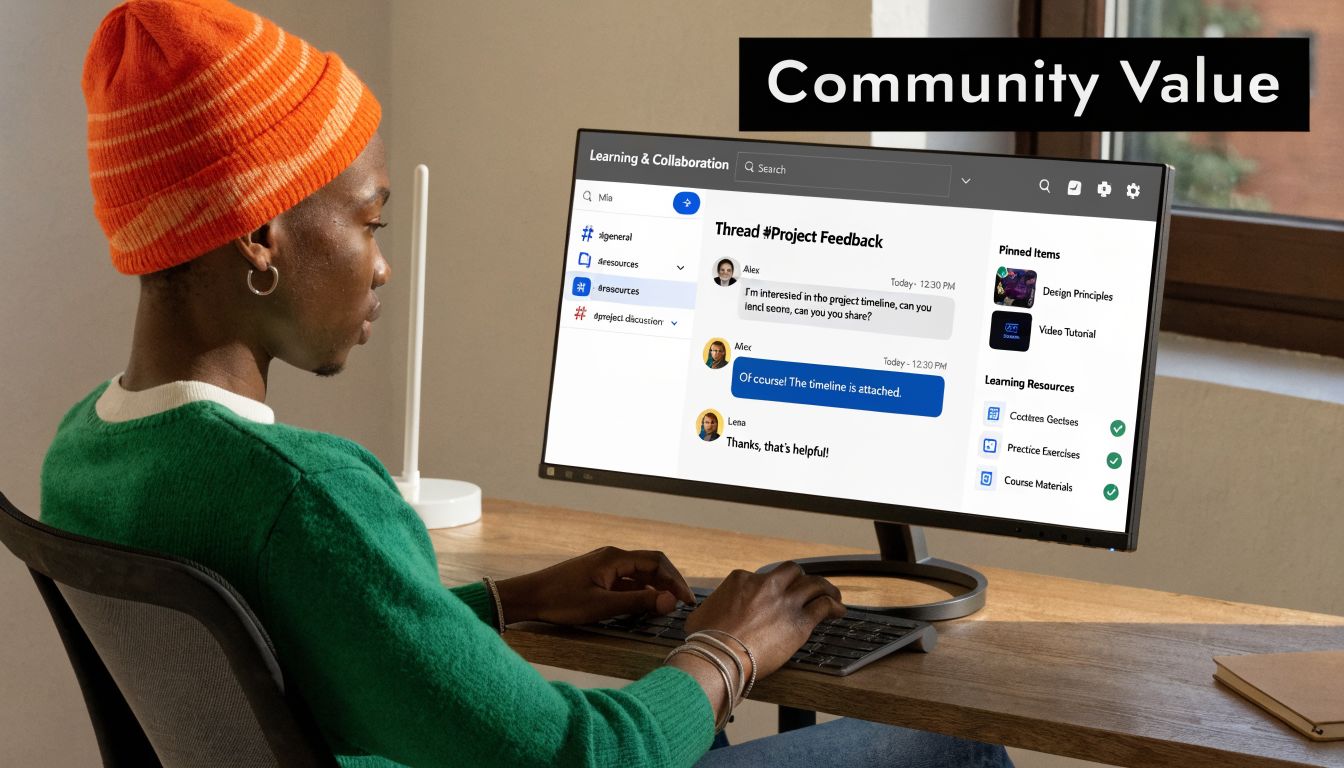
A day trading discord server is a private or public online community built inside Discord, usually organized around market commentary, trade ideas, alerts, education, and chat. The simplest way to think about it is this: it's a digital trading floor.
Some digital trading floors feel like a loud pit full of half-formed opinions. Others feel closer to a structured desk where people share plans, levels, and execution logic.
The main types you'll run into
Not all servers are trying to do the same job.
- Free-for-all communities often have open chat, memes, market chatter, and scattered trade ideas. They can be good for seeing sentiment, but they often produce more confusion than learning.
- Premium alert groups sell access to a leader's entries, exits, watchlists, or options flow. These rooms attract traders who want speed and direction.
- Education-focused communities try to teach setups, journaling, psychology, and risk rules. These are better if you're trying to become independent.
- Prop-style communities usually center on rules, execution discipline, and staying inside drawdown limits. The conversation is more about surviving and repeating process than chasing the next hot ticker.
The anatomy of a server
Most day trading Discord servers use a similar layout. Once you know the basic structure, they're easier to read.
| Channel type | What it's usually for | What to watch for |
|---|---|---|
| #announcements | Rule changes, live session times, market notes | Good servers keep this clear and sparse |
| #trade-ideas | Setups, charts, levels, thesis | Useful if people explain invalidation |
| #education | Strategy guides, recordings, glossary | Weak servers barely maintain this |
| #general-chat | Open discussion, reactions, off-topic talk | This is where noise usually spreads |
| #bot-commands | Market data, alerts, calendars, scanners | Helpful if bots support process, not hype |
| Voice channels | Live trading, screen share, Q&A | Often where you learn the most nuance |
Why beginners get overwhelmed
Discord compresses a lot of information into one place. That sounds efficient, but it creates a problem. A new trader sees five charts, three opinions, two breaking headlines, and one alert. It feels like access. It often isn’t understanding.
The right mental model is simple. Treat the server like a feed of raw inputs. Your job is to decide what deserves attention, what belongs on a watchlist, and what doesn’t fit your plan at all.
The Unfiltered Pros and Cons of Joining
There are real benefits to joining a day trading discord. There are also structural downsides that have nothing to do with scams. Even a legitimate group can train bad habits if you use it poorly.
What traders actually gain
A good room can shorten the learning curve on market language and routine. You hear traders talk through entries, reactions, liquidity, news, and execution. That exposure matters.
It can also help with isolation. Trading alone is mentally hard. A decent community can normalize patience, trade review, and sitting on your hands when conditions are poor.
A few practical advantages stand out:
- Real-time context helps you understand how traders react when price moves, not just how they describe setups after the fact.
- Faster pattern recognition comes from seeing charts discussed repeatedly across sessions.
- Shared preparation can improve your premarket routine if the room posts levels, watchlists, and scenarios.
- Emotional stability sometimes improves when you’re around traders who respect process instead of revenge trading.
A trading room is most useful before and after the trade. During the trade, it can become a crutch.
Where the format breaks down
The biggest problem with many Discord groups is that they sell proximity, not competence. Premium subscriptions in this space commonly range from $99 to $199 per month, some communities have 85,000+ members, and many operators earn from fees rather than trading profits, while most servers still lack structured curricula for sustainable development, according to this review of trading Discord communities.
That matters because the business model shapes the behavior. If a room’s main product is excitement, then frequent alerts, strong opinions, and urgency become part of the experience whether they help members or not.
The hidden trade-offs
The cons usually show up slowly.
- Herd mentality kicks in when traders pile into the same idea because a leader sounds confident.
- Analysis paralysis happens when too many channels and too many voices conflict at once.
- Dependency grows when members stop building their own thesis and wait for alerts.
- Attention drift shows up when general chat pulls you away from your own watchlist and execution plan.
The hard truth is that many traders confuse activity with progress. Reading chat all day can feel productive. It often replaces the deeper work that builds actual skill, like replay, journaling, and reviewing why a trade fit your rules.
Major Risks and Red Flags to Avoid
Most traders don’t blow up because they lacked access to ideas. They blow up because they trusted bad information, traded too big, or copied someone else’s conviction without understanding the risk.
That danger gets worse inside noisy groups because speed creates pressure. You feel late. You force entries. You skip your checklist.
The background reality you can’t ignore
The failure rate in day trading is already brutal before you add unverified Discord calls to the mix. According to day trading statistics compiled here, 72% of day traders end the year with a net loss, 87% quit within three years, and only 1% remain profitable after five years.
Those numbers should change how you hear every claim inside a trading room. The burden of proof belongs to the person making the claim, not to you.
If someone says their alerts will help you beat a field where long-term success is rare, you shouldn’t lean in. You should slow down and inspect the process.
Red flags that deserve immediate skepticism
Some warning signs are obvious. Others are disguised as confidence.
- Guaranteed outcomes. If a server promises easy profits, high certainty, or “can’t miss” trades, leave.
- High-pressure upsells. If every losing day leads to a pitch for a higher tier, mentorship upgrade, or special room, that’s a bad sign.
- No risk language. Serious traders talk about invalidation, position sizing, and loss limits. Promoters talk only about entries and targets.
- Track record avoidance. If admins dodge hard questions and redirect to screenshots, testimonials, or hype, assume the worst.
- Pump behavior. If the room looks focused on exciting low-quality names through coordinated chatter, protect yourself.
One simple test
Ask one question in plain language: What should a member do when the alert fails?
A professional answer includes stop logic, sizing, and what conditions would invalidate the trade. A weak answer turns defensive, vague, or motivational.
For a broader look at how to think critically around bold claims in trading, this article on whether forex trading is a scam is worth reading because the underlying skepticism applies here too.
If the room teaches entries without teaching how to take a loss, it isn’t teaching trading.
How to Evaluate and Choose a Worthy Server
Most traders evaluate a day trading discord the wrong way. They look at screenshots, testimonials, and how active the chat is. Activity doesn’t equal quality. Noise can look like value when you’re new.
The better approach is due diligence. You aren’t buying entertainment. You’re deciding whether this environment will sharpen your process or weaken it.
Start with transparency
A major issue in this space is the lack of clear, independently verified performance data. As noted in this overview of options trading Discord servers, many servers cost $47 to $224 monthly, yet few provide independently verified performance metrics or clear risk standards.
That doesn’t mean every paid room is bad. It means you can’t assume credibility just because a room charges money.
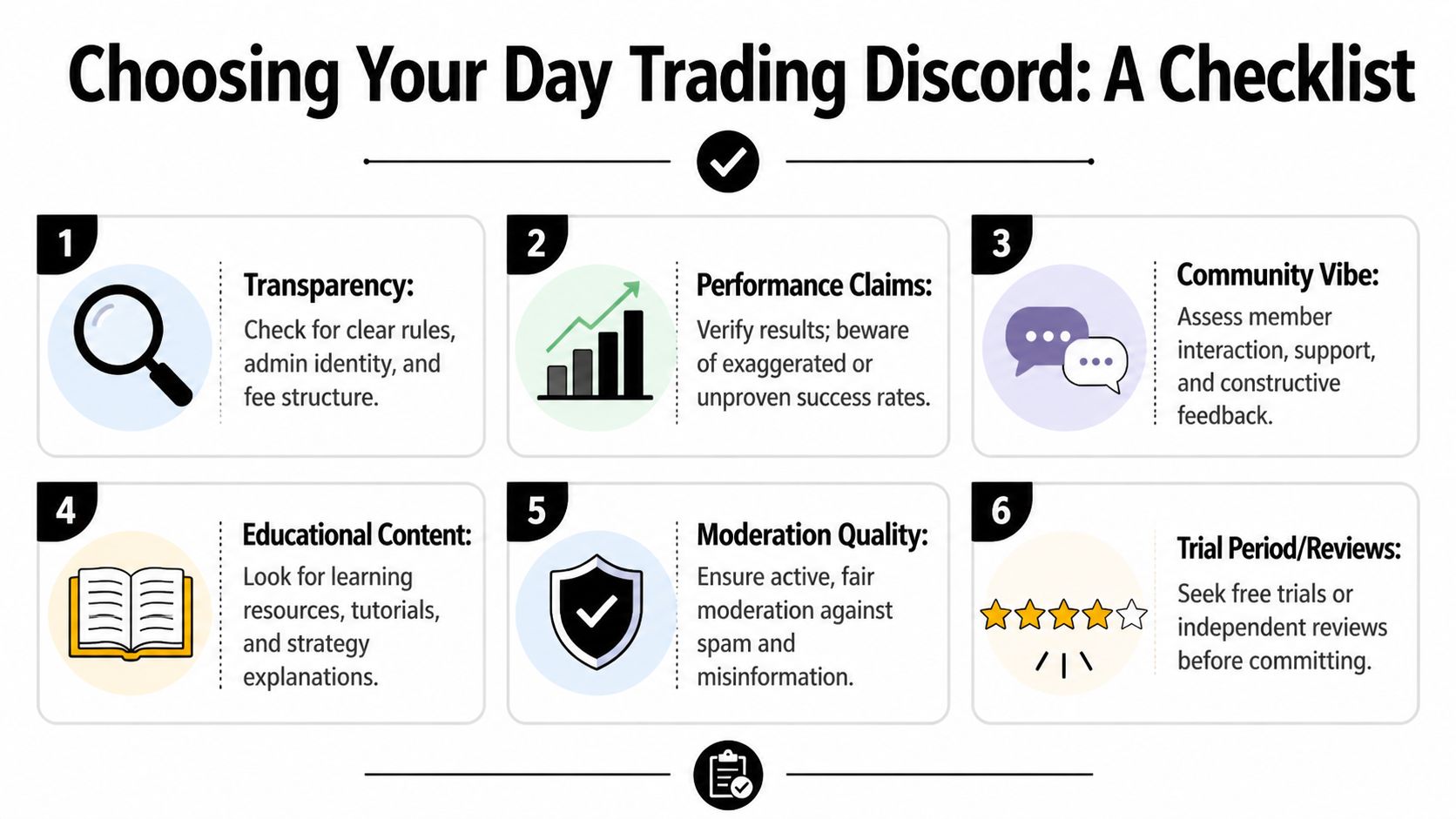
Use this checklist before joining.
- Know who runs it. You should be able to identify the admins, what they trade, and how they communicate risk.
- Read the rules before the marketing copy. Good communities make expectations clear. Weak ones make excitement clear.
- Check whether education exists outside live chat. If everything depends on “being there live,” the room may be built around dependency.
- Look for a trial or preview. You need to observe the room when you are not emotionally committed.
- Watch how losses are discussed. Mature rooms review bad trades openly. Weak rooms bury them.
Judge the community, not just the leader
A server’s culture tells you more than its sales page.
If members ask process questions, share journals, and discuss what invalidated setups, that’s healthy. If the room is full of blind praise, panic, and “what’s the play?” every few minutes, that’s a warning.
This also applies to moderation. Teams that manage communication well usually produce better learning environments. The same principles that matter in broader online communities around streamlining social media channels matter here too. Clear organization, active moderation, and reduced noise improve decision quality.
A short evaluation grid
| What to check | Healthy sign | Bad sign |
|---|---|---|
| Leadership | Explains risk and uncertainty | Sells confidence as proof |
| Education | Has lessons, playbooks, recaps | Mostly alerts and screenshots |
| Member behavior | Constructive discussion | Constant FOMO and hero worship |
| Moderation | Spam and misinformation get handled | Anything goes |
| Pricing logic | Clear access and expectations | Confusing tiers and constant upsells |
Before paying for any room, compare the sales claims with outside commentary and your own observations. This guide on how to find honest prop firm reviews is useful because the same review habits apply when you’re vetting Discord communities. You’re looking for consistency, not polish.
How to Get Real Value from a Trading Community
Let’s assume you’ve found a decent server. Good. Most traders still use it badly.
They join, turn on every notification, chase every alert, and confuse access with edge. That’s the fast path to sloppy execution.
Treat alerts as prompts, not commands
The best use of a day trading discord is idea generation plus context. An alert should send you into analysis, not straight into the market.
A stronger benchmark exists in professional-style communities. Some Discords provide 1 to 3 daily alerts with live voice explanation of the reasoning behind each trade, and some claim win rates over 85% as a benchmark for structured alert quality, according to this discussion of trading Discord communities. The key detail isn’t the claim by itself. It’s the combination of filtered alerts and live explanation of the “why.”
That tells you what to look for in practice:
- Limited alerts suggest selectivity.
- Voice commentary helps you understand context.
- Reasoning matters more than the signal itself.
- Consistency in format makes review possible later.
If an alert arrives with no thesis, no invalidation, and no risk discussion, skip it.
Use the room to improve your own process
The most productive members aren’t the ones asking for tickers. They’re the ones asking better questions.
Good examples:
- What made this setup valid before the breakout?
- What would have invalidated it?
- Was this a first test, a reclaim, or a late chase?
- How would you size this differently in high volatility?
Weak examples:
- Is it too late?
- Calls or puts?
- What’s the next alert?
Borrow the framework, not the conviction.
Build a filter for noise
You need rules for using the room, or the room will use your attention for you.
A practical routine looks like this:
- Check only the channels tied to your market and style. If you trade indices, don’t spend your morning bouncing between small-cap chat and options flow.
- Mute general chat during active execution. Open discussion is useful before and after market, not during your decision window.
- Tag and save educational posts. Build a personal library of trade reviews, not a memory of random comments.
- Review alerts after the session. Compare the call, the reasoning, and the outcome against your own plan.
If you need more structure in your day, a daily trading checklist can help you keep Discord in its place. The room should fit inside your routine, not replace it.
The Professional Standard MyFundedCapital’s Community
Public Discords often revolve around discovery, opinion, and personality. A professional trading community should revolve around execution, rules, and accountability.
That’s the difference in a prop-focused environment. The purpose isn’t to keep people subscribed to alerts. The purpose is to help traders operate inside a defined framework and make better decisions consistently.
In a stronger community model, the useful conversations are practical:
- how to stay within daily loss rules
- how to handle platform questions quickly
- how to prepare for sessions without overtrading
- how to review mistakes without turning one bad day into three bad days
That structure matters because real trading progress usually comes from constraint, not freedom. Traders improve when the environment reinforces discipline, risk boundaries, and repeatable habits.
For traders who want more than chat-room momentum, a professional prop setting creates a better standard. You have clear rules, support, and a reason to focus on process over excitement. That doesn’t remove risk. Trading still involves risk of loss. It does create an environment where skill development has a better chance of becoming consistent behavior.
Frequently Asked Questions About Trading Discords
Are paid day trading Discord groups better than free ones
Not automatically. A fee doesn’t prove quality. Some paid rooms offer better moderation, cleaner structure, and more direct access to experienced traders. Others just charge for urgency and screenshots. What matters is whether the server teaches process, risk, and review instead of feeding dependency.
Can I learn to trade only from a Discord server
You can learn pieces of trading there, but you shouldn’t rely on it as your only education source. Discord is good for exposure, discussion, and live context. It usually isn’t enough for building a complete trading framework. You still need your own playbook, journal, risk rules, and review process.
Should I copy alerts if I’m a beginner
No. A beginner should treat alerts as case studies. First ask why the trade exists, where it fails, and whether it fits your own plan. If you copy alerts without understanding them, you’re outsourcing judgment while keeping all the risk.
Can a Discord group help me pass a prop challenge
It can help indirectly if it improves your routine, discipline, and market reading. It won’t replace the core skills required to pass and keep a funded account. Prop-style trading rewards risk control, consistency, and rule compliance. A chat room can support those habits, but it can’t do them for you.
If you’re ready to move from chat-room noise to a more structured trading path, explore MyFundedCapital. You can compare funding programs, review account types, and choose a challenge that fits your style while working inside clear rules built around risk discipline and trader development.
