

 AR
AR
 NL
NL
 FR
FR
 DE
DE
 ES
ES
 IT
IT
 PL
PL
 SV
SV
 PT
PT


Most advice about great forex traders gets the main point wrong. It treats greatness like a secret strategy problem, when in practice it’s a discipline problem.
The traders who last aren’t the ones hunting for a holy grail setup. They’re the ones who can execute a tested edge, stay calm inside hard risk limits, and make the same good decision repeatedly when money is on the line. Trading involves risk of loss, and this article is educational only, not financial advice.
Beyond the Hype What Truly Defines Great Traders
Great forex traders are built through process.
That may sound less exciting than “find the perfect setup,” but it’s the truth. Most struggling traders already know enough technical analysis to be dangerous. What they lack is a professional framework for risk, execution, review, and self-control.
A great trader doesn’t need to feel brilliant every day. A great trader needs to be consistent. That means showing up with a plan, taking valid trades, skipping weak ones, and respecting loss limits without negotiation.
Practical rule: If your results depend on feeling confident, your process is weak.
Under real prop-style conditions, this becomes obvious fast. A trader can’t survive on impulse when there’s a hard daily loss boundary and a maximum drawdown rule. Those conditions expose the difference between someone who wants to trade and someone who can operate like a risk manager.
The blueprint is simple to describe and hard to live by:
- Build one repeatable edge
- Control downside before thinking about upside
- Track your behavior as closely as your entries
- Stay emotionally neutral after wins and losses
- Adapt without abandoning your process every week
That’s what this article focuses on. Not mythology, not hype, and not fantasy screenshots. Just the habits that matter if you want to trade like a professional.
The Core Traits of Elite Forex Traders
Great forex traders don’t look special trade by trade. They look ordinary in the best possible way. They follow rules, they make fewer emotional decisions, and they treat mistakes like operating failures rather than personal drama.
The biggest shift is this. Amateurs chase outcomes. Professionals manage inputs.
Discipline beats excitement
Elite traders don’t trade because the market is moving. They trade because their setup is present, risk is defined, and the conditions fit their playbook.
That sounds basic. It isn’t. Most traders break down in one of three places:
- After a loss: They force another trade to get money back.
- After a win: They get loose, increase size, and start seeing setups everywhere.
- During chop: They confuse activity with opportunity.
A disciplined trader does the opposite. They keep position size steady, pass on mediocre trades, and accept that no-trade is often the highest-quality decision available.
Accountability is visible, not verbal
A lot of traders say they’re serious. Serious traders leave evidence.
They journal trades. They save screenshots. They note why they entered, where the idea failed, whether they followed plan, and what emotional state they were in. Without that record, it’s almost impossible to separate bad luck from bad execution.
Useful journal notes usually include:
- Setup quality: Was this one of your best patterns or a borderline idea?
- Context: Trend, session, news environment, and whether the pair was clean or messy.
- Execution quality: Did you enter where planned, or did you chase?
- Emotional state: Calm, impatient, fearful, overconfident, distracted.
- Rule adherence: Did you follow your stop, target, and invalidation rules?
A trader who reviews this weekly improves faster than the trader who keeps jumping to new indicators.
Emotional detachment is a real edge
Great traders prioritize process and give very little consideration to any single trade.
That doesn’t mean they’re robots. It means they’ve learned the cost of attaching self-worth to outcomes. If every loss feels like a personal failure, discipline won’t hold for long. If every win feels like proof of genius, discipline won’t hold either.
A professional trader can lose on a good trade and still call it good execution.
That mindset matters because forex is probabilistic. Even strong setups fail. Traders who understand this stop trying to be right all the time. They focus on executing a positive process over a series of trades.
Adaptation matters, but random change kills progress
Elite traders learn constantly, but they don’t reinvent themselves every bad week.
They review patterns in their own results. Maybe a setup works better during London than New York. Maybe they do well in clean trends and poorly in compressed ranges. Maybe their best trades come from waiting for confirmation, not anticipating reversals.
That’s adaptation. It’s different from strategy-hopping.
Here’s the contrast in plain terms.
| Situation | Amateur Trader's Reaction | Great Trader's Behavior |
|---|---|---|
| Losing streak | Changes strategy immediately | Reviews execution and setup quality first |
| Winning streak | Increases risk out of confidence | Keeps risk stable and stays process-focused |
| Missed trade | Jumps into the next move late | Waits for the next valid setup |
| Bored market | Forces trades to stay active | Does nothing and protects capital |
| Stop-loss hit | Tries to win it back quickly | Logs the trade and reassesses calmly |
| New indicator online | Adds it to chart the same day | Tests it before changing anything |
| Strong opinion on a pair | Trades bias instead of setup | Lets rules override opinion |
What great traders usually sound like
They don’t say, “I know this one will work.”
They say things like:
- “The setup is valid, risk is defined.”
- “If this level breaks, my idea is wrong.”
- “I don’t need to trade this if the structure is messy.”
- “I followed plan. That matters more than this one result.”
That’s the language of someone thinking like a manager of risk, not a gambler.
Proven Strategies Great Traders Actually Use
Great traders are usually boring to watch.
They are not hunting for a magic setup. They are repeating a small number of plays they understand well enough to execute under pressure, including pressure from firm rules, drawdown limits, and consistency requirements. That matters if the goal is not just to make money for a week, but to get funded and keep the account.
Trend-following earns its place by keeping decisions simple
Trend-following fits many traders because it reduces the number of judgments they need to make. Instead of calling tops and bottoms, they wait for direction, wait for a pullback or retest, and act only when the structure still supports the trade.
That simplicity helps under prop firm conditions. A trader trying to force reversals often burns daily drawdown on low-quality attempts. A trader following a defined trend model can filter harder and pass on messy charts without damaging the month.
A workable trend plan should answer four questions:
- What confirms the trend is intact? Higher highs and higher lows, moving average alignment, or another rule you can test.
- What gets you in? Pullback entry, breakout retest, momentum break, or one fixed trigger.
- Where is the trade invalidated? The exact price area that proves the idea wrong.
- How is the trade managed? Fixed targets, trailing logic, scale-outs, or one consistent exit model.
If those rules keep changing, the strategy is not ready for capital.
Mean reversion works best in controlled conditions
Mean reversion can be profitable, but it punishes impatience fast. Traders lose money with this style when they confuse "extended" with "must reverse now."
Good mean reversion trades usually have context behind them. Price is stretched into a level that has already mattered. Momentum is slowing. Order flow is no longer as one-sided as it was on the push into the zone. Without those conditions, fading a move is often just standing in front of momentum.
Two mistakes show up again and again:
- Selling strength only because a move looks overdone
- Buying weakness without any sign of absorption or basing
That kind of trading can wreck a funded account quickly because the losses tend to stack before the reversal ever comes. Mean reversion needs tighter selection than trend-following, and traders who ignore that usually learn it the expensive way.
Supply and demand only helps if the zones are selective
Supply and demand is one of the most abused concepts in retail trading. Traders draw boxes everywhere, call every reaction meaningful, and end up with charts full of opinions and no real rules.
The professional version is much narrower. Mark the areas that produced clear displacement. Check whether the zone still makes sense inside current market structure. Decide beforehand what confirmation is required, then wait for it.
That process is easier to standardize if the setup is built from tested chart rules rather than intuition. This guide on creating a forex strategy based on technical analysis gives a practical framework for doing that.
Macro context improves trade selection
Technical entries get cleaner when they line up with a real market driver.
George Soros' famous short against the British pound remains one of the clearest examples. He was not reacting to a chart pattern in isolation. He had a macro thesis about the pound's position inside the European Exchange Rate Mechanism, and his execution reflected that broader view, as outlined in the Encyclopaedia Britannica profile on George Soros. Retail traders do not need Soros-sized conviction or size. They do need to stop treating every chart as if it exists in a vacuum.
For prop traders, this matters in a practical way. A clean setup taken against a major rate decision, central bank shift, or strong macro repricing often has worse odds than the same setup traded with that backdrop.
Build one playbook you can repeat
The traders who last are usually running a short playbook, not ten half-tested ideas.
Write down the answers to these questions:
What market condition does the setup need?
Trend, range, expansion, compression, news-driven momentum, or quiet rotation.What does the entry look like in plain language?
Define the candle pattern, level interaction, or confirmation step clearly enough that two traders would mark the same setup.What cancels the trade?
The setup should be invalid before you enter if conditions no longer match the model.What will you track after 20 trades?
Session, pair, setup type, holding time, rule breaks, and outcome by R.
That is how a strategy becomes usable under real evaluation rules. It can be reviewed, repeated, tightened, and trusted. A trader with one proven setup and clean records usually outperforms the trader who keeps changing methods every time the last trade loses.
Risk and Money Management The Professional Way
The fastest way to spot inexperience is to ask a trader about their entry and hear a long answer, then ask about risk and hear something vague.
Great forex traders think the other way around. Risk comes first. Entry comes second.
Position size is where professionalism begins
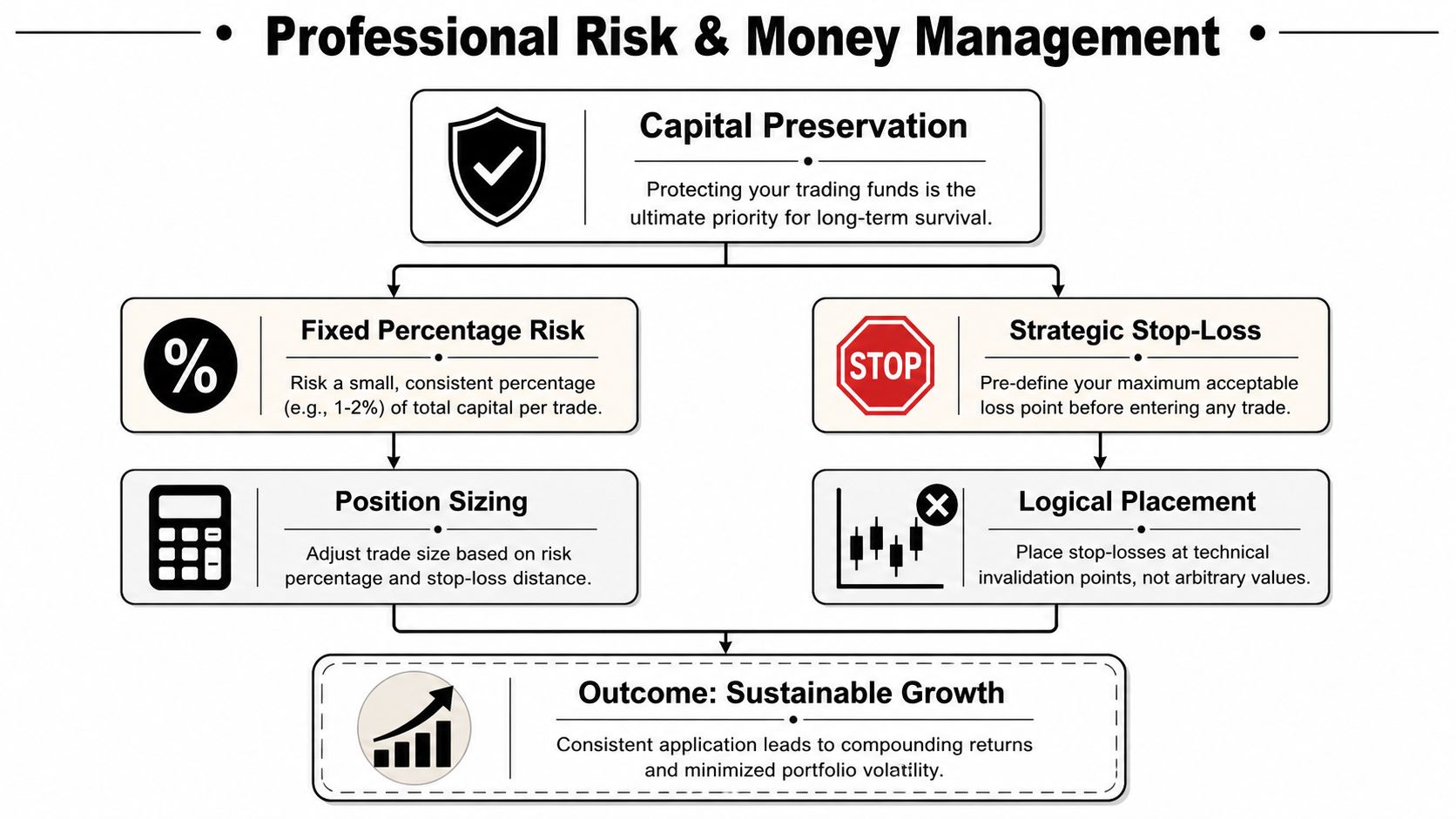
One distinguishing habit of consistently profitable traders is that they usually risk only 0.5% to 1% of account size per trade, maintain at least a 1:2 risk-reward ratio, and often operate with win rates around 35% to 50%, which can still create positive expectancy when the math is sound, according to Titan FX’s overview of core forex risk skills.
That last point matters. Many newer traders think they need to win most of the time. They don’t. They need to structure trades so average winners are meaningfully larger than average losers.
The same source notes that a 40% win rate at 1:2 risk-reward yields an expected value of +0.2R per trade. That’s the kind of math professionals build around. Not hope, not prediction, and not chest-beating about accuracy.
Risk-reward is not a slogan
A lot of traders say they target 1:2, but their behavior says otherwise. They move stops wider when price pushes against them, then cut winners too early when profit appears.
That destroys expectancy.
To use risk-reward properly, you need three things working together:
A fixed point of invalidation
Your stop belongs where the trade idea is wrong, not where the loss amount feels comfortable.A realistic target
Your take-profit should align with structure, momentum, and the way your setup behaves.Consistent execution
You can’t collect the math if you change rules every time you feel pressure.
Key takeaway: Great traders don’t ask, “How much can I make?” first. They ask, “What happens if I’m wrong?”
Drawdown control keeps careers alive
The reason professional traders survive is not that they avoid losses. They avoid catastrophic sequences of bad decisions.
Hard risk boundaries force that behavior. A flat daily loss cap and a maximum drawdown rule can feel restrictive to an undisciplined trader, but they are protective for anyone serious about longevity. They stop the common spiral of oversized revenge trading, emotional averaging down, and trying to rescue a bad day with bigger bets.
Many funded-trader aspirants often fail. Their strategy may be workable, but their money management isn’t built for a rule-based environment. If you want to improve that side of your process, this guide on risk management in forex trading covers the operational side well.
A simple professional framework
You don’t need a complicated model to trade with discipline. You need a repeatable one.
Use a checklist like this before every order:
- Defined risk amount: The trade has a fixed loss size before entry.
- Clear invalidation: The stop-loss sits where the setup no longer makes sense.
- Minimum reward structure: The target justifies the risk taken.
- Position size calculated: Size is based on risk, not on how strongly you feel.
- Daily exposure reviewed: You know how this trade affects your room for error if the day goes badly.
What doesn’t work
A few habits consistently wreck otherwise capable traders:
- Random size changes based on confidence
- Averaging into losers because the original bias still feels right
- No hard stop-loss because “I’m watching it manually”
- Taking low-quality trades after reaching frustration
- Thinking in dollars only after the trade is open
None of those are strategy problems. They’re risk problems.
The real role of money management
Money management does more than protect capital. It protects your decision quality.
When size is controlled, you can think. When size is too large, every candle feels personal. That’s when traders interfere, override their plans, and turn acceptable losses into damaging ones.
Professional trading is not built on avoiding pain. It’s built on keeping pain small enough that your process survives it.
The Underrated Power of Trading Psychology
Most traders don’t blow up because they lack chart knowledge. They blow up because they can’t execute what they already know when stress enters the room.
That’s the psychology-to-profitability gap. A trader can have a viable setup, understand structure, and still fail because fear, greed, impatience, and frustration hijack decisions at the worst possible moments.
Discipline matters more than strategy shopping
Elite traders rely on disciplined patience, rigorous risk management, emotional resilience, and an in-depth understanding of global economics. The same source also notes Paul Tudor Jones’ view that risk management is the most important aspect of trading and that discipline is what separates consistent traders from the rest, as discussed in this article on top forex traders and trading discipline.
That rings true in live conditions. Traders often perform well when calm and alone in backtesting, then break rules in real time because live uncertainty feels different. The edge didn’t vanish. Their behavior changed.
Build routines that reduce emotional decisions
Psychology improves when you stop treating it like motivation and start treating it like procedure.
A practical pre-trade checklist might include:
- Market condition check: Is this the environment your strategy needs?
- Setup validation: Does this trade meet your written criteria, not your gut feeling?
- Risk confirmation: Is size appropriate and stop placement fixed?
- Mental state check: Are you calm, rushed, angry, tired, or trying to recover losses?
- Reason to skip: What would make this a no-trade right now?
That last item is underrated. Great traders know why not to trade.
For traders who want to tighten that side of execution, this resource on developing a trading mindset for consistent performance is worth reading.
Post-trade review is where emotional maturity shows up
It's common to only review losers. That’s a mistake.
Winning trades can hide sloppiness. Losing trades can still be excellent decisions. The review process should separate outcome from behavior.
Use three labels after each trade:
- Good trade, good outcome
- Good trade, bad outcome
- Bad trade, any outcome
That framework keeps your confidence tied to execution quality instead of recent P and L swings.
Your job is not to feel perfect before every trade. Your job is to have rules that still work when you don’t.
What emotional control actually looks like
It doesn’t look dramatic. It looks boring.
It looks like closing the platform after a loss instead of forcing a comeback trade. It looks like reducing screen time when conditions are messy. It looks like taking the same quality threshold into a funded environment that you used in practice, rather than pressing harder because the account feels important.
Psychology becomes a practical edge when it changes behavior. Until then, it’s just something traders talk about after they break rules.
Lessons from Legends and Common Pitfalls to Avoid
Great traders are usually remembered for one big trade. That memory hides the part that matters. The key lesson is how they built a view, waited for alignment, and executed inside conditions they understood.
George Soros is the standard example. His famous short against the British pound is still studied because it was driven by a macro thesis, policy pressure, and timing, not excitement. The Bank of England’s own historical account of Black Wednesday helps show the backdrop that made the trade possible, from ERM strain to failed currency defense efforts, as outlined in the Bank of England’s summary of Black Wednesday.
For a funded trader, that lesson matters more than the headline profit figure. Prop firms do not pay for dramatic opinions. They pay for traders who can identify a repeatable edge, express it with controlled risk, and stay inside drawdown rules while doing it.
What traders get wrong when they study legends
Retail traders often copy the visible part of a famous trade and miss the operating standard behind it.
They remember conviction. They forget preparation.
That mistake usually shows up in a few predictable ways:
- Treating a market opinion like proof of edge
- Sizing too aggressively because the setup feels obvious
- Sitting through invalidation because the original thesis still sounds good
- Mistaking boredom for missed opportunity and forcing entries
Those habits are expensive in any account. In a prop environment, they can end an evaluation fast. A trader can be right on direction for the month and still fail because execution was sloppy, risk was inconsistent, or one oversized position broke the rules.
Big positions only work when the downside is contained
Stories about aggressive currency trades attract attention because they are extreme. Andrew Krieger is often mentioned for taking a huge position against the New Zealand dollar. That story gets repeated because it is unusual.
The practical takeaway is simple. Size is a tool, not a personality trait.
Professionals increase size when the setup, liquidity, and risk limits support it. Undisciplined traders increase size because they are impatient, behind on a profit target, or trying to make one trade matter too much. Under prop firm rules, that difference shows up quickly. The trader with average entries and stable risk often lasts longer than the trader with excellent entries and erratic size.
A common failure point is mental clutter
Bad trades rarely begin with the click. They begin earlier, when the trader is trapped between fear of missing out and fear of being wrong.
That leads to late entries, skipped stop losses, partial exits with no plan, and impulsive re-entry after price has already moved.
If that pattern is familiar, work on breaking the overthinking cycle. Trading is not therapy, but mental noise damages execution. In funded accounts, hesitation and second-guessing often cause more rule breaches than poor strategy design.
The traders who keep accounts are rarely the most aggressive. They are the clearest. They know what qualifies, what disqualifies, and when doing nothing is the highest quality decision.
Your Blueprint to Become a Great Trader
The path is not mysterious. It’s demanding, but it’s clear.
A practical checklist
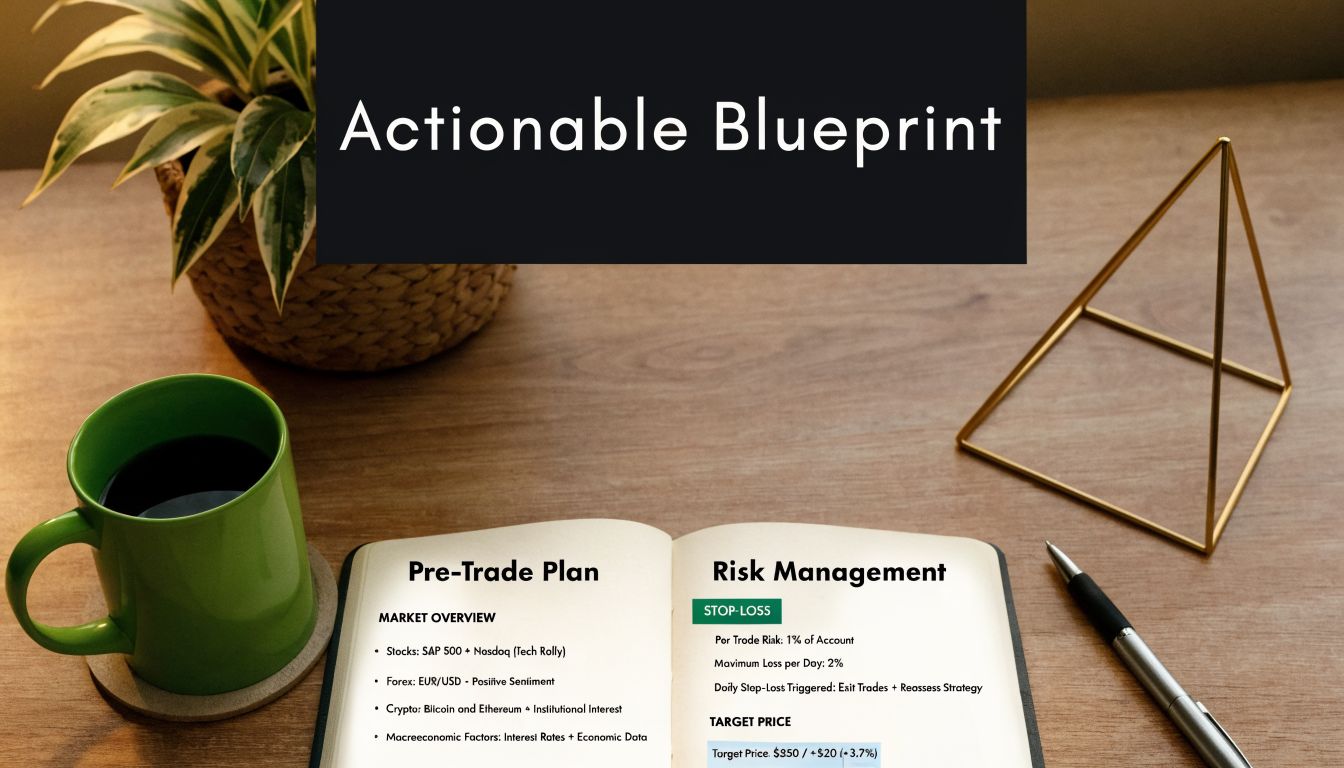
Choose one strategy and define it fully
Write down setup rules, invalidation, target logic, and the market conditions it needs. If it can’t be explained with clarity, it probably isn’t ready.Backtest and replay until the pattern is familiar
You’re not looking for perfection. You’re looking for evidence that the setup has logic and that you can execute it consistently.Set strict risk rules
Decide your per-trade risk, your maximum pain for the day, and what behavior automatically ends the session.Keep a real trading journal
Screenshot entries and exits. Grade execution. Note emotional state. Review weekly.Use a pre-trade routine
A short checklist prevents a surprising amount of bad trading. It also makes rule-breaking obvious.Practice under realistic constraints
Trading skill only matters when you can apply it under pressure. A challenge environment is useful because it tests not just your entries, but your discipline.
What success usually looks like
It usually looks quieter than people expect.
You start skipping bad trades faster. You stop changing systems every week. Losses sting less because they’re planned. Wins feel less intoxicating because they’re just part of the process. Your trading starts to look repeatable.
That’s the blueprint. Great forex traders don’t build careers on excitement. They build them on controlled repetition.
Frequently Asked Questions
How long does it take to become consistently profitable in forex?
There’s no honest fixed timeline. It depends on how quickly you stop changing strategies, start tracking execution, and build discipline around risk. Some traders waste years because they keep looking for better indicators instead of correcting bad habits.
Do you need a large personal account to trade seriously?
Not necessarily. Many capable traders are undercapitalized, which is why prop firms attract attention. What matters first is proving that you can follow rules, manage drawdown, and execute a real edge.
Is leverage always bad?
No. Misused magnified capital is bad. Famous traders have used it in exceptional situations, but most retail traders lose money with magnified capital. In prop-style environments, hard loss rules can force better behavior and turn magnified capital into a controlled tool instead of a blowup accelerant, as discussed in this analysis of famous forex traders and leverage risk.
Can AI or automation make someone a great trader?
Only if the underlying process is sound. Automation can help with screening, journaling, and execution consistency, but it won’t fix poor risk control or emotional decision-making. If you’re interested in the broader operational side of tech in finance, this piece on strategic AI adoption for finance firms gives useful context.
If you’re ready to test your process under real rules, explore the funding options at MyFundedCapital. Compare the challenge models, review the account types, and choose the route that matches your trading style and risk discipline.
