

 AR
AR
 NL
NL
 FR
FR
 DE
DE
 ES
ES
 IT
IT
 PL
PL
 SV
SV
 PT
PT

A lot of traders hit the same wall. They’ve built a strategy that works well enough on a small account, but the gains don’t move the needle because the capital is too limited.
That’s where a funded trading accounts review matters. Not because funded accounts are easy money, but because the right program can help a disciplined trader scale without putting a large personal account at risk. This guide looks at funded accounts the way traders use them in practice. Through rules, execution constraints, payout terms, and strategy fit. Trading involves risk of loss, and this article is educational only, not financial advice.
Is a Funded Trading Account Right for You
A funded account makes sense when your main problem is access to capital, not lack of a trading process. If you’re still changing strategies every week, chasing signals, or ignoring your own stop rules, a prop challenge usually magnifies those weaknesses instead of fixing them.
The better candidate is the trader who already has a repeatable setup and wants more buying power. That might be a forex day trader stuck on a small personal account, a swing trader who wants room to scale positions, or an algo trader who needs a cleaner path to larger notional exposure.
A simple self-test helps:
- You track your trades: You know your setup types, average hold times, and where you usually break discipline.
- You can follow hard limits: Daily loss caps and max drawdown rules won’t feel optional once money is on the line.
- You care about process over excitement: Passing an evaluation usually looks boring. That’s a feature, not a flaw.
- You want capital efficiency: You’d rather risk a challenge fee than tie up a much larger personal account.
Most traders don’t fail funded accounts because their entries are terrible. They fail because the rules expose weak risk control.
If that sounds familiar, a funded account may be useful. If you mainly want freedom and hate external limits, a personal account is usually the better fit.
How Funded Trading Programs Actually Work
A prop firm doesn’t hand you a blank check and tell you to swing for the fences. The model is much more controlled than that.
Most firms run some version of an evaluation, then move successful traders into a funded environment with a profit split. Some offer one-step challenges. Some use two-step models. Some also offer instant funding for traders who want to skip a traditional multi-stage path and accept a different cost and rule structure.

The basic model
Here’s the operating logic behind most funded programs:
| Stage | What you do | What the firm is testing |
|---|---|---|
| Evaluation | Trade under defined rules and hit the target | Can you make money without breaking limits |
| Verification or second phase | Repeat under another rule set or target | Was the first result skill or luck |
| Funded stage | Continue trading and request payouts based on the split | Can you stay consistent over time |
The important point is this. Firms are usually screening for discipline under constraints, not just raw profitability.
If you want a plain-English walkthrough of the model itself, this overview of how proprietary trading firms work gives the broad structure without the usual marketing haze.
Why pass rates are low
The pass rates tell you what these programs really are. They are filters.
Industry-wide pass rates for funded trading accounts consistently range from 5% to 10%, and FPFX Technology data shows that out of every 100 challenge purchases, roughly 14 pass evaluations, but only 7 receive payouts, according to FunderPro’s pass-rate breakdown.
That tells you two things fast:
- Passing isn’t common
- Passing still doesn’t guarantee payout success
A lot of new traders misread this. They think the challenge is about hitting a profit target as quickly as possible. In practice, fast starts often create bigger problems. Traders oversize, force trades, then clip the loss limit.
What works and what doesn’t
What tends to work:
- Rule-aware sizing: Position size based on drawdown limits, not emotion
- A narrow playbook: A few setups traded repeatedly
- Session discipline: Trading only when your edge usually appears
- Low ego execution: Taking small losses without trying to earn them back immediately
What usually fails:
- Challenge mode behavior: Trading more aggressively than you would on a personal account
- Strategy mismatch: Running a swing or EA model inside rules built for intraday scalping
- Ignoring mechanics: Not knowing how daily loss, trailing thresholds, or payout conditions work
A funded account is not a shortcut around skill. It’s a structure that rewards traders who already trade like risk managers.
Key Factors for Your Funded Trading Account Review
Most traders compare firms the wrong way. They look at account size first, maybe the fee second, then stop there. That misses the part that ultimately determines whether your strategy can survive the rules.
The useful funded trading accounts review starts with operational fit.
Start with the rule engine
The biggest difference between firms usually isn’t branding. It’s the risk framework.
Some firms use daily loss limits plus trailing drawdown rules. Others remove one restriction but tighten another. Risk management rules are a primary differentiator. Some firms like Topstep enforce both daily loss limits and end-of-day trailing drawdowns, while others like Apex eliminate daily limits but use intraday trailing drawdowns. This changes which strategies are viable, as outlined in this Topstep vs Apex vs Bulenox comparison.
That matters in real trading:
- A scalper may prefer no daily loss limit if the strategy takes many small scratches before catching momentum.
- A swing trader usually cares more about whether drawdown is fixed or trails aggressively.
- An algo trader needs to know whether the system can hold trades, scale in legally, and survive intraday equity swings.
Review checklist before you buy
Use this checklist before paying for any challenge:
- Drawdown type: Is it fixed, trailing, balance-based, or equity-based?
- Daily loss enforcement: Does the rule include floating loss, closed loss, or both?
- Trading style permissions: Are EAs, copy trading, news trading, and weekend holding allowed?
- Payout conditions: How often can you withdraw, and are there extra conditions before first payout?
- Platform support: DXtrade, cTrader, MT4, MT5, or something else. Your platform affects execution comfort more than most reviews admit.
Profit split matters, but not in isolation
A high split looks great on a landing page. It means less if the rule set makes your strategy hard to execute.
Still, you should review it carefully because structures differ a lot across firms. In the verified comparison data, basic profit splits range from 50% to 90%, and some firms use tiered models that improve as performance improves. That’s good when the upgrade path is clear and not buried in conditions.
A lower split with cleaner rules can outperform a higher split with constant friction.
Practical rule: If you can’t explain the drawdown math and payout conditions in one minute, you shouldn’t buy the challenge yet.
One-step, two-step, or instant
These models attract different traders.
One-step models
Good for traders who want fewer hoops and already trust their process. The pressure can still be high because one bad stretch hurts more when there’s less room for error.
Two-step models
Often better for traders who value a more gradual path. The first stage proves you can make money. The second proves you can repeat it without collapsing.
Instant funding
This appeals to traders who want to begin operating under funded-style conditions immediately. The trade-off is usually cost structure and tighter attention to ongoing rules.
A strong review doesn’t ask which model is “best.” It asks which model fits how you trade.
MyFundedCapital Review A Deep Dive
A useful case study is one where the firm’s rules are easy to map onto real trading styles. That’s where MyFundedCapital stands out. The structure is broad enough for different trader types, but the more important point is that the operating terms are relatively clear.
Funding paths and who they suit
MyFundedCapital offers Instant Funding, 1-Step, and 2-Step models. That matters because different traders need different onboarding pressure.
The 1-Step route suits traders who don’t want a long qualification sequence and are comfortable performing under a tighter pass structure. The 2-Step route is better for traders who prefer to show consistency in phases rather than compress the whole test into one push.
Instant Funding is the outlier. It’s attractive for traders who already know their process and don’t want to spend weeks proving it in a staged challenge. That can work well for experienced discretionary traders and for system traders who’ve already validated the strategy and mainly want funded-style scale.
Risk rules and why they matter more than the headline account size
Many reviews often become superficial. They list the loss limits, then move on. That misses the most important question: how those limits behave while you’re in a live position.
Many reviews fail to clarify the distinction between trailing drawdown, which follows unrealized highs, and fixed drawdown based on account balance. This is a hidden failure point, and a transparent fixed drawdown structure like MFC’s 10% maximum loss provides clearer risk parameters, as explained in this review of funded account drawdown mechanics.
For MyFundedCapital, the key framework is:
Core rule structure: a flat 5% daily loss limit and 10% maximum drawdown
That’s not just a risk policy. It changes trader behavior.
A fixed maximum drawdown is easier to plan around than a trailing rule that creeps upward with every unrealized gain. Swing traders care about this because positions can fluctuate before the move resolves. Algo traders care because backtests often degrade when the prop rule structure punishes temporary equity expansion and retracement.
In plain terms, fixed drawdown tends to be more predictable. Predictability helps traders size correctly.
Profit split and payout flexibility
MyFundedCapital starts traders at an 80/20 split with paths to 90/10 or even 100%, which puts it in the competitive tier of firms using incentive upgrades rather than a static low split. That matters for traders who plan to stay with one firm and scale instead of hopping between accounts.
The payout side also deserves attention. The firm offers payout timing options that suit different styles of cash flow management, including scheduled windows and faster options. That’s practical for active traders who want to realize gains regularly instead of waiting through long payout cycles.
A lot of traders underestimate this. A payout policy isn’t just an admin detail. It affects how attractive the whole model feels once you’re profitable.
Platforms and market coverage
MyFundedCapital supports DXtrade and cTrader, with MT5 coming soon according to the publisher brief. That already covers a wide part of the trader base.
Here’s why this matters by style:
- DXtrade users often want a modern web-based workflow with straightforward account management.
- cTrader users usually care about execution feel, charting clarity, and algo compatibility.
- Manual traders benefit from broad instrument access and clear rule visibility.
- System traders need stable platform behavior and enough allowed flexibility to deploy repeatable logic.
The firm also supports trading across 350+ instruments, including forex, indices, crypto, and commodities. For traders who monitor broader financial markets instead of just one asset class, that flexibility matters because opportunity rotates. A trader who only has edge in one market during one regime often struggles more than a trader who can shift focus when conditions change.
Add-ons that actually affect strategy fit
Some firm “features” are fluff. These aren’t.
Optional support for news trading, weekend holding, and faster payouts directly affects how usable the account is.
News trading
If your edge comes from event-driven volatility, a no-news rule ruins the strategy before it starts. A firm that allows this through an add-on gives you a cleaner match.
Weekend holding
This is a real issue for swing traders and some crypto traders. Forced flat rules can break trades that need time.
Faster payouts
Not every trader needs this, but if you’re treating prop trading like a business, cash flow timing matters.
Cleaner rules beat flashy promises. Traders can work with strict limits if the limits are visible and stable.
For a direct overview of account routes, rules, and platform access, the clearest starting point is how MyFundedCapital works.
Where the fit is strongest and where it isn’t
MyFundedCapital looks strongest for traders who value:
- Fixed risk math over moving thresholds
- Multiple funding paths instead of one narrow evaluation
- Platform choice
- Style flexibility through optional permissions
It’s less ideal for traders who want zero structure, zero challenge pressure, or unrestricted trading freedom. No prop environment gives that anyway, but some traders still expect it.
This is still prop trading. The rules matter every day. The upside is that the rule set is easier to understand than many firms that bury the important mechanics under vague marketing copy.
How MyFundedCapital Compares to the Competition
A firm doesn’t need to be “best” across every category to be a good choice. It needs to be better matched to your trading method than the alternatives.
That’s the right lens for comparison.
The industry is large enough to be taken seriously
One reason traders keep looking at prop firms is simple. The model is no longer niche.
The broader prop trading space has seen large verified payout figures. Apex Trader Funding has documented over $598 million in payouts by late 2025, according to this overview of prop firm statistics and industry payouts. That doesn’t mean every firm is equal. It does mean the category itself is substantial enough that serious traders shouldn’t dismiss it outright.
Side-by-side practical comparison
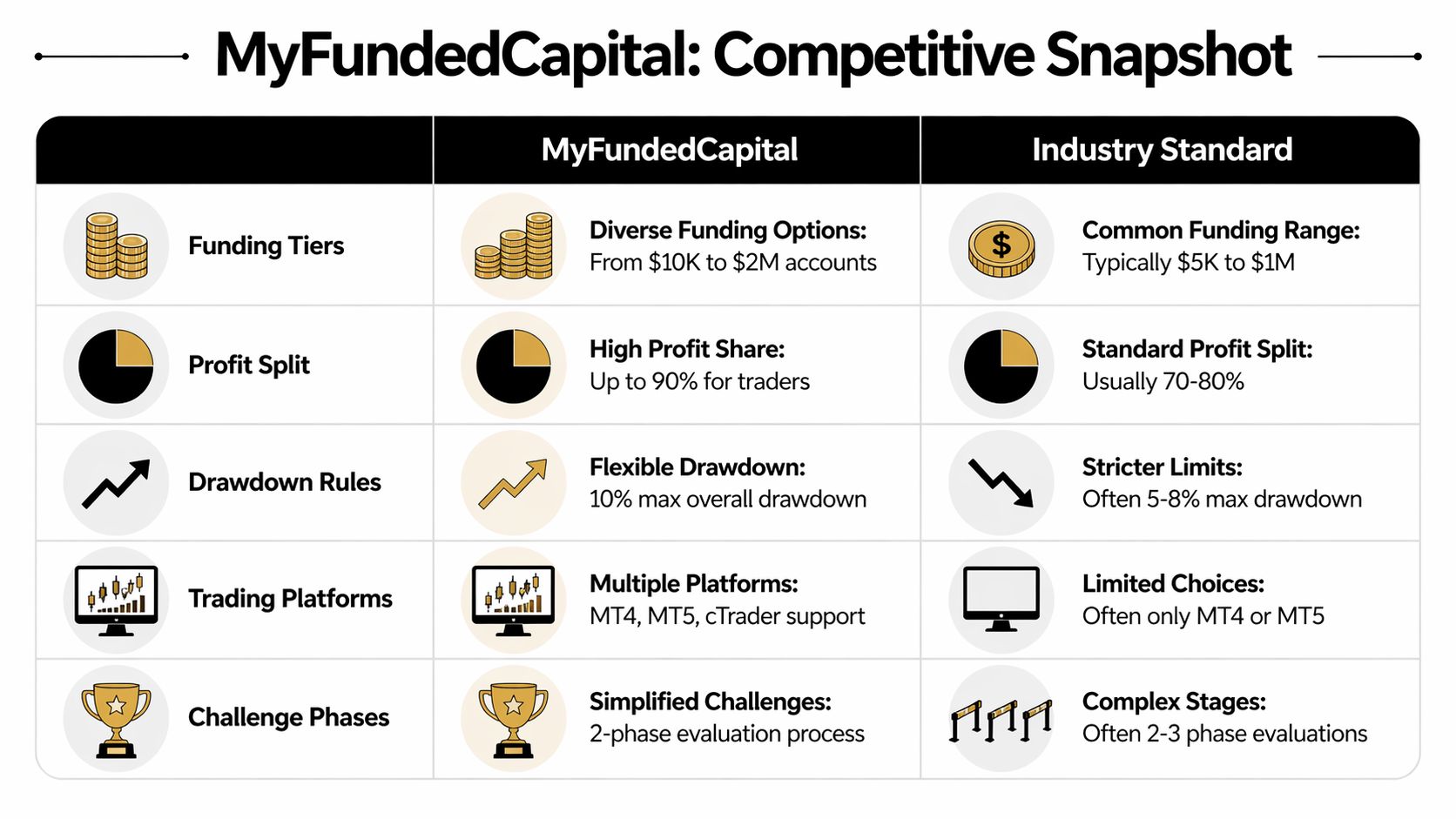
Here’s a grounded comparison between MyFundedCapital and common industry patterns:
| Review point | MyFundedCapital profile | Common friction at other firms |
|---|---|---|
| Drawdown clarity | Fixed-style structure with clearly stated limits | Trailing rules that confuse traders during open profit swings |
| Strategy support | Manual, algo, and copy trading support | Restrictive rules that quietly disqualify EAs or specific execution styles |
| Holding flexibility | Optional news and weekend permissions | Forced flat conditions that break swing and event-driven setups |
| Funding path choice | Instant, 1-Step, and 2-Step | One rigid model that may not fit your psychology |
| Payout structure | Competitive split with upgrade path | Lower retention or less transparent payout progression |
Where this creates a real edge
This comparison matters most for three groups.
First, traders burned by trailing drawdown at other firms usually value rule transparency more than headline account size. Second, algo traders care less about branding and more about whether the strategy is allowed to function. Third, swing and news traders need holding permissions that won’t force them into bad exits.
The strongest prop choice usually isn’t the firm with the loudest offer. It’s the one whose rules distort your strategy the least.
That doesn’t make MyFundedCapital universal. It makes it a better operational match for traders who want clearer risk limits and more flexibility than the average rule-heavy model.
Who Should Choose MyFundedCapital?
The best way to judge fit is to stop thinking in generic terms and look at trader types. Not everybody needs the same account structure.

The algorithmic trader
This trader already has a rules-based system and wants a firm that won’t create silent conflicts between strategy logic and account rules.
The appeal here is straightforward:
- EA and copy-trading support
- Platform access through cTrader and DXtrade
- Risk limits that are easier to model
- Optional flexibility for specific holding conditions
For system traders, predictability matters more than hype. If the drawdown structure is readable and the strategy is allowed, testing and execution become cleaner.
The swing trader
Swing traders often get punished by prop rules designed for intraday behavior. Forced flat requirements, vague floating-loss treatment, and trailing drawdown can all make a good swing setup untradeable.
MyFundedCapital fits better when the trader needs:
- Weekend holding options
- A fixed-style maximum drawdown
- Broad instrument coverage across forex, indices, crypto, and commodities
This trader usually cares less about flashy challenge targets and more about staying in the trade long enough for the thesis to play out.
The disciplined day trader
This is the trader who already works with session structure, fixed risk, and clear setup selection. They don’t need loose rules. They need fair ones.
The appeal is strongest if you want:
- Defined daily and maximum loss limits
- Frequent payout availability
- Profit split upside
That profit split piece matters because funded account profit splits vary from 50% to 90%, and an 80/20 split with a path to 90/10 or 100% is highly competitive, based on this comparison of prop firm profit-sharing structures.
Who probably shouldn’t choose it
Not every trader is ready for a prop environment, even a flexible one.
This may not be the right fit if you:
- Change strategies constantly
- Need total trading freedom with no external rules
- Can’t accept losing challenge fees as part of the learning curve
- Struggle to stop after hitting a daily loss limit
A good firm can support a solid process. It can’t replace one.
Actionable Tips to Pass Your Funding Challenge
Passing usually comes down to ordinary discipline done well. Not genius entries. Not oversized conviction trades. Just repeated execution inside the rules.
Before you start trading
Most challenge failures begin before the first order.
Run this pre-challenge checklist:
Translate the rules into your trade plan
Write down the daily loss limit, max drawdown, restricted behaviors, payout conditions, and any style permissions. If you can’t explain the account rules from memory, you’re not ready to trade it.Backtest with the prop rules applied
A strategy can look strong in a vacuum and fail immediately once daily loss caps or holding restrictions are added. If you use external idea sources, treat them as inputs, not substitutes for a tested plan. For traders who monitor crypto setups, this guide to best crypto trading signals can be useful for understanding signal workflows, but challenge performance still depends on whether the setup fits your firm’s rules.Cut your normal size
Most traders should start smaller than they think. The goal early in a challenge is account preservation and data gathering.
During the challenge
Execution needs to stay boring.
Use a hard daily stop
If you hit your planned daily loss, stop. Don’t negotiate with yourself because “the next one looks clean.” The market will be open tomorrow.
Trade your best session only
A lot of challenge damage happens in low-quality hours. If your edge is strongest during London open, New York open, or a specific overlap, wait for that window.
Limit setup variety
If you normally trade breakouts, pullbacks, reversals, and mean reversion all in the same week, narrow it down. Challenges reward consistency more than versatility.
Small green days and small red days beat one huge winner followed by a rule breach.
Common mistakes that kill otherwise decent traders
- Revenge trading: One loss turns into three because you need to “get back to flat”
- Rule drift: You start with discipline, then loosen after a good run
- Target obsession: You trade the profit target instead of the market in front of you
- Platform mismatch: You choose a firm whose platform or permissions don’t suit your method
If you want a more focused walkthrough, this guide on how to pass a prop firm challenge is worth reviewing before you buy anything.
Frequently Asked Questions About Funded Accounts
What happens if you breach a rule on a funded account
In most cases, the account is failed or disabled under the firm’s terms. That can apply to daily loss breaches, maximum drawdown breaches, or prohibited trading behavior. The exact consequence depends on the firm, so read the rulebook before trading, not after a violation.
Are evaluation fees refundable
Sometimes yes, sometimes no. It depends on the firm and the specific program terms. Some firms offer refunds after successful completion or under certain payout milestones. Others treat the fee strictly as the cost of evaluation access. Never assume refundability unless the term is clearly stated.
Can you have multiple funded accounts
Some firms allow it. Some cap the number of active accounts. Others allow multiple evaluations but restrict account merging or simultaneous use of certain strategies. If you plan to scale through multiple accounts, check those policies carefully before buying.
Are funded accounts legitimate or a scam
Funded accounts are a legitimate business model when the firm is transparent about simulated trading, rule enforcement, and payouts. The space also attracts weak operators, so skepticism is healthy. Focus on firms with clear drawdown language, visible support, understandable payout terms, and rules that make sense for your strategy.
Trading involves risk of loss. Funded programs don’t remove that. They change the structure of the risk.
If you want a prop firm built around transparent rules, flexible funding paths, and support for manual, algo, and swing trading styles, take a closer look at MyFundedCapital. Compare the account types, review the risk parameters, and choose a challenge only if the rules fit the way you trade.
