

 AR
AR
 NL
NL
 FR
FR
 DE
DE
 ES
ES
 PT
PT
 IT
IT
 PL
PL
 SV
SV


Passing a prop firm challenge isn't about being a trading genius; it's about proving you are a disciplined risk manager. This guide gives you a practical, step-by-step framework to treat the evaluation like a professional audit, manage risk effectively, and dramatically increase your chances of getting funded. Forget the hype—this is about building a sustainable process.
The Brutal Truth About Prop Firm Challenges
Let's be direct: most traders fail these challenges. Industry-wide pass rates are often as low as 5-10%, but not because their strategies are flawed. The real reasons for failure are almost always a breakdown in risk management and poor trading psychology.
Many traders view the profit target as a race and the evaluation fee as a lottery ticket. They fixate on the potential gains and ignore the drawdown limits, which are much easier to hit. This mindset is a direct path to a blown account. Trading involves a significant risk of loss, and this content is for educational purposes only, not financial advice.
It's a Risk-Management Test, Not a Profit Contest
Prop firms aren't looking for gamblers; they are searching for fund managers who can protect capital. The rules aren't obstacles—they are the test. The firm wants to see if you can consistently prove you are a responsible risk manager.
They are testing your ability to:
- Respect their capital by strictly following the daily and maximum drawdown limits.
- Execute your plan consistently, without letting fear or greed dictate your actions.
- Show patience by waiting for high-probability setups instead of forcing trades.
The challenge isn't designed to see if you can get lucky. It's built to find out if you have a repeatable process that prioritizes capital preservation. Grasping this is the single biggest mental shift you can make.
When you hit an inevitable losing streak, your ability to stick to the plan is what separates you from the 90% who fail. It's in those moments that you need to develop emotional resilience and overcome adversity, because that’s the true test of a professional trader.
Common Ways Traders Fail
The road to a failed challenge is paved with the same few mistakes:
- Revenge Trading: A trader takes a loss, gets emotional, and immediately re-enters with a larger position size to "make it back." Minutes later, they breach the daily drawdown limit. Challenge over.
- Target Fixation: In the final week, a trader is far from the profit target and starts taking wild, low-probability trades, hoping for a miracle.
- Bad Math: A trader risks 2% per trade on an account with a 5% daily drawdown limit. It only takes three consecutive losses to get disqualified. It's simple, brutal math.
Your win rate means very little if your risk management is a mess. By shifting your focus from "how much can I make?" to "how well can I manage risk?" you adopt a professional's mindset. This is how you join the small percentage of traders who successfully pass prop firm challenge evaluations.
Build Your Pre-Challenge Success Blueprint
Your journey to pass a prop firm challenge starts long before you pay the fee. Too many traders treat the evaluation as a starting line when it's really the final exam. Skipping this preparation is a ticket to failure.
This prep phase is where you prove—statistically and mentally—that you can execute your strategy under pressure. It’s about shifting from a hobbyist to a systematic operator.
The path to failure is predictable. It almost always starts with bad risk management, which triggers poor psychological decisions, ultimately leading to a busted challenge account.
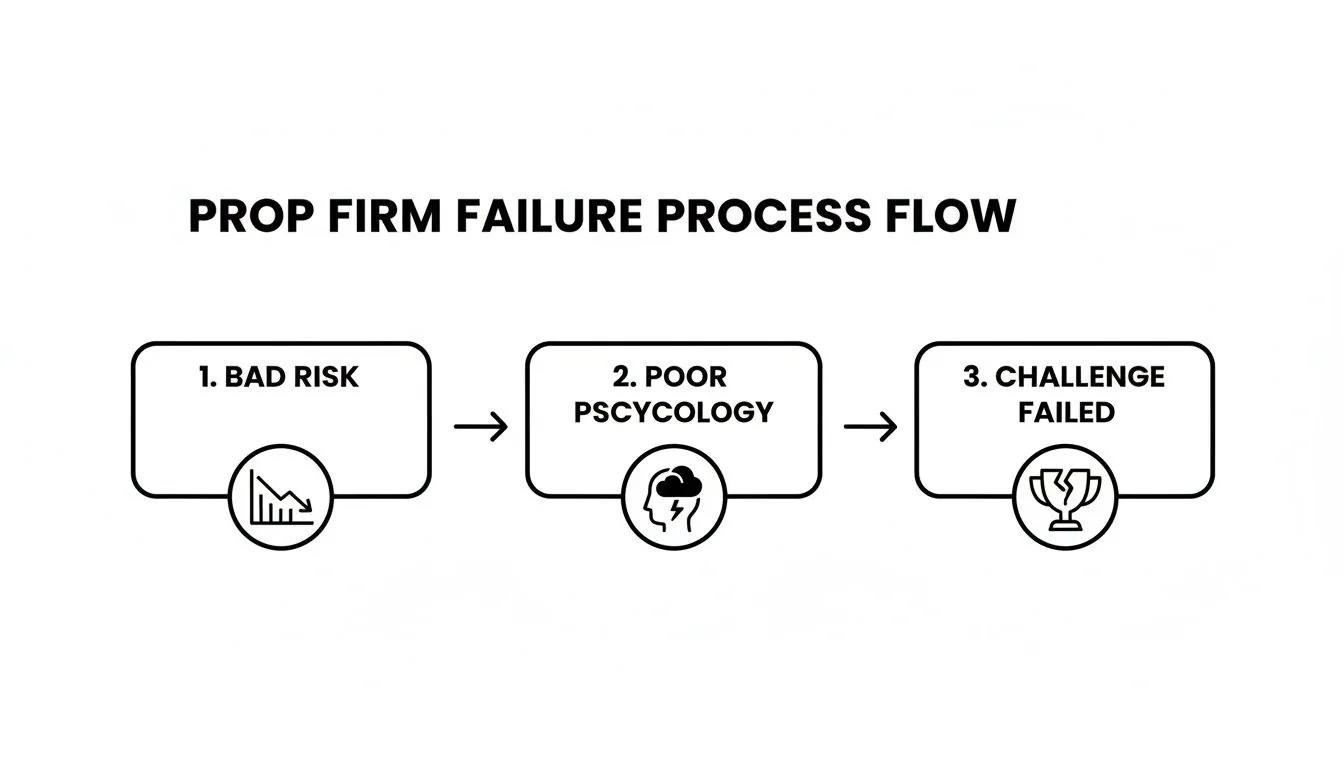
As you can see, failure isn't random. It’s the direct result of a broken process. Let's build a better one.
Prove Your Edge with Hard Data
Before you consider a challenge, you must prove your strategy has a statistical edge. This is non-negotiable. Your goal is to collect enough data to know your system’s performance metrics inside and out.
Your mission is to backtest your strategy over at least 200 trades. This sample size provides a statistically significant picture of your system's behavior. You will learn its true:
- Win Rate: What percentage of trades do you actually win?
- Average Risk-to-Reward (R:R) Ratio: How much do your winners make versus what your losers cost?
- Maximum Consecutive Losses: What’s the longest losing streak you can realistically expect?
- Average Drawdown: How far does your equity typically dip from its peak?
Knowing these numbers is the foundation of a solid trading plan and gives you the conviction to stick with your system during a losing streak.
Replicate the Challenge Environment
Once your backtesting confirms you have an edge, it's time for a mandatory 30-day demo trading period. The key is to simulate the exact conditions of the prop firm challenge you plan to take.
Set up a demo account with the same starting capital (e.g., $100,000) and strictly follow the firm's rules. If the challenge has a 5% daily drawdown limit, you treat that $5,000 line as sacred. This isn't just practice; it's building the discipline to respect the rules when real pressure is on.
Most prop firm failures aren't due to a bad strategy, but to psychological collapses under pressure. Understanding the mental models of top performers is key to building the resilience needed to trade professionally.
Journal Every Move for 4-8 Weeks
Throughout your demo trading, keep a detailed trading journal. This isn't just for logging wins and losses; it's for exposing your psychological triggers and performance patterns.
For every single trade, write down:
- Your exact reason for taking the trade.
- The emotions you felt at the time (e.g., confident, anxious, greedy, FOMO).
- The outcome and, most importantly, what you learned from it.
After 4-8 weeks, this journal will be a goldmine of information about your behavior. You'll see exactly when and why you are most likely to break your rules, allowing you to create systems to stop yourself before it happens. This self-awareness is what separates funded traders from the frustrated masses. At the heart of it all is rock-solid risk management. To get started, check out our guide on essential Forex risk management strategies and build that foundation first.
The Rules Aren't Obstacles—They're the Entire Game
Let’s be clear about prop firm challenges: the rules aren't just a list of things to avoid. They are the test. Firms aren't looking for a trading genius who can hit a 10% profit target in a week. They're looking for a disciplined risk manager who can protect their capital.
This is where so many aspiring funded traders go wrong. They fixate on the profit goal, treating the drawdown limits as a distant problem. In reality, your number one job is to never breach those limits. If you can do that, the profits will naturally follow.

Cracking the Code on Drawdown
Drawdown is the heart of every prop firm evaluation. It's how they measure your ability to handle risk. You'll typically encounter two main types.
Daily Drawdown: This is the maximum you can lose in a single day, usually 5%. This limit resets every 24 hours and is the one you must watch closely throughout the trading day.
Maximum Drawdown: This is the total your account equity can drop from its peak. Think of it as your overall risk budget for the entire challenge, typically set between 8-10%.
These aren't guidelines; they are unbreakable laws. Breaching them by even a single cent results in an instant, automatic failure.
The fastest way to fail? Bad math. A trader facing a 5% daily drawdown who risks 2% on every trade is just three straight losses away from blowing their account. You have to think defensively.
Building Your Risk Model Around the Limits
Your entire trading plan must be built backward from the drawdown rules. Forget asking, "How much can I make?" The only question that matters is, "How much can I afford to lose on this trade and still be perfectly safe?"
The most sustainable way to approach this is by risking a tiny fraction of your account on any single trade. A professional standard is between 0.5% and 1%. This isn't being timid; it's being smart. It's what keeps you in the game long enough for your strategy's edge to work.
To make this crystal clear, here’s a breakdown of what that looks like in dollar terms.
Safe Risk Per Trade Based on Account Size & Drawdown
This table shows your maximum dollar risk per trade to stay well within a typical 5% daily drawdown limit, comparing a conservative 0.5% risk with a more standard 1% risk.
| Account Size | 5% Daily Drawdown Limit | Max Risk Per Trade (0.5% of Account) | Max Risk Per Trade (1% of Account) |
|---|---|---|---|
| $100,000 | $5,000 | $500 | $1,000 |
| $50,000 | $2,500 | $250 | $500 |
| $25,000 | $1,250 | $125 | $250 |
Look at those numbers. Even with a 1% risk on a $100,000 account, you’d need five consecutive full-stop losses in a single day to get disqualified. If you stick to 0.5%, you've given yourself a buffer of ten straight losses. That’s a robust safety net.
It's also crucial to understand exactly how your firm calculates drawdown. You can get a deeper dive in our guide on what trailing drawdown is and how it differs from static or relative limits.
Getting an Edge with Challenge Add-Ons
Standard prop firm rules often restrict trading during high-impact news or holding trades over the weekend. But for many traders, those are precisely the moments when their strategies perform best.
This is where add-ons can be a strategic advantage. We've built in options to give you the flexibility your strategy needs.
- News Trading Add-On: If you're a news trader, this is essential. It removes restrictions around major economic releases so you can execute your strategy without compromise.
- Weekend Holding Add-On: A game-changer for swing traders. This gives you the freedom to hold positions over the weekend to capture bigger, multi-day moves.
By choosing the right add-ons, you’re not just buying more flexibility; you're molding the challenge to fit your proven trading style. This can dramatically increase your odds to pass a prop firm challenge because you get to trade your best, without unnecessary constraints.
Crafting Your Challenge-Specific Trading Plan
Entering a prop firm challenge without a trading plan designed specifically for its rules is a recipe for failure. A generic plan that works for a personal account won't cut it. Your plan is your personal rulebook—the one thing that keeps you grounded when the pressure to hit a profit target feels overwhelming.
Think of it as your business plan. It’s what you fall back on to make objective decisions, manage risk, and keep emotions from sabotaging your progress. It turns the challenge from a guessing game into a calculated operation.
Match Your Plan to the Challenge Type
Your strategy needs to be adapted for the specific challenge you're taking. The game plan for a 2-Step evaluation is fundamentally different from a 1-Step.
- For a 2-Step Challenge (like an 8% Target): The lower profit target in phase one rewards patience and consistency. The goal isn't to hit home runs; it's to grind out small, steady profits while staying clear of drawdown limits. Your plan should focus on high-probability setups, even if they have a smaller reward. This is a marathon, not a sprint.
- For a 1-Step Challenge (like a 10% Target): With a single, larger profit target, you might need to be slightly more aggressive, but discipline is even more critical. You might hunt for trades with a higher risk-to-reward ratio, but your absolute risk per trade must remain locked in at 1% or less.
Here's the most important thing to remember: The profit target is not your main goal. Your #1 job is to protect the account and obey the drawdown rules. Profits are simply the byproduct of excellent risk management.
Let's Break Down the Math
An $8,000 goal on a $100k account can sound intimidating, but when you break it down, it becomes far more manageable. This is key to removing the psychological pressure that leads to mistakes.
Let's use a standard $100,000 2-Step Challenge as an example:
- Profit Target (Phase 1): 8% ($8,000)
- Time Limit: 30 days (approx. 20 trading days)
- Daily Drawdown: 5% ($5,000)
- Max Drawdown: 10% ($10,000)
To hit that $8,000 target in 20 trading days, you only need to average $400 in profit per day. Suddenly, that doesn't seem so daunting.
So, how do you make $400 a day without breaking the rules?
Let’s say you stick to a conservative 0.5% risk per trade. On this account, that’s a $500 risk. If your strategy typically produces a 1:2 risk-to-reward (R:R) ratio, just one successful trade nets you $1,000.
- Based on that, you only need one winning trade every two days to pass.
- Even with a more modest 1:1.5 R:R, a single win brings in $750.
- Hitting your $400 daily average could be as simple as one small 0.8R trade.
This perspective shifts your focus from hunting for massive trades to finding a single, quality setup that fits your plan. It’s a calmer, more professional way to trade and keeps you safely within the drawdown limits. If you're not sure where to start, you can download and customize our helpful trading plan template.
Build a Rock-Solid Daily Routine
A great plan is a full-blown daily process. This is what separates pros who pass challenges from amateurs who keep failing.
Your routine should look something like this:
- Pre-Market Prep: Before trading, review the economic calendar, mark key support and resistance levels, and identify what a perfect trade setup looks like for the day.
- Know Your Numbers: Reconfirm your max risk per trade (0.5% is a great starting point). More importantly, define your maximum loss for the day. If you hit that number, you're done. Close the charts and walk away. No exceptions.
- Define Your Trading Window: Don't stare at charts all day. Only trade during market sessions where your strategy performs best.
- End-of-Day Review: This is non-negotiable. At the end of your session, journal your trades. Log your entry, exit, the reason for the trade, and how you felt. Be honest about your mistakes. This feedback loop is where real improvement happens.
This structure removes emotion and guesswork, making it infinitely easier to stay disciplined under pressure.
From Passing the Challenge to Your First Payout
Passing the evaluation is a huge achievement, but this is where the real test begins. The transition to a live funded account is a psychological minefield where many promising traders stumble. Your goal is no longer about hitting a profit target; it’s about building a long-term, sustainable track record.
I’ve seen it countless times: a trader who was disciplined during the evaluation gets their funded account and abandons the very strategy that got them there. They see the new capital as a license to ramp up risk and often give back all their progress before their first withdrawal.
The Mental Shift to a Funded Account
The mindset that gets you through a prop firm challenge isn't the one that makes you a consistently paid trader. The challenge is a sprint; a funded account is a marathon. The need to "hit the target" is gone, replaced by the much more critical need to "protect the account."
You have to consciously make these mental adjustments:
- From Target-Driven to Process-Driven: Forget about profit targets. Your new job is to execute your trading plan perfectly. Profit is the natural result of a solid process.
- From Aggression to Preservation: Your number one priority is capital preservation. If anything, you should tighten your risk, not loosen it.
- From Short-Term to Long-Term: Your new timeline is indefinite. There’s no rush. Focus on building a smooth, steadily rising equity curve over months, not days.
This mental pivot is everything. Industry data suggests only a small fraction of traders who pass an evaluation ever receive a payout. Why? Because most end up breaching drawdown rules on their live account. You can learn more by reading these insights on prop firm challenge statistics.
Understanding the Payout Process
Getting paid is the entire point, so you need to know exactly how it works. We’ve designed the payout system at MyFundedCapital to be as straightforward as possible.
Your first payout is a massive psychological win. It makes the whole thing real. It shifts your belief from "I think I can do this" to "I am doing this," and that confidence is invaluable.
The timelines for our funding models are set up to get you your profits without unnecessary delays:
- Instant Funding Accounts: You’re eligible for your first payout just 14 days after you place your first trade.
- Challenge Accounts (1-Step & 2-Step): Once you're funded, you move onto a simple bi-weekly payout cycle.
We also have add-ons that can speed things up, like options for 7-day payout cycles. The system is designed to reward consistent performance.
Your First Month as a Funded Trader
Those first 30 days with a funded account are critical. The habits you build now will set the foundation for your entire funded trading career. Use this checklist to stay grounded.
- Stick to Your Rules: Do not increase your risk per trade. If you risked 0.5% to pass the challenge, you keep risking 0.5%. Ignore the temptation to go bigger.
- It's Not "House Money": This is a dangerous fallacy. It's not the firm's money you're playing with; it's capital you are professionally managing. Treat it with respect.
- Set a Small Weekly Goal: Instead of chasing a big monthly number, aim for something small and achievable, like 1-2% a week. This keeps you focused on consistency.
- Take Your First Payout: As soon as you're eligible, request a withdrawal, no matter how small. Banking that first profit builds incredible confidence and solidifies a professional mindset.
Frequently Asked Questions (FAQ)
Here are answers to some of the most common questions aspiring funded traders ask. Getting these right can make all the difference.
What is the single biggest mistake traders make in a prop firm challenge?
The number one reason traders fail is poor risk management. It's not a bad strategy—it's blowing up the account by risking too much on a single trade. Many traders fixate on the profit target and risk 2-5% of their capital, thinking it's a shortcut. With a 5% daily drawdown, risking 2.5% per trade means you are only two consecutive losses away from disqualification. Professionals stick to a defensive game, risking just 0.5% to 1% per trade to stay in the game long enough for their strategy to work.
Should I choose a 1-Step or 2-Step challenge?
There's no single "best" option; it depends on your trading style.
- 2-Step Challenge: This is built for the patient, consistent trader. With lower profit targets (e.g., 8% in Phase 1, 5% in Phase 2), it's ideal if your strategy focuses on grinding out small, steady gains over time.
- 1-Step Challenge: This is more direct, with a single, higher profit target (e.g., 10%). It's a great fit if you're confident in your ability to catch bigger moves and want a faster path to funding. However, it's less forgiving of mistakes.
Analyze your backtested results. Does your strategy produce steady gains or larger, less frequent wins? Your answer will point you to the right challenge.
How do I survive a losing streak without breaching my drawdown?
Losing streaks are inevitable. The key is to have a plan before one starts. First, your risk rules are non-negotiable. Stick to your predetermined risk per trade (e.g., 0.5%) especially when you're losing. This is your best defense. After a few consecutive losses, stop trading for the day. Review your journal to see if you are forcing trades or if market conditions are poor for your strategy. Never "revenge trade" to win it back. A smart move is to cut your position size in half until you regain confidence with a few small wins.
Ready to put your strategy to the test? MyFundedCapital offers the flexibility and transparent rules designed to help disciplined traders succeed.
Explore our funding programs and start your challenge today!
